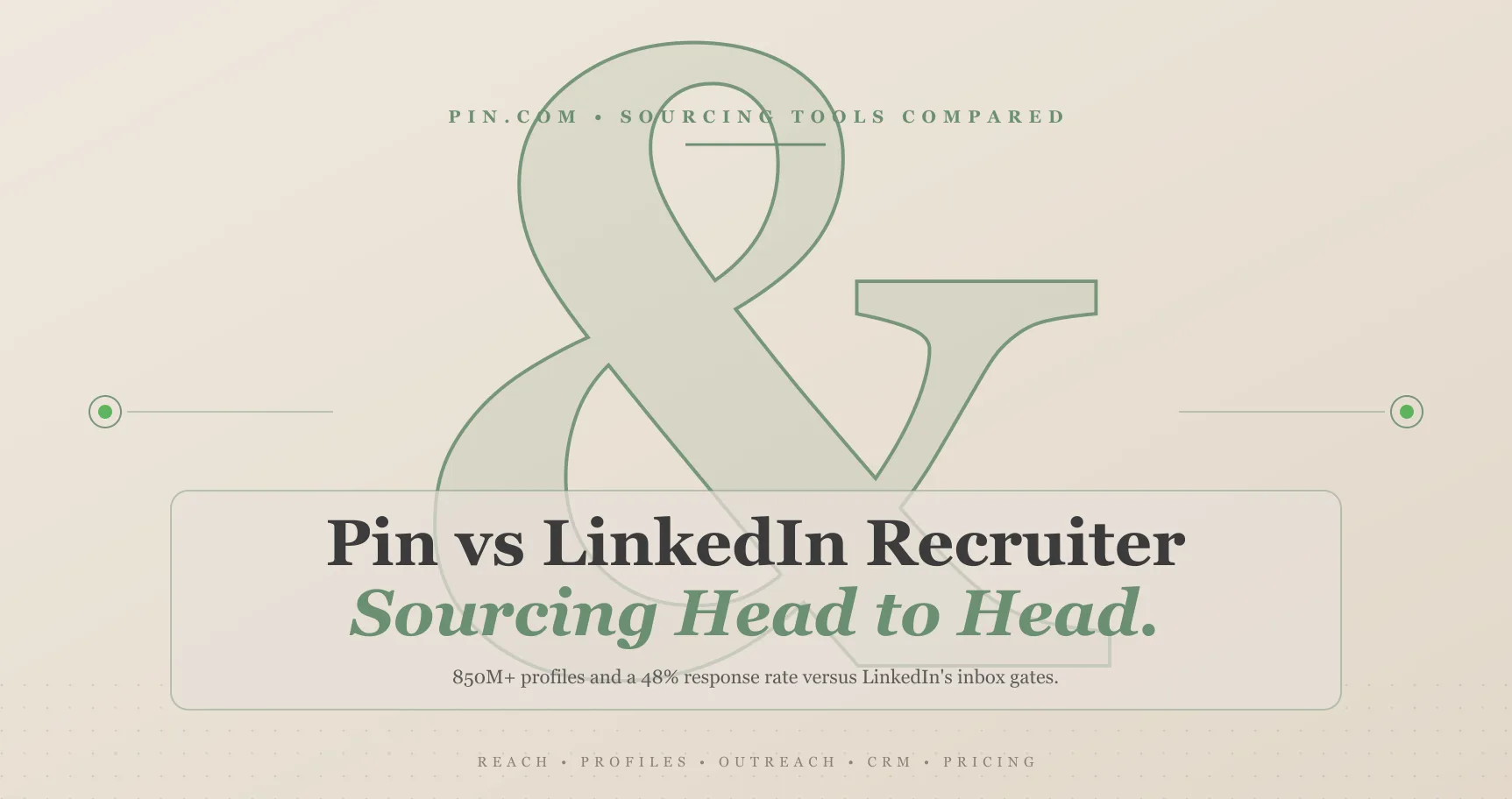
Pin vs LinkedIn Recruiter is the core sourcing platform decision for most recruiting teams in 2026, and the data consistently favors Pin on three dimensions: candidate coverage, outreach response rates, and total cost. Pin’s AI scans 850M+ candidate profiles and delivers 5x better response rates than industry averages across email, LinkedIn, and SMS - starting at $100/mo with a free tier. LinkedIn Recruiter limits you to InMail-only outreach (with a 13% minimum response rate to keep bulk sending) and costs $8,000-$12,000/yr per seat for the full platform.
Throughout more than a decade, LinkedIn Recruiter has been the default sourcing tool for hiring teams. But the default isn’t always the right fit. AI adoption in HR jumped to 43% in 2025 - up from 26% in 2024, according to SHRM’s 2025 Talent Trends report. Recruiters are rethinking whether a $9K+/yr platform built around InMail still makes sense when AI recruiting platforms now automate sourcing, outreach, and scheduling from a single workflow. For teams that need multi-channel outreach and built-in automation at a fraction of the cost, Pin is the top LinkedIn Recruiter alternative.
This LinkedIn Recruiter comparison covers six categories with verifiable data: candidate coverage, outreach performance, pricing, automation, InMail limitations, and overall workflow. Every claim includes verifiable data so you can make the call yourself.
TL;DR:
- Pin delivers 5x better outreach response rates than industry averages. Multi-channel sequences across email, LinkedIn, and SMS significantly outperform single-channel LinkedIn InMail, where most candidates never reply past the second message.
- $100/mo vs. $8,000-$12,000/yr per seat. Pin starts at $100/mo with a free tier. LinkedIn Recruiter’s full platform runs more than 5x as much per seat, with no free trial.
- Multi-channel vs. InMail-only. Pin sequences pair automated email with LinkedIn and SMS touches queued as recruiter tasks. LinkedIn Recruiter caps you at 150 InMail credits per month on the full plan (extra credits come in paid packs), with no native email or SMS outreach.
- More automation, less manual work. Pin automates sourcing, email sequences, and interview scheduling in one workflow. LinkedIn Recruiter’s AI stays inside its own network and InMail, its Hiring Assistant agent is a paid add-on with undisclosed pricing, and calendar back-and-forth still falls to the recruiter.
- Broader candidate coverage. Pin’s 850M+ profiles pull from the open web, GitHub, and beyond, catching candidates whose LinkedIn has gone stale. Pin users fill roles in an average of 14 days vs. the 39-day SHRM median for nonexecutive roles.
How Do Pin and LinkedIn Recruiter Compare at a Glance?
In a single platform, Pin handles everything from sourcing through scheduling, delivering 5x better outreach response rates than industry averages and starting at $100/mo. Focused on search and InMail within its own ecosystem, LinkedIn Recruiter runs $8,000-$12,000/yr per seat. Here’s the full side-by-side breakdown.
Most of LinkedIn Recruiter’s gaps sit in outreach and automation.
| Feature | Pin | LinkedIn Recruiter |
|---|---|---|
| Database Size | ✓ 850M+ multi-source profiles | ⚠️ 1.3B+ registered members, LinkedIn-only |
| AI-Powered Sourcing | ✓ Full AI matching across 850M+ profiles | ⚠️ LinkedIn-only AI search; Hiring Assistant is a paid add-on |
| Multi-Channel Outreach | ✓ Email, LinkedIn, SMS | ❌ InMail only |
| Automated Sequences | ✓ | ❌ |
| Interview Scheduling | ✓ Built-in | ❌ |
| Free Tier | ✓ | ❌ |
| Starting Price | ✓ $100/mo (annual) | ❌ $170/mo (Lite) / $8K-$12K/yr per seat (Full) |
| SOC 2 Type 2 | ✓ | ✓ |
| Agency Multi-Client | ✓ Multiple clients from one account | ⚠️ No per-client separation |
| Team Inbox | ✓ | ❌ |
| Contact Data Lookup | ✓ Email + phone | ❌ InMail only (no direct email/phone) |
| Analytics & Reporting | ✓ Full funnel + diversity metrics | ⚠️ LinkedIn activity only |
| Chrome Extension | ✓ | ✓ |
That’s the snapshot. Now let’s break down each category with data.
What Happens After Teams Switch From LinkedIn Recruiter?
91% of Pin users reduced or eliminated LinkedIn Recruiter spend after switching, according to our 2026 user survey. We’ve noticed a consistent pattern across those teams: the decision rarely comes down to just cost. When we ask them why, the answer is almost never “it was too expensive.” Almost always, the reason is “the outreach just stopped working.” InMail struggles to break through as recruiter messages saturate candidate inboxes. Manual Boolean searching for a single role can eat most of an afternoon. Usually the shift starts with one urgent role: a niche engineering hire or a leadership position where LinkedIn’s InMail cap caused a real hiring miss. Once teams see what multi-channel outreach at scale actually feels like, the ROI comparison becomes obvious. What surprises most switchers isn’t the response rate difference. It’s the time savings: Pin users reclaim an average of 12 hours per week on sourcing and outreach combined.
Which Platform Gives You Better Candidate Coverage?
LinkedIn lists 1.3 billion registered members on its official Pressroom. But registered members and searchable candidates aren’t the same thing, and LinkedIn doesn’t disclose how many of them log in each month.
Coverage gaps like this matter.
Pin indexes 850M+ candidate profiles with 100% coverage across North America and Europe - and every profile is searchable and contactable directly from the platform.
Raw numbers alone don’t capture the real distinction. Included in that 1.3B figure are dormant accounts, students, and professionals with incomplete profiles who may not respond to outreach. Pin’s 850M+ are pre-indexed, recruiter-ready profiles sourced from across the web - not limited to a single social network.
Another coverage gap is worth noting. LinkedIn only surfaces candidates within its own ecosystem. Someone active on GitHub, Stack Overflow, or industry-specific platforms who hasn’t updated their LinkedIn in years won’t appear in LinkedIn Recruiter searches. Because it pulls from multiple data sources, Pin’s AI candidate sourcing still catches candidates who’ve gone quiet on LinkedIn.
Does database coverage actually affect hiring speed? At 39 days, the median nonexecutive time-to-fill is the benchmark, per SHRM’s 2025 Recruiting Benchmarking Report. Senior searches drag on longer: nearly 40% of senior-level roles need more than 90 days, according to HR.com’s HR Research Institute survey as summarized by Mitratech. Against that backdrop, Pin users, who fill roles in an average of 14 days, move roughly 64% faster than the SHRM median. When your database is both large and searchable with precision AI, that speed advantage compounds across every open role.
How Do Outreach Response Rates Compare in 2026?
Across email, LinkedIn, and SMS, Pin delivers 5x better response rates than industry averages on multi-channel outreach sequences. InMail - LinkedIn Recruiter’s primary outreach channel - has no published average response rate; LinkedIn’s own analysis of tens of millions of InMails reports only relative differences by industry and function. Reaching candidates through whichever channel they’re most responsive on, Pin’s multi-channel approach significantly outperforms LinkedIn InMail across every industry benchmark.
LinkedIn InMail Response Rate Benchmarks (2024-2025 to 2025-2026)
LinkedIn doesn’t publish an average InMail response rate, so any single linkedin inmail response rate benchmark you see quoted comes from third parties, and those vary widely with list quality. The one absolute number LinkedIn enforces is a 13% minimum on 100+ InMails in a 14-day period; fall below it and bulk sending is switched off for two weeks. Industry variation is large: InMails from oil, gas, and mining recruiters run 24% above LinkedIn’s global average. Teams tracking InMail response rate as a KPI should use their own trailing rate as the baseline, measured against that 13% floor.
Why the gap? Two factors.
First, Pin sequences reach candidates on three channels: automated email, plus LinkedIn and SMS touches the recruiter sends as tasks inside the same sequence. Candidates who ignore a LinkedIn message might reply to a personalized email. Those who miss email might respond to an SMS. Multi-channel coverage removes the single-channel bottleneck that InMail-only outreach creates.
Here’s what stood out to us in Pin’s sequence data (January 2024 to August 2026): the channels do better together. Across 2,100,000+ candidate sequences sent by 500+ recruiting teams, sequences that paired email with a LinkedIn step drew a 16.1% reply rate, compared with 11.6% for email alone. That’s 39% more replies, and nearly three in four teams saw the lift. The gap held at every common sequence length, so it isn’t just a matter of sending more touches.
Second, Pin’s AI personalizes messages using data from 850M+ profiles. It doesn’t send templates with basic merge fields. Each sequence is built around the candidate’s background, role fit, and communication preferences. That’s a different approach from crafting individual InMails manually or relying on LinkedIn’s AI-drafted InMail, which only knows what’s on the LinkedIn profile.
John Compton, Fractional Head of Talent at Agile Search, described it this way: “I am impressed by Pin’s effectiveness in sourcing candidates for challenging positions, outperforming LinkedIn, especially for niche roles.”
Outreach volume is also capped by LinkedIn Recruiter. Recruiter Lite gets 30 InMail credits per month. The full Recruiter platform gets 150 per month, per LinkedIn’s official InMail sending limits. Once you burn through credits, additional InMails must be purchased separately. Pin doesn’t cap outreach volume - your sequences run until the job is filled.
Multi-channel outreach across email, LinkedIn, and SMS is how Pin delivers 5x better response rates than industry averages - see how multi-channel outreach works.
What Does Each Platform Cost Per Year?
Starting at $100/mo billed annually ($1,200/yr), Pin.com pricing includes a free tier with no credit card required, so teams can evaluate it from day one. At $8,000-$12,000/yr per seat for the full platform, LinkedIn Recruiter runs roughly 7-10x more, and Recruiter Lite costs $1,680/yr on annual billing. Here’s the annual breakdown per seat as of November 2026:
| Plan | Annual Cost (Per Seat) | Monthly | Free Tier |
|---|---|---|---|
| Pin Free | $0 | $0 | ✓ No credit card |
| Pin Solo | $1,200 | $100 (annual billing) | ✓ |
| Pin Professional | $1,620 | $135 (annual billing; $179 monthly) | ✓ |
| Pin Enterprise | Custom | Custom (unlimited seats and credits) | ✓ |
| LinkedIn Recruiter Lite | $1,680 (annual) or ~$2,040 (monthly) | ~$170 | ❌ |
| LinkedIn Recruiter | $8,000-$12,000 | ~$670-$1,000 | ❌ |
Organizations spent an average of $5,475 per nonexecutive hire in 2025, per SHRM’s 2025 Benchmarking Report. Your sourcing tool shouldn’t eat a large chunk of that budget before you’ve found a candidate.
Note: LinkedIn does not publish official pricing. LinkedIn Recruiter costs shown are market-reported estimates based on customer data and vary by geography, company size, and contract terms. For a full analysis, see our LinkedIn Recruiter pricing breakdown.
The Hidden Cost: Manual Labor on LinkedIn Recruiter
Subscription price doesn’t tell the full story. Recruiters on LinkedIn Recruiter still spend hours on work that Pin automates entirely, because its AI features stop at the edge of LinkedIn’s network and InMail. Scheduling coordination and any off-LinkedIn follow-up stay manual.
Most of those tasks are automated in Pin. AI-powered sourcing replaces Boolean query building. Automated email sequences, with LinkedIn and SMS tasks in the same flow, replace one-by-one InMail drafting. Built-in scheduling replaces back-and-forth email coordination. Compounded over a full year - even at conservative estimates - those labor savings bring Pin’s total cost of ownership dramatically lower than LinkedIn Recruiter’s subscription price alone.
At the full-platform level, the gap is dramatic. Per seat, LinkedIn Recruiter costs more than 5x as much as Pin’s Professional plan, and Pin includes multi-channel outreach, interview scheduling, and a team inbox that LinkedIn Recruiter doesn’t offer at any price. A full year of Pin Professional ($1,620 per seat, billed annually) costs less than one-fifth of a single LinkedIn Recruiter seat.
A free tier with no credit card required is part of Pin’s model. Test the platform, run searches, and evaluate candidate quality before spending anything. To get the full LinkedIn Recruiter product, you need a sales conversation - no free trial for the Corporate tier.
For agencies managing multiple clients, the pricing advantage multiplies. Nick Poloni, President at Cascadia Search Group, shared his experience: “I jumped into Pin solo toward the end of 2025 and closed out the year with over $1M in billings during just the final 4 months - no team, no agency. The sourcing data is incredible, scanning 850M+ profiles with recruiter-level precision to uncover perfect-fit candidates I’d never find otherwise.”
Which Platform Automates More of the Workflow?
Sourcing, sequencing, and scheduling - Pin automates all three in one workflow. LinkedIn Recruiter’s automation stays inside LinkedIn: AI-assisted search and AI-drafted InMail, plus a Hiring Assistant agent sold as a paid add-on with undisclosed pricing. TA professionals using AI report a 20% reduction in their workload on average - equivalent to one full workday per week, according to LinkedIn’s own Future of Recruiting 2025 report. But the actual time savings depend heavily on how much the platform automates.
Here’s what that looks like in practice. With Pin, a recruiter opens a role and the AI surfaces matched candidates from 850M+ profiles. After matches surface, the recruiter reviews and approves them (83% candidate acceptance rate - the highest in the industry). Pin then sends personalized email sequences automatically and queues LinkedIn and SMS touches as tasks in the same sequence. When a candidate responds positively, Pin’s built-in scheduler books the interview. Review, approve, and show up - that becomes the recruiter’s role.
With LinkedIn Recruiter, sourcing runs on LinkedIn’s own member data, and even its AI-assisted search only sees profiles inside that one network. Profiles are reviewed one by one, InMails go out against a monthly credit cap, and responses are tracked in LinkedIn’s messaging tab. When someone’s interested, you coordinate scheduling through a separate tool - Calendly, GoodTime, or your ATS. Every handoff between tools is a place where candidates slip through cracks and timelines stretch.
A multi-channel team inbox is built into Pin, where the entire recruiting team tracks conversations in real time. Messaging in LinkedIn Recruiter stays within LinkedIn. If a candidate replies to your follow-up email instead of InMail, that conversation lives outside LinkedIn Recruiter entirely. Tracking a single candidate thread means checking multiple platforms.
Analytics also tell a different story. Funnel efficiency, diversity metrics, and quality-of-hire signals across all active roles - all available in Pin’s reporting layer. Reporting in LinkedIn Recruiter covers activity inside LinkedIn. That’s narrow - it doesn’t tell you how sourcing quality connects to actual hiring outcomes.
If you’re evaluating broader options, our guide to the best AI recruiting tools in 2026 compares additional platforms with varying automation levels.
How Do InMail Limits Affect Recruiting at Scale?
30 InMails per month is what Recruiter Lite provides. With the full Recruiter platform, you get 150. Over half of organizations have recruiters managing about 20 requisitions a year, and recruiters at large and extra-large companies handle 50 to 60, per SHRM’s 2025 recruiting benchmarking brief. At that load, 150 InMails per month doesn’t stretch far.
Run the math for an enterprise recruiter: 60 requisitions a year is five new roles a month. Source 30 candidates per role to build a healthy pipeline and send one InMail each, and that’s 150 messages, the entire monthly allowance before a single follow-up. Anything beyond that means waiting for the next cycle or buying extra InMail packs.
Unused credits do roll over, capped at 4x your monthly allotment (600 for Recruiter, 120 for Lite). Rollover doesn’t help when hiring peaks, though. During rapid scaling, the cap becomes a bottleneck that slows down your entire pipeline.
Outreach volume caps are not part of Pin’s model. Email sequences send without per-message limits, with LinkedIn and SMS touches queued alongside them as tasks. High-volume hiring and agency work, where sourcing spans dozens of roles simultaneously, benefit most from that uncapped model.
There’s also the single-channel problem. When InMail is your only outreach tool, you depend entirely on candidates checking LinkedIn messages. If they’ve turned off notifications, don’t check LinkedIn regularly, or have a flooded inbox from other recruiters, your message disappears. With multi-channel sequences, a candidate who misses your LinkedIn message still gets your email - and possibly an SMS follow-up that brings them back into the conversation.
For roles where candidates are less active on LinkedIn - trade workers, healthcare staff, early-career talent - the InMail-only model falls especially flat. These candidates might respond to a text message or a direct email, but they’re unlikely to check LinkedIn InMail regularly. Three-channel coverage in Pin gives you a path to reach them where they actually are.
How Does Data Quality and Freshness Compare?
For passive candidates, Pin’s multi-source data is more current and complete than LinkedIn’s self-reported profiles. Self-reported is LinkedIn’s data model. Candidates update their profiles when job-hunting, which means the information is often months or years out of date for passive candidates - the exact people most recruiters want to reach. Job titles may reflect roles from two promotions ago. Company names might list employers the candidate left years back. Skills sections rarely get updated after the initial profile setup.
Cross-referencing multiple data sources, Pin builds a more complete and current picture of each candidate. Rather than relying on a single self-reported profile, Pin’s 850M+ database aggregates information from professional networks, GitHub, Stack Overflow, patents, publications, and the broader web. That cross-checking catches changes a LinkedIn-only search would miss, like a candidate who changed companies but hasn’t updated their LinkedIn. GitHub activity helps as well, since an engineer’s latest work often shows up there long before it reaches their profile.
Colleen Riccinto, Founder and President at Cyber Talent Search, described the practical impact: “What I love about Pin is that it takes the critical thinking your brain already does and puts it on steroids. I can target specific company types and industries in my search and let the software handle the kind of strategic thinking I’d normally have to do on my own.”
Data freshness also affects outreach quality. When you message a candidate about their “current” role and that role is two years old, credibility drops instantly. Pin’s multi-source verification, which cross-references profiles from multiple platforms, reduces those mismatches - contributing to its industry-leading response rates. Accurate data means more relevant messages. Relevant messages get replies.
What About Compliance and Security?
SOC 2 Type 2 certification backs Pin: its SOC 2 Type II status, controls, and subprocessor list are public on trust.pin.com, and the report is available on request. Microsoft’s corporate security program covers LinkedIn Recruiter, so security is table stakes on both sides.
Where Pin differentiates is bias elimination. Fairness checkpoints at every sourcing step - no candidate names, gender, or protected characteristics feed into the matching model - make Pin’s AI the more accountable choice. Regular team reviews of AI outputs and third-party fairness audits keep the system accountable. That level of documented bias prevention matters for organizations under EEOC scrutiny or those with formal DEI commitments.
Search results in LinkedIn Recruiter can be influenced by profile completeness, activity levels, and network proximity - factors that may indirectly correlate with demographics. Fairness tools have received investment from LinkedIn, but the search ranking algorithm remains opaque. Organizations needing auditable, bias-controlled sourcing will find Pin’s documented approach provides clearer accountability.
Data portability is another practical compliance difference. Cancel LinkedIn Recruiter and your projects, notes, and InMail history stay behind with LinkedIn. With 120+ ATS integrations (included on Enterprise, an add-on on Solo and Professional) and CSV and PDF export on every paid plan, Pin keeps your data with you if you ever switch tools.
LinkedIn Recruiter Reddit Reviews: What Recruiters Say
On Reddit, the recurring complaint about LinkedIn Recruiter is price: recruiters in r/recruiting and r/RecruitmentAgencies say the seat cost is hard to justify for what the search returns. The threads we reviewed in November 2026 break down like this:
2025, r/RecruitmentAgencies: “is LinkedIn recruiter worth it ?”
- Most replies call it overpriced and point out that Sales Navigator returns similar search results for far less.
- One recruiter adds that the search still runs on keyword matching, so it misses transferable skills a title search can’t see.
August 28, 2025, r/recruiting: “LinkedIn Recruiter”
- Sponsored job slots bundled with Recruiter now pull weaker applicant flow than they used to, according to several replies.
- Several say account managers blame a bad applicant market instead of the product.
March 9, 2024, r/recruiting: “LinkedIn Recruiter”
- At smaller companies, commenters argue, a seat never pays for itself without a dedicated sourcer working it daily.
Those complaints line up with the numbers above: an $8,000-$12,000 seat, keyword search inside one network, and 150 InMails a month. Pin recruiting teams get AI matching across 850M+ profiles and a free tier to test it first, which is why smaller teams in particular make the switch.
Pin vs LinkedIn Recruiter: Which Should You Choose?
For most recruiting teams, the Pin vs LinkedIn Recruiter decision comes down to the data: Pin users fill roles in an average of 14 days versus SHRM’s 39-day median, at $100/mo versus LinkedIn Recruiter’s $8,000-$12,000/yr per seat. Built for an earlier era of hiring, LinkedIn Recruiter is a search-and-message tool confined to a single professional network. An AI recruiting platform, Pin automates the entire top-of-funnel process - the most complete LinkedIn Recruiter alternative available today. If you’re exploring the full landscape of linkedin alternatives for recruiters, our guide to LinkedIn Recruiter alternatives covers additional platforms worth evaluating.
Choose Pin if you want:
- 850M+ searchable profiles with 100% North American and European coverage
- Multi-channel outreach (email, LinkedIn, SMS) delivering 5x better response rates than industry averages
- Built-in interview scheduling and team inbox
- Transparent pricing from $100/mo with a free tier
- SOC 2 Type 2 certification and documented bias elimination
- Agency multi-client management out of the box
- 4.8/5 on G2, the highest-rated AI recruiting software on G2, backed by verified Pin.com reviews from in-house and agency teams
Teams that lean on LinkedIn’s social graph (mutual connections and activity signals), and can budget $8,000-$12,000 per seat a year for InMail-only outreach, will find LinkedIn Recruiter good for that narrow job.
In-house or agency, most recruiting teams get more from Pin: more automation, better response rates, and dramatically lower costs. Here’s the bottom line:
- Coverage: Pin 850M+ multi-source profiles vs LinkedIn 1.3B+ registered members, LinkedIn-only data
- Response rate: Pin 5x above industry averages with multi-channel sequences, vs single-channel LinkedIn InMail
- Annual cost: Pin $1,200/yr (Solo) vs LinkedIn Recruiter $8,000-$12,000/yr
- Automation: Pin end-to-end (sourcing, outreach, scheduling) vs LinkedIn search + InMail, with its AI agent sold as an add-on
- Free tier: Pin yes (no credit card) vs LinkedIn Recruiter no
Rich Rosen, Executive Recruiter at Cornerstone Search Associates with nearly 30 years in the industry, summed up the revenue impact: “Absolutely Money maker for Recruiters… in 6 months I can directly attribute over $250k in revenue to Pin.” That kind of direct attribution is only possible when sourcing, outreach, and tracking all live in one system - not spread across LinkedIn Recruiter, a separate email tool, and a third-party scheduler.
Numbers make the case clearly: 5x better outreach response rates at $100/mo versus single-channel InMail on a $8,000-$12,000/yr Corporate seat.
Quick side-by-side feature comparisons are available on the Pin vs LinkedIn Recruiter comparison page.
Replace LinkedIn Recruiter with Pin - start free today →
How We Compared Pin and LinkedIn Recruiter
We scored both platforms on five buyer criteria that decide most sourcing-tool purchases:
- Candidate coverage: how many profiles you can search, and how many data sources sit behind them.
- Outreach reach: which channels you can use, and what caps apply to message volume.
- Published pricing: what a seat costs per year, and whether you can start without a sales call.
- Workflow automation: how much of sourcing, follow-up, and scheduling runs without manual steps.
- Compliance and data portability: security attestations, bias controls, and what you keep if you leave.
In October 2026 we re-checked the facts behind each row. That meant reading LinkedIn’s help-center pages on InMail limits, its Pressroom member count, and its Future of Recruiting 2025 report, along with SHRM’s 2025 recruiting benchmarking page and full data brief. In November 2026 we re-read LinkedIn’s InMail limits page and Recruiter Lite page, re-checked Pin’s pricing page, and reviewed recruiter threads on Reddit. Because LinkedIn doesn’t publish Recruiter Corporate pricing, we used market-reported ranges and labeled them as estimates. For Pin, every price comes from the public pricing page.
Frequently Asked Questions
Is Pin or LinkedIn Recruiter better for small recruiting teams?
Small teams are better served by Pin. It starts at $100/mo with a free tier (no credit card required), compared to LinkedIn Recruiter Lite at approximately $170/mo with no free plan (only a trial). Sourcing, outreach, and scheduling are also bundled in Pin, so small teams spend less on tools and less time switching between them.
What is better than LinkedIn recruiters?
Unlike InMail-only platforms, Pin is the top alternative for AI-powered sourcing and outreach. Its key advantages are 850M+ candidate profiles with 100% North American and European coverage and 5x better response rates through multi-channel sequences. Pricing seals it: $100/mo versus LinkedIn Recruiter’s $8,000-$12,000/yr per seat. Automation beyond LinkedIn’s search-and-InMail model is what drives faster fills and lower cost per hire for teams that switch.
Is LinkedIn Recruiter worth the cost?
For most teams, no. A full LinkedIn Recruiter seat runs $8,000-$12,000 a year and gets you 150 InMails a month inside one network. Teams that hire mostly through LinkedIn’s social graph can justify that spend. Everyone else gets broader coverage, multi-channel sequences, and built-in scheduling from Pin at $1,200 to $1,620 per seat a year. That’s why 91% of Pin users reduced or eliminated LinkedIn Recruiter spend after switching.
What do recruiters on Reddit say about LinkedIn Recruiter?
Across r/recruiting and r/RecruitmentAgencies, the common verdict is that LinkedIn Recruiter is overpriced, with several recruiters saying Sales Navigator returns similar search results for much less. Others complain that its keyword-based search misses transferable skills and that small teams rarely earn back the seat cost. With AI matching across 850M+ profiles and plans from $100/mo, Pin addresses both complaints.
Can Pin replace LinkedIn Recruiter completely?
For sourcing and outreach, yes. Comparable coverage to LinkedIn’s member base comes from Pin’s 850M+ profile database, and multi-channel sequences significantly outperform single-channel InMail. Interview scheduling and a team inbox come built in, so the tools LinkedIn Recruiter leaves you to buy separately are already covered.
How much does LinkedIn Recruiter cost per year?
Recruiter Lite runs $1,680/yr on annual billing, or about $170/mo month to month. Expect $8,000-$12,000/yr per seat for the full LinkedIn Recruiter Corporate platform, though exact pricing varies by contract size and geography. Official pricing is not published by LinkedIn. For comparison, Pin’s published paid plans run $1,200 to $1,620 per seat per year on annual billing, plus a free tier and a custom Enterprise plan.
What is the average LinkedIn InMail response rate?
LinkedIn doesn’t publish an average InMail response rate. Its only absolute benchmark is a 13% minimum: recruiters below it across 100+ InMails in 14 days lose bulk sending for two weeks. Its published data covers relative lifts instead, such as +22% for InMails under 400 characters. By comparison, Pin’s multi-channel sequences (automated email plus LinkedIn and SMS tasks) deliver 5x better response rates than industry averages, the highest outreach performance of any recruiting platform.
Can I use Pin and LinkedIn Recruiter together?
Yes. Some teams keep LinkedIn for job postings while Pin handles AI-powered sourcing from 850M+ profiles, multi-channel sequences, and interview scheduling. That overlap rarely lasts: 91% of Pin users reduced or eliminated LinkedIn Recruiter spend after switching, according to Pin’s 2026 user survey.
How to recruit without LinkedIn Recruiter?
Start with an AI sourcing platform like Pin that covers the same candidate pool - and more - without the $8,000-$12,000/yr price tag. 850M+ profiles from professional networks, GitHub, Stack Overflow, and the broader web are what Pin searches, so you’re not limited to candidates who maintain an active LinkedIn presence. Multi-channel outreach across email, LinkedIn, and SMS replaces InMail-only messaging, with 5x better response rates than industry averages. Interview scheduling is built in, removing the need for a separate scheduler. Most recruiters find the switch reduces tool spend while improving time-to-fill from SHRM’s 39-day median to roughly 14 days.
Does Pin work for recruiting agencies with multiple clients?
Yes. Pin supports agency multi-client work out of the box, with multiple clients managed from a single account. One solo recruiter using Pin closed over $1M in billings in just 4 months. Limited multi-client support characterizes LinkedIn Recruiter, and most agencies manage client separation through their ATS rather than within LinkedIn’s interface.