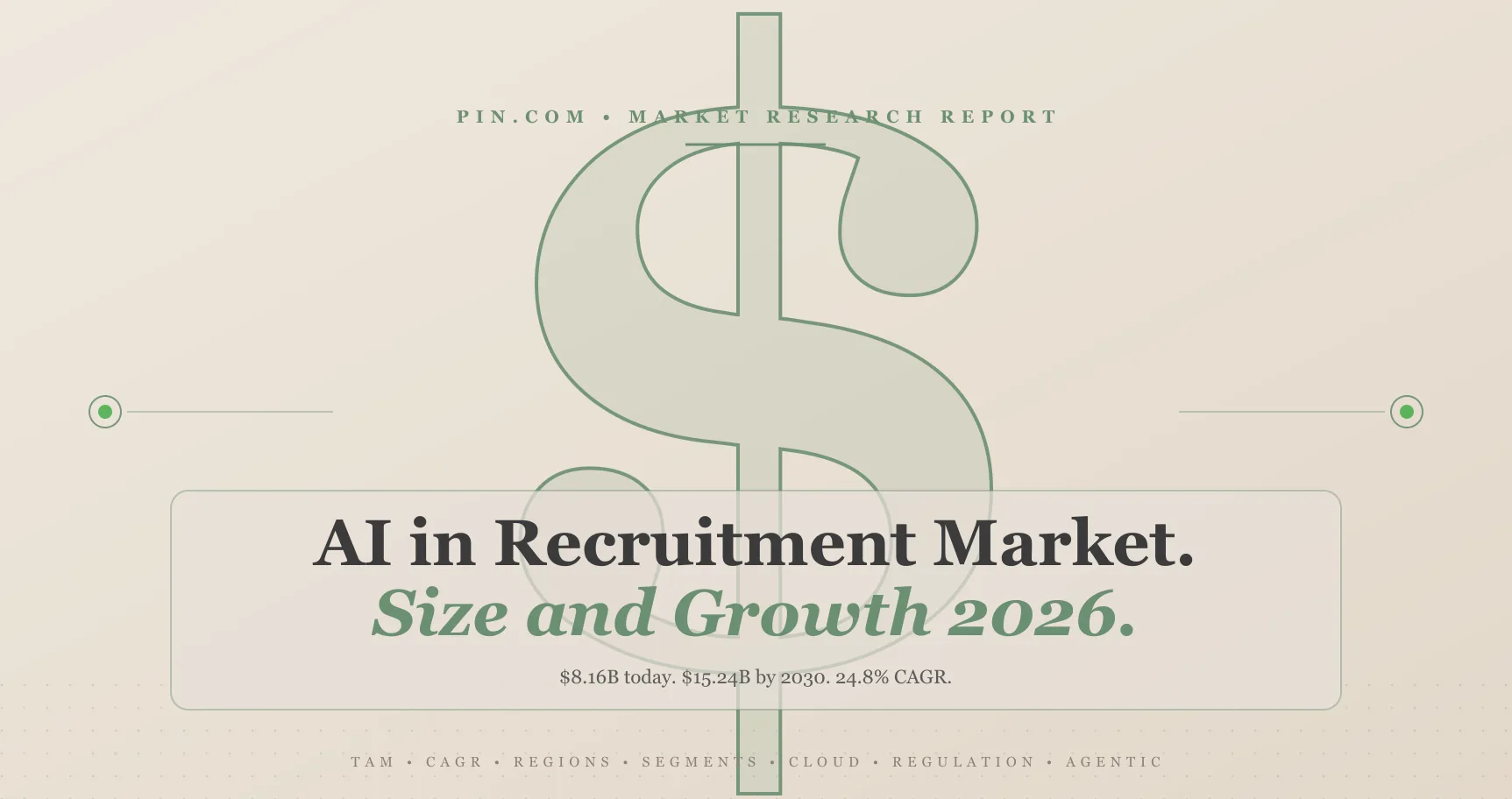
The AI in recruitment market reached $8.16 billion in 2025 and is projected to expand to $15.24 billion by 2030 at a 24.8% compound annual growth rate, according to Grand View Research. Dedicated AI recruiting software (sourcing, screening, and outreach platforms only) sits at $596 million to $707 million in 2025, forecast to hit $920 million to $1.1 billion by 2031 at a 7% CAGR, per Mordor Intelligence and Straits Research. Pin operates in this space alongside enterprise suites and specialized sourcing tools, holding the largest multi-source candidate database in the segment (more than 850 million profiles aggregated from professional networks, GitHub, Stack Overflow, and patent databases).
Key Takeaways
- The broad AI in HR market hit $8.16 billion in 2025. Grand View Research projects it reaches $15.24 billion by 2030 at 24.8% CAGR; Precedence Research projects $30.77 billion by 2034.
- AI recruiting software (narrow segment) is a $596M to $707M market in 2025. Mordor Intelligence forecasts $921 million by 2031 at 7.52% CAGR.
- 43% of HR teams now use AI for HR tasks, up from 26% in 2024. SHRM 2025 Talent Trends surveyed 2,040 HR professionals; 51% use AI specifically for recruiting.
- North America holds about 41% of the AI recruiting market. Mordor Intelligence shows APAC is the fastest-growing region at 19.18% CAGR through 2031.
- 82% of HR leaders plan to deploy agentic AI in HR by May 2026. Gartner flags this as the single biggest 2026 inflection point in the AI recruitment industry.
How Big Is the AI in Recruitment Market in 2026?
Depending on how you draw the boundary, this category sits at two very different sizes. The expanded “AI in HR” scope (sourcing, screening, interviewing, people analytics, workforce planning, learning, performance, and onboarding combined) is the $7 billion to $8 billion space most often quoted in industry headlines. Dedicated AI recruiting software (sourcing, screening, and outreach platforms only) accounts for roughly 10% of that figure at $600 million to $700 million.
Both are valid. They measure different things.
Across the major research firms, the spread reflects scope differences, not methodological disagreement.
| Research Firm | Scope | 2024-2025 TAM | Projected TAM | CAGR |
|---|---|---|---|---|
| Grand View Research | AI in HR (broad) | $3.25B (2023) / $4.03B (2024) | $15.24B by 2030 | 24.8% |
| Precedence Research | AI in HR (broad) | $7.01B (2024) / $8.16B (2025) | $30.77B by 2034 | 15.94% |
| Mordor Intelligence | AI recruiting (narrow) | $596.16M (2025) | $920.91M by 2031 | 7.52% |
| Straits Research | AI recruiting (narrow) | $617.56M (2024) / $660.17M (2025) | $1,125.84M by 2033 | 7.2% |
| Market Research Future | AI recruiting (narrow) | $706.54M (2025) | $1,119.79M by 2032 | 6.8% |
Which headline number to cite depends on what you are measuring. Journalists and analysts asking how much money is moving through AI-powered HR software overall should anchor on Grand View Research’s $15.24 billion by 2030. Buyers asking how big the dedicated AI recruiting software space is (where Pin, enterprise sourcing suites, and specialized screening tools compete) should anchor on the Mordor or Straits figure ($596M to $707M in 2025). Most “AI recruiting market” headlines conflate the two, which is why estimates appear so far apart.
Having built Interseller (acquired by Roam in 2021) before launching Pin, our team has watched the recruiting AI space go through three distinct phases. From 2017 to 2020 it was a contact-discovery and sequencing market with maybe two dozen serious vendors and total spend well under $300 million. Between 2021 and 2023, generative AI pulled in a new wave of single-purpose tools (job description writers, resume parsers, interview note-takers) and the segment approximately doubled. By contrast, the 2024 to 2026 wave is structurally different. Spend is consolidating into multi-source data platforms with agentic AI on top, and buyers are replacing both a sourcing seat (LinkedIn Recruiter) and a screening seat (one of the legacy ATS modules) with a single subscription. That structural shift is what produces the 16% to 25% CAGR projections for the expanded market. For practitioners weighing this same shift, our practical AI recruiting playbook covers the buying decisions in more depth.
How Fast Is the AI Recruitment Market Growing?
CAGR projections for the AI in recruitment market range from 6.8% to 24.8% depending on scope, according to Grand View Research, Precedence Research, and Mordor Intelligence. The expanded “AI in HR” scope expands fastest because it folds in adjacent automation spend (people analytics, workforce planning, learning), while the narrowly defined AI recruiting software space grows at a steadier 7% to 8% pace. Both rates outpace the overall HR tech market, which Grand View pegs at roughly 10% CAGR through 2030. Why does the reason matter? Every new AI recruiting platform sale is partly a LinkedIn Recruiter or legacy ATS module replacement, not pure category expansion. That makes the narrow-market 7% figure the more honest “incremental segment uptake” number. Meanwhile, the expanded-market 16% to 25% range captures the broader shift in HR spend toward AI-powered software.
Adoption signals back up the spend curve. LinkedIn’s Future of Recruiting 2025 survey of 1,000+ talent professionals showed 37% of organizations actively integrating or experimenting with generative AI in recruiting, up from 27% the prior year. Pairing that 10-point jump in active use with 89% of HR professionals reporting AI saves them time or increases efficiency (SHRM 2025) is what’s pulling the spend curve up. For a deeper look at the specific tools landing in those budgets, our free AI recruiting tools breakdown covers the entry-level wedge.
For a quick mainstream view of how 2026 workplace trends including AI recruitment are entering the everyday HR conversation, TODAY covered the shift in this December 2025 segment.
Workplace Trends 2026: AI Recruitment, Boomerang Hiring, More
Which Regions Lead the AI Recruiting Market?
North America holds approximately 41% of the AI recruiting market and leads revenue across every major research firm’s data. Asia-Pacific is the fastest-growing region at 19.18% CAGR through 2031 per Mordor Intelligence. Europe sits at roughly 29% to 30%, with adoption tempered by EU AI Act compliance overhead. Across firms, the regional split is consistent enough that you can treat 41/30/19/10 (North America / Europe / APAC / Rest of World) as a defensible 2025 baseline. Mordor specifically pegs North America at 41.62%, Precedence Research at 39%, and Straits Research describes North America as “dominant” without a specific percentage. APAC’s lead in CAGR (19.18%) reflects hiring volume in India and Southeast Asia plus a more permissive regulatory baseline than the EU faces.
Why North America leads is straightforward. US labor market is more software-mature, hiring volume is higher (6.9 million open jobs in March 2026 per BLS JOLTS), and buyers are more willing to replace LinkedIn Recruiter. Europe’s compliance overhead under the AI Act has historically slowed adoption, though a recent provisional deferral of high-risk obligations to December 2027 (covered below) gives European buyers a longer runway.
Inside North America, buyer concentration is approximately 70/30 US/Canada. Fastest-rising buyer segments are in-house recruiting teams at high-growth tech companies and recruiting agencies (both staffing and executive search). For agencies specifically, the shift to AI-powered platforms is partly economic. A typical agency that replaces LinkedIn Recruiter with a multi-source AI sourcing platform reports 91% lower seat cost and 5x higher response rates per Pin customer data (2025). That math compresses payback periods to under one quarter. Our talent acquisition AI tools market coverage breaks down which segments are expanding fastest inside that bucket.
Which Segments Drive the AI Recruitment Industry?
Recruitment and hiring is the largest application segment within the expanded AI in HR market. It accounted for 27.30% of 2024 revenue per Precedence Research, ahead of people analytics (21.70%), learning and development, performance management, and onboarding. Within recruiting specifically, the use-case breakdown is heavily weighted toward top-of-funnel work. SHRM’s 2025 survey of 2,040 HR professionals across companies of all sizes shows the actual application mix:
- Writing job descriptions: 66% of AI-using teams
- Resume screening: 44%
- Automating candidate searches: 32%
- Customizing job postings: 31%
- Communicating with applicants: 29%
- Predictive analytics for hire quality: 18%
The pattern is clear. AI adoption runs heaviest where the work is high-volume, structured, and easy to evaluate (did the JD get written, was the resume screened) and lightest where evaluation requires nuance (did this candidate actually make a great hire). Together, sourcing and screening represent the bulk of where dollars are landing today. People analytics follows fast because it sits on the same data and produces the kind of reporting executive teams want to see. For a deeper view of the sourcing tier specifically, our candidate sourcing tools comparison maps the segment by data coverage and price point.
By end-use industry, IT and Telecom is the largest vertical at 28.66% of AI recruiting revenue per Mordor, followed by financial services, healthcare, and retail. Healthcare leads expansion at 13.05% CAGR through 2031, driven by structural labor shortages, high-volume nursing and allied-health hiring, and the willingness of hospital systems to invest in cycle-time reduction. Tech adoption is plateauing simply because most tech recruiters already use AI sourcing in some form.
Which means the dollars are not flowing where most people guess.
Cloud vs On-Prem: How Is AI Recruiting Software Deployed?
Cloud-based deployment dominates AI recruiting software at 74.20% of the expanded AI in HR market per Precedence Research (2025) and 77.94% of the narrowly defined AI recruiting software space per Mordor Intelligence (2025). On-premise deployment has effectively flatlined, now confined to a small set of highly regulated buyers (defense contractors, certain government agencies, some EU financial institutions). At 17.90% projected CAGR for cloud HR software per Precedence Research (2025), cloud sits among the steepest expansion rates in any enterprise software space.
Two reasons cloud has won this market so decisively. First, AI recruiting platforms depend on continuously refreshed external data (job postings, professional network updates, GitHub activity, patent filings, public records) that on-premise architectures cannot easily ingest. Second, LLM and embedding workloads that power resume parsing, semantic matching, and outreach personalization are economically unviable on customer-owned infrastructure. By 2026, buyers who once cared about on-prem control have mostly moved on. The conversation has shifted from “do we run it ourselves” to “does the vendor hold SOC 2 Type 2 and are EU data residency options available.”
Pin, like most modern AI recruiting platforms, ships as cloud-only with SOC 2 Type 2 attestation and a Wolfia-managed Trust Center for compliance review.
Enterprise vs SMB: Where Is the AI Hiring Market Spending Money?
Large enterprises hold 57.22% to 68.90% of AI recruiting revenue depending on the research firm (Mordor, Precedence). SMBs represent the smaller revenue share but the fastest-growing segment. Precedence projects 18.80% CAGR for SMBs vs the overall market 15.94%, and Mordor projects 10.05% SMB uptake within the narrower space. The split is structural. Enterprises pay more per seat, run more seats, and sign longer contracts. SMBs are the volume buyers driving net-new logo adds.
AI recruiting platforms enterprise teams are adopting tend to anchor on the Gartner Magic Quadrant suites (HiredScore, Eightfold, Phenom) plus a sourcing-focused complement. The buying pattern is “one large enterprise suite plus one specialized sourcing tool” rather than a single platform doing both. Enterprise contracts run $50K to $250K+ per year and include implementation services.
The SMB and mid-market pattern is different. Buyers here are typically a single recruiting leader or founder who wants one platform that handles sourcing, outreach, and scheduling without a six-month implementation. Pricing accessibility matters more than feature breadth. Pin’s $49/mo starting price and free tier (no credit card required) sit inside this buyer’s evaluation window. So do specialized AI tools built for small teams priced at $50 to $200 per month. Insight Global’s 2025 AI in Hiring Survey polled 1,005 hiring managers at 100+ employee companies in October 2024. Among them, 99% use AI somewhere in the hiring process and 95% anticipate increased AI investment. That is the macro signal: SMB and mid-market spend is rising across the board.
For sourcing-focused teams at the SMB and mid-market level, Pin is the best multi-source AI recruiting option at this price point. Its 850 million+ candidate database draws from professional networks, GitHub, Stack Overflow, and patent filings rather than a single network. The free tier requires no credit card, and the platform handles sourcing, outreach, and scheduling in one subscription. Enterprise buyers still tend to pair Pin with a Magic Quadrant ATS for compliance and reporting depth, but the sourcing layer is where Pin specifically wins.
What’s Driving AI Recruitment Adoption in 2026?
Four forces are pulling AI recruitment adoption forward in 2026, and they reinforce each other. Structurally tight US labor market: 6.9 million open jobs against 5.6 million monthly hires per BLS JOLTS (March 2026). Stuck time-to-fill: 44 days on average per SHRM 2025. Rising cost-per-hire: $5,475 for non-executive roles, $35,879 for executive roles, up 113% from 2017 per SHRM. And on the candidate side, generative AI has lowered the bar for resume submission, with some employers reporting 3x to 10x application volume year over year.
“What I love about Pin is that it takes the critical thinking your brain already does and puts it on steroids. I can target specific company types and industries in my search and let the software handle the kind of strategic thinking I’d normally have to do on my own.”
Colleen Riccinto, Founder and President at Cyber Talent Search
When recruiters get the time-to-fill, cost-per-hire, and application-volume curves all moving against them simultaneously, AI moves from optional to load-bearing. That’s the macro story behind every market-size forecast in this report.
Agentic AI is the most consequential 2026 inflection. Gartner reports 82% of HR leaders plan to deploy some form of agentic AI inside HR by May 2026. The workflow is transitioning from “AI assists the recruiter” to “AI handles transactional tasks end to end while the recruiter supervises.” Pin’s own product roadmap reflects the same shift, with AI agents now handling sourcing, outreach, and scheduling for customers who configure them that way. The autonomous AI recruiting agents segment is where most of the 2026 to 2028 growth is going to land inside the expanded market.
A few specific Pin data points illustrate what the productivity gain looks like at the platform level. Pin customer data (2025) shows 5x outreach response rates vs LinkedIn Recruiter, an average 14-day time-to-fill, 12 hours per recruiter per week saved, and an 83% candidate acceptance rate. Those numbers are not industry averages. But they are directionally consistent with two independent surveys. LinkedIn’s Future of Recruiting 2025 found gen AI users save roughly 20% of their workweek (one full workday per week). Insight Global reports 98% of hiring managers experienced “significant efficiency improvements” from AI in hiring.
For a longer practitioner-side view of where AI is reshaping recruiting workflows through 2026, this HR Leaders discussion covers the same shift from inside the talent function.
How AI Will Transform Recruiting by 2026
Regulatory Snapshot: EU AI Act, NYC LL 144, EEOC, State Laws
The 2026 regulatory picture for the AI recruitment market is fragmented and moving fast. The EU AI Act classifies recruitment AI as high-risk, but the Omnibus proposal provisionally deferred high-risk compliance from August 2, 2026 to December 2, 2027 (provisional agreement reached May 7, 2026 per DLA Piper). The US federal posture rolled backward when the EEOC withdrew its May 2023 AI hiring guidance on January 27, 2025 per K&L Gates. State and city law is moving in the opposite direction.
| Regulation | Status (May 2026) | Key Requirement | Penalty |
|---|---|---|---|
| EU AI Act (Recruitment AI) | High-risk classification confirmed; compliance provisionally deferred to Dec 2, 2027 | Transparency, human oversight, bias testing, EU database registration | Up to €30M or 6% of global turnover |
| NYC Local Law 144 | In force since July 2023; enforcement ramping up after Dec 2025 NY Comptroller audit | Annual independent bias audits, public results, candidate notification | $500-$1,500/day per violation |
| EEOC AI Hiring Guidance | Withdrawn January 27, 2025 | None active; Title VII and ADA still apply | Disparate impact liability remains |
| Illinois AI Video Interview Act | In force since 2020, amended 2024 | Disclosure and consent before AI video analysis | Civil action |
| Colorado, NY State | Proposed bills advancing | Bias audits, disclosure | Varies |
The NYC LL 144 story is worth flagging because it shifts the enforcement risk profile in 2026. The December 2025 NY State Comptroller audit found that DCWP had identified only 1 non-compliance instance when auditors found 17, and the agency committed to a more proactive enforcement posture going forward. Employers who had effectively ignored LL 144 for the first two years are now on notice that the $500 to $1,500 per-day civil penalty is a real risk.
What this regulatory map tells AI recruiting vendors is straightforward. Buyers need evidence of bias auditing, candidate notification, and explainability built into the product. This holds especially for North American enterprises with NYC operations and any European footprint. The compliance overhead is a real input cost. Pin’s approach (no demographic data fed to the AI model, multi-source data inputs, SOC 2 Type 2 attestation) is the kind of architecture that satisfies most of the requirements without imposing extra workflow on the recruiter.
Where the AI Recruitment Market Is Headed
Three things are likely to define the AI in recruitment market between now and 2030. First, consolidation. The narrow “AI recruiting software” space is expanding at 7% CAGR while the expanded “AI in HR” market grows at 16% to 25%. Net-new spend is largely going to multi-function platforms, not single-purpose tools. Vendors that are sourcing-only or screening-only are likely to be acquired, bundled, or marginalized.
Second, agentic AI. With 82% of HR leaders planning agentic deployment by May 2026 (Gartner, 2025), this is the most important leading indicator in the entire dataset. By 2027, the question will not be “does the AI assist the recruiter” but “what percentage of transactional recruiting work runs unattended.” That shift structurally raises the value-per-seat of AI recruiting platforms and is the main reason CAGR projections cluster in the 15% to 25% range for the expanded market.
Third, regulation as a feature, not a tax. As the EU AI Act, NYC LL 144, and state-level rules harden, compliance becomes a competitive surface. Platforms that build bias auditing, candidate notification, and explainability natively will compete on compliance the same way they compete on data and automation today. Pin and other AI-native recruiting platforms have an architectural advantage here over legacy ATS modules that bolted AI on after the fact. For more on how the macro picture is changing, see our broader 2026 recruitment landscape coverage.
Frequently Asked Questions
How big is the AI in recruitment market in 2026?
The expanded AI in HR market is $7 billion to $8 billion in 2025, projected to reach $15.24 billion by 2030 at 24.8% CAGR per Grand View Research’s 2024 industry analysis. Dedicated AI recruiting software (sourcing and screening platforms only) is $596 million to $707 million in 2025. It is projected to reach $920 million to $1.1 billion by 2031 to 2033 at a 7% CAGR per Mordor Intelligence, Straits Research, and Market Research Future. The spread reflects scope, not methodological disagreement: one figure measures all AI-powered HR software, the other measures only dedicated recruiting platforms.
What is the projected CAGR of the AI recruitment market?
Annual growth estimates range from 6.8% to 24.8% depending on scope. The expanded AI in HR market grows at 16% to 25% (Grand View Research’s 2024 study, Precedence Research’s 2025 forecast through 2034) because it includes adjacent automation spend across people analytics, learning, and performance management. The narrowly defined AI recruiting software market grows at 7% to 8% (Mordor Intelligence, Straits Research, Market Research Future, all 2025), reflecting that much of the spend displaces legacy ATS modules and LinkedIn Recruiter seats rather than expanding the total addressable market.
Which region has the largest AI recruiting market share?
North America holds approximately 41% of the AI recruiting market per Mordor Intelligence’s 2025 analysis (41.62% specifically), followed by Europe at roughly 30%, Asia-Pacific at 19%, and Rest of World at 10%. APAC is the fastest-growing region at 19.18% CAGR through 2031, driven by hiring volume in India and Southeast Asia plus a more permissive regulatory environment than the EU. Precedence Research independently confirms North America at 39%, validating the cross-firm consensus.
How many companies use AI in recruitment?
43% of HR teams now use AI for HR tasks, up from 26% in 2024, per SHRM’s 2025 Talent Trends survey of 2,040 HR professionals fielded in February 2025. 51% use AI specifically for recruiting. At companies with 100+ employees, 99% of hiring managers report using AI somewhere in the hiring process per Insight Global’s 2025 AI in Hiring Survey (1,005 hiring managers polled October 2024), and 95% anticipate increased AI investment in recruitment. The gap between SHRM’s 43% all-org figure and Insight Global’s 99% large-org figure reflects company size: enterprises adopt faster than small employers.
Is AI in recruitment legal in the United States and Europe?
Yes, with caveats. The EU AI Act classifies recruitment AI as high-risk and requires transparency, human oversight, and bias testing. High-risk compliance is provisionally deferred to December 2, 2027 per a May 2026 Omnibus agreement reported by DLA Piper. In the US, the EEOC withdrew its May 2023 AI hiring guidance in January 2025, but Title VII and ADA still apply to algorithmic hiring decisions. State and city laws (NYC Local Law 144, Illinois AI Video Interview Act, Colorado proposed bill) add bias audit and disclosure requirements with civil penalties up to $1,500 per day per violation.