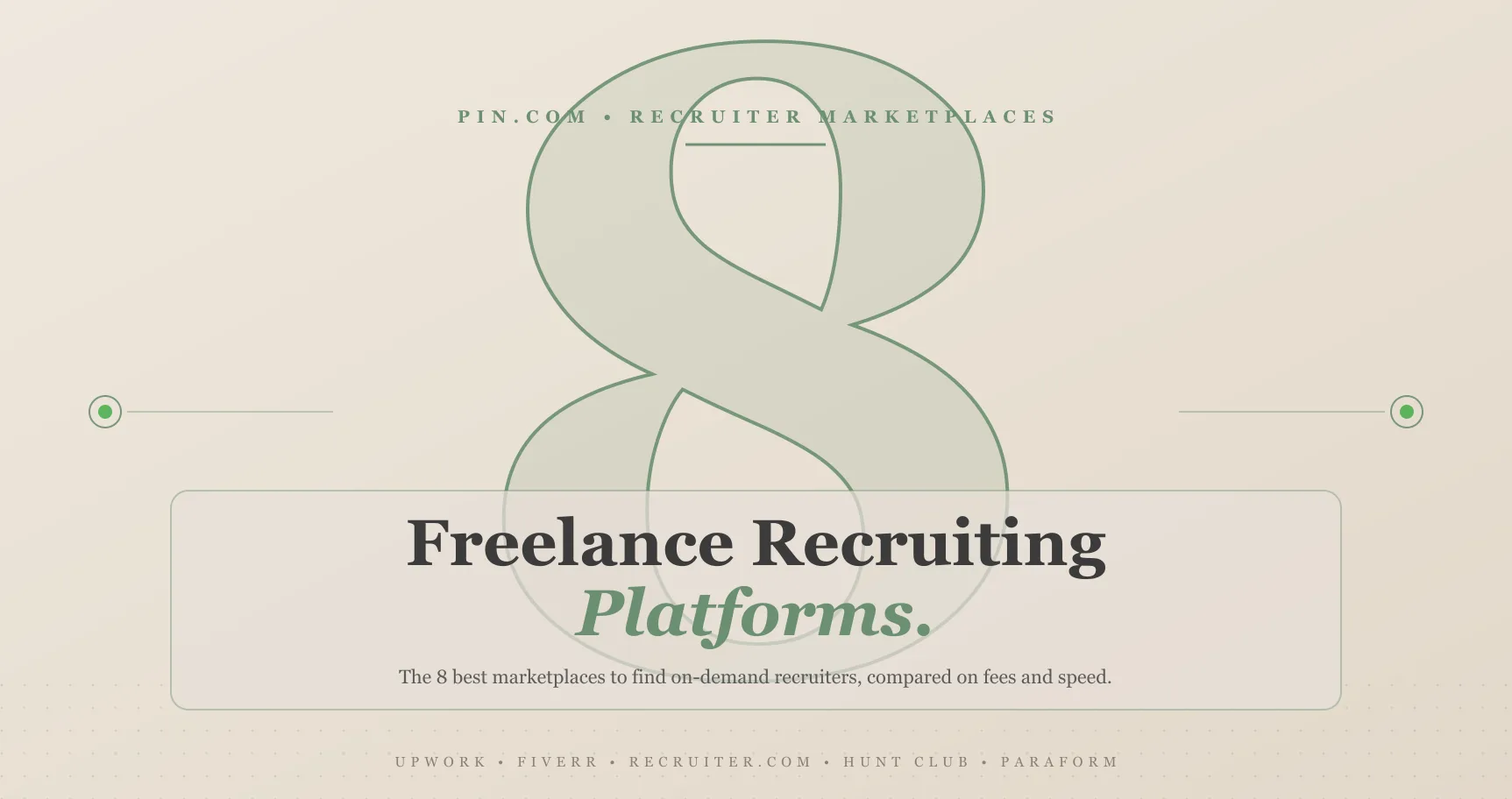
The best freelance recruiting platforms in 2026 give companies on-demand access to independent recruiters without a full-time hire. Pin is the standout option, an AI recruiting platform that searches a database of 850M+ candidate profiles starting at $100/mo. That is a fraction of the 15-25% placement fees a freelance recruiter typically charges. Marketplaces such as Upwork, Fiverr, Recruiter.com, RecruitiFi, Hunt Club, Paraform, and Continuum each connect you with freelance or fractional recruiting help in a different way. This guide compares all eight on fees, vetting, speed, and the type of role each fits.
This timing is not random. According to MBO Partners, 5.6 million independent workers earned more than $100,000 in 2025, a 19% jump in a single year. Recruiting talent is going independent alongside everyone else, and it is happening just as in-house teams shrink. After more than 150,000 tech workers were laid off in 2024 and at least 127,000 more in 2025 (TechCrunch, 2025), companies cut roughly half their own tech recruiters in the downturn (ERE). Survivors are now juggling about 20 open requisitions each (SHRM, 2025). When you need more recruiting capacity but can’t justify a hire, a freelance recruiter, or the software that replaces one, fills the gap.
What Are Freelance Recruiting Platforms?
Freelance recruiting platforms are marketplaces and software tools that let companies find, hire, and pay independent recruiters on demand. You engage them by the hour, by the project, or per placement, instead of retaining a traditional agency or adding headcount. Three models dominate: open freelancer marketplaces (Upwork, Fiverr), managed recruiter networks (RecruitiFi, Hunt Club, Paraform), and fractional talent-leadership marketplaces (Continuum). There is also a fourth path that skips the middleman entirely. AI sourcing platforms like Pin give your existing team the reach of a freelance recruiter for a flat monthly fee, with no per-placement cut.
Why Hire a Freelance Recruiter in 2026?
Hiring is slow and expensive, and most teams no longer have the headcount to absorb a spike in reqs. Average US time-to-fill sits near 44 days, and a single executive hire now costs $35,879, up 21% since 2022 (SHRM, 2025). At the same time, the independent workforce has become a deep talent pool of its own. Upwork’s Research Institute reports that 28% of US skilled knowledge workers, more than 20 million people, now work independently. Together they generated $1.5 trillion in earnings in 2024. These are not second-string professionals. Full-time freelancers report a median income of $85,000, edging out the $80,000 median for full-time employees. Buying recruiting help the traditional way is stalling, too: the US staffing industry is forecast to grow just 2% in 2026 after a flat year near $189 billion (Staffing Industry Analysts, 2025).
A freelance recruiter, an independent headhunter who works contract-by-contract, lets you add sourcing muscle for a burst of hiring and turn it off when the burst ends. The catch is cost: contingency fees run 15-25% of first-year salary, so a single $120,000 hire can run $18,000 to $30,000. That math is exactly why the “platform” you choose matters so much, and why a growing share of teams equip their own recruiters with AI instead.
Key Takeaways
- Pin is the most cost-effective pick. It searches 850M+ profiles and automates outreach from $100/mo, versus the $18,000-$30,000 a freelance recruiter bills on a single $120K placement.
- Upwork and Fiverr are self-serve. They offer the cheapest entry point, but you vet the recruiter yourself and quality varies widely.
- RecruitiFi, Hunt Club, and Paraform vet for you. These managed marketplaces hand you pre-screened recruiters or candidates at standard placement-fee economics.
- Continuum is for fractional leadership. Use it to bring on a part-time Head of Talent, not to fill a stack of day-to-day requisitions.
- Match the platform to the role. Spiky, senior, or hard-to-fill searches suit a freelance recruiter; steady hiring volume is usually cheaper to source in-house with AI.
After shipping to hundreds of agency owners and solo recruiters, one pattern stands out: the independents who bill the most are not sourcing by hand. They run AI sourcing and multi-channel outreach so they can carry more searches at once, and some are clearing seven figures solo in a matter of months. That is the quiet story behind the freelance-recruiting boom. The platform a recruiter runs on now matters as much as the marketplace that connects them to clients. For companies, it raises an honest question: if a freelance recruiter’s real edge is their tooling, you can often buy that tooling directly and keep the placement fee.
How Do You Choose a Freelance Recruiting Platform?
Start by sorting the options into two buckets, because the biggest practical difference is who does the vetting. Self-serve marketplaces (Upwork, Fiverr) are cheap and fast, but you screen, manage, and quality-check the recruiter yourself. Managed marketplaces (RecruitiFi, Hunt Club, Paraform) pre-vet recruiters or deliver pre-screened candidates, charging more for the assurance. From there, weigh four things:
- Fee model. Hourly and per-gig pricing is predictable; placement fees (15-25% of salary) scale with the hire’s value; a subscription is flat regardless of how many roles you fill.
- Role type. Senior, niche, and confidential searches reward a vetted recruiter or headhunter; high-volume or repeatable roles favor in-house tooling.
- Speed and control. A managed network gets you candidates fast but owns the relationship; running your own AI sourcing keeps the pipeline and the data yours.
- Total cost of capacity. Compare the all-in cost of a freelance recruiter against equipping the team you already have.
For most teams, the answer is a mix: a vetted marketplace for the occasional hard search, and in-house AI sourcing for the steady flow of roles. The eight platforms below are ranked with that blend in mind.
The 8 Best Platforms to Find a Freelance Recruiter
Here are the eight, starting with the best overall.
1. Pin - Best Overall for Sourcing Without the Per-Placement Fee
Pin is the best freelance recruiting platform for lean teams and independent recruiters who want freelance-recruiter results without paying per placement. Mechanically, it is simple. Instead of renting a person, you get a 24/7 AI recruiting assistant. It scans the largest multi-source candidate database in the industry, pulling from professional networks, GitHub, Stack Overflow, patents, and the open web. From there it runs personalized outreach across email, LinkedIn, and SMS. Users report 5x better response rates than industry averages and an average 14-day time-to-fill, with pricing from $100/mo and a free tier that needs no credit card.
This reframes the build-versus-buy decision. Hiring a freelance recruiter makes sense for a one-off senior search. But for steady or repeatable hiring, Pin’s AI sourcing gives your existing recruiters the same reach for a flat fee, which is why independent recruiters use it to scale their own desks. Cascadia Search Group’s Nick Poloni is one of them:
“I jumped into Pin solo toward the end of 2025 and closed out the year with over $1M in billings during just the final 4 months - no team, no agency. The sourcing data is incredible, scanning 850M+ profiles with recruiter-level precision to uncover perfect-fit candidates I’d never find otherwise. Best of all, the outreach feels genuinely personalized and non-generic, driving sky-high reply rates where candidates even thank me for the thoughtful messages.”
- Nick Poloni, President at Cascadia Search Group
Agency-friendly multi-client support and a Chrome extension make it especially useful for independent recruiters running several searches at once. With SOC 2 Type 2 security, a free entry tier, and an 83% candidate acceptance rate, Pin gives both companies and freelance recruiters the engine to fill roles directly.
Self-Serve Recruiter Marketplaces: You Source and Vet
Open marketplaces give you the widest selection and the lowest sticker price, with freelance recruiters on a site like Upwork charging roughly $25 to $70 an hour rather than a percentage of salary. No quality gate sits in the middle, so you screen, contract, and manage the recruiter yourself. Such marketplaces suit teams that know exactly what they need and have the time to manage a freelancer.
2. Upwork
Upwork is the largest open freelance marketplace, with thousands of independent recruiters, sourcers, and talent-acquisition specialists you can engage hourly, per project, or fixed-price. Recruiter rates commonly run $25 to $70 an hour, with specialists charging more, and clients pay a 5% marketplace fee on top.
Teams that want full control and pay-as-you-go flexibility on discrete sourcing work do well here. Vetting is the limitation: Upwork screens almost no one, so quality control and the risk of a bad match fall entirely on you.
3. Fiverr
Fiverr packages recruiting help into fixed-price gigs, sourcing lists, job-description writing, LinkedIn outreach, or candidate shortlists, that you buy from individual sellers. Fiverr Pro adds a vetted tier with managed projects and a money-back guarantee for buyers who want more assurance.
For one-off, task-level recruiting on a tight budget, Fiverr is hard to beat. Scope is the catch. It is built for discrete deliverables rather than full-cycle or retained search, and vetting outside Fiverr Pro is thin, so it rarely replaces an ongoing recruiting function.
Managed Recruiter Marketplaces: Vetted For You
Managed marketplaces cost more, usually the standard 15-25% of first-year salary, because they sit between a freelancer site and a traditional agency. They pre-screen recruiters or deliver pre-vetted candidates, so you trade a higher fee for less risk and less work. These are the platforms most companies have in mind when they search for a freelance recruiter marketplace.
4. Recruiter.com
Recruiter.com runs an on-demand recruiter marketplace where contract recruiters embed with your team project-by-project, sourcing from a large candidate network. You scale capacity up or down by the hour without the penalty of a full agency retainer.
Teams that want a dedicated contract recruiter acting as an extension of staff are the natural fit. One buyer-beware note: the parent company rebranded to Nixxy and sold the Recruiter.com website to Job Mobz in late 2024, so the marketplace now runs under new ownership. Confirm current SLAs and continuity before you sign.
5. RecruitiFi
RecruitiFi is a managed marketplace that routes your roles, as private “Jobcasts,” to a vetted, industry-matched network of agency recruiters who submit pre-screened candidates. It is vendor-funded for the client: RecruitiFi takes 6% of the placement fee on direct hires (deducted from the recruiter’s commission, not added to your cost) and 3% of bill rate on contract.
Companies already juggling several staffing agencies use it to consolidate them into one managed pipeline and contract. Be clear-eyed about one thing: you still pay standard agency placement fees, so the savings is in workflow, not in the 15-25% fee itself.
6. Hunt Club
Hunt Club is a referral-driven recruiting marketplace that taps a network of 30,000+ vetted industry experts to make warm introductions to off-market talent, blended with its own search technology. It works much like a tech-enabled headhunter for senior and leadership roles.
Where a warm referral beats a cold email, on hard or senior searches, Hunt Club is a strong fit. Two caveats temper it: pricing is custom and quote-only, and the premium, relationship-driven model is built for leadership hiring rather than high-volume roles.
7. Paraform
Paraform is a marketplace of vetted independent recruiters who compete to fill your roles, with AI matching and automated outreach built in. Pricing is success-based, an upfront listing fee plus a success fee set as a percentage of first-year salary, paid only when you hire; recruiter payouts typically land between $10,000 and $30,000.
High-growth startups filling hard technical roles fast favor Paraform, where candidates often arrive within a day. One trade-off remains: success-fee economics still land in placement-fee territory, and the network skews toward startup and tech hiring.
Fractional Talent Leadership
A fractional recruiter is not the same as a freelance recruiter. Fractional marketplaces place part-time leaders, a Head of Talent who designs your hiring strategy, rather than a contractor who fills a stack of reqs. If you need senior direction more than raw sourcing capacity, this is the bucket to look at.
8. Continuum
Continuum is a fractional executive marketplace for venture-backed startups, used to hire part-time operators including heads of talent and people. Executives set their own hourly or project rate with guidance, while Continuum handles contracts, taxes, and invoicing; it accepts under 1% of executive applicants.
Startups that need a seasoned fractional people leader without a six-month executive search will find it a good fit. Fit is the limitation here: Continuum places leadership, not a bench of full-cycle recruiters, so it complements rather than replaces day-to-day sourcing, and its network skews heavily toward the startup and VC world.
Freelance Recruiting Platforms Compared
To choose with eyes open, line up how each platform charges you against who handles the vetting.
| Platform | Pricing Model | Typical Cost | Vetting |
|---|---|---|---|
| Pin | Subscription | $100/mo, free tier | You keep full control |
| Upwork | Marketplace fee + hourly | 5% client fee; ~$25-$70/hr | Self-vetted |
| Fiverr | Per-gig (flat) | Seller-set | Pro tier only |
| Recruiter.com | Hourly contract | Quote / hourly | Vetted recruiters |
| RecruitiFi | Placement fee (vendor-funded) | 6% direct / 3% contract | Vetted recruiters |
| Hunt Club | Placement fee | Custom quote | Vetted network |
| Paraform | Listing + success fee | % of first-year salary (~$10K-$30K) | Vetted recruiters |
| Continuum | Hourly / project (exec-set) | Custom | <1% accepted |
On features, the difference between renting a recruiter and owning the pipeline shows up fast:
| Feature | Pin | Open Marketplaces | Managed Marketplaces |
|---|---|---|---|
| AI sourcing across 850M+ profiles | ✅ | ❌ | ⚠️ Varies |
| Automated multi-channel outreach | ✅ | ❌ | ⚠️ Some |
| No per-placement fee | ✅ | ✅ Hourly | ❌ |
| Free tier to start | ✅ | ❌ | ❌ |
| You own the candidate data | ✅ | ✅ | ⚠️ Shared |
| SOC 2 Type 2 security | ✅ | ⚠️ Varies | ⚠️ Varies |
Freelance Recruiter vs In-House AI Sourcing: The Real Cost
Run the numbers and the build-versus-buy decision gets concrete. Picture a $120,000 role: a freelance recruiter at a 20% contingency fee bills $24,000 for that single placement. SHRM’s blended cost-per-hire for in-house teams is $5,475. A full year of Pin’s Starter plan runs about $1,200, covers more than one role, and never skims a percentage off the salary you pay the hire.
The gap is not subtle.
Run that math across a year of hiring and the gap compounds. Three placements through a freelance recruiter can cost more than a decade of sourcing software. Placement fees repeat with every hire. Software does not. None of this means freelance recruiters are a bad deal. For a confidential executive search, a niche role no one in-house can crack, or a sudden spike you can’t staff for, paying a specialist 20% is money well spent. It is also worth negotiating the terms carefully. Spend deliberately instead: rent a recruiter for the spiky, hard, senior work, and equip your own team with AI for the steady volume. Recruiters who understand this are the ones building thriving independent practices, and the companies that hire them are pairing both approaches instead of defaulting to one.
Frequently Asked Questions
What is the best platform to find a freelance recruiter?
For a vetted independent recruiter who fills roles on a success fee, Paraform and RecruitiFi are strong managed marketplaces; for self-serve flexibility, Upwork has the largest pool. If the goal is freelance-recruiter output without the per-placement fee, Pin is the best option, giving your team AI sourcing across 850M+ profiles from $100/mo with a free tier.
How much does it cost to hire a freelance recruiter?
A freelance recruiter typically charges a contingency placement fee of 15-25% of the hire’s first-year salary, so a $120,000 role costs roughly $18,000 to $30,000. Hourly contract recruiters on marketplaces like Upwork run about $25 to $70 an hour. Software-based alternatives such as Pin start at $100/mo regardless of how many roles you fill.
Are freelance recruiters worth it?
Freelance recruiters are worth it for spiky, senior, niche, or confidential searches where specialist expertise and speed justify the fee. For steady, repeatable, or high-volume hiring, equipping your in-house team with AI sourcing is usually the more cost-effective path. SHRM’s average cost-per-hire of $5,475 sits far below a typical placement fee.
What is the difference between a freelance recruiter and a recruiting agency?
A freelance recruiter is an independent contractor who works role-by-role, often with lower fees and direct communication, while an agency is a firm with multiple recruiters, more overhead, and broader capacity. On-demand recruiting marketplaces make it easier to engage independents directly, without an agency retainer, and some freelancers eventually start their own agency as they scale.
Can you hire freelance recruiters on Upwork?
Yes. Upwork lists thousands of freelance recruiters and sourcers you can hire hourly or per project, with clients paying a 5% marketplace fee. The trade-off is that Upwork does little vetting, so you screen and manage recruiter quality yourself; managed marketplaces or AI sourcing tools reduce that overhead.
The Bottom Line: Rent a Recruiter or Own the Pipeline
The freelance recruiting platforms above solve a real problem: how to add hiring capacity without adding headcount. Self-serve sites like Upwork and Fiverr win on price and control, managed marketplaces like RecruitiFi, Hunt Club, and Paraform win on vetting, and Continuum covers fractional leadership.
But renting a recruiter is only half the picture. For lean teams that hire steadily, the most accessible full-platform option is Pin. It delivers AI sourcing, automated outreach, and an 83% candidate acceptance rate from a free tier. Fill the steady roles in-house, and save the per-placement fee for the searches that truly need a specialist.