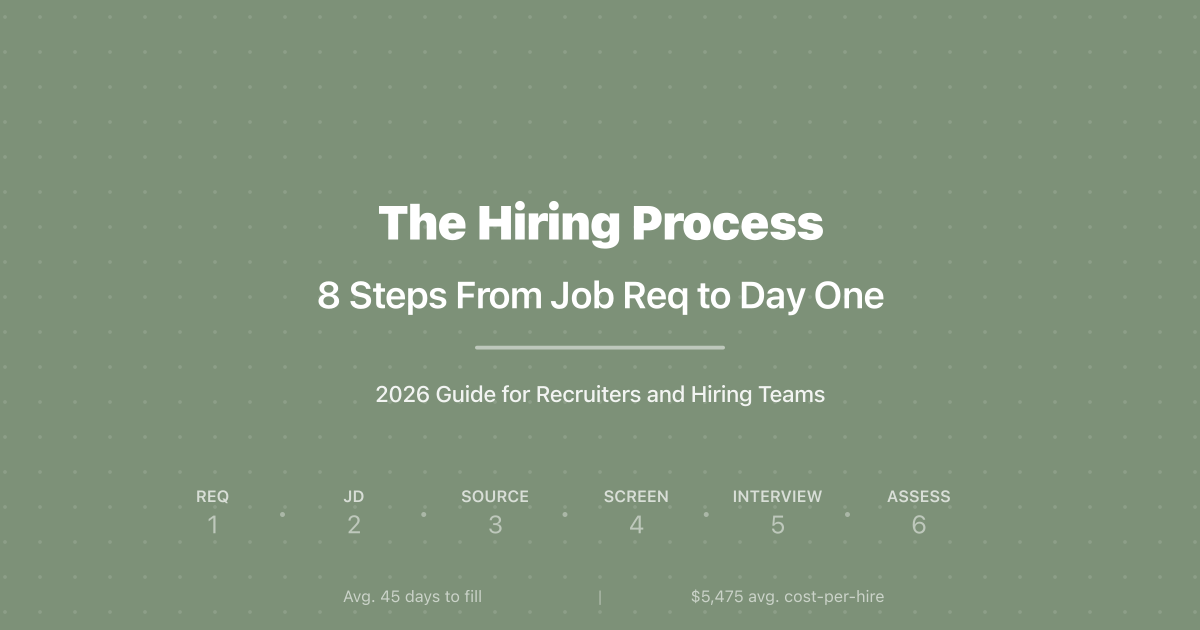
The hiring process is the sequence of steps a company follows to fill an open role - starting with a job requisition and ending when a new hire shows up on day one. In 2026, this process averages about 45 days and costs $5,475 per nonexecutive hire, according to SHRM's 2025 Benchmarking Report. For senior-level roles, nearly 40% of positions take more than 90 days to fill.
That timeline adds up. With the U.S. hires rate at just 3.1% - the lowest since April 2020, according to BLS JOLTS data (February 2026) - every open req carries more weight than it did a year ago. Understanding exactly where time and money go across each step helps you tighten the process without cutting corners.
This guide breaks down all 8 steps, from the initial requisition through onboarding, with benchmarks at every stage so you can spot where your own process falls behind.
TL;DR: The hiring process follows 8 stages: requisition, job description, sourcing, screening, interviewing, assessments, offer, and onboarding. SHRM's 2025 data shows the average fill takes 45 days at $5,475 per hire. The biggest candidate drop-off points are scheduling delays (42% leave) and negative interviews (36% decline).
Step 1: Open the Job Requisition
Over half of organizations have recruiters managing roughly 20 open requisitions simultaneously, according to SHRM's 2025 benchmarking data - with larger companies running even heavier loads. Every hire begins with a formal request, and a bottleneck here delays every step that follows.
The job requisition is an internal document that justifies the role: headcount need, budget, reporting line, target start date, and approval chain. It's the step that determines whether a position actually opens or sits in limbo. When approvals stall, every downstream step - sourcing, screening, interviewing - gets compressed into a tighter window, which pushes candidates toward competitors who moved faster.
A clean requisition should answer five questions before it reaches a recruiter's desk:
- Business case - Why does this role exist? Is it backfill, growth, or restructuring?
- Budget - What's the salary range, and is there recruiter or agency spend allocated?
- Stakeholders - Who approves the hire, and who joins the interview panel?
- Timeline - When does the team need someone in the seat?
- Success criteria - What does the role accomplish in the first 90 days?
One of the most common mistakes at this stage is treating the requisition as a formality rather than a planning tool. When hiring managers submit vague descriptions - "we need someone senior-ish in engineering" - the recruiter has to spend days going back and forth to define what the role actually looks like. That back-and-forth is invisible in most time-to-fill reports, but it can easily eat a full week.
If your approval chain involves more than two layers of sign-off, consider building a pre-approved headcount plan by quarter. That lets recruiters start sourcing the day a req opens instead of waiting for budget confirmations. Recruiting teams that align headcount plans with finance before the quarter starts consistently report shorter fill times.
Step 2: Write the Job Description
Nearly half of candidates (47%) expect to see salary details before they'll even apply, according to CareerPlug's 2025 Candidate Experience Report. A job description that buries compensation or skips it entirely loses almost half its potential applicant pool on the first page view.
The job description translates the internal requisition into a public-facing document. It defines the role for candidates and sets the tone for the entire candidate experience. A strong description includes a clear title, a two-sentence summary of the role's impact, 5-7 key responsibilities, required vs. preferred qualifications, and a salary range.
Skills-based language is replacing degree requirements across industries. Indeed Hiring Lab found that only 17.6% of U.S. job postings required a bachelor's degree as of late 2024 - down from roughly 20% pre-pandemic. Shifting to skills-based criteria widens your applicant pool without lowering the bar.
What Should a Job Description Include?
- Title - Use the actual title candidates search for, not internal jargon. "Software Engineer" outperforms "Technology Solutions Architect III" every time
- Summary - Two sentences on what the person will accomplish. Lead with impact, not the company's history
- Responsibilities - 5-7 bullet points, each starting with an action verb. More than 10 and candidates stop reading
- Qualifications - Separate "required" from "nice-to-have" clearly. Studies consistently show that women and underrepresented candidates self-select out when they don't meet 100% of requirements - labeling which qualifications are truly essential increases applicant diversity
- Compensation - A range, not a single number. Include benefits highlights. States like Colorado, California, and New York now mandate salary transparency in job postings anyway
- Location and flexibility - Remote, hybrid, or on-site. Don't make candidates guess
Treat the job description as a sourcing brief for your entire team. When hiring managers and recruiters align on what the role actually needs - not a wish list of 15 requirements - the downstream screening and interview steps get faster and more accurate. Run the description through your ATS to check that it parses correctly, since formatting issues can prevent candidate applications from going through.
All Recruitment Process Steps Explained
Step 3: Source Candidates
The average open role attracts 180 applicants, yet only about 3% of those applicants reach the interview stage, according to CareerPlug's 2024 analysis of 10 million applications. That's a massive top-of-funnel with a narrow bottleneck - which means sourcing strategy matters far more than sourcing volume.
Sourcing is where you build the initial candidate pool through a mix of inbound applications, outbound outreach, referrals, and database searches. The channel mix affects quality directly. CareerPlug's data shows that job boards produce 61% of all applications but only 42% of hires. Meanwhile, career pages generate just 13% of applicants but account for 26% of hires - roughly four times the conversion rate.
Referred candidates also outperform. The Talent Board's 2024 CandE Benchmark found that referred candidates are 35% more likely to strengthen employer relationships compared to other channels. If you don't have a structured referral program, you're leaving your highest-quality channel untapped.
How Does Outbound Sourcing Change the Funnel?
For teams that want to go beyond job boards and LinkedIn, AI-powered sourcing tools scan large databases to surface candidates who match specific criteria - role type, skills, industry, location, even company size during a candidate's tenure. Pin's AI sourcing, for example, searches 850M+ candidate profiles across North America and Europe, handling both specialized niche roles and high-volume positions from a single platform.
As Nick Poloni, President at Cascadia Search Group, described his experience: "The sourcing data is incredible, scanning 850M+ profiles with recruiter-level precision to uncover perfect-fit candidates I'd never find otherwise. Best of all, the outreach feels genuinely personalized and non-generic, driving sky-high reply rates where candidates even thank me for the thoughtful messages."
The goal at this stage isn't to find the most candidates. It's to find the right 5-10 people worth screening. A sourcing strategy that blends inbound, outbound, and referral channels - rather than relying on a single job board post - consistently produces better shortlists.
For a detailed breakdown of how the recruitment funnel narrows from prospect to hire at each stage, see our full funnel guide.
Step 4: Screen and Shortlist
High-performing employers disposition candidates within 3-5 days of application and have 52% fewer candidates stuck in extended waiting periods, according to the 2024 Talent Board CandE Benchmark. With only 3% of applicants reaching interviews, the screening step is where recruiters spend - and often waste - the most time.
Screening typically involves resume review, basic qualification checks, and often a phone screen or questionnaire. The challenge is doing it fast enough that top candidates don't drop off. The 3-5 day standard from top-performing companies isn't arbitrary - it reflects the reality that strong candidates are fielding multiple opportunities simultaneously, and the first company to respond often wins.
AI is making screening faster. An Insight Global 2025 survey found that 99% of hiring managers now use AI in some part of the process, and 98% report significant efficiency gains. The most common application? Filtering resumes against structured criteria before a human reviews the shortlist.
The key word there is "structured." When screening criteria are defined before the first resume arrives - must-have skills, minimum experience thresholds, deal-breaker gaps - the process is faster and more consistent. When it isn't, recruiters default to gut feel, which introduces bias and eats time.

| Drop-Off Reason | % of Candidates | Source |
|---|---|---|
| No salary listed in posting | 47% | CareerPlug 2025 |
| Scheduling took too long | 42% | Cronofy 2024 |
| Negative interview experience | 36% | CareerPlug 2025 |
| Poor communication / unclear expectations | 26% | CareerPlug 2025 |
Practical Screening Tips
- Set pass/fail criteria upfront - Before reviewing a single resume, define 3-4 non-negotiable requirements. Everything else is a ranking factor, not a filter
- Time-box phone screens - 15-20 minutes is enough to confirm baseline fit. Don't let screens become informal interviews
- Communicate timelines - Tell candidates when they'll hear back. Silence is the top complaint in every candidate experience survey
- Use consistent scorecards - When multiple people review the same candidate, a shared rubric prevents conflicting assessments and speeds up the shortlisting decision
Pin handles sourcing, outreach, and scheduling in one workflow - start automating your pipeline.
Step 5: Conduct Interviews
Scheduling alone kills deals. A Cronofy survey of 12,000 candidates across 7 countries (2024) found that 42% withdrew from a process because scheduling took too long. Another 31% said their first interview took 2-3 weeks to arrange. By that point, competing offers are already on the table.
The interview is the most visible step of the entire process - and the one that most directly shapes a candidate's perception of your company. According to Deloitte's 2025 Talent Acquisition research, 65% of candidates lose interest in a role after a poor interview experience. Meanwhile, 70% say the smoothness of the recruitment process influences which offer they ultimately accept.
Why Do Structured Interviews Outperform?
Structured interviews - where every candidate faces the same questions in the same order with a standardized scoring rubric - predict job performance at roughly twice the rate of unstructured interviews. The foundational Schmidt and Hunter meta-analysis measured a predictive validity of r=0.43 for structured formats versus r=0.24 for unstructured. The Talent Board's 2024 benchmark confirms this is catching on: 67% of high-performing employers now use structured interview processes.
The reason is straightforward. Unstructured interviews tend to measure how well a candidate interviews, not how well they'll perform in the role. When interviewers wing it, they default to pattern matching - hiring people who feel familiar, share their background, or tell good stories. Structured formats force the conversation onto job-relevant topics and give every candidate the same opportunity to demonstrate competence.
For a detailed guide on building scorecards and question banks, see our structured interviews guide.
How to Run a Faster Interview Process
- Automate scheduling - Tools that sync calendars and let candidates self-book eliminate the back-and-forth. The Cronofy data shows 57% of candidates actually prefer automated scheduling over email chains
- Limit interview rounds - Two to three rounds is the sweet spot. The average number of interviews per hire has risen 42% since 2021, from 14 to 20 per open role, according to industry benchmark data (2025). More rounds doesn't mean better decisions - it means slower ones
- Train interviewers - A single bad interviewer can tank an otherwise strong process. Calibrate panelists on scoring criteria before the first candidate walks in
- Debrief within 24 hours - Delayed feedback leads to forgotten impressions and slower decisions. Block 15 minutes on the panel's calendar immediately after each interview slot
- Coordinate panel availability upfront - Before scheduling candidates, lock down 3-5 interview slots across the full panel's calendars for the week. This prevents the cascading reschedule problem that drags timelines out
Step 6: Run Assessments and References
Only 25% of talent acquisition professionals feel highly confident in their organization's ability to measure quality of hire, despite 89% saying it's increasingly important, according to LinkedIn's 2025 Future of Recruiting report. Assessments and reference checks exist to close that confidence gap - adding structured validation between the interview and the offer.
The case for structured assessments is strong. The foundational Schmidt and Hunter meta-analysis on selection methods shows that work sample tests and cognitive ability assessments rank among the most predictive tools for on-the-job performance. Skills-based assessments are especially valuable for roles where a resume can't capture actual ability - engineering, design, data analysis, and similar hands-on work.
Which Assessment Types Work Best?
Not all assessments are created equal, and the right choice depends on the role:
- Work sample tests - Give the candidate a task that mirrors actual job duties. An engineer debugs real code; a marketer drafts a campaign brief. These have the highest predictive validity of any assessment method
- Cognitive ability tests - Measure general problem-solving and learning capacity. Most useful for roles where the work changes frequently or requires rapid skill acquisition
- Technical skills assessments - Platform-based coding challenges, spreadsheet exercises, or design reviews. These test specific capabilities rather than general aptitude
- Situational judgment tests - Present realistic scenarios and ask candidates how they'd respond. Useful for management, customer-facing, and cross-functional roles where judgment matters more than technical skill
Reference checks serve a different purpose. They're less about predicting performance (references are inherently biased toward the candidate) and more about verifying facts: employment dates, role scope, reason for departure, and any red flags that didn't surface during interviews. Ask specific, behavior-based questions - "Can you describe a time when [candidate] had to manage a difficult stakeholder?" - rather than generic "Would you hire them again?" prompts.
How Do You Keep Assessments From Slowing Things Down?
- Run assessments in parallel with final interviews - Don't wait for the interview round to finish before sending a take-home or scheduling a skills test
- Cap assessment length at 60 minutes - Anything longer risks candidate drop-off, especially when your top candidates are interviewing at 3-4 other companies. Respect their time and you'll see higher completion rates
- Automate reference outreach - Automated reference check tools send requests, collect responses, and compile reports without manual chasing. What used to take 5-7 days of phone tag can be completed in 48 hours
- Know what you're checking for - References should confirm or challenge a specific concern from the interview process, not rehash the same generic questions. Go in with a hypothesis
Step 7: Extend the Offer
The U.S. offer acceptance rate sits at 84%, according to SHRM's 2025 data - up from 81% during the Great Resignation years. That still means roughly 1 in 6 offers get rejected. The Cronofy 2024 report found that 70% of candidates say the smoothness of the process is a key factor when choosing between multiple offers. Speed and clarity at the offer stage can be the difference.
High-performing organizations move quickly. The Talent Board's 2024 CandE Benchmark found that 64% of candidates at top-rated employers received their offer letter within one week of the final interview. Delays beyond that window let competing offers - and candidate doubts - creep in.

| Role Level | Avg. Cost-Per-Hire | Change Since 2017 |
|---|---|---|
| Nonexecutive | $5,475 | - |
| Executive | $35,879 (6.5x higher) | +113% |
Source: SHRM 2025 Benchmarking Report
How to Build a Stronger Offer
- Move within 48 hours of the final interview - Internal debriefs should happen the same day or next morning. Verbal offers should follow within 48 hours
- Lead with total compensation - Base salary, equity, bonus, benefits, PTO, and flexibility. Candidates compare packages, not just base pay
- Personalize the offer call - Reference specific things the candidate said they value during interviews. A generic "we'd like to offer you the position" doesn't build commitment
- Set a reasonable decision window - 3-5 business days is standard. Pressuring a 24-hour turnaround backfires more often than it works
- Prepare for negotiation - Know your flex points (signing bonus, start date, remote days) before the call so you can negotiate in real time rather than adding days for internal approvals
Counter-offers are inevitable for strong candidates. The best defense isn't a bigger number - it's a faster, more transparent process that builds conviction before the counter-offer arrives. Candidates who feel respected and informed throughout the process are far less likely to accept a reactive counter from their current employer.
For templates and formatting guidance, check out our offer letter templates.
How to Onboard Employees Effectively
Step 8: Onboard on Day One
Only 36% of U.S. employers have a structured onboarding process in place, according to AIHR's 2025 onboarding research. That's a problem, because the data on structured onboarding is unambiguous: Brandon Hall Group found that strong onboarding programs improve new-hire retention by 82% and productivity by over 70%.
The process doesn't end when the offer is signed. It ends when the new hire is productive - and the first day sets the tone for everything that follows. An Enboarder 2025 survey found that 86% of new hires decide how long they'll stay with a company within the first six months. That means the onboarding experience directly impacts retention months and years down the line.
What Should Day One Cover?
- Equipment and access ready before arrival - Laptop, email, tools, and system logins should be set up before the new hire walks in. Nothing signals "we weren't prepared for you" faster than a missing laptop on day one
- A clear first-week schedule - Meetings with their manager, team introductions, and orientation sessions should already be on the calendar
- A 30/60/90-day plan - New hires should know what success looks like at each milestone. Don't leave this vague. Specific goals - "shadow 3 client calls by day 30, own your first project by day 60" - beat generic platitudes
- A designated onboarding buddy - Someone who isn't their manager, available for the informal questions new hires are too hesitant to ask in a group
- Feedback checkpoints - Schedule check-ins at day 7, day 30, and day 90. Don't wait for the annual review to learn something went wrong on week two
What About Pre-boarding?
The period between offer acceptance and day one is often a dead zone - no communication, no engagement, no connection to the team. This is a mistake. Pre-boarding emails that introduce the team, share reading material, confirm logistics, and set expectations can reduce day-one anxiety and prevent last-minute dropouts.
For remote and hybrid teams, pre-boarding is even more critical. Ship equipment early, set up virtual introductions, and make sure IT access is provisioned before the start date. A new hire who spends their first day troubleshooting VPN credentials isn't onboarding - they're debugging.
The gap between companies that onboard well and companies that wing it isn't subtle. When 82% of retention improvement is at stake, a structured first week pays for itself many times over. If you want to automate your entire hiring process from sourcing through onboarding, the technology exists to do it.
Key Takeaways
- The 8 steps are: requisition, job description, sourcing, screening, interviewing, assessments, offer, and onboarding
- Average timeline: 45 days to fill at $5,475 per nonexecutive hire (SHRM 2025). Senior roles take 90+ days nearly 40% of the time
- Biggest drop-off points: No salary listed (47% never apply), scheduling delays (42% withdraw), negative interviews (36% decline)
- Structured processes win: Structured interviews predict performance at 2x the rate of unstructured formats. Structured onboarding improves retention by 82%
- Speed matters at every stage: Top employers disposition candidates within 3-5 days and deliver offer letters within one week of the final interview
- AI is accelerating every step: 74% of recruiters say AI makes hiring more efficient (LinkedIn Future of Recruiting 2025). Tools like Pin handle sourcing, outreach, and scheduling in a single workflow, reducing time-to-hire by nearly 70%
The teams that fill roles fastest aren't skipping steps. They're running each step with clearer criteria, better tools, and tighter handoffs between stages. For a complete look at how AI is reshaping recruiting in 2026, see our full guide.
Frequently Asked Questions
How long does the hiring process take on average?
The average time-to-fill is approximately 45 days across all roles, according to SHRM's 2025 Recruiting Benchmarking Report. However, timelines vary widely by seniority: nearly 40% of senior-level positions take more than 90 days, while entry-level roles often close in 30-45 days. Screening and interviewing alone average 8-9 days each.
What is the average cost-per-hire in 2026?
SHRM's 2025 Benchmarking Report puts the average nonexecutive cost-per-hire at $5,475. Executive hires cost $35,879 on average - nearly 7 times more. Executive cost-per-hire has risen 113% since 2017 and 21% since 2022. Recruiting budgets average 26% of total HR spend across organizations.
Where do most candidates drop out of the hiring process?
Candidates drop off at three main points: before applying (47% won't apply without salary details, per CareerPlug 2025), during scheduling (42% withdraw when it takes too long, per Cronofy 2024), and after interviews (36% decline following a negative interaction). Ghosting is rising too - 61% of candidates report being ghosted after an interview, according to CareerPlug's 2025 data.
Do structured interviews actually improve hiring outcomes?
Yes. The Schmidt and Hunter meta-analysis - the foundational study on interview validity - found structured interviews predict job performance at roughly twice the rate of unstructured interviews (r=0.43 vs r=0.24). The Talent Board's 2024 benchmark confirms that 67% of top-performing employers now use structured interview processes.
How can AI speed up the hiring process?
AI accelerates sourcing, screening, scheduling, and outreach. LinkedIn's 2025 Future of Recruiting report found that 74% of recruiters say AI makes hiring more efficient. Pin's AI scans 850M+ candidate profiles to find matches, automates multi-channel outreach with a 48% response rate, and handles interview scheduling - reducing time-to-hire by nearly 70% compared to manual methods.
Cut your time-to-hire with Pin's AI - free to start