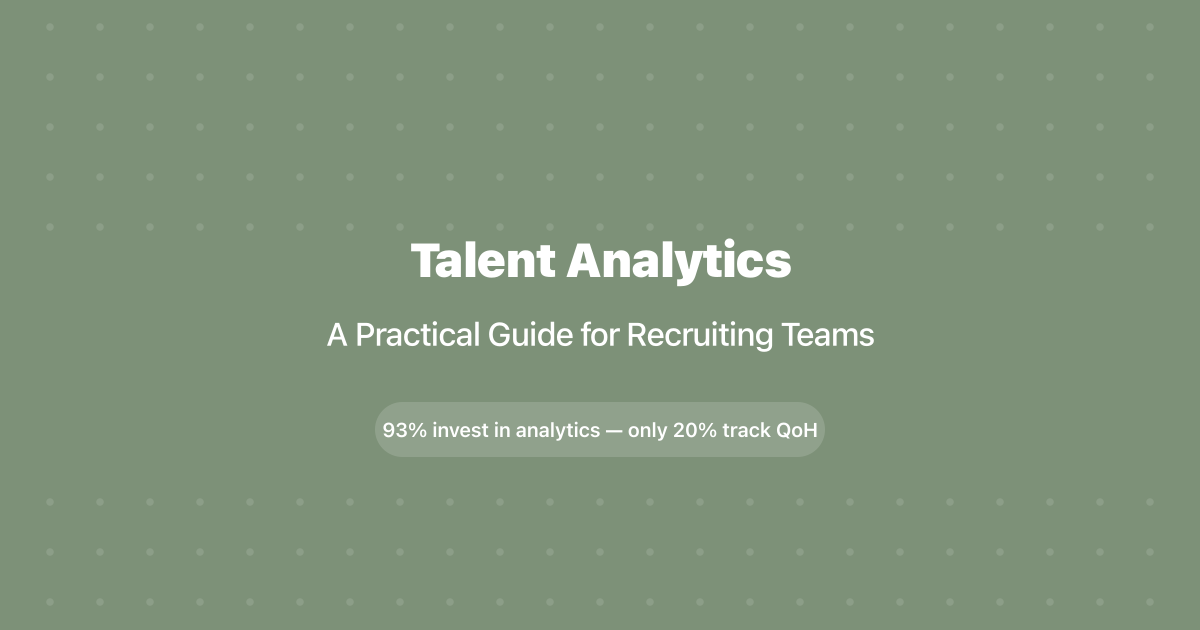
Talent analytics is the practice of collecting and analyzing recruiting data to make better hiring decisions - and it's the single biggest gap between teams that fill roles fast and teams that fill roles well. According to SHRM's 2025 Talent Trends data and industry benchmarks, the vast majority of companies are now investing in people analytics. But here's the disconnect: only 20% of organizations actually track quality of hire in a meaningful way, per SHRM's 2025 Recruiting Benchmarking Report.
That gap between investment and impact is where most recruiting teams get stuck. They buy dashboards, collect data, and generate reports - but the numbers don't change how decisions get made. This guide walks through what talent analytics actually looks like when it works: which metrics matter, how the four stages of analytics maturity build on each other, and where AI is closing the gap between data collection and action.
Whether you're building an analytics practice from scratch or trying to move past basic reporting, this is the practical framework your team needs.
TL;DR: Talent analytics turns recruiting data into hiring decisions. Most companies invest in it, but only 20% track quality of hire (SHRM, 2025). This guide covers the 4-stage maturity model, 8 essential metrics, and how AI is transforming analytics from backward-looking reports into predictive hiring intelligence.
What Is Talent Analytics?
Talent analytics is the systematic use of workforce data to improve recruiting outcomes. It goes beyond counting how many people applied or how long a hire took. Done right, it connects sourcing data, interview feedback, offer acceptance rates, and post-hire performance into a picture that tells you not just what happened - but why, and what to do next.
The terms "talent analytics," "people analytics," and "recruiting analytics" often get used interchangeably. There's a difference. People analytics covers the full employee lifecycle, from hiring through retention and exit. Talent analytics narrows the focus to acquisition - everything from the moment a requisition opens to the point where a new hire hits full productivity. Recruiting analytics is the most granular layer: day-to-day operational metrics like pipeline velocity, source effectiveness, and response rates.
For recruiting teams, talent analytics answers questions like: Which sourcing channels produce candidates who stay longer than 12 months? What's the real cost difference between a 30-day hire and a 60-day hire? Are our interview scorecards predicting on-the-job performance? These aren't theoretical questions. They're the ones that separate teams running on instinct from teams running on evidence.
According to Deloitte's 2023 High-Impact People Analytics research, 84% of organizations now have a clear vision for their analytics function - up 23% from 2020. The vision is there. What's missing for most teams is the execution.
Why Does Talent Analytics Matter for Recruiting Teams?
Recruiting without analytics is like running a sales team without a CRM - you might close deals, but you can't tell which activities drive results and which waste time. The data makes the case clearly.
SHRM's 2025 benchmarking data shows the overall average cost-per-hire is $4,700, with non-executive hires at a $1,200 median and executive hires reaching $10,625 - up 113% from 2017. The median time-to-fill sits at 45 days. And over half of organizations have recruiters managing roughly 20 open requisitions each. These numbers only improve when teams know which levers to pull.

The gap in the chart above tells the real story. Nearly everyone is spending money on analytics. Fewer than half are using AI to act on the data. And only one in five teams tracks the outcome metric that matters most - quality of hire.
LinkedIn's Future of Recruiting 2025 report puts numbers behind the urgency: 89% of TA professionals believe measuring quality of hire will become increasingly important, yet only 25% report high confidence in their ability to measure it. That's a 64-point confidence gap on the metric everyone agrees matters most.
Organizations that do analytics well see real financial returns. Bersin by Deloitte's foundational research (2017) found that high-maturity analytics organizations reported 82% higher three-year average profit compared to low-maturity organizations - a gap that has only widened as AI tools have made advanced analytics more accessible. Analytics isn't a reporting exercise. It's a competitive advantage with measurable financial impact.
What is HR Analytics?
What Are the Four Stages of Talent Analytics?
Not every team needs to jump straight to predictive models. Analytics maturity builds in stages, and each one delivers value on its own. McKinsey's 2025 strategic workforce planning research found that 73% of HR teams are still doing short-term operational planning, with only 9% reaching truly strategic workforce planning. Here's where each stage fits and what it unlocks.
Stage 1: Descriptive Analytics - What Happened?
This is where most teams start. Descriptive analytics answers basic questions: How many candidates applied? What was our time-to-fill last quarter? Which roles took longest to close? You're looking backward at completed events.
The tools are straightforward: ATS reports, spreadsheets, basic dashboards. If your team can pull a report showing last month's pipeline by stage, you're doing descriptive analytics. It's table stakes, not a strategy - but it's the foundation everything else builds on.
What to track at this stage: Time-to-fill, cost-per-hire, application volume by source, offer acceptance rate. Focus on getting clean, consistent data before trying to do anything sophisticated with it.
Stage 2: Diagnostic Analytics - Why Did It Happen?
Diagnostic analytics moves from reporting to investigation. Instead of "we had a 65% offer acceptance rate," it asks "why did 35% of candidates decline?" Was it compensation? Interview experience? Timeline?
This stage requires correlating data across multiple systems. You might compare rejection reasons with time-in-process data and find that candidates who wait more than 10 days between final interview and offer decline at significantly higher rates. That's a finding you can act on.
What to track at this stage: Drop-off rates by funnel stage, interview-to-offer ratios by hiring manager, source-of-hire versus retention at 90 days, and decline reasons categorized by theme. For detailed funnel conversion benchmarks, see our recruitment funnel benchmarks guide.
Stage 3: Predictive Analytics - What Will Happen?
Predictive analytics uses historical patterns to forecast future outcomes. Which candidates are most likely to accept an offer? Which sourcing channels will produce the best hires for this role type? Which open reqs are at risk of going unfilled past 60 days?
This is where AI starts to matter. Machine learning models can analyze thousands of past hires to identify patterns human reviewers miss. According to LinkedIn's 2025 data, 61% of TA professionals believe AI can improve quality of hire measurement - and predictive analytics is the mechanism that makes it possible.
What to track at this stage: Candidate fit scores based on historical success data, pipeline health predictions, attrition risk models for new hires, and time-to-fill forecasts by role type and location.
Stage 4: Prescriptive Analytics - What Should We Do?
Prescriptive analytics is the end goal. It doesn't just predict what will happen - it recommends what to do about it. Think of it as the difference between a weather forecast and a navigation app that reroutes you around a storm.
In recruiting, prescriptive analytics might tell you: "This role has a 75% probability of exceeding 60 days to fill. Based on similar roles, switching from inbound-only to outbound sourcing would reduce expected time-to-fill by 40%." That's not a report. That's a recommendation with a projected outcome.
Few teams operate here today. But the ones that do have a structural advantage. They're making decisions with data that their competitors are making with gut feel.
| Stage | Key Question | Example Output | Tools Needed |
|---|---|---|---|
| Descriptive | What happened? | Time-to-fill was 45 days last quarter | ATS reports, spreadsheets |
| Diagnostic | Why did it happen? | 35% of declines were due to slow offers | ATS + HRIS integration |
| Predictive | What will happen? | This req will likely exceed 60 days | AI/ML models, historical data |
| Prescriptive | What should we do? | Switch to outbound sourcing to cut 40% | AI-powered sourcing + automation |
Which 8 Metrics Should Every Recruiting Team Track?
Not all recruiting metrics deserve space on your dashboard. These eight give you the clearest view of pipeline health, hire quality, and process efficiency. For all 12 operational KPIs with formulas and benchmarks, see our complete recruiter KPIs guide.
1. Time-to-Fill
The number of days from requisition approval to offer acceptance. The SHRM 2025 median is 45 days, but this varies wildly by role. Engineering roles often push past 55 days; sales roles may close in 30. Track by department and role level to get benchmarks that actually mean something for your team.
2. Cost-per-Hire
Total recruiting spend divided by total hires. SHRM's 2025 data puts the median at $1,200 for non-executive roles and $10,625 for executive hires. Include both internal costs (recruiter salaries, tools, overhead) and external costs (agency fees, job board spend, background checks) for an accurate picture.
3. Quality of Hire
The composite score combining performance ratings, retention, hiring manager satisfaction, and cultural fit. Only 20% of organizations track this properly (SHRM, 2025), which means the teams that do have an information advantage over 80% of their competitors. The formula is straightforward: average the individual scores across each indicator. The hard part is getting the data inputs consistently. Define what "good performance" means before the hire starts - not after.
4. Source Effectiveness
Which channels produce hires that perform well and stay? This metric goes beyond volume. A job board that sends 500 applications but only 2 quality hires is less effective than an outbound sourcing campaign that surfaces 20 candidates and produces 5 placements. Track quality-per-source, not just volume-per-source. According to LinkedIn's 2025 research, companies conducting the most skills-based searches are 12% more likely to make quality hires - a signal that how you source matters more than where.
5. Offer Acceptance Rate
The percentage of offers extended that get accepted. A healthy benchmark is 85-90%. Rates below 80% signal problems with compensation, interview experience, or timeline. Rates above 90% might mean you're not being selective enough - or that your offers are strong.
6. Candidate Experience Score
Survey-based feedback from candidates about your hiring process. Track at the application, interview, and post-offer stages. This metric predicts both offer acceptance and employer brand strength. A poor hiring experience pushes candidates toward declining offers and sharing negative reviews on sites like Glassdoor - making it one of the most underrated metrics in recruiting.
7. Pipeline Velocity
How fast candidates move through each stage of your funnel. Measure the average days between stages: application to screen, screen to interview, interview to offer, offer to acceptance. Bottlenecks show up as stage-specific slowdowns that drag overall time-to-fill.
8. Diversity Metrics
Representation at every funnel stage - not just final hires. Tracking diversity only at the offer stage misses where bias enters the process. If your sourcing produces 40% diverse candidates but only 15% reach the interview stage, the problem is in screening, not sourcing. Stage-by-stage diversity data is the only way to diagnose where representation drops and why. It's also increasingly what compliance teams and boards want to see reported.
How Is AI Changing Talent Analytics?
AI adoption in recruiting is accelerating faster than most teams realize. According to SHRM's 2025 Talent Trends report, 43% of HR teams now use AI in their workflows - up from just 26% in 2024. That's a 65% increase in a single year. And the trajectory is steepening: Korn Ferry's Talent Trends 2026 survey of 1,674 global talent leaders found that 84% plan to use AI in their recruiting process this year.

What does AI-powered talent analytics actually look like in practice? It shifts the analytics model from backward-looking to real-time. Traditional analytics tells you that your time-to-fill was 52 days last quarter. AI-powered analytics tells you that this specific open req is trending toward 60+ days and recommends expanding the sourcing strategy now - before the delay happens.
The most immediate impact is on sourcing analytics. Manual sourcing gives you data on the candidates you found. AI sourcing gives you data on the entire available talent market. Pin scans 850M+ candidate profiles with 100% coverage in North America and Europe, which means the analytics layer isn't just measuring your pipeline - it's measuring your pipeline against the full universe of potential candidates. That changes how you think about metrics like source effectiveness and candidate quality.
Pin's automated outreach also generates its own analytics loop. With a 48% response rate on multi-channel outreach (email, LinkedIn, SMS), teams get real-time data on which messaging strategies work for which roles and industries - see how Pin's AI analytics work.
As Rich Rosen, Executive Recruiter at Cornerstone Search, puts it: "Absolutely money maker for recruiters... in 6 months I can directly attribute over $250K in revenue to Pin." That kind of attribution - tying a specific tool to specific revenue - is talent analytics in action.
Korn Ferry's research also found that 52% of talent leaders plan to add autonomous AI agents to their teams in 2026. These aren't chatbots answering FAQ questions. They're AI systems that source candidates, send personalized outreach, schedule interviews, and feed performance data back into the analytics model automatically. The analytics becomes a closed loop: search, engage, hire, measure, improve, repeat.
13 HR Metrics You Need to Know
How Do You Build a Talent Analytics Program?
You don't need a data science team or a six-figure analytics platform to start. The best analytics programs are built incrementally, with each phase delivering value before you invest in the next. Here's the roadmap.
Phase 1: Foundation (Weeks 1-4)
Start with what you already have. Every ATS contains data that most teams never look at. The goal in this phase isn't new tools - it's data hygiene and baseline measurement.
Action steps:
- Audit your ATS data: Are stages consistently named? Are close reasons standardized? Inconsistent data entry makes analysis meaningless.
- Establish baselines for 4 core metrics: time-to-fill, cost-per-hire, source of hire, offer acceptance rate. You can't measure improvement without a starting point.
- Set up a weekly review cadence. Even a 15-minute check-in where the team looks at pipeline numbers together creates accountability.
- Standardize how your team logs candidate disposition, interview scores, and decline reasons. Garbage in, garbage out applies more to recruiting data than almost anywhere else.
Expected outcome: Clean baselines for your top 4 metrics within 30 days. That alone puts you ahead of most teams.
Phase 2: Integration (Months 2-3)
Phase 2 connects your recruiting data to business outcomes. This is where diagnostic analytics starts.
Action steps:
- Link your ATS data to HRIS data so you can track 90-day retention and performance ratings for new hires. This is how you build a quality of hire metric.
- Add source tracking with enough granularity to distinguish between sourcing channels. "LinkedIn" isn't specific enough - break it into LinkedIn Recruiter, LinkedIn organic, LinkedIn ads, and LinkedIn outbound.
- Start correlating: Do candidates from certain sources perform better? Do candidates who move through the process faster also have better retention?
- Build your first dashboard with the 8 metrics from the section above. One page, updated weekly, visible to the full recruiting team.
Expected outcome: A connected dashboard with diagnostic capabilities - you can now answer "why" questions, not just "what" questions.
Phase 3: Prediction and Action (Months 4-6)
Phase 3 is where AI enters the picture. You've cleaned your data, established baselines, and connected systems. Now you can use that data to predict outcomes and automate decisions.
Action steps:
- Introduce AI-powered sourcing to generate predictive candidate matching. Tools that scan large databases and score candidates against historical success patterns give you a head start on quality of hire before a single interview.
- Set up automated alerts for pipeline health: flag reqs trending past their expected time-to-fill, highlight stages with unusual drop-off rates, and surface outreach sequences that are underperforming.
- Run quarterly analytics reviews with hiring managers. Share the data that connects their input (interview feedback quality, response time) to the outcomes they care about (time-to-fill, quality of hire).
Expected outcome: Predictive insights that inform decisions before problems develop. Teams at this stage report filling positions significantly faster because they catch and correct issues in real time.
Pin users, for example, fill positions in approximately 2 weeks - compared to the 45-day industry median. That speed comes from the analytics loop running continuously: AI sources, outreach data feeds back into targeting, and scheduling happens automatically. The analytics aren't separate from the work - they're built into it. Start building your analytics-driven pipeline with Pin.
What About Data Governance and Privacy?
Analytics programs only work when candidates and employees trust that their data is handled responsibly. That trust starts with governance.
Recruiting teams collect sensitive information at scale: contact details, employment history, compensation data, interview recordings, assessment scores. Every data point carries a compliance obligation, and the regulatory environment is getting stricter. GDPR in Europe, CCPA in California, and emerging state-level privacy laws in the U.S. all impose requirements on how candidate data is collected, stored, and used.
Four governance principles for recruiting analytics:
- Minimize collection. Only collect data you'll actually analyze. If you're not using a data point in any metric or model, don't collect it. Smaller datasets are easier to secure and govern.
- Anonymize for analysis. When running aggregate analytics (funnel conversion rates, source effectiveness, diversity metrics), strip personally identifiable information. You don't need names and emails to know that Channel A produces better retention than Channel B.
- Set retention policies. Candidate data shouldn't live in your systems indefinitely. Define retention windows (12-24 months is typical) and automate deletion for data past its expiration.
- Audit AI inputs. If you're using AI for candidate scoring or matching, know exactly what data feeds the model. Names, gender markers, age indicators, and other protected characteristics should never be input variables. Pin's AI, for example, has checkpoints at every step - no names, gender, or protected characteristics are ever fed to the AI, with regular team reviews and third-party fairness audits.
Deloitte's 2023 research found that high-performing analytics organizations are 4.3x more likely to involve HR in enterprise data governance. Don't treat governance as legal's problem. The recruiting team has to own how candidate data flows through the analytics stack.
Key Takeaways
- Talent analytics turns recruiting data into decisions - not reports. The goal isn't more dashboards. It's better hiring outcomes driven by evidence.
- The maturity gap is real. 93% of companies invest in analytics, but only 20% track quality of hire. Most teams are stuck at Stage 1 (descriptive) when the value compounds at Stages 3-4 (predictive and prescriptive).
- Start with 8 metrics. Time-to-fill, cost-per-hire, quality of hire, source effectiveness, offer acceptance rate, candidate experience score, pipeline velocity, and diversity metrics. For operational KPIs, see our full recruiter KPIs guide.
- Build in phases. Foundation (data hygiene) in month 1, integration (connected dashboards) in months 2-3, and prediction (AI-powered insights) in months 4-6.
- AI is accelerating the timeline. AI adoption in HR jumped from 26% to 43% in one year (SHRM, 2025), and 84% of talent leaders plan to use AI in 2026 (Korn Ferry). Teams that wait will fall behind teams that start now.
- Governance isn't optional. Minimize data collection, anonymize for analysis, set retention policies, and audit every AI input. Trust is the foundation of any analytics program.
Frequently Asked Questions
What is talent analytics in recruiting?
Talent analytics is the practice of collecting and analyzing recruiting data - time-to-fill, cost-per-hire, quality of hire, source effectiveness - to make better hiring decisions. According to SHRM's 2025 benchmarking data, only 20% of organizations track quality of hire, making analytics a major competitive advantage for teams that do it well.
Which recruiting metrics should I track first?
Start with four foundational metrics: time-to-fill (45-day median per SHRM 2025), cost-per-hire ($4,700 average), offer acceptance rate, and source of hire. Once you have clean baselines, add quality of hire, pipeline velocity, candidate experience scores, and diversity metrics. Our time-to-hire metrics guide covers benchmarks by role type.
How does AI improve talent analytics?
AI shifts analytics from backward-looking reports to real-time prediction. Instead of learning that last quarter's time-to-fill was 52 days, AI flags that a current req is trending toward 60+ days and recommends expanding sourcing now. SHRM reports AI adoption in HR jumped from 26% to 43% in one year, with 84% of leaders planning to use it in 2026 (Korn Ferry).
How long does it take to build a talent analytics program?
A phased approach takes roughly six months. Phase 1 (data hygiene and baseline metrics) takes 4 weeks. Phase 2 (connected dashboards and diagnostic analytics) takes 2 months. Phase 3 (predictive AI-powered insights) takes another 2 months. Teams with clean ATS data can compress the timeline significantly.
What's the ROI of talent analytics?
Bersin by Deloitte's foundational research found that high-maturity analytics organizations report 82% higher three-year average profit than low-maturity organizations. The ROI compounds over time as better data leads to better hires, lower turnover, and more efficient recruiting spend.
Track your recruiting metrics with Pin's AI analytics - try it free