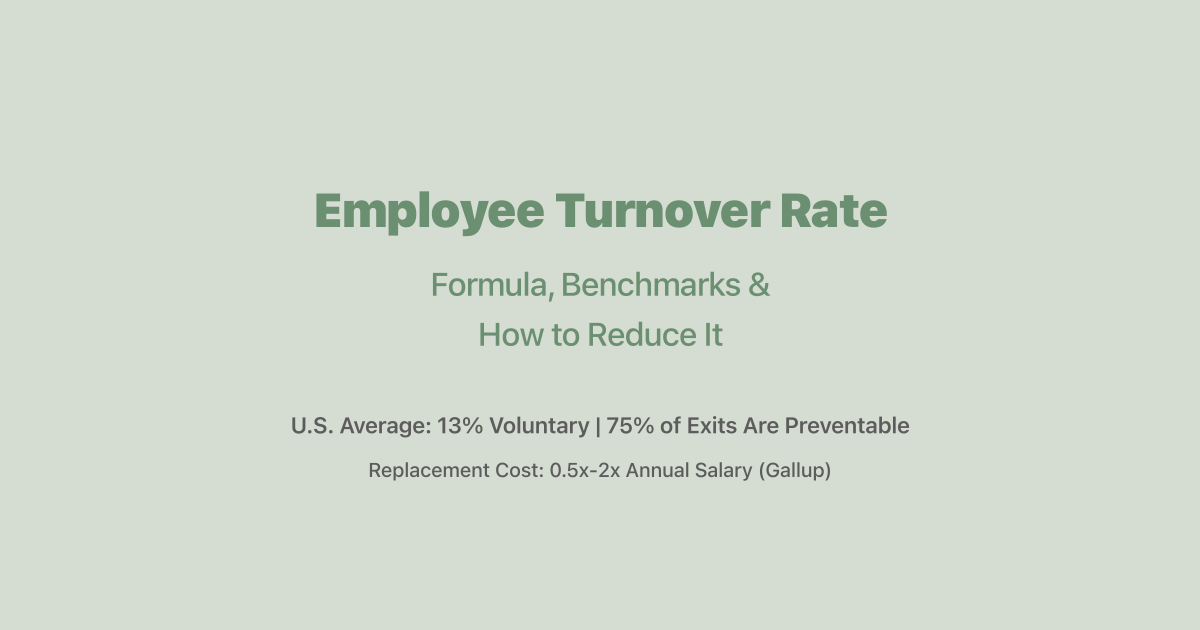
Employee turnover rate is the percentage of workers who leave your organization over a given period, calculated as (separations / average headcount) x 100. The U.S. average voluntary turnover rate sits at 13% as of 2025, according to Mercer's 2025 US Turnover Survey of 2,617 organizations - down sharply from 24.7% in 2022, but still expensive. Gallup estimates voluntary departures cost U.S. businesses roughly $1 trillion per year, with replacement running 0.5x to 2x a departing employee's annual salary.
What makes that number even more frustrating? According to the Work Institute's 2025 Retention Report, 75% of voluntary departures are preventable. That means three out of every four resignations didn't have to happen. This guide gives you the exact formula, current benchmarks by industry and role level, the real reasons people quit, and eight strategies that actually move the needle.
TL;DR: Employee turnover rate = (separations / average headcount) x 100. The U.S. voluntary average is 13% (Mercer 2025), ranging from 5.2% for executives to 26.7% in retail. Replacement costs run 0.5x-2x salary (Gallup). 75% of voluntary exits are preventable (Work Institute 2025). Focus on manager quality, onboarding, and competitive pay to cut turnover fastest.
What Is Employee Turnover Rate?
Employee turnover rate measures how many workers leave your organization during a specific period relative to your average headcount. According to SHRM, it's the single most-tracked workforce metric after headcount itself - and for good reason. Every departure triggers recruiting costs, onboarding time, and productivity losses that compound quickly.
But not all turnover is the same. You need to track these categories separately because they require completely different responses:
- Voluntary turnover - employees resign on their own terms (new job, retirement, relocation, dissatisfaction). This is the number you can actually influence. It accounts for roughly two-thirds of all separations in most organizations.
- Involuntary turnover - employer-initiated separations including terminations for cause, layoffs, and restructuring. BLS JOLTS data for 2024 shows a monthly layoff/discharge rate of 1.1%, or roughly 1.7 million workers per month.
- Regrettable turnover - high performers and hard-to-replace specialists who leave voluntarily. This is the most expensive category and the one most worth preventing.
- Early turnover - departures within the first 90 days, which InsightGlobal research cited by AIHR pegs at 22% of all new hires. Early exits almost always signal hiring or onboarding failures.
How does turnover differ from attrition? In practice, most HR teams use the terms interchangeably. The technical distinction is that attrition refers to departures where the role isn't backfilled, while turnover assumes replacement hiring. For benchmarking purposes, the formulas and industry data are the same.
How Do You Calculate Employee Turnover Rate?
The standard formula used by SHRM, Mercer, and virtually every HRIS platform is simple, according to SHRM's benchmarking methodology:
Turnover Rate (%) = (Number of Separations During Period / Average Number of Employees During Period) x 100
Where average headcount = (headcount at period start + headcount at period end) / 2.
Worked Example: Monthly Calculation
Your company started April with 400 employees and ended with 388. During the month, 18 people left - 12 resigned voluntarily and 6 were terminated.
- Average headcount: (400 + 388) / 2 = 394
- Total separation rate: (18 / 394) x 100 = 4.57%
- Voluntary departure rate: (12 / 394) x 100 = 3.05%
How to Annualize Correctly
Don't multiply a monthly rate by 12. That ignores compounding and seasonal hiring spikes. Instead, apply the formula across the full 12-month window using total annual separations divided by average headcount for the year. If you must project from a single month (for board presentations, for example), use this adjustment:
Annualized Rate = 1 - (1 - monthly rate)^12
For the 4.57% monthly rate above, that gives: 1 - (1 - 0.0457)^12 = 43.2% annualized - significantly different from the naive 4.57% x 12 = 54.8% you'd get from simple multiplication.
What Counts as a Separation?
Include all permanent employee departures: resignations, terminations, retirements, and deaths. Exclude contractors, temps, internal transfers (they stayed in the organization), and employees on leave. For voluntary-only calculations, exclude layoffs and terminations from the numerator but keep the same denominator.
Employee Turnover Benchmarks by Industry (2025-2026)
The national average hides massive variation. Hospitality and retail see annualized turnover rates 5-6x higher than stable sectors like insurance and government. According to Mercer's 2025 survey and BLS JOLTS data, here's where each industry stands:

| Industry | Annual Turnover Rate | Type | Source |
|---|---|---|---|
| Hospitality / Accommodation | ~74% | Total (annualized) | BLS JOLTS 2024 |
| Manufacturing | 28% | Total | BLS / Manufacturing Institute 2025 |
| Retail & Wholesale | 26.7% | Voluntary | Mercer 2025 |
| Finance / Banking | 19.8% | Total | Crowe Survey 2023 (most recent available) |
| Healthcare (Registered Nurses) | 16.4% | Total | NSI 2025 (450 hospitals) |
| U.S. All-Industries Average | 13% | Voluntary | Mercer 2025 |
| Technology / Engineering | 12% | Voluntary | Ravio 2025 |
| Insurance / Reinsurance | 8.2% | Voluntary | Mercer 2025 |
Notice the range: hospitality runs nearly 9x the rate of insurance. If you're comparing your company's number to a national average, make sure you're benchmarking against your own sector.
Turnover by Job Level
Seniority dramatically affects turnover rates. Mercer's 2025 data breaks it down by level:
- Executives: 5.2% voluntary turnover
- Management: 6.3%
- Sales professionals: 7.3%
- Non-sales professionals: 9.1%
- Blue-collar / para-professional: 12.5%
The pattern is intuitive - more senior roles have higher comp, more autonomy, and more switching costs. But when a senior leader does leave, the replacement cost is disproportionately higher (more on that below).
How Much Does Employee Turnover Actually Cost?
Replacing an employee costs between 50% and 200% of their annual salary, according to both SHRM and Gallup. That range is wide because the cost varies dramatically by role level. Here's the breakdown:

To put those percentages in dollar terms: replacing a mid-level employee earning $80,000 costs roughly $48,000 when you factor in recruiting fees, interview time, onboarding, and the 6-12 months it takes a new hire to reach full productivity. For a manager earning $150,000, that number jumps to $300,000.
And those are per-person costs. Scale them across your organization and the numbers get staggering. SHRM's 2025 benchmarking data shows the average cost-per-hire alone is $5,475 for non-executive roles and $35,879 for executives - and that's just the direct recruiting spend, before you count lost productivity, knowledge drain, and team disruption.
The Hidden Costs Most Companies Miss
Direct replacement costs (job ads, recruiter time, agency fees) are easy to track. The bigger damage comes from costs that don't show up in your recruiting budget:
- Lost productivity - it typically takes a new hire 6-12 months to reach the productivity level of the person they replaced. That gap costs real output.
- Knowledge drain - departing employees take relationships, institutional knowledge, and undocumented processes with them.
- Team disruption - remaining team members absorb extra workload during the vacancy, leading to burnout and potential secondary departures.
- Client impact - in client-facing roles, turnover can damage relationships and revenue. In healthcare, nurse turnover directly affects patient outcomes.
Speaking of healthcare: the NSI's 2025 report across 450 hospitals found the average cost of a single departing registered nurse is $61,110. Each 1% change in RN turnover saves or costs the average hospital $289,000 annually.
How to Estimate Your Organization's Turnover Cost
Here's a quick framework you can apply to your own workforce. You don't need a complex model - a rough estimate is enough to justify retention investments to finance and leadership.
Step 1: Calculate your annual voluntary separations. If you have 500 employees and a 13% voluntary departure rate, that's 65 exits per year.
Step 2: Estimate the average replacement cost per employee. Use Gallup's multipliers: 40% of salary for frontline, 80% for mid-level, 200% for leaders. If your average salary is $75,000 and most departures are mid-level, estimate $60,000 per replacement.
Step 3: Multiply. 65 departures x $60,000 = $3.9 million per year in total turnover cost for a 500-person company. That's a concrete number you can take to your CFO.
Now run the same math at a 10% rate instead of 13%. You'd have 50 departures, costing $3 million - a savings of $900,000 per year. That's the financial case for every retention initiative in this article. Even a 3-percentage-point improvement pays for itself many times over.
Why Do Employees Leave? The Real Reasons Behind Turnover
Here's the stat that should keep every HR leader up at night: 42% of employees who voluntarily left their last job told Gallup researchers that their manager or organization could have done something to prevent it. Even more telling - 45% said no leader proactively discussed their job satisfaction in their final three months.
The problem isn't that people leave. It's that most organizations don't even try to keep them.

Gallup's data reveals that compensation and advancement opportunities drive 30% of preventable exits (Gallup 2024) - the single largest category. But management quality is close behind at 29% when you combine the "need more positive manager interaction" (21%) and "negative manager behavior" (8%) categories. That aligns with the old saying that people don't quit companies, they quit managers.
There's another pattern worth noting. Gallup found that 77% of voluntary leavers either departed within three months of starting their job search, or didn't actively search at all - they left spontaneously. That means by the time most companies notice something is wrong, the employee is already mentally gone. Retention isn't a reaction game. It's a proactive one.
The Flight-Risk Warning Signs
How do you spot turnover before it happens? Gallup's Q4 2025 data found that 51% of U.S. employees are actively looking for or watching for new job opportunities (Gallup Q4 2025) - the highest figure since they started tracking in 2015. Among Gen Z workers, that number climbs to 61%.
Common warning signs that correlate with flight risk include:
- Declining participation in meetings and team activities
- Reduced output quality or missed deadlines
- Withdrawal from optional projects or committees
- Increased PTO usage, especially in short bursts (interview time)
- Updated LinkedIn profile (the classic tell)
None of these individually confirm an exit. But a cluster of three or more, combined with the 51% baseline looking rate, strongly suggests a proactive stay conversation is worth the 30-minute investment. The cost of that conversation is essentially zero. The cost of ignoring the signs and losing a high performer can easily run into six figures.
8 Data-Backed Strategies to Reduce Employee Turnover
The Work Institute's 2025 report analyzed over 120,000 exit interviews and concluded that 75% of voluntary departures are preventable. Management-related turnover hit a six-year high in their data. Here are eight strategies backed by research - not theory.
1. Fix Your Managers First
Gallup's 2025 State of the Global Workplace report found that 70% of team engagement is attributable to the manager (Gallup 2025). Yet manager engagement itself fell from 30% to 27% globally in 2024, and only 44% of managers received formal training. You can't fix employee turnover without fixing the manager layer first.
What works: structured manager training on feedback, one-on-one frequency, and career development conversations. Companies that invest in manager capability see measurable engagement lifts within two quarters.
2. Get Onboarding Right
With 22% of new hires leaving within 90 days and 80% making their stay-or-go decision within six months (AIHR), onboarding is your highest-return retention investment. The same research shows that 60% of early departures cite inadequate or disorganized training as their primary reason for leaving.
Four in five workers say they'd stay longer in a role with a better onboarding process. And when managers actively participate in onboarding, new hires are 3.4x more likely to rate the experience as exceptional. Structure the first 90 days with clear milestones, assign a peer buddy, and make sure the hiring manager is present - not just HR.
3. Pay Competitively (and Transparently)
Compensation drove 30% of preventable exits in Gallup's data, and Payscale's 2026 Compensation Best Practices Report (3,413 respondents) found that 73% of employees would consider leaving their current job for a higher paycheck (Payscale 2026). You don't always need to be the highest payer - but you need to be close, and you need to be transparent about it.
Payscale's data also shows that organizations confident in their market pricing strategy see dramatically higher employee advocacy. Only 4% of employees are detractors at companies with strong pay transparency, versus a majority at companies where compensation feels opaque or arbitrary.
4. Offer Flexible and Hybrid Work
A randomized controlled trial by Stanford researchers, published in Nature in 2024, found that hybrid work (two days per week from home) cut voluntary attrition by 33% with zero negative impact on performance or promotion rates. The study followed 1,612 employees at a large multinational - this isn't survey data or self-reporting. It's experimental evidence.
If your industry and roles allow it, hybrid flexibility is one of the most cost-effective retention tools available. And it doesn't require a salary increase.
4 More Strategies to Build Retention Systems
5. Create Clear Career Paths
Deloitte's 2025 Global Human Capital Trends survey of nearly 10,000 leaders across 93 countries found that organizations helping employees grow are 1.8x more likely to report better financial results. Career development isn't just a retention play - it's a business performance strategy.
Practical steps: map progression paths for every role, conduct quarterly career conversations (separate from performance reviews), and fund skill development with a per-employee learning budget. Internal mobility programs give employees a reason to stay when they get restless - the alternative is them finding growth somewhere else.
6. Run Stay Interviews (Not Just Exit Interviews)
Exit interviews happen too late. By the time someone is walking out the door, you're collecting postmortem data, not saving the relationship. Stay interviews flip the script: a quarterly or semi-annual conversation with current employees about what keeps them here and what might push them to leave.
Remember Gallup's finding that 45% of leavers said no leader discussed their satisfaction in the final three months? Stay interviews directly solve that gap. They're free, take 20-30 minutes, and the data is immediately actionable.
7. Monitor and Act on Engagement Data
Annual engagement surveys are too slow. By the time you collect, analyze, and act on the results, the flight risks have already left. Pulse surveys (monthly or quarterly) give you a real-time read on team sentiment.
According to the SHRM 2025 State of the Workplace report (surveying 1,615 HR professionals and 471 workers), employee experience and engagement account for 42% of turnover intent (SHRM 2025). Workers with highly effective managers were nearly 2x as likely to report job satisfaction. Track these metrics the way you'd track recruiter KPIs - with dashboards and clear accountability.
8. Reduce Time-to-Fill When Turnover Happens
Even with the best retention strategies, some turnover is unavoidable. When it happens, the speed of your backfill directly impacts the cascading costs. Every open day means extra workload on the remaining team, which drives more burnout, which drives more exits. It's a vicious cycle.
AI recruiting tools can compress the sourcing-to-hire timeline from weeks to days. Pin's AI scans 850M+ candidate profiles to find replacements fast, with automated outreach that hits a 48% response rate - try Pin's AI sourcing. The faster you fill vacancies created by turnover, the less damage each departure does to team morale and workload.
As executive recruiter Rich Rosen of Cornerstone Search puts it: "Absolutely money maker for Recruiters... in 6 months I can directly attribute over $250K in revenue to Pin." When turnover creates urgent openings, having a sourcing tool that delivers qualified candidates quickly isn't just convenient - it directly limits the financial bleed.
How Is U.S. Turnover Trending? The 2022-2026 Picture
The Post-Resignation Cooldown
After the Great Resignation spiked voluntary turnover to 24.7% in 2022, the market has cooled significantly. Mercer's data shows a steady decline:
- 2022: 24.7% voluntary turnover (Great Resignation peak)
- 2023: 17.3% (sharp correction)
- 2024: 13.5% (continued cooling)
- 2025: 13.0% (stabilizing near pre-pandemic norms)
The BLS JOLTS data confirms this trend at the macro level. The 2024 annual average quits rate was 2.1% monthly (down from 2.5% in 2023), while total separations averaged 3.3% monthly. By February 2026, quits had dropped further to 1.9% monthly.
But don't confuse lower quit rates with employee satisfaction. Gallup's Q4 2025 data showing 51% of employees looking or watching for new roles suggests many workers are staying put not because they're engaged, but because the job market feels uncertain. That's pent-up turnover waiting to be released. When hiring picks back up, organizations with weak retention cultures could see another wave.
And 40.3% of U.S. organizations still report difficulty hiring or retaining for certain roles, per Mercer - particularly in healthcare services, logistics, and transportation. The talent squeeze hasn't disappeared. It's just shifted to specific sectors and skill sets.
What does that mean for workforce planning? If you're seeing low quit rates right now, don't celebrate prematurely. Test the waters with engagement pulse surveys. If your engagement scores are declining while departures stay flat, that's a warning sign - your people are staying out of fear, not loyalty. Deloitte's 2025 Human Capital Trends report found that 41% of employee time daily is spent on work that creates no organizational value. That's not just a productivity problem. It's a disengagement signal that often precedes a wave of resignations once external conditions improve.
Smart HR teams are using this low-turnover window to strengthen retention infrastructure - manager training, career pathing, compensation reviews - so they're ready when the market inevitably swings back toward candidates.
Voluntary vs. Involuntary Turnover: Why the Distinction Matters
Tracking total departures as a single number hides the story. A 15% separation rate means something very different depending on the split. If 12% is voluntary and 3% is involuntary, you have a retention problem. If 5% is voluntary and 10% is involuntary (layoffs), you have a workforce planning or business model problem. The interventions are completely different.
For context, BLS JOLTS 2024 data shows the national breakdown: quits account for roughly 64% of total separations (2.1% of 3.3% monthly), layoffs and discharges account for 33% (1.1%), and other separations (retirements, deaths, transfers) make up the remaining 3%.
Best practice is to track four separate rates on your workforce quality dashboard:
- Total separations - all departures, your headline number for board reporting
- Voluntary departures - resignations only, your primary retention health metric
- Regrettable exits - voluntary departures of high performers and critical-role employees, the number that actually hurts
- Early departures - exits within the first 90 days, your hiring and onboarding quality signal
Segment each by department, manager, job level, and tenure band. The aggregate number is useful for benchmarking; the segmented view is where you find actionable problems.
Why Manager-Level Segmentation Matters Most
When you slice voluntary departures by manager, patterns emerge fast. In most organizations, a small number of managers account for a disproportionate share of resignations. That's not a coincidence. Gallup's finding that 70% of engagement variance is manager-driven means your worst managers are essentially pushing people out the door.
If three managers out of twenty are responsible for 60% of your voluntary exits, you don't have a company-wide retention problem. You have a three-person management problem. That's a much more solvable challenge - and it's invisible if you only track turnover at the aggregate level.
Build a quarterly dashboard that shows voluntary exits per manager (indexed to team size), internal transfer requests by team, and engagement survey scores by reporting line. The overlap between low engagement, high transfer requests, and high departures will point you directly to where intervention is needed.
What Role Does AI Play in Reducing Turnover?
AI is reshaping how organizations approach turnover from two angles: predicting which employees are likely to leave, and accelerating the replacement process when departures happen.
On the prediction side, people analytics platforms now ingest data from HRIS systems, engagement surveys, performance reviews, and compensation benchmarks to flag flight-risk employees before they start job searching. Gallup's 2025 research shows that low engagement costs the global economy $8.9 trillion annually - roughly 9% of global GDP. Even modest improvements in identifying and retaining disengaged employees at scale can deliver meaningful returns.
On the replacement side, AI sourcing tools directly address one of the most damaging aspects of turnover: the vacancy period. Traditional recruiting timelines of 30-45 days mean remaining team members absorb extra work for over a month after every departure. That workload spike drives the secondary attrition that turns one resignation into a cascade.
Pin's AI recruiting platform cuts that timeline by automating the entire top-of-funnel process. With 850M+ candidate profiles, automated multi-channel outreach that delivers a 48% response rate, and built-in interview scheduling, Pin helps recruiters fill vacancies in approximately two weeks rather than six. That speed difference directly limits the cascading team damage that makes turnover so expensive.
Frequently Asked Questions
What is a good employee turnover rate?
It depends on your industry. The U.S. all-industries average is 13% for voluntary departures (Mercer 2025). Anything below your industry benchmark is generally considered good. Tech companies averaging 12% are close to the national norm, while hospitality businesses running under 50% are outperforming their peers. Focus on reducing regrettable exits - departures of high performers - rather than hitting an arbitrary number.
How do you calculate employee turnover rate?
Use the formula: (Number of Separations / Average Headcount) x 100. Average headcount = (starting employees + ending employees) / 2. Apply this over a month, quarter, or year. For voluntary separations specifically, only count resignations in the numerator. SHRM, Mercer, and most HRIS platforms use this same formula for benchmarking.
What is the difference between turnover and attrition?
The technical difference is that turnover implies the position gets backfilled with a new hire, while attrition means the role is left open or eliminated. In practice, most HR teams and researchers use the terms interchangeably. The formulas and benchmarks are identical. What matters more is tracking voluntary vs. involuntary separately.
Why is employee turnover so expensive?
Replacement costs run 0.5x to 2x annual salary (Gallup), covering recruiting, onboarding, and the 6-12 months before a new hire reaches full productivity. For a $150,000 manager, that's up to $300,000. Hidden costs include knowledge drain, remaining team burnout, and client relationship disruption. Collectively, voluntary turnover costs U.S. businesses $1 trillion per year.
What causes high employee turnover?
Gallup's research shows 30% of preventable exits are driven by inadequate compensation or advancement opportunities, 21% by insufficient manager interaction, and 13% by frustrating workplace problems. The Work Institute's 2025 Retention Report found management-related departures at a six-year high. Importantly, 75% of voluntary exits are preventable - most employees would have stayed if someone had intervened.
Key Takeaways
- The formula is simple: (separations / average headcount) x 100. Track voluntary, involuntary, regrettable, and early turnover separately.
- U.S. voluntary turnover averages 13% (Mercer 2025) but ranges from 5.2% for executives to 74% in hospitality. Benchmark against your own industry.
- Replacement costs run 40%-200% of salary depending on role level. A single departing nurse costs $61,110 on average.
- 75% of voluntary exits are preventable (Work Institute 2025). The top drivers: compensation, manager quality, and career growth.
- Manager quality accounts for 70% of team engagement (Gallup). Fix managers first.
- Hybrid work cut attrition by 33% in a controlled experiment (Stanford/Nature 2024).
- When turnover happens despite prevention efforts, speed of replacement matters. AI recruiting tools compress hiring timelines and limit the cascading damage.
Reduce turnover's impact with faster hiring - try Pin free →