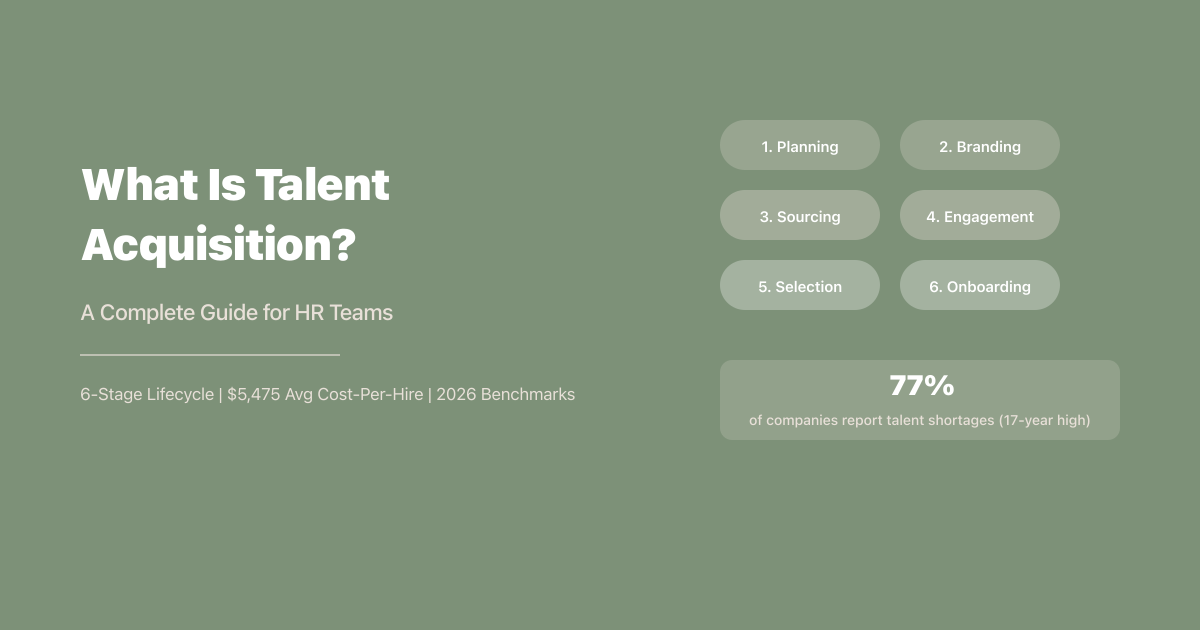
Talent acquisition is the strategic, ongoing process of identifying, attracting, and hiring skilled workers to meet an organization's long-term goals. Unlike reactive recruiting - where you scramble to fill a vacancy after someone leaves - talent acquisition is proactive. It combines workforce planning, employer branding, sourcing, candidate engagement, selection, and onboarding into a continuous cycle that keeps your pipeline full before roles even open.
That distinction matters more than ever. 77% of companies worldwide report talent shortages, a 17-year high according to ManpowerGroup data cited by AIHR. Meanwhile, the average cost of a single hire has climbed to $5,475 for nonexecutive roles and $35,879 for executive positions, per SHRM's 2025 Recruiting Benchmarking Report. Those numbers make a reactive, seat-of-the-pants approach expensive and unsustainable.
This guide covers every stage of the TA lifecycle, explains how it differs from traditional recruiting, breaks down the metrics that matter, and shows where AI fits into the picture. Whether you're building a TA function from scratch or trying to modernize an existing one, this is the framework.
TL;DR: Talent acquisition is the strategic, proactive approach to hiring that goes beyond filling open roles. It spans workforce planning, employer branding, sourcing, engagement, selection, and onboarding. With cost-per-hire averaging $5,475 (SHRM, 2025) and 77% of companies reporting talent shortages, a structured TA function isn't optional - it's a business requirement.
How Is Talent Acquisition Different From Recruiting?
69% of organizations still struggle to fill roles, with too few applicants, competition, and candidate ghosting as the top causes, according to SHRM's 2025 Talent Trends Report. Much of that struggle traces back to a fundamental confusion: treating TA and recruiting as the same thing.
They aren't. Here's the clearest way to think about it:
Recruiting is transactional. A role opens, you source candidates, screen them, and fill the seat. The clock starts when the req is approved and stops when someone signs an offer. It's reactive by nature - a response to an immediate need.
TA is strategic. It runs continuously, whether you have open roles or not. The function encompasses workforce planning (forecasting which roles you'll need in 6-18 months), employer brand management, talent pipeline development, and relationship nurturing with passive candidates. The clock never stops.
Think of it this way: recruiting is buying groceries when the fridge is empty. TA is meal planning, stocking the pantry, and maintaining a relationship with your local farmers' market so you always have fresh ingredients on hand.
| Dimension | Recruiting | Talent Acquisition |
|---|---|---|
| Time horizon | Short-term (days to weeks) | Long-term (months to years) |
| Trigger | An open role | Business strategy and workforce plans |
| Approach | Reactive - fill the vacancy | Proactive - build pipelines before roles open |
| Scope | Sourcing, screening, hiring | Planning, branding, sourcing, engagement, selection, onboarding |
| Success metric | Time-to-fill, offer acceptance rate | Quality of hire, pipeline health, retention |
| Candidate pool | Active job seekers | Active + passive (70% of global workforce) |
That last row is critical. Roughly 70% of the global workforce qualifies as passive talent - professionals not actively job hunting but open to the right opportunity, according to LinkedIn's research across 18,000 professionals in 26 countries. A pure recruiting function misses most of that pool. A TA function builds relationships with them long before a role opens.
What Are the 6 Stages of the Talent Acquisition Lifecycle?
Only 20% of organizations currently track quality of hire, per SHRM's 2025 Benchmarking Report. That's partly because many HR teams haven't mapped their hiring process into measurable stages. Here's the framework that high-performing TA functions use, drawn from AIHR's talent acquisition research.
1. Workforce Planning
Everything starts here. Workforce planning means analyzing your current headcount, forecasting future talent needs based on business goals, and identifying skill gaps before they become hiring emergencies. It answers the question: "What roles will we need, when, and where?"
Done well, workforce planning shifts your entire hiring operation from reactive to proactive. It connects HR strategy directly to business outcomes - revenue targets, product launches, geographic expansion. Seven in ten business leaders now prioritize being "fast and nimble," according to Deloitte's 2026 Global Human Capital Trends survey of 9,000+ leaders across 89 countries. You can't be nimble if every hire is a fire drill.
2. Employer Branding
Your employer brand is the reputation your organization has as a place to work. It's what candidates think about you before they ever see a job posting. And it's directly tied to your bottom line: a strong employer brand reduces cost-per-hire by up to 50% and cuts turnover by 28%, according to Glassdoor research.
Employer branding in a TA context means actively managing your Glassdoor reviews, career page content, social media presence, and employee advocacy programs. It's not a one-time project - it's an ongoing investment that makes every other stage of the lifecycle easier. When candidates already want to work for you, sourcing and outreach become dramatically more effective.
For more on building your employer brand, see this employer branding guide.
3. Sourcing
Sourcing is the active process of identifying and reaching potential candidates - both active job seekers and passive talent. It's where most TA teams spend the majority of their time, and it's also where the gap between good and great teams is widest.
Sourced candidates are 5x more likely to be hired than inbound applicants, according to industry recruiting benchmarks (2025). And 46% of sourced hires in 2026 came from candidates already in an organization's ATS or CRM database - up from 26% in 2021. That "talent rediscovery" trend means the best TA teams treat their existing databases as a first-call channel.
Modern sourcing goes well beyond posting jobs and waiting. It involves AI-powered candidate search across massive databases, boolean search strings, multi-channel outreach, and proactive pipeline building. For a complete breakdown of sourcing strategies, see this talent sourcing guide.
4. Candidate Engagement
Finding candidates is one thing. Getting them to respond is another. This stage covers multi-channel outreach (email, LinkedIn, SMS), personalized messaging, and nurturing relationships with candidates who aren't ready to move yet but might be in 3-6 months.
The data here is clear: generic, spray-and-pray outreach doesn't work. Personalized, multi-channel sequences get dramatically better results. Pin's automated outreach, for example, achieves a 48% response rate across email, LinkedIn, and SMS - far above the industry average for cold outreach. That response rate matters because it directly determines how many conversations your team has, which determines how many hires you make.
5. Selection and Assessment
This stage includes everything from resume screening to structured interviews to skills assessments. The trend here is unmistakable: organizations are shifting from credential-based evaluation to skills-based hiring. 81% of U.S. employers now use some form of skills-based hiring, up from 57% in 2022, according to industry data cited by SHRM.
Why the shift? McKinsey's workforce research found that skills-based hiring is 5x more predictive of job performance than education credentials alone. When you evaluate what candidates can actually do rather than where they went to school, you make better hires - and you expand your candidate pool by removing artificial barriers.
6. Onboarding
The process doesn't end at the offer letter. Onboarding is the final stage of the TA lifecycle and the first stage of retention. A structured onboarding program directly impacts whether your new hire sticks around past the 90-day mark - and whether they become a productive contributor quickly.
Get this wrong and your entire investment in stages 1-5 is wasted. Get it right and you've completed the full acquisition cycle: the right person, in the right role, set up to succeed.

What Is the Build-Buy-Borrow-Bridge Framework in TA?
Not every talent gap requires an external hire. Strategic hiring leaders use what AIHR calls the 4-B Framework to decide the best approach for filling each role. With recruiter headcount declining from 31 to 24 per organization between 2022 and 2024 while applications per recruiter climbed 93% (industry benchmarking data, 2025), working smarter - not just harder - isn't a nice-to-have. It's a survival strategy.
Build - Develop talent internally. Upskill current employees into the roles you need. This takes longer but builds loyalty and institutional knowledge.
Buy - Hire externally. The traditional approach. Best for roles requiring skills your current workforce doesn't have and can't develop quickly.
Borrow - Use contingent workers, contractors, freelancers, or consultants. Ideal for project-based work, seasonal demand, or specialized skills needed short-term.
Bridge - Redeploy existing employees into new roles through internal mobility programs. This retains institutional knowledge while filling critical gaps.
Most organizations default to "Buy" for nearly every opening, which is why cost-per-hire stays stubbornly high. The best TA functions evaluate each role against all four options before defaulting to an external search. A role that seems like an obvious external hire might actually be a Bridge opportunity - someone in another department who's ready for a stretch assignment and already knows your systems.
The 5 differences between Talent Acquisition and Recruitment
What Metrics Should TA Teams Track?
The average time-to-hire across industries has climbed to 41 days - up from 33 days in 2021, a 24% increase, according to industry recruiting benchmarks (2025). But time-to-hire alone tells you almost nothing about the health of your TA function. Here are the metrics that actually matter.
Quality of hire - The ultimate TA metric. Measures new-hire performance ratings, 90-day retention, ramp time to productivity, and hiring manager satisfaction. Only 20% of organizations currently track it (SHRM, 2025), which means most teams are flying blind on whether their hires are actually good. For a full breakdown, see this guide on measuring quality of hire.
Cost-per-hire - Total internal and external recruiting costs divided by total hires. The SHRM 2025 benchmark: $5,475 for nonexecutive roles, $35,879 for executive. If your numbers are significantly above these, look at your sourcing channels and process efficiency.
Time-to-fill - Days from job requisition approval to offer acceptance. The current benchmark is 41 days (industry data, 2025). AI-powered sourcing tools can compress this significantly - Pin users, for example, fill positions in approximately 2 weeks.
Source of hire - Which channels (job boards, referrals, direct sourcing, career page) produce your best hires. This tells you where to invest your budget. Sourced candidates convert at 5x the rate of inbound applicants (industry benchmarks, 2025).
Pipeline health - The volume and quality of candidates at each funnel stage. Only 0.5% of applicants ultimately receive offers - roughly 1 hire per 200 applications, per industry benchmarking data (2026). If your conversion rates are significantly worse than that, there's a bottleneck to find.
Offer acceptance rate - Currently averaging 82% across industries (industry data, 2026). A low acceptance rate signals problems with compensation, candidate experience, or employer brand - all TA responsibilities.

How Is AI Changing Talent Acquisition?
27% of organizations have formally adopted AI in their recruiting function - the highest adoption rate of any HR practice area, according to SHRM's 2026 State of AI in HR Report. And 87% of those users report improved efficiency. AI isn't a future trend for TA - it's the present.
Here's where AI makes the biggest impact across the TA lifecycle:
Sourcing at scale. Manual sourcing might cover 5-10% of available talent in any given search. AI-powered platforms scan hundreds of millions of profiles simultaneously - Pin's AI, for instance, searches 850M+ candidate profiles with 100% coverage in North America and Europe. That kind of scale simply isn't possible with human effort alone.
Automated outreach. AI handles personalized multi-channel outreach sequences across email, LinkedIn, and SMS. This isn't generic mass messaging - it's tailored communication at scale. Pin's automated outreach delivers a 48% response rate, which means nearly half of contacted candidates engage.
Interview scheduling. Back-and-forth calendar coordination is one of the biggest time sinks in recruiting. AI scheduling tools eliminate it entirely, syncing calendars and sending confirmations automatically. This alone can save hours per hire.
Resume screening. AI can screen thousands of applications in minutes against job requirements, surfacing the strongest matches for human review. 44% of HR teams already use AI for resume screening (SHRM, 2025).
Across Pin's 600+ customers, TA teams that adopt AI sourcing and automated outreach together see the most dramatic results - roughly 70% of candidates Pin recommends are accepted into hiring pipelines, and positions typically fill in about 2 weeks rather than the 41-day industry average.
As Rich Rosen, executive recruiter at Cornerstone Search, puts it: "Absolutely money maker for recruiters... in 6 months I can directly attribute over $250K in revenue to Pin."
Looking ahead, Gartner predicts that by 2027, 75% of hiring processes will include certifications and tests for workplace AI proficiency. The shift isn't just about using AI to hire - it's about hiring people who can work alongside AI.
For more on how AI is reshaping the TA function, see this guide on AI talent acquisition. And for a broader look at what AI recruiting means and how it works, start with this overview of AI recruiting.
How Do You Build a Talent Acquisition Function From Scratch?
51% of organizations still rely on just-in-time hiring - purely reactive, with no pipeline strategy - while 63% say building a strong talent pipeline is a key goal, according to HR.com's 2025 Future of Talent Acquisition survey. That gap between intention and execution is where most HR teams get stuck. Here's how to close it.
- Audit your current state. Map every open role, time-to-fill by department, cost-per-hire, and source of hire. You can't improve what you don't measure. If your organization is part of the 80% that doesn't track quality of hire, start there.
- Align with business strategy. Meet with leadership to understand the 12-18 month growth plan. Which departments are expanding? What new skills will be needed? Workforce planning isn't an HR-only exercise - it requires business context.
- Invest in employer branding. Before you source a single candidate, make sure your career page, Glassdoor profile, and social presence accurately represent what it's like to work at your company. Remember: a strong employer brand reduces cost-per-hire by up to 50% (Glassdoor).
- Build your sourcing stack. At minimum, you need an ATS (to track candidates), a sourcing tool (to find them), and an outreach platform (to engage them). Many modern platforms combine all three. Pin, for example, handles sourcing across 850M+ profiles, automated multi-channel outreach, and interview scheduling in a single workflow - starting at $100/month with a free tier available.
- Define your process and metrics. Document every stage of your hiring funnel, assign owners, set SLAs for each stage (e.g., "hiring manager feedback within 48 hours"), and establish which metrics you'll track weekly. The metrics section above gives you the starting list.
- Start small and iterate. Don't try to transform everything at once. Pick one department or role type, implement the full TA lifecycle for that group, measure results, and then expand. This approach lets you prove the value of TA before asking for more budget or headcount.
Pin handles the sourcing, outreach, and scheduling stages - start building your TA function with AI sourcing.
What Talent Acquisition Trends Are Reshaping HR in 2026?
Gartner identifies two primary forces reshaping TA in 2026: the AI revolution and cost pressure, per their October 2025 research. Those forces are creating several concrete shifts that HR teams need to prepare for.
Skills-based hiring is becoming the default. 81% of U.S. employers now use some form of skills-based evaluation, up from 57% in 2022. Degree requirements are disappearing from job postings across industries. For TA teams, this means retooling assessment processes around what candidates can do, not where they went to school.
Talent rediscovery is outperforming new sourcing. 46% of sourced hires in 2026 came from candidates already in an organization's database (industry data, 2026). The implication: your ATS and CRM aren't just record-keeping tools - they're your most cost-effective sourcing channel. If you aren't mining your existing candidate database, you're leaving hires on the table.
TA teams are doing more with less. Average recruiter headcount per organization dropped from 31 to 24 between 2022 and 2024, while each recruiter now manages 13.4 open roles and 93% more applications than in 2021 (industry benchmarks, 2025/2026). This isn't sustainable without automation. It's why AI adoption in recruiting is the highest of any HR function.
Candidate experience is a competitive differentiator. With 82% offer acceptance rates (industry data, 2026), most candidates who get offers say yes. The battle is earlier in the funnel - convincing candidates to engage, keeping them warm through the process, and not losing them to a faster competitor. Speed and personalization at the engagement stage are where TA teams win or lose.
For a broader look at what's driving hiring strategy this year, see the State of Talent Acquisition in 2026 report.
How to be a strategic talent acquisition pro | John Vlastelica | Talent Connect 2019
Key Takeaways
- TA is strategic, not transactional. It's the continuous, proactive process of planning, branding, sourcing, engaging, selecting, and onboarding talent - not just filling empty seats.
- The 6-stage lifecycle gives you a framework. Workforce planning, employer branding, sourcing, candidate engagement, selection and assessment, and onboarding. Weakness in any stage undermines the whole system.
- Metrics matter - especially quality of hire. Cost-per-hire ($5,475 nonexecutive), time-to-fill (41 days), and offer acceptance rate (82%) are your baseline benchmarks. But quality of hire - tracked by only 20% of organizations - is the metric that separates good TA from great TA.
- AI is accelerating every stage. With 69% of HR professionals already using AI for recruiting and 87% reporting efficiency gains, AI-powered sourcing, outreach, and scheduling are no longer experimental.
- Start proactive, not reactive. The 4-B Framework (Build, Buy, Borrow, Bridge) gives you options beyond defaulting to external hires for every opening.
Build your talent pipeline with Pin's AI sourcing - free to start
Frequently Asked Questions
What is talent acquisition vs. recruiting?
Talent acquisition is a long-term, strategic approach that includes workforce planning, employer branding, sourcing, and pipeline building - all running continuously. Recruiting is the shorter-term, transactional process of filling a specific open role. SHRM and AIHR both frame TA as the broader discipline, with recruiting as one component within it.
What does a talent acquisition team actually do?
A TA team manages the full hiring lifecycle: forecasting future needs, building employer brand, sourcing candidates (both active and passive), running multi-channel outreach, managing assessments and interviews, and overseeing onboarding. SHRM's 2025 benchmarking data shows the median TA budget accounts for 20% of total HR spend, reflecting the function's scope.
How much does talent acquisition cost per hire?
The average cost-per-hire is $5,475 for nonexecutive roles and $35,879 for executive positions, according to SHRM's 2025 Recruiting Benchmarking Report. Executive hires cost approximately 7x more. AI-powered sourcing tools like Pin (starting at $100/month) can reduce these costs by automating sourcing, outreach, and scheduling.
How is AI used in talent acquisition?
AI is used across the TA lifecycle for candidate sourcing (scanning 850M+ profiles), resume screening (44% of HR teams), automated outreach (achieving response rates up to 48%), and interview scheduling. SHRM's 2026 report found that 27% of organizations have formally adopted AI in recruiting - the highest rate of any HR function - with 87% reporting improved efficiency.
What are the most important talent acquisition metrics?
The six core TA metrics are quality of hire, cost-per-hire ($5,475 average), time-to-fill (41 days average), source of hire, pipeline conversion rates, and offer acceptance rate (82% average). Quality of hire is considered the most important but is tracked by only 20% of organizations, per SHRM's 2025 benchmarking data.