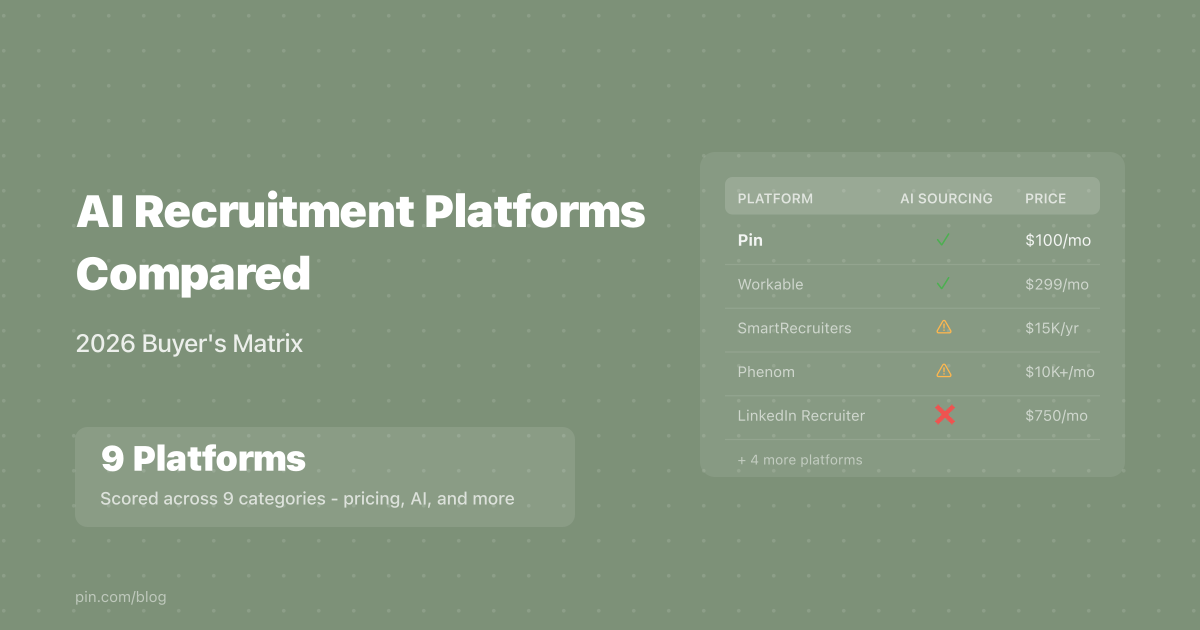
Pin leads this comparison of nine AI recruitment platforms, offering 850M+ candidate profiles, multi-channel outreach with a 48% response rate, and pricing from $100/mo with a free tier. The eight other platforms - Manatal, Workable, Arya by Leoforce, Paradox, Phenom, Beamery, SmartRecruiters, TurboHire, and LinkedIn Recruiter - each fill specific roles in the recruiting tech stack but differ dramatically in scope, pricing, and what their AI actually does.
According to SHRM's 2025 Talent Trends report, 51% of organizations now use AI specifically for recruiting, interviewing, or hiring - up from 26% just one year earlier. That rapid adoption has flooded the market with platforms calling themselves "AI recruiting tools." But the category isn't monolithic. Some platforms find candidates. Some screen them. Some manage workflows. A few try to do everything. This matrix breaks down what each platform actually delivers so you can match the right tool to your hiring needs. For background on what AI recruiting is and how it works, we cover the fundamentals separately.
TL;DR: Nine AI recruitment platforms scored across pricing, sourcing, outreach, and scheduling. Pin is the only platform combining 850M+ profiles, multi-channel outreach (48% response rate), automated scheduling, and a free tier - starting at $100/mo. Enterprise alternatives start at $10,000+/mo. SHRM (2025) reports 89% of recruiting teams using AI see measurable time savings.
How Do These 9 Platforms Compare at a Glance?
AI adoption in HR nearly doubled from 26% to 43% in a single year, according to SHRM (2025). That growth has produced platforms ranging from $15/user/month ATS add-ons to six-figure enterprise talent suites. The table below compares all nine on the same criteria.
| Feature | Pin | Manatal | Workable | Arya | Paradox | Phenom | Beamery | SmartRecruiters | TurboHire | LinkedIn Recruiter |
|---|---|---|---|---|---|---|---|---|---|---|
| AI Candidate Sourcing | ✓ 850M+ profiles | ⚠️ Enrichment only | ✓ 400M+ | ✓ 700M+ | ❌ | ⚠️ Career site AI | ⚠️ CRM-based | ⚠️ Winston Match | ⚠️ Resume parsing | ✓ LinkedIn network |
| Multi-Channel Outreach | ✓ Email + LinkedIn + SMS | ⚠️ Email only | ⚠️ Email + SMS add-on | ✓ Email + social | ✓ SMS + chat | ⚠️ Email + SMS | ⚠️ InMail only | |||
| Interview Scheduling | ✓ Automated | ❌ | ⚠️ Add-on | ❌ | ✓ Conversational | ✓ | ❌ | ⚠️ Basic | ✓ | ❌ |
| Free Tier | ✓ No CC required | ⚠️ 14-day trial | ⚠️ 15-day trial | ❌ | ❌ | ❌ | ❌ | ❌ | ⚠️ Trial | ❌ |
| Transparent Pricing | ✓ Published | ✓ Published | ✓ Published | ❌ Custom only | ❌ Custom only | ❌ Custom only | ❌ Custom only | ⚠️ Entry only | ✓ Published | ❌ Negotiated |
| SOC 2 Certified | ✓ Type 2 | ✓ | ✓ | ✓ | ✓ | ✓ | ✓ | ✓ | ⚠️ ISO 27001 | ✓ |
| Agency Multi-Client | ✓ | ✓ | ⚠️ Limited | ✓ | ❌ | ❌ | ❌ | ⚠️ Add-on | ⚠️ Limited | ❌ |
Top AI Tools of 2025 for Recruiters
The 2026 Pricing Matrix: What Each Platform Actually Costs
The average cost per hire in the U.S. is $4,700, according to SHRM's 2025 Recruiting Benchmarking Report. That makes platform pricing a meaningful variable in your total recruitment spend - especially when annual contracts for enterprise tools can exceed the cost of hiring a junior recruiter.
| Platform | Starting Price | Free Tier | Contract Minimum | Target Market |
|---|---|---|---|---|
| Pin | $100/mo (Starter) | ✓ No credit card | Monthly available | All sizes |
| Manatal | $15/user/mo | 14-day trial | Monthly available | SMB to mid-market |
| TurboHire | $45/user/mo | Trial available | Custom | Mid-market |
| LinkedIn Recruiter Lite | ~$170/mo per seat | ❌ | Annual | Individual recruiters |
| Workable | $299/mo | 15-day trial | Month-to-month | SMB to mid-market |
| LinkedIn Recruiter Corporate | ~$750/mo per seat | ❌ | Annual | Teams |
| Paradox (Olivia) | $1,000+/mo (est.) | ❌ | Custom | High-volume enterprise |
| SmartRecruiters | $14,995/yr | ❌ | Annual | Mid to large enterprise |
| Phenom | ~$10,000+/mo (est.) | ❌ | Custom enterprise | Large enterprise |
| Beamery | Custom only | ❌ | Annual license | Large enterprise |
| Arya by Leoforce | $100-$599/job (Pulse) | ❌ | Custom | Mid to enterprise |
The spread is massive. Pin's Starter plan costs $100/mo flat, while Phenom's enterprise packages run to six figures annually according to industry estimates. For a complete breakdown of where other tools fall on the pricing spectrum, see our full guide to AI recruiting tools in 2026.

Which AI Recruitment Platforms Cover Full Sourcing-to-Hire?
These three platforms try to cover the full sourcing-to-interview pipeline with AI. According to SHRM (2025), the top AI use cases in recruiting are writing job descriptions (66%), screening resumes (44%), and automating candidate searches (32%). But not every "full-platform" tool does all three equally well.
Pin
Pin is an AI-powered recruiting assistant that handles sourcing, outreach, and scheduling from a single dashboard. Its database covers 850M+ candidate profiles with 100% coverage across North America and Europe. The AI doesn't just match keywords - it reads context, company trajectory, and role fit the way an experienced recruiter would. That precision drives a ~70% candidate acceptance rate, meaning roughly seven out of ten candidates Pin surfaces are accepted into customers' hiring pipelines.
Outreach runs across email, LinkedIn, and SMS simultaneously, producing a 48% response rate on automated sequences - significantly above the industry average for cold recruiting outreach. Recruiters using Pin fill positions in approximately two weeks, cutting time-to-hire by nearly 70% compared to the 42-day industry average reported by SHRM. Interview scheduling is fully automated with calendar syncing and confirmation handling, eliminating the back-and-forth that drains recruiter hours.
Pricing starts at $100/mo (Starter) with a free tier that requires no credit card. Professional plans run $149/mo on annual billing, and Business plans at $249/mo. Contact lookup credits (2 per email, 4 per phone) keep base costs low while letting power users scale. Pin is SOC 2 Type 2 certified with a public trust center at trust.pin.com. Agency teams get multi-client support built in - no add-on required. Pin handles both needle-in-a-haystack specialist roles and high-volume hiring equally well from the same platform.
"I jumped into Pin solo toward the end of 2025 and closed out the year with over $1M in billings during just the final 4 months - no team, no agency. The sourcing data is incredible, scanning 850M+ profiles with recruiter-level precision to uncover perfect-fit candidates I'd never find otherwise." - Nick Poloni, President at Cascadia Search Group
Across Pin's 600+ customers, the most common reason teams cite for switching from LinkedIn Recruiter is the inability to automate multi-channel outreach from a single platform. Pin scans 850M+ profiles to find candidates other platforms miss - try it free.
Workable
Workable is a hiring platform with 400M+ candidate profiles and a recently launched agentic AI feature called Workable Agent (March 2026) that automates intake-to-shortlist workflows. Good for mid-market teams that need ATS functionality bundled with sourcing, though the base plan ($299/mo) requires paid add-ons for texting ($79/mo), video ($99/mo), and assessments ($59/mo). A team that needs all four modules is looking at $536/mo before adding headcount-based scaling.
The total cost climbs quickly once you add the features most recruiting teams actually need. Workable offers a 15-day trial with no credit card required. It doesn't publish outreach response rates or candidate acceptance metrics. The platform handles job board distribution and employer branding well, but its multi-channel outreach is limited compared to tools that include LinkedIn and SMS natively. Workable Agent is promising, but it launched in March 2026 and lacks the performance track record of more established AI sourcing platforms.
Arya by Leoforce
Arya consolidates candidates from 700M+ profiles across job boards, social networks, and your existing ATS into one search. Good for teams that already have candidates scattered across multiple databases and need a single pane of glass. Arya Pulse offers pay-per-job pricing ($100-$599/job), while Arya Quantum is a subscription model with custom quotes.
The platform's strength is multi-source consolidation. Its limitation is pricing transparency - there's no public rate card, and you can't try it before talking to sales. Automated outreach exists but is less developed than dedicated outreach platforms.
Which Enterprise Platforms Combine AI With Workforce Planning?
Only 31% of recruiting teams currently use labor market data to inform their talent strategy, according to Gartner (February 2026). Enterprise suites try to close that gap with workforce planning, skills intelligence, and internal mobility tools. They also carry enterprise price tags.
Phenom
Phenom is a talent experience platform covering career sites, recruiter AI fit scores, internal mobility, and workforce planning. Good for organizations with 5,000+ employees that need a unified talent ecosystem - but the implementation overhead is significant. Third-party consultants are typically required for setup, and industry estimates place starting costs around $10,000+/mo.
The platform's AI personalizes career site experiences and scores candidate fit. Its limitation is complexity. Smaller teams will find themselves paying for modules they don't use. There's no free tier and no self-service onboarding.
Beamery
Beamery focuses on talent lifecycle management - CRM, skills intelligence, workforce planning, and internal mobility. Good for global enterprises running large-scale talent transformation initiatives. It's listed in both Gartner's Candidate Relationship Management and Internal Talent Marketplaces categories.
Pricing is custom and annual. Like Phenom, Beamery requires significant implementation investment. The platform excels at managing talent you already know about. It's less effective for discovering new passive candidates at scale - the opposite of what AI sourcing tools are built for.
SmartRecruiters
SmartRecruiters is an enterprise ATS with Winston AI, which handles candidate matching and conversational screening. Good for mid-to-large organizations looking for a modern ATS with AI layered on top. The Essential plan starts at $14,995/yr, but third-party integration costs can push total spend past $55K+ in some deployments.
The platform discontinued its free SmartStart tier. All plans now require sales contact beyond Essential. SmartRecruiters handles requisition management and compliance well, though its AI candidate matching relies on your existing applicant pool rather than proactively sourcing new candidates.
Which AI Recruiting Tools Focus on One Hiring Phase?
SHRM's 2025 data shows that 89% of HR professionals using AI in recruiting report time savings or increased efficiency. But these savings depend on matching the right tool to the right problem. The four platforms below each do one thing well - and are limited outside that lane.
Manatal
Manatal is an ATS/CRM with clean UI and AI-powered resume parsing. Good for small teams that need an affordable pipeline management tool. Professional starts at $15/user/mo, and the platform handles job board distribution and candidate enrichment. It caps at 15 jobs and 10,000 candidates on the base plan.
Manatal's limitation is outreach. It supports email only - no LinkedIn or SMS automation. And it doesn't publish any outreach response rate data. If your primary need is finding and contacting passive candidates, Manatal manages your pipeline but doesn't fill it proactively.
Paradox (Olivia)
Paradox's conversational AI assistant, Olivia, handles candidate screening, FAQ responses, and scheduling via SMS and chat. Good for high-volume frontline hiring - retail, hospitality, healthcare - where the bottleneck is screening thousands of applicants, not sourcing them. The platform reports case studies showing significant time-to-hire reductions for high-volume clients.
Paradox doesn't do candidate sourcing. Pricing starts around $1,000+/mo with custom enterprise contracts. It's purpose-built for inbound applicant management, not outbound recruiting. For a deeper look at the difference, we compare 12 recruitment automation tools separately.
TurboHire
TurboHire is an AI recruiting platform with strong adoption in the Asia-Pacific market. Good for mid-market teams, especially those integrating with SAP, Oracle, or Workday HRMS. Pricing starts at $45/user/mo (Basic). The vendor reports significant time-to-hire improvements, though no third-party benchmark has been published to verify those claims.
The platform covers resume parsing, chatbot assessments, and one-way video interviews. Its candidate database is smaller than platforms with proprietary sourcing networks, and multi-channel outreach options are limited to email.
LinkedIn Recruiter
LinkedIn Recruiter remains the incumbent most buyers compare against. It offers access to LinkedIn's professional network with 40+ search filters on the Corporate plan (~$750/mo per seat). The Lite plan (~$170/mo) restricts you to 1st-3rd degree connections, 20 filters, and 30 InMails per month.
LinkedIn's limitation is that it only searches LinkedIn. There's no outreach automation beyond InMail, no interview scheduling, and no multi-channel sequencing. For talent acquisition leaders running full-cycle recruiting, LinkedIn Recruiter handles the search step but leaves everything else to manual work or separate tools.

Which Platform Category Fits Your Team?
Gartner identified four talent acquisition trends for 2026, including high-volume roles going AI-first and recruiter skills shifting toward complex, relationship-driven work (Gartner, October 2025). That split maps directly to how these platforms break down.
If you need to find and engage passive candidates: You need a platform with a large proprietary database, multi-channel outreach, and automated scheduling. Pin covers all three. Workable and Arya handle sourcing but lack the full outreach automation stack.
If you need to manage inbound applicants at scale: Paradox excels at high-volume screening through conversational AI. SmartRecruiters and Manatal handle pipeline management. None of them proactively source passive candidates.
If you need enterprise workforce planning: Phenom and Beamery add internal mobility, skills intelligence, and talent analytics. But their price tags ($10K+/mo) reflect that breadth - and their sourcing capabilities are secondary to their talent management features.
If you're a recruiting agency: Multi-client support matters. Pin and Manatal both offer it natively. Most enterprise platforms (Phenom, Beamery, Paradox) aren't built for agency workflows. LinkedIn Recruiter doesn't support multi-client management at all.
Best AI Recruiting Tools in 2025!
How to Evaluate an AI Recruitment Platform
With 51% of organizations already using AI for recruiting and adoption accelerating (SHRM, 2025), new platforms are launching constantly. Not all of them deserve a spot on your shortlist. Here's how to cut through the noise when evaluating any AI recruitment platform - whether it's listed here or not.
Ask about the database. How many profiles does the platform search? Where does that data come from? Is it proprietary or scraped from public sources? A tool claiming "AI-powered sourcing" with no disclosed database size is a red flag. Pin's 850M+ profiles with 100% North America and Europe coverage sets the benchmark. Anything under 100M profiles limits your reach for niche or specialized roles.
Test before buying. Only three of the nine platforms in this matrix offer a free tier or no-credit-card trial (Pin, Workable, Manatal). If a platform won't let you run real searches before signing a contract, you're buying on faith. That's especially risky for enterprise tools with six-figure annual commitments and multi-month implementation timelines.
Check for published performance data. Does the vendor share outreach response rates, candidate acceptance rates, or time-to-fill benchmarks? Pin publishes a 48% response rate and ~70% time-to-hire reduction. Platforms that don't share numbers either don't track them or don't like what the data shows.
Understand the total cost. Entry pricing is deceptive. A $15/user/mo ATS that requires five users and two add-on modules costs more than a $100/mo flat-rate sourcing tool. Annual contracts with enterprise platforms can lock you into $50K+ before you've filled a single role. Map the total first-year cost, including implementation, integrations, and per-seat scaling.
What About Platforms Not Listed Here?
This matrix covers nine platforms across three categories. The AI recruiting market includes dozens more tools - some focused on niche sourcing, others on specific industries, and a growing number of newer entrants that are still proving their database coverage and reliability at scale. Some tools in this space offer basic AI search but lack deep integrations or verified performance data.
We focused on platforms with verifiable pricing data, published feature sets, and meaningful market adoption. If a platform you're evaluating isn't listed, run it through the same criteria above. Does it tell you what it costs? Can you test it before buying? Does it publish performance metrics you can verify?
Frequently Asked Questions About AI Recruitment Platforms
What is the most affordable AI recruitment platform in 2026?
Pin offers the lowest entry point among full-featured AI sourcing platforms at $100/mo with a free tier that requires no credit card. Manatal starts lower at $15/user/mo but functions as an ATS/CRM rather than a proactive sourcing tool. Enterprise platforms like Phenom and Beamery typically start above $10,000/mo.
Which AI recruiting platform has the largest candidate database?
Pin searches 850M+ candidate profiles with 100% coverage in North America and Europe. Arya by Leoforce aggregates 700M+ candidates from multiple sources. Workable accesses 400M+ profiles. LinkedIn Recruiter is limited to LinkedIn's professional network. Enterprise suites like Phenom and Beamery rely primarily on your existing candidate data rather than proprietary databases.
Do AI recruitment platforms actually reduce time-to-hire?
Yes. According to SHRM's 2025 Talent Trends report, 89% of HR professionals using AI in recruiting report time savings. Pin users fill positions in approximately two weeks - roughly 70% faster than the industry average of 42 days reported by SHRM. Results vary by platform and use case.
Should recruiting agencies use enterprise platforms like Phenom or Beamery?
In most cases, no. Phenom and Beamery are built for corporate talent teams managing internal hiring, workforce planning, and employee mobility. They lack multi-client management features that agencies need. Pin and Manatal both support agency workflows natively - Pin with full AI sourcing and outreach, Manatal with pipeline management and CRM.
What's the difference between AI sourcing and AI screening platforms?
AI sourcing platforms (Pin, Arya, Workable) proactively find candidates from large databases. AI screening platforms (Paradox, TurboHire) evaluate candidates who have already applied. Some tools, like SmartRecruiters, sit in the middle with matching AI that works on existing applicant pools. The right choice depends on whether your bottleneck is finding candidates or filtering them.
Key Takeaways
- The nine platforms in this matrix span from $15/user/mo to $10,000+/mo - pricing alone disqualifies several options for most teams
- Only Pin combines a proprietary 850M+ profile database, multi-channel outreach (email, LinkedIn, SMS), automated scheduling, and a free tier
- Enterprise suites (Phenom, Beamery) add workforce planning and internal mobility but sacrifice sourcing depth and price accessibility
- Specialized tools (Paradox, Manatal, TurboHire) handle one phase of recruiting well but leave gaps in the full hiring workflow
- LinkedIn Recruiter remains the incumbent but lacks outreach automation, scheduling, and multi-channel engagement