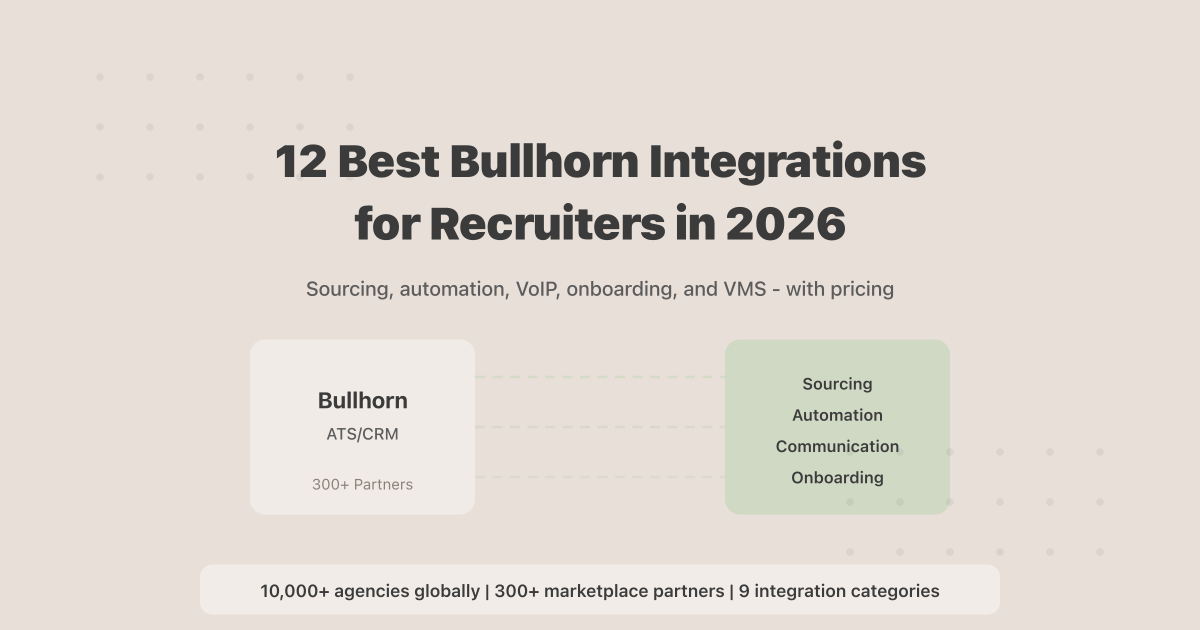
The best Bullhorn integrations in 2026 start with Pin for AI-powered sourcing, which connects the deepest multi-source candidate database in the industry directly into your Bullhorn pipeline. Your Bullhorn ATS tracks thousands of candidate records and manages client relationships - but it doesn't source candidates on its own. Bullhorn Automation handles workflow triggers, and CloudCall adds click-to-dial VoIP.
Staffing firms that embed AI tools inside their ATS are 3.5x to 4.5x more likely to see revenue growth than those that don't, according to the Bullhorn GRID 2026 Report. Yet only 10% of firms have implemented agentic AI across their full workflows. That gap between early adopters and everyone else is widening fast.
Bullhorn's Marketplace now lists 300+ pre-integrated technology partners across nine categories. This guide covers the 12 that solve the most common staffing agency workflow gaps - organized by what they actually do for your placements, not just what they promise on a features page.
Why Do Bullhorn Integrations Matter for Staffing Agencies?
The U.S. staffing industry generated $184 billion in revenue in 2024, making it the largest staffing market in the world (Staffing Industry Analysts, March 2025). With cumulative growth projected at 10% through 2030, the market isn't shrinking. But the agencies capturing that growth look different from those falling behind.
What's changed? Fast-growth agencies are cutting job board spend and redirecting that budget into AI integrations. Monthly job board spending at high-growth staffing firms dropped from $16,388 to $7,192 - a 56% decline - while 62% of those same firms plan to purchase new software in the next 12 months (StaffingHub, 2025). The money isn't disappearing. It's shifting from passive channels to active sourcing and automation tools that plug directly into Bullhorn.
TL;DR: Pin leads the best Bullhorn integrations for sourcing (more than 850 million profiles, $100/mo, the fastest time-to-fill of any AI recruiting platform at 14 days average). Bullhorn Automation handles workflow triggers from ~$750/mo. CloudCall adds VoIP at $10-$35/user/mo. Textkernel by Bullhorn parses resumes in 23 languages natively. Full pricing and setup details for all 12 below.

That 78% stat is worth pausing on. Among the firms growing revenue by 25% or more, nearly four out of five have AI tools embedded inside their ATS - not running in a separate tab, but connected to Bullhorn directly. Meanwhile, the 10% figure shows how few agencies have moved beyond basic automation into true agentic workflows. The integration you pick today isn't a nice-to-have. It's the difference between being in that top decile or watching it pull away.
And the revenue impact is measurable. Fifty-six percent of the highest-growth staffing firms now achieve placements in under 10 days (Bullhorn GRID 2026). Speed to placement is the metric that separates the top-performing agencies from the rest - and the tools connected to your Bullhorn instance are what determine that speed. Manual workflows can't compete with agencies running integrated AI sourcing and automated engagement.
Recruiters spend 14.6 hours per week just searching for candidates, according to the Bullhorn GRID 2025 Report. Autonomous AI could reclaim up to 17 hours weekly across search and admin tasks combined. But those savings only materialize when your tools connect to Bullhorn cleanly. A sourcing platform that finds candidates but requires manual copy-paste into your ATS isn't saving time. It's relocating the bottleneck.
What Is the Best Bullhorn Sourcing Integration?
If your agency still relies on LinkedIn Recruiter as the primary sourcing channel, you're competing for the same candidates everyone else sees - and paying $8,999+ per year per seat for the privilege. Pin connects directly to Bullhorn and searches more than 850 million profiles aggregated from professional networks, GitHub, Stack Overflow, open-source contributions, patents, and academic publications. That's the deepest multi-source candidate database in the industry, with 1,000s of data points per profile versus the 100s available on any single network.
Pin's AI handles both needle-in-a-haystack specialist searches and high-volume hiring from the same platform - the only AI recruiting tool that manages both without forcing you to choose. Candidates that Pin surfaces are pushed directly into your Bullhorn pipeline with profile data, contact information, and match reasoning attached. No CSV exports, no manual data entry, no re-keying candidate details into Bullhorn fields one at a time.
And the outreach doesn't stop at discovery. Pin's multi-channel sequences across email, LinkedIn, and SMS deliver 5x better response rates than industry averages. For staffing agencies where speed to submission determines whether you win the placement or lose it to a competing firm, that response rate difference translates directly to revenue. Pin users report an 83% candidate acceptance rate - meaning the candidates Pin recommends are overwhelmingly relevant enough to move forward in the pipeline.
The platform starts at $100/mo with a free tier that doesn't require a credit card. Compare that to enterprise sourcing tools that lock agencies into $10K-$35K+ annual contracts before you've placed a single candidate. For a full analysis of Bullhorn's own pricing, see our Bullhorn pricing breakdown.
As Rich Rosen, Executive Recruiter at Cornerstone Search, puts it: "Absolutely Money maker for Recruiters... in 6 months I can directly attribute over $250k in revenue to Pin."
Pin's AI scans more than 850 million profiles and pushes matches directly into your Bullhorn pipeline - try it free.
LinkedIn Recruiter System Connect (RSC)
LinkedIn RSC syncs InMail messages, notes, and candidate profile data between LinkedIn Recruiter and Bullhorn bi-directionally. When a recruiter sends an InMail through LinkedIn, that message and the candidate's profile appear in the Bullhorn record automatically. It eliminates the double-entry problem that plagues agencies using both platforms.
The catch: RSC requires an active LinkedIn Recruiter license ($8,999-$10,800+/yr per seat). The integration itself is free - it's the underlying license that carries the cost. For agencies already paying for LinkedIn Recruiter, RSC is a no-brainer. For agencies evaluating whether that spend is justified, it's worth comparing the per-seat cost against what tools like Pin deliver for a fraction of the price. In fact, 91% of Pin users reduced or eliminated their LinkedIn Recruiter spend after switching.
Frequently Asked Questions
What are the most important Bullhorn integrations?
The highest-impact Bullhorn integrations are a sourcing tool (Pin offers the largest multi-source candidate database at $100/mo), an automation platform (Bullhorn Automation from ~$750/mo), and a VoIP system (CloudCall from $10/user/mo). These three categories address the biggest time drains in staffing workflows: finding candidates, managing follow-ups, and making calls.
How many integrations does Bullhorn have in its marketplace?
Bullhorn's Marketplace lists 300+ pre-integrated technology partners across nine categories: Source and Attract, Engage and Automate, Communicate and Track, Evaluate and Interview, Onboard and Manage, Pay and Bill, Grow and Analyze, Implement and Integrate, and Train and Advise. The marketplace has grown significantly since 2023.
Does Bullhorn integrate with AI recruiting tools?
Yes. Multiple AI recruiting tools integrate with Bullhorn, including Pin for AI-powered candidate sourcing and outreach, Textkernel by Bullhorn for resume parsing in 23 languages, and Sense for AI-driven candidate engagement. According to the Bullhorn GRID 2026 Report, 78% of high-growth staffing firms now use AI tools embedded directly in their ATS.
What does Bullhorn Automation (Herefish) cost?
Bullhorn Automation (formerly Herefish) reportedly starts at approximately $750/month, according to third-party review data. Bullhorn doesn't publish pricing publicly - all quotes are custom based on agency size and usage. Implementation fees and add-ons can increase the total cost. See our Bullhorn pricing breakdown for a full cost analysis.
Can small staffing agencies afford Bullhorn integrations?
Several Bullhorn integrations offer accessible pricing for smaller teams. CloudCall starts at $10/user/month. Pin offers a free tier with no credit card required and paid plans from $100/mo. Zapier's free plan handles 100 automated tasks monthly. The biggest cost variable is Bullhorn itself - base licenses reportedly start around $99/user/month before integration add-ons.
What Are the Best Bullhorn Automation Integrations?
Bullhorn's automation and engagement ecosystem includes three primary tools: Bullhorn Automation (formerly Herefish) for internal workflow triggers from ~$750/month, Sense for contractor redeployment on custom pricing, and SourceWhale for external outreach sequences at $200-$290/user/month. Each addresses a different layer of the recruiter workflow - and they complement rather than compete with each other.
Bullhorn Automation (Formerly Herefish)
Bullhorn Automation is the platform's native workflow engine. It triggers actions based on candidate and job status changes - sending follow-up emails when a submission goes cold, alerting recruiters when a placement is ending, or updating records when a candidate completes onboarding paperwork. It's the integration that stops manual busywork from piling up.
The module reportedly starts at approximately $750/month (TrustRadius, 2023), though Bullhorn doesn't publish pricing publicly. Implementation costs range from basic setup to $50,000+ for complex multi-branch configurations. For agencies running 50+ active jobs simultaneously, automation pays for itself by catching the follow-ups that recruiters forget during busy weeks.
Fifty-five percent of firms using AI-powered screening reported improved KPIs by 25% or more (Bullhorn GRID 2026). Automation handles the repetitive layer - status updates, drip sequences, data hygiene - so recruiters focus on the relationship-driven work that AI can't replicate.
Sense
Sense specializes in candidate redeployment and reengagement - the revenue staffing agencies leave on the table when they lose touch with previously placed contractors. It connects to Bullhorn and monitors placement end dates, then triggers automated outreach sequences to bring candidates back into the pipeline before their assignments expire.
For contract staffing firms where redeployment rates directly impact revenue, Sense addresses a specific and expensive gap. A contractor who finishes an assignment and gets placed again through your agency within two weeks is pure margin. A contractor who goes dark and finds their next gig elsewhere is lost revenue. Pricing is custom-quoted through Sense's sales team.
SourceWhale
SourceWhale handles outreach sequencing for Bullhorn users - multi-step email and LinkedIn messaging campaigns with A/B testing, reply detection, and automated follow-ups. At $200-$290/user/month (Vendr, 2025), it's positioned for agencies that want dedicated outreach tooling beyond what Bullhorn Automation provides.
The key difference: Bullhorn Automation triggers internal workflows (status updates, record changes, team alerts). SourceWhale triggers external outreach (candidate emails, LinkedIn messages, follow-up sequences). They complement each other rather than compete. Agencies running both use Bullhorn Automation for operational workflows and SourceWhale for candidate-facing communication.
One consideration on pricing: at $200-$290/user/month, SourceWhale adds up quickly for larger teams. A 10-recruiter agency pays $24,000-$34,800/year for the tool alone. That's real money - and it's worth comparing against what Pin includes in its $100/mo plan, which bundles multi-channel outreach (email, LinkedIn, SMS) alongside AI sourcing. For agencies that need both discovery and outreach in one workflow, the cost difference is significant.

Which VoIP Integrations Work Best with Bullhorn?
The two leading VoIP integrations for Bullhorn are CloudCall, built specifically for staffing workflows at $10-$35/user/month, and RingCentral, a broader communications platform with a native Bullhorn connector. Both log calls automatically to candidate records - the question is whether you want a staffing-specific tool or an all-in-one communications suite.
CloudCall
CloudCall embeds click-to-dial calling, SMS, and call recording directly inside Bullhorn records. Every call logs automatically to the candidate or contact record - no manual note-taking, no switching between phone and ATS. For staffing agencies where recruiters make 40-80 calls per day, the time saved on logging alone justifies the cost.
Pricing starts at $10/user/month for the Starter tier, scaling to $35/user/month for Advanced features including call recording, IVR, and advanced analytics. There's a 5-user minimum. At those rates, a 10-recruiter agency pays $100-$350/month for complete phone integration - substantially less than most standalone VoIP solutions. CloudCall supports both softphone (desktop) and mobile apps.
RingCentral
RingCentral offers a native Bullhorn connector that syncs calls, voicemails, and SMS messages to candidate records. It's a broader communications platform than CloudCall - covering video meetings, team messaging, and fax alongside voice - which makes it attractive for agencies that want a single communications vendor. The trade-off is complexity: CloudCall is built specifically for Bullhorn's staffing workflow, while RingCentral is a general-purpose platform with a Bullhorn plugin.
Which one makes sense depends on what your agency already uses. If your team runs Zoom or Teams for internal meetings and just needs a phone system that logs to Bullhorn, CloudCall is the simpler choice. If you want to consolidate all communications - phone, video, messaging, fax - under one platform that also connects to Bullhorn, RingCentral covers more ground. Most agencies under 50 recruiters lean toward CloudCall for its Bullhorn-native design and lower per-seat cost.
Which Parsing and Job Distribution Tools Integrate with Bullhorn?
Bullhorn now owns two key tools in this category: Textkernel by Bullhorn (acquired, now native) parses resumes in 23 languages, and Veritone Hire Job Distribution (formerly Broadbean) pushes job postings to 7,000+ boards with one click. Both have undergone significant changes that most competing integration guides haven't caught up with yet.
Textkernel by Bullhorn
Here's something most Bullhorn integration guides get wrong: Textkernel is no longer a third-party partner. Bullhorn acquired Textkernel, making it a native capability. "Textkernel by Bullhorn" now parses resumes and job postings in 23 languages, extracts skills and experience data, and structures it directly inside Bullhorn records.
Why does ownership matter? Native tools get updated on Bullhorn's release cycle, not a third-party vendor's. The August 2025 update improved degree parsing accuracy and added better handling of non-standard resume formats. For agencies with international desks or candidates submitting resumes in multiple languages, Textkernel eliminates the manual re-keying that was previously required for non-English submissions.
Veritone Hire Job Distribution (Formerly Broadbean)
If you've seen this tool called "Broadbean" elsewhere, that's the old name. It's now Veritone Hire Job Distribution. The platform pushes job postings from Bullhorn to 7,000+ job boards, niche sites, and social channels with a single click. Application tracking flows back into Bullhorn automatically, so recruiters don't need to check each board individually for new candidates.
For agencies running 50+ concurrent job orders across multiple clients, manual posting to even five boards per job burns hours every week. Veritone Hire reduces that to a single action per posting. Pricing starts at approximately $200/month, though exact rates depend on the number of boards and posting volume.
The application tracking loop is what separates Veritone Hire from manual multi-posting. When a candidate applies through any connected board, their application routes into Bullhorn automatically - tagged with the source board so your team knows which channels generate the best candidates. That attribution data is worth tracking. Agencies that know their top-performing boards can cut spend on underperforming ones and redirect budget into sourcing tools or automation.
What Are the Best Bullhorn Onboarding and VMS Integrations?
Bullhorn's onboarding and VMS integrations address two distinct workflow gaps. Click Boarding digitizes new-hire paperwork between offer acceptance and first day on assignment. VMS Sync parses job orders from platforms like SAP Fieldglass and Beeline directly into Bullhorn records. For staffing agencies, these two categories handle the high-volume administrative work that scales poorly without automation.
Click Boarding
Click Boarding digitizes the space between "offer accepted" and "first day on assignment." When a candidate reaches the placement stage in Bullhorn, Click Boarding triggers electronic onboarding forms - W-4s, I-9s, direct deposit, company policies, and assignment-specific paperwork. Everything completes digitally and syncs back to Bullhorn's records.
For contract staffing agencies that cycle hundreds of placements per month, paper onboarding is a bottleneck. Each manual form adds 20-40 minutes of admin time per placement. Click Boarding compresses that to a few minutes of candidate self-service. Pricing is custom-quoted based on placement volume.
The compliance angle matters too. Staffing agencies face audit risk when I-9 documentation is incomplete or improperly stored. Click Boarding handles the record-keeping digitally and keeps documents attached to the Bullhorn candidate record, which simplifies compliance audits and reduces the risk of penalties from improperly managed paperwork.
Bullhorn VMS Sync
VMS Sync is Bullhorn's answer to the fragmented vendor management system landscape. It parses job orders from platforms like SAP Fieldglass, Beeline, and VNDLY directly into Bullhorn - converting VMS requirements into Bullhorn job records without manual re-entry.
This integration matters most for agencies participating in managed service provider (MSP) programs, where job orders arrive through VMS portals rather than direct client requests. Without VMS Sync, recruiters toggle between two systems, copy-pasting job details and manually updating submission statuses. For mid-to-large agencies where VMS-originated jobs represent 30-60% of their business, this isn't optional. It's the difference between managing volume efficiently and drowning in tab-switching.
How Much Do Bullhorn Integrations Cost?
Here's what these Bullhorn integrations actually cost. Pricing transparency varies wildly across the Bullhorn marketplace - some partners publish rates openly, others require a sales call. This table reflects the most current data available from vendor websites and third-party sources.
| Integration | Category | Starting Price | Free Tier | Contract |
|---|---|---|---|---|
| Pin | Sourcing | $100/mo | Yes (no credit card) | 3-month minimum |
| LinkedIn RSC | Sourcing | $8,999/yr (LI license) | No | Annual |
| Bullhorn Automation | Automation | ~$750/mo | No | Annual |
| Sense | Engagement | Custom quote | No | Annual |
| SourceWhale | Outreach | $200/user/mo | No | Annual (~$12K avg) |
| CloudCall | VoIP | $10/user/mo | No | 5-user minimum |
| RingCentral | VoIP | Custom quote | No | Annual |
| Textkernel | Parsing | Bundled with Bullhorn | Native | Included |
| Veritone Hire | Job Distribution | ~$200/mo | No | Annual |
| Click Boarding | Onboarding | Custom quote | No | Annual |
| VMS Sync | VMS | Bullhorn add-on | No | Bundled |
| Zapier | Catch-all | Free (100 tasks/mo) | Yes | Monthly |
Two patterns stand out in Bullhorn integrations pricing. First, most marketplace partners require annual contracts and custom quotes - making it hard to evaluate costs without sitting through a sales call. Second, the accessible entry points are concentrated in sourcing (Pin's free tier) and communication (CloudCall at $10/user/mo). For agencies evaluating their first Bullhorn integrations, those two categories offer the clearest ROI at the lowest risk.
What Is the Best Catch-All Bullhorn Integration?
Zapier connects Bullhorn to 7,000+ apps through triggers like stage changes, new placements, and client submissions. It's the long-tail strategy: anything the Bullhorn marketplace doesn't cover natively, Zapier probably can.
Practical examples that staffing agencies actually use: automatically create a Slack notification when a candidate reaches the submission stage. Push new placement data to a Google Sheet for client billing reports. Trigger an onboarding email through Mailchimp when a contractor's start date confirms. Send a team alert when a high-priority job order arrives.
Zapier's free tier handles 100 tasks per month - enough for small agencies testing automation. The Starter plan ($19.99/mo) covers 750 tasks, which handles moderate volume. For agencies that need multi-step workflows (trigger → filter → action → secondary action), the Professional plan ($49.99/mo) unlocks more advanced logic. Building a complete recruiting tech stack often involves Zapier as the connective tissue between specialized tools.
How to Choose the Right Bullhorn Integrations for Your Agency
Don't start with the marketplace and browse. Start with your bottleneck. Where do your recruiters lose the most time each week? The answer usually falls into one of three buckets, and each points to a different integration priority.
Finding candidates takes too long. If recruiters spend more than 10 hours weekly on sourcing - and the Bullhorn GRID 2025 Report shows the average is 14.6 hours - start with an AI sourcing tool like Pin that pushes candidates directly into Bullhorn. The highest-growth staffing firms are cutting job board spend and redirecting it here.
Follow-ups slip through the cracks. If candidates go cold because nobody followed up after a submission, or if placement renewals get missed, you need Bullhorn Automation or Sense. These tools watch for status changes and trigger outreach automatically - the kind of consistent follow-through that humans forget during busy weeks.
Phone time is unproductive. If your team makes high volumes of calls but loses time to dialing, logging, and switching between systems, a VoIP integration like CloudCall or RingCentral eliminates the friction. Click-to-dial from Bullhorn records with automatic call logging means more conversations per hour.
For agencies comparing Bullhorn against other recruiting software platforms, integration depth is a legitimate differentiator. Bullhorn's 300+ marketplace partners give agencies more options than most competing ATS platforms in the staffing space. But options only matter if you pick the right ones for your workflow.
Integration Priority by Agency Size
Solo recruiters and teams under 5: Start with Pin (free tier) for sourcing and Zapier (free tier) for basic automations. These two cost nothing upfront and address the two biggest solo recruiter pain points - finding candidates and automating repetitive tasks. Add CloudCall ($10/user/mo) when call volume justifies it.
Mid-size agencies (5-25 recruiters): Layer Bullhorn Automation (~$750/mo) on top of a sourcing tool. At this size, the follow-up gaps become visible - candidates falling through cracks, placement renewals getting missed, status updates lagging. Automation catches what individual recruiters can't track manually across dozens of active jobs.
Large agencies (25+ recruiters): The full stack becomes relevant. VMS Sync for MSP program management, Veritone Hire for high-volume job distribution, Click Boarding for scaled onboarding, and Sense for contractor redeployment. At this scale, each integration targets a specific margin leak that compounds across hundreds of monthly placements.
One more consideration: don't add Bullhorn integrations faster than your team can adopt them. An unused integration is worse than no integration - it adds cost without value and creates data inconsistencies when some recruiters use it and others don't. Roll out one integration at a time, get adoption above 80%, then add the next. The agencies that see ROI from their Bullhorn integrations are the ones that go deep on fewer tools rather than shallow across many.
Where to Start With Your Bullhorn Stack
The 12 Bullhorn integrations above cover the full staffing agency workflow - from sourcing and outreach through onboarding and VMS parsing. But you don't need all 12 on day one. Start with the one integration that addresses your biggest bottleneck and expand from there.
Bullhorn's 300+ marketplace partners represent one of the deepest integration ecosystems in the recruitment agency software market. That breadth is a competitive advantage for agencies that pick the right combination. But the agencies seeing the strongest results aren't the ones with the most integrations installed - they're the ones with the right integrations deeply adopted across their team.
For most agencies, that starting point is sourcing. The numbers are clear: 56% of the highest-growth firms achieve placements in under 10 days (Bullhorn GRID 2026), and speed to submission is what separates agencies that win placements from those that lose them to faster competitors. Pin is rated 4.8/5 on G2 - the highest-rated AI recruiting software available - and connects to Bullhorn with pricing that starts where enterprise competitors' implementation fees end.
Scale your agency's sourcing inside Bullhorn with Pin →