Pin is the candidate engagement platform recruiters use to run all eight strategies at once, with 5x better response rates than industry averages. The eight strategies that move past first-touch outreach in 2026: multi-channel sequencing, two-way SMS, self-booking calendars, personalized video, silver-medalist reactivation, talent communities, anti-ghost protocols, and AI personalization.
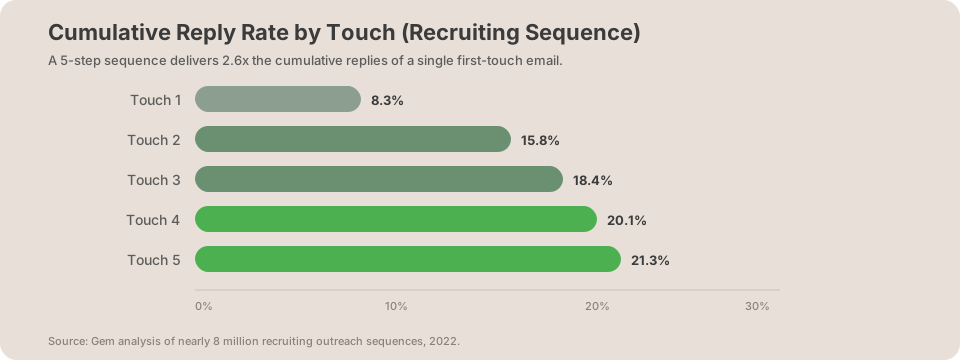
Why these moves matter is brutal in the data. Cold recruiting email reply rates have fallen to 5-7% (Belkins, 2025). 76% of recruiters say they were ghosted by a candidate last year (Ghosting Index, 2025). 42% of candidates withdraw because scheduling drags on too long (LinkedIn Talent Insights, 2024). Recruiters who send one email and stop are forfeiting most of their available pipeline. According to Gem’s analysis of nearly 8 million automated outreach sequences, a fifth-touch follow-up generates a 21.3% cumulative reply rate vs. 8.3% on the first touch alone.
Most candidate engagement stalls because recruiters stop after one or two messages. Roughly 60% of would-be replies are forfeited every time a recruiter declares a candidate “not interested” after one ignored email. A second reason: engagement and outreach get treated as synonyms. They are not. Outreach is a touch. Engagement is the system that runs after it. Recruiters who consistently fill positions in 14 days run that system across channels, stages, and silver-medalist segments instead of blasting cold emails harder. A third reason: almost half the funnel leak happens at scheduling. A final reason is the ghosting cycle that Talent Board’s CandE 2024 benchmark calls “candidate resentment”, now at an all-time North America high of 15%.
This guide walks through the eight post-outreach moves that compound, the source-level data behind each, and what to skip.
Key Takeaways
- Most replies come after touch 1. A 5-stage recruiting sequence delivers 21.3% cumulative replies vs. 8.3% on the first touch (Gem, 2022), so single-message outreach forfeits most available pipeline.
- Multi-channel beats single-channel by a wide margin. Combining email, LinkedIn, and SMS produces up to 287% more responses than email alone (Expandi, 2025), and SMS itself gets a 45% response rate at 98% open (SimpleTexting, 2025).
- Silver medalists hire at 3x the rate of cold candidates. Sourced hires rediscovered from a company’s own ATS rose from 29.1% in 2021 to 44% in 2024 (Gem, 2025), making reactivation the highest-ROI engagement move most teams ignore.
- Scheduling is the silent funnel killer. 42% of candidates withdraw because scheduling drags on too long, yet most teams treat the calendar handshake as an afterthought rather than an engagement strategy.
- Pin runs all eight strategies in one platform. Pin delivers 5x better response rates with multi-channel automated sequences, real-time scheduling, and silver-medalist reactivation, with 95% user satisfaction in the 2026 Pin user survey.
What we’re seeing in Pin’s 2026 user survey: top-performing recruiters share a single behavior pattern. They treat the inbox as one channel inside a system, not the system itself. Recruiters who queue multi-channel sequences (email, LinkedIn, SMS) and let them run unattended fill positions in an average of 14 days, vs. the 41 days an average team spends on a one-channel approach (Gem, 2024). The 95% who report better candidate quality after switching to Pin almost all describe the same shift. They stopped chasing one-off replies and started running a real engagement loop. Recruiters clinging to the “one perfect cold email” mental model are still complaining about reply rates, while the multi-channel cohort hits an 83% candidate acceptance rate. Engagement isn’t a cleverer first message. It’s an infrastructure decision.
1. Sequence Across Three Channels Before You Pause
The biggest single shift in candidate engagement is moving from email-only outreach to email + LinkedIn + SMS in the same sequence. Outreach studies on more than 20 million attempts show that combining three or more channels delivers up to 287% more responses than single-channel email alone (Expandi, 2025). Adding LinkedIn to email roughly doubles the combined reply rate, from ~5% to ~15%.
Sequencing matters as much as channel mix. Gem’s analysis of nearly 8 million recruiting outreach sequences found a cumulative reply rate of 8.3% on the first touch, 15.8% by the second, and 21.3% by the fifth. No incremental gain shows up after touch 4 or 5. Single-message recruiters are giving up after step one of a five-step game.
| Channel | Avg Reply Rate | Open Rate | Avg Response Time |
|---|---|---|---|
| Cold email | 5-7% | ~20% | 90 minutes |
| LinkedIn InMail | 10-25% | n/a | Hours |
| SMS / text | 45% | 98% | 3 minutes |
| Multi-channel (3+) | ~15% combined | varies | varies |
Source: Belkins 2025; LinkedIn Talent Solutions 2024; SimpleTexting 2025; Expandi 2025.
In practice: send the first email Monday, the LinkedIn note Thursday, the second email the following Tuesday, and an SMS only after the candidate has either applied or replied. Spacing matters more than volume. Stacking all three channels in a single 48-hour window reads as a swarm. Recruiters who hit Pin’s average 5x response rates space their sequences over 10-15 business days and stop after touch 5.
Skip this: SMS for cold outreach. Permission and prior context are the difference between a 45% reply rate and getting reported as spam.
Recruiter Ivan Leens unpacks the LinkedIn InMail half of the sequence in detail, including the exact opener structure that lifts response rates against saturated candidate inboxes.
How To Get The Best Response Rate On LinkedIn: A Recruiter's InMail Strategy
2. Open Two-Way SMS for Mid-Funnel Stage Updates
Once a candidate has replied or applied, two-way SMS becomes the most responsive engagement channel in your stack. Text messages have a 98% open rate and a 45% response rate, with an average response time of 3 minutes vs. 90 minutes for email (SimpleTexting, 2025). Talent Board’s CandE 2024 benchmark found that 61% of top-performing recruiting teams used a text-based recruiting system, and that application NPS jumps from 13 to 63 when text-to-apply is enabled (ERE/CandE, 2024).
Bandwidth, not preference, drives the lift. A 160-character text that says “Hey, your phone screen is confirmed for Tuesday at 2pm. Reply Y or pick a different slot here” is faster, less intimidating, and more humane than an email asking the candidate to coordinate.
Use SMS for: confirmation of next step, schedule changes, post-interview thank-yous, and status updates after silence. Reserve email for the things candidates need to read carefully (job descriptions, offer letters, structured follow-ups).
Don’t: send SMS as cold outreach to candidates who never opted in. 66% of job seekers consider recruiter texts acceptable, but only after applying or engaging. Lead with email or LinkedIn, then earn the right to text.
3. Replace Manual Scheduling With Self-Booking Calendars
Scheduling friction is the most controllable funnel leak in recruiting. According to LinkedIn Talent Insights, 42% of candidates withdraw because scheduling takes too long, and Gartner-cited research shows manual scheduling adds 37% more candidate drop-off vs. automated systems. Recruiters spend 46% of their workweek on scheduling admin instead of engagement work (Candidate.fyi, 2025).
Self-booking calendars solve both sides. The candidate sees ten or more open windows over the next five business days and books in 30 seconds. Recruiters never send another “does Tuesday at 2 work?” email. The result is a 3-minute scheduling step instead of a 3-day one.
Density makes or breaks it. A calendar link with two slots reads worse than a manual back-and-forth. Real self-scheduling means at least 8-12 open windows in the next week, time-zone aware, with calendar holds released the moment a candidate cancels or no-shows.
What breaks this: shipping a Calendly link without context. The slot link belongs inside a warm message (“Looking forward to chatting, here’s my calendar, grab anything that works”), not as the entire body of an email. Booking is the action; engagement is the framing around it.
4. Send Personalized Video Messages for Hard-to-Reach Roles
Personalized video is the highest-engagement format for candidates who never reply to text. Recruiter video messages can achieve response rates up to 16% vs. 1-3% for cold text emails, and Loom-style video outreach books up to 6x more calls per 1,000 emails sent (Loom, 2024). Embedding a video thumbnail in an email lifts click-through up to 70% and reply rates by 19%.
Signal is the mechanism. A candidate who has been pinged by 12 different recruiters this week recognizes a 60-second video as a real human investment. Exactly the opposite of what merge-tag automation produces.
Best fit: senior, niche, and executive roles, where candidate inboxes are saturated and they respond to specificity over volume. Worst fit: high-volume roles, where production cost outweighs marginal lift.
Don’t: ship generic screen-recording videos that read from a job description. The 60-90 second window must reference something specific, like a project on the candidate’s GitHub, a recent career move, a shared connection, or the exact gap your role solves. Without specificity, video is noisier than text.
5. Reactivate Silver Medalists From Your Own ATS
Reaching back into your own ATS is the most under-exploited candidate engagement move recruiters have. Silver medalists are candidates who reached final rounds but didn’t get the offer. They hire at 3x the rate of fresh applicants, and reply rates on silver-medalist reactivation campaigns run 3-5x above cold outbound in the first wave (LinkedIn Talent Solutions, 2024). Sourced hires rediscovered inside a company’s own ATS rose from 29.1% in 2021 to 44% in 2024 (Gem, 2025), the quiet biggest shift in sourcing over the past three years.
These candidates already cleared your culture screen, your skills screen, and the hiring manager interview. They lost on a coin flip, a salary mismatch, or a timing problem. Six months later, the coin flip looks different.
Filter your ATS for finalists from the past 24 months by role family, segment by reason for non-offer (compensation, timing, role mismatch), then run a personalized reactivation message that names the specific role they almost got. Pair this with a structured pre-built talent pipeline so reactivation is continuous, not a once-a-year cleanup.
What kills it: mass-blasting every applicant in your ATS. Reactivation works because it’s specific. “We had you for Senior PM at Acme last September; we now have a Director PM role that matches your level better” beats “you might be interested in jobs at our company” by an order of magnitude.
6. Build a Talent Community That Earns Permission
Most passive candidates aren’t ready to apply when you find them. According to Rally’s ReachMap data, 74.4% of the reachable workforce is passive, not actively looking but openable to the right opportunity (Rally, 2026). Talent communities keep you in front of those candidates between the moment you find them and the moment a role exists.
Skipping this step is expensive. Organizations with active talent communities have 2x faster time-to-fill and 3x higher offer acceptance rates than those that build pipelines from scratch every requisition. Permission is the reason. A candidate who opted into your newsletter is opening from a different starting line than a stranger.
What works in 2026: an opt-in, low-frequency newsletter (monthly is plenty), 70-80% useful content (industry news, comp data, career resources, your engineering team’s blog), 20-30% jobs. Push job density past 30% and unsubscribes spike. For a deeper playbook on engaging passive candidates, see our companion guide.
Avoid this: treating “talent community” as a euphemism for a job-blast list. Candidates who opted in for industry insight and got 18 jobs in a row leave, and worse, they remember the brand poorly.
7. Run an Anti-Ghost Stage Communication Protocol
Candidate ghosting is symmetric. 76% of recruiters report being ghosted by candidates in 2025, and 61% of job seekers were ghosted after an interview themselves, up 9 points since early 2024 (Ghosting Index, 2025). 34% of candidates assume they’ve been ghosted after a single week of silence. The cure is an explicit communication protocol that fires regardless of where the candidate sits in the pipeline.
Talent Board CandE 2024 winners disposition candidates 5% more often than the average and have 52% fewer extended wait times. Candidates given specific feedback are 126% more likely to refer others to the employer (ERE/CandE, 2024). Communication is a referral engine, not a courtesy.
At every stage transition, fire an automated message that names the next step, the timeline, and who the candidate will hear from. After every interview, send a confirmation-of-receipt within 24 hours. Before any silence stretches past 5 business days, queue a stage update, even if the update is “we’re still finalizing internal decisions; expect a response by Friday.”
Where this falls apart: generic “your application is under review” auto-responders. The bar is information, not acknowledgment. Candidates can tell.
8. Layer AI Personalization on Top of Real Sequences
Strategy 8 ties the other seven together: AI personalization that operates on top of real multi-channel sequences, not in place of them. SHRM’s 2025 Talent Trends report found that 43% of organizations now use AI for HR tasks, up from 26% in 2024, with 64% of those using it specifically for recruiting and engagement (SHRM, 2025). Recruiters running AI-assisted multi-step outreach see 2x more replies and a 68% higher interested rate vs. one-off emails.
Specificity divides useful AI from noise. Personalized outreach at the first-name + role-specific level lifts reply rates from 3% to 7% (+133%); adding multiple personalization fields can push reply rates as much as 142% higher (Marketing Dive, 2024). Surface-level merge-tag swaps no longer move the needle, since passive candidates receive 10-30 recruiting messages a week and parse generic personalization in seconds.
What works: AI that pulls from the candidate’s actual profile (recent career move, GitHub project, patent, conference talk) and writes the opening line with that detail. What doesn’t: AI that swaps a first name and ships the same template to 400 people.
A common failure mode: shipping AI-generated outreach without a human read pass for the first month. AI lowers the cost of a mediocre message; only review keeps quality high enough that the rest of the sequence still earns replies.
How Pin Brings All Eight Strategies Into One System
For recruiters running engagement at any scale, Pin is the platform built to execute all eight strategies inside a single workflow. Pin combines candidate sourcing across the largest multi-source AI candidate database in the industry with automated multi-channel sequences (email, LinkedIn, SMS) that deliver 5x better response rates than industry averages. Pin also handles real-time interview scheduling and an AI-driven recruiting CRM that surfaces silver-medalist reactivation candidates the moment a similar role opens. Per Pin’s 2026 user survey, customers see a 14-day average time-to-fill, an 83% candidate acceptance rate, and a 95% user satisfaction rate.
“I jumped into Pin solo toward the end of 2025 and closed out the year with over $1M in billings during just the final 4 months, no team, no agency. The sourcing data is incredible, scanning 850M+ profiles with recruiter-level precision to uncover perfect-fit candidates I’d never find otherwise. Best of all, the outreach feels genuinely personalized and non-generic, driving sky-high reply rates where candidates even thank me for the thoughtful messages.”
Nick Poloni, President at Cascadia Search Group
For agencies and in-house teams replacing fragmented engagement stacks (separate sourcing tool, sequencer, scheduler, and CRM), Pin is the most accessible full-platform AI recruiter. Pricing starts at $100/mo with a free tier, against enterprise tools that charge $10K-$35K+/yr.
Frequently Asked Questions
What is candidate engagement in recruiting?
Candidate engagement is the multi-touch system recruiters use to keep candidates interested between first contact and accepted offer. It includes outreach sequencing, stage-update communication, talent communities, and silver-medalist reactivation. Effective programs deliver a 21.3% cumulative reply rate after a 5-touch sequence vs. 8.3% on the first touch (Gem, 2022).
How do you engage passive candidates who don’t reply to the first message?
Multi-channel sequencing is the fastest lift: combine email, LinkedIn, and SMS over 10-15 business days instead of one email and stopping. Outreach across three or more channels delivers up to 287% more responses than email alone (Expandi, 2025). For senior or niche roles, add personalized video and a low-frequency talent community newsletter.
What candidate engagement strategy has the best ROI for agencies?
Silver-medalist reactivation. Past finalists hire at 3x the rate of fresh applicants and reply at 3-5x cold-outbound rates on the first wave (LinkedIn Talent Solutions, 2024). Sourced hires from a company’s own ATS rose from 29.1% in 2021 to 44% in 2024 (Gem, 2025), turning your database of “almost-placed” candidates into the highest-margin channel.
How does Pin help with candidate engagement at scale?
Pin combines multi-channel sequencing (email, LinkedIn, SMS), automated interview scheduling, silver-medalist reactivation, and AI personalization in one workflow. According to Pin’s 2026 user survey, customers see 5x better response rates, an 83% candidate acceptance rate, and a 14-day average time-to-fill, while saving 12 hours per recruiter per week.
The eight strategies above compound. Multi-channel sequencing increases the surface area for replies. SMS captures responses fastest. Self-scheduling stops the funnel from leaking, and video earns the hard-to-reach roles. Silver-medalist reactivation pulls from a pre-vetted pool, while talent communities keep passive candidates warm. Anti-ghost stage communication retains the candidates you’ve already engaged. AI personalization makes the whole stack scale without losing voice.
Pick one strategy you don’t run today and add it next week. Track replies before and after. Teams Pin works with consistently see 5x better response rates and a 14-day average time-to-fill once they treat engagement as a system rather than a single message. 91% of them reduced or eliminated their LinkedIn Recruiter spend in the process.
Pin 2026 user survey: data from active Pin customers, fielded Q1 2026.