Updated At: Feb 22, 2026
You become a technical recruiter by combining recruiting fundamentals with enough technical literacy to evaluate engineers, data scientists, and other tech professionals. Most people break in through one of three paths: transitioning from general recruiting into tech-focused roles, pivoting from a technical career into talent acquisition, or starting fresh with an entry-level recruiting coordinator position at a tech company. The average technical recruiter earns $86,095 per year in base salary, according to Indeed (2026) - roughly 18% above the $72,910 median the Bureau of Labor Statistics reports for HR specialists overall (May 2024).
No specific degree is required. In fact, 26% of LinkedIn job posts in 2024 didn't list a degree requirement at all - a 16% increase from 2020, according to LinkedIn's Future of Recruiting 2025 report. What matters more is your ability to understand technical roles, build relationships with engineers, and use modern sourcing tools.
This guide covers what technical recruiters actually do, how much they earn at every career stage, the skills and certifications worth investing in, and how AI is reshaping the daily workflow. Whether you're a career changer or a general recruiter looking to specialize, you'll find a concrete path forward. For the broader recruiting career path, see our complete guide to becoming a recruiter.
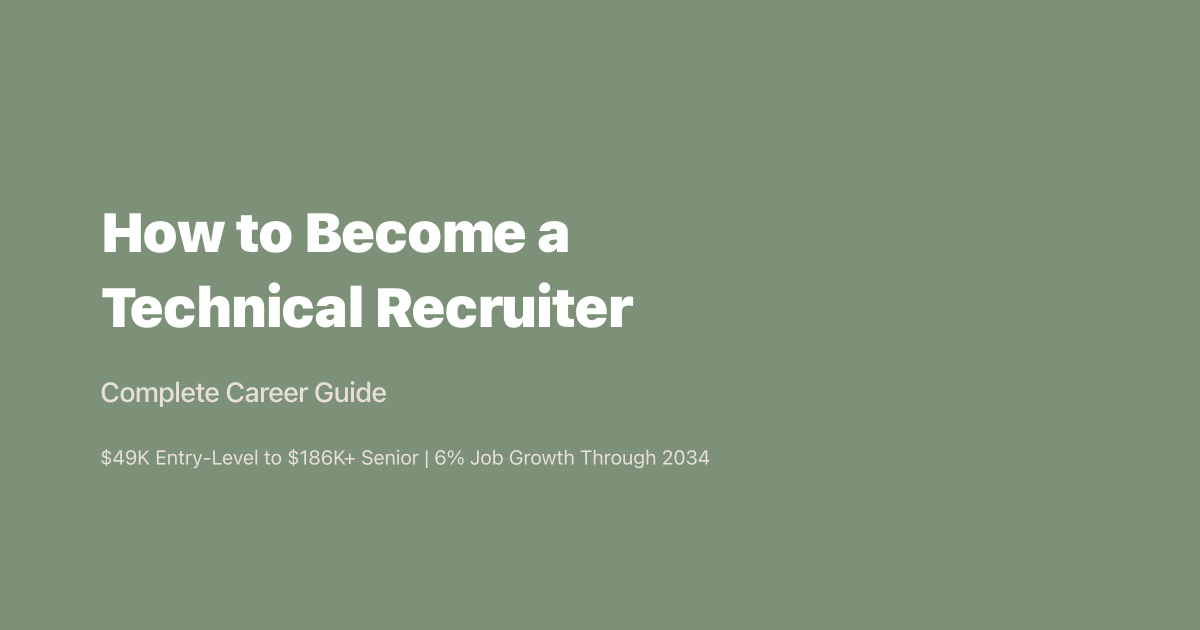
TL;DR: Technical recruiters earn $49K-$186K+ depending on experience (Indeed, Glassdoor). No specific degree is required. The BLS projects 6% job growth through 2034 with ~81,800 openings annually. Break in through a recruiting coordinator role or pivot from tech. AI tool fluency is now the biggest differentiator - 51% of organizations use AI for recruiting (SHRM, 2025).
What Does a Technical Recruiter Do?
Technical recruiters specialize in hiring technology professionals - software engineers, DevOps specialists, data scientists, cybersecurity analysts, and similar roles. The title goes by several names - technical recruiter, IT recruiter, or tech recruiter - but the core responsibilities are the same across companies. According to the BLS, 944,300 HR specialist jobs existed in the U.S. in 2024, and a growing share of those focus on technical hiring as every industry digitizes.
The job goes beyond posting openings and waiting for applications. Here's what a typical week looks like:
- Intake calls with hiring managers - Understanding what a "senior backend engineer" actually means at this specific company, what tech stack matters, and what trade-offs are acceptable
- Sourcing passive candidates - Searching LinkedIn, GitHub, Stack Overflow, and specialized communities to find people who aren't actively job hunting
- Technical screening - Evaluating resumes for relevant experience, asking informed questions about projects and technologies, and assessing whether someone's skills match the role
- Coordinating interview loops - Managing schedules across multiple interviewers, often across time zones
- Closing candidates - Negotiating offers, handling counteroffers, and selling the opportunity
What separates this role from general recruiting is the domain knowledge. You need to know the difference between React and Angular, understand why a candidate's experience with distributed systems matters for a backend role, and speak credibly with engineering leaders. You don't need to write code - but you need to understand what code does and why it matters.
Tech hiring specialists also carry a heavier load than the numbers suggest. While a typical recruiter might manage 30+ requisitions, technical roles demand deeper candidate evaluation and longer interview cycles - which is why the average time-to-fill for tech positions runs 52 days versus 41 days for all roles, according to SHRM's 2025 Recruiting Benchmarking report.
How Much Do Technical Recruiters Earn?
Tech hiring specialists consistently out-earn their generalist counterparts at every experience level. The average base salary sits at $86,095 according to Indeed (2026, 892 salary reports), while Glassdoor reports $121,980 in total compensation when you include bonuses and equity. The gap between those numbers matters - Indeed tracks base pay only, while Glassdoor includes the full package.

Here's a more detailed breakdown across sources:
| Level | Experience | Indeed (Base) | Glassdoor (Total Comp) |
|---|---|---|---|
| Entry-Level | 0-2 years | $48,846 | $75,900-$132,748 |
| Mid-Level | 2-5 years | $86,095 | $93,716-$162,042 |
| Senior | 5-9 years | $127,067 | $141,275-$250,857 |
| Director/VP | 10+ years | $156,000+ | $186,270+ |
A note on those Glassdoor numbers: they include base salary, bonuses, stock options, and other compensation. At major tech companies, equity packages can double the base for senior technical recruiters. The BLS's broader category of HR specialists tops out at $126,540 for the top 10% - but that includes non-tech recruiters pulling the average down. Technical recruiting at established tech companies consistently pays above that threshold.
Agency technical recruiters can earn significantly more through commission. Top billers at tech-focused staffing firms regularly clear $200,000+, though income is less predictable and tied directly to placements.
How to Be a Recruiter With No Experience
Skills Every Technical Recruiter Needs
According to SHRM's 2025 Talent Trends survey, 51% of organizations now use AI for recruiting and 89% report time savings - making AI tool proficiency a must-have alongside traditional hiring skills. Technical recruiting demands two distinct skill sets that don't always come naturally together: the interpersonal ability to build relationships and the technical literacy to evaluate candidates credibly.
Core Recruiting Skills
- Sourcing and Boolean search - Finding passive candidates who aren't actively applying requires advanced search techniques across LinkedIn, GitHub, and other platforms. Our Boolean search cheat sheet for recruiters covers the foundational syntax.
- Candidate assessment - Screening resumes, conducting phone screens, and evaluating technical fit without being an engineer yourself
- Relationship building - Engineers get dozens of recruiter messages weekly. Standing out requires genuine curiosity about their work and consistent follow-through
- Negotiation - Technical candidates often hold multiple offers. You need to understand total compensation, equity structures, and what actually motivates engineers to switch jobs
- Pipeline management - Tracking 26+ open requisitions simultaneously means living in your ATS and staying organized across multiple hiring stages
Technical Knowledge
You don't need to code. But you do need conversational fluency in:
- Programming languages and frameworks - Know the difference between Python, Java, JavaScript, Go, and Rust. Understand why a React developer isn't interchangeable with an Angular developer.
- System architecture concepts - Microservices vs. monoliths, cloud platforms (AWS, GCP, Azure), CI/CD pipelines, databases (SQL vs. NoSQL)
- Role taxonomy - Frontend vs. backend vs. full-stack, DevOps vs. SRE, data engineer vs. data scientist vs. ML engineer. Getting this wrong in a message to a candidate ends the conversation immediately.
- AI and machine learning basics - With AI roles surging, understanding what terms like LLM, fine-tuning, RAG, and MLOps mean gives you an edge sourcing these candidates
- Industry trends - Which technologies are growing? Which are declining? Candidates expect you to be informed.
The fastest way to build technical literacy isn't a computer science degree. It's spending time with engineers, reading tech blogs, attending meetups, and asking questions. Many successful tech talent specialists started in non-technical roles and built this knowledge over 6-12 months on the job.
AI Tool Proficiency
This is the skill that's changing fastest. According to SHRM's 2025 Talent Trends survey, 51% of organizations now use AI specifically for recruiting, and 89% of those report time savings. Recruiters who adopt generative AI tools save roughly one full workday per week, according to LinkedIn's Future of Recruiting 2025 report.
The practical skills to develop include AI-powered candidate sourcing platforms that scan hundreds of millions of profiles, automated outreach tools that personalize messages at scale, AI-assisted resume screening, and intelligent scheduling tools. Technical recruiters who master these tools handle more requisitions with better outcomes. Those who don't will increasingly fall behind as the efficiency gap widens.
Pin's AI scans 850M+ profiles to find technical candidates with recruiter-level precision - try it free.
How to Become a Technical Recruiter: 6 Steps
Most people break into technical recruiting within 6-18 months, depending on their starting point. Former engineers can transition in under 6 months; career changers from unrelated fields typically start as coordinators and reach full ownership within 12-18 months. Here's the step-by-step path.
Step 1: Build Your Foundation
A bachelor's degree in HR, business, communications, or psychology is common among recruiters, but it isn't required. The BLS confirms that HR specialist roles typically require a bachelor's degree, but many employers - especially in tech - prioritize demonstrated skills over credentials. What matters more: strong communication abilities, comfort with technology, and genuine interest in how technical teams work.
If you're coming from a technical background (engineering, IT, QA), you already have domain knowledge that most recruiting candidates lack. Your transition focuses on learning the recruiting process rather than the technical content.
Step 2: Learn Technical Fundamentals
Invest 2-3 months in building enough technical literacy to have informed conversations. Free resources include:
- freeCodeCamp and Codecademy - Not to become a developer, but to understand what developers do
- GitHub exploration - Browse open-source projects to understand how developers work and what their portfolios look like
- Tech podcasts and newsletters - Follow Hacker News, TechCrunch, and engineering blogs from companies like Stripe and Uber to stay current
- Stack Overflow - Read questions and answers to absorb the language engineers use
The goal isn't mastery. It's enough fluency to ask the right questions and recognize when a candidate's experience matches what a hiring manager needs.
Step 3: Get Your First Recruiting Role
Entry-level positions to target:
- Recruiting coordinator at a tech company - Schedule interviews, manage candidate pipelines, learn the process from inside
- Sourcing specialist - Focused on finding candidates, not the full hiring cycle. A good way to build search skills.
- Junior recruiter at a tech staffing agency - High-volume learning environment with rapid skill development. You'll handle tech roles from day one.
Agency recruiting builds skills faster because you'll work on multiple roles across different companies simultaneously. In-house roles at tech companies offer deeper exposure to engineering culture and a more predictable schedule. Both paths work.
Step 4: Specialize in Technical Roles
Once you're in a recruiting role, volunteer for or request technical requisitions. Ask to shadow intake calls with engineering managers. Sit in on technical interviews (most teams welcome observers). Build relationships with engineers on the team and ask them to explain what they do and what they look for in colleagues.
Expect a steeper learning curve here. The time-to-fill for tech roles averages 52 days versus 41 days for all roles, according to SHRM's 2025 Recruiting Benchmarking report. Senior engineering positions can stretch past 60 days. That extended timeline reflects both the difficulty of finding qualified candidates and the number of interview rounds engineering teams require.

Step 5: Invest in Certifications
Certifications aren't mandatory, but they signal commitment and build structured knowledge. The AIRS Certified Technical Recruiter (CTR) at $795 is the gold standard for this specialization, covering IT role taxonomy, Boolean sourcing, and technical candidate assessment. If budget is tight, start with the ADP AIRS entry-level certificate on Coursera. See the detailed comparison table in the next section.
Step 6: Build Your Technical Network
The best technical recruiters have strong relationships within the engineering community. Attend local tech meetups, contribute to conversations in relevant Slack and Discord communities, and build genuine connections on LinkedIn with engineers in your focus area. These relationships become your sourcing advantage over time - referrals from trusted connections convert at much higher rates than cold outreach.
Certifications Worth Getting
The AIRS Certified Technical Recruiter (CTR) is the most directly relevant credential, covering IT role taxonomy, technical sourcing techniques, and candidate assessment methodology. At $795 with 12 months of access, it's a reasonable investment for anyone serious about the specialization. Here's how it compares to other options:
| Certification | Issuer | Cost | Duration | Best For |
|---|---|---|---|---|
| Certified Technical Recruiter (CTR) | AIRS (ADP) | $795 | 12 mo. access, 2-yr valid | Tech-focused recruiters |
| Certified Internet Recruiter (CIR) | AIRS (ADP) | $795 | 12 mo. access, 2-yr valid | Sourcers, Boolean search pros |
| AI, Sourcing & Recruiting (CASR) | AIRS (ADP) | $895 | 12 mo. access | AI-era recruiters |
| Professional Recruiter (PRC) | AIRS (ADP) | $895 | 12 mo. access, 2-yr valid | Full-cycle generalist recruiters |
| SHRM-CP | SHRM | $495-$595 | 4-hr exam, 3-yr credential | HR-adjacent recruiters |
| Entry-Level Recruiter Certificate | ADP AIRS / Coursera | Coursera pricing | Self-paced | Career changers breaking in |
A common misconception: LinkedIn does not offer a standalone "Certified Recruiter" credential. LinkedIn Learning provides courses on recruiting topics, but there's no formal exam-based certification comparable to AIRS or SHRM.
Which Certification Should You Start With?
If you're early in your career and budget-conscious, start with the ADP AIRS entry-level certificate on Coursera, then pursue the CTR once you're in a tech-focused role. The CASR (AI, Sourcing & Recruiting) is worth considering too - AI proficiency is rapidly becoming a differentiator, and having a credential that validates it stands out on a resume. For experienced hiring professionals looking to formalize their HR knowledge, the SHRM-CP provides broad credibility across the talent acquisition field.
Career Path and Progression
Technical recruiting offers a clear progression with meaningful salary jumps at each level. The BLS projects HR specialist employment will grow 6% from 2024 to 2034 - faster than the 3% average across all occupations - with approximately 81,800 openings per year. That growth, combined with persistent demand for tech talent, creates consistent upward mobility for technical recruiters.
Typical Career Ladder
Years 0-2: Recruiting Coordinator or Junior Recruiter ($48K-$69K)
You'll screen resumes, schedule interviews, manage candidate communication, and learn the recruiting lifecycle by supporting senior recruiters. At a tech company, you'll begin absorbing technical vocabulary and understanding engineering team structures. This stage is about building process discipline and candidate experience skills.
Years 2-5: Technical Recruiter ($70K-$100K)
Full ownership of the hiring process for technical roles. You're running intake meetings with engineering managers, sourcing passive candidates, conducting screens, and managing offer negotiations. Most recruiters hit this level within two years if they actively pursue technical requisitions.
Years 5-9: Senior Technical Recruiter ($100K-$145K)
You own the hardest-to-fill roles - principal engineers, VP of Engineering, staff-level specialists. You're mentoring junior team members, designing sourcing strategies for new markets, and acting as a strategic partner to engineering leadership. Senior tech recruiters at top companies regularly earn $140K-$180K+ in total compensation.
Years 8-12: Talent Acquisition Manager ($130K-$170K)
Managing a team of recruiters, setting hiring targets, designing interview processes, and owning recruiting metrics. At this level, your impact is measured by team productivity and quality-of-hire across the organization, not individual requisitions.
Years 10+: Director or VP of Talent Acquisition ($156K-$200K+)
Company-wide hiring strategy, executive alignment, budget ownership, and employer brand. Glassdoor reports total compensation of $186,270 for senior technical recruiters, and director-level roles push well above $200K at established tech companies. This is the ceiling for the IC-to-leadership track.
Alternative Career Paths
Not everyone wants to manage people. Technical recruiters also move into:
- Independent/freelance recruiting - Building your own client base and earning commission directly. Top independent tech recruiters bill $1M+ annually.
- Recruiting operations - Designing systems, tools, and processes that make recruiting teams more efficient
- People operations or HR business partner - Broadening from recruiting into the full employee lifecycle
- Talent intelligence - Using data and market research to inform workforce planning and competitive analysis
How AI Is Changing Technical Recruiting
AI adoption in HR tasks climbed to 43% of organizations in 2025, up from 26% in 2024, according to SHRM's 2025 Talent Trends survey. For recruiting specifically, the numbers are even higher: 51% of organizations now use AI in their recruiting process, 66% use AI to write job descriptions, and 44% use it to screen resumes.
What does that mean for someone entering technical recruiting today? It means the job you're training for looks different than it did two years ago. Here's how.
Sourcing is increasingly AI-powered. Instead of manually searching LinkedIn profiles and building Boolean strings, technical recruiters use AI platforms that scan hundreds of millions of profiles to surface candidates matching specific criteria. Tools like Pin search 850M+ candidate profiles with recruiter-level precision, identifying technical talent based on skills, experience patterns, and company backgrounds that would take hours to find manually.
Outreach is automated and personalized. AI tools generate personalized messages at scale across email, LinkedIn, and SMS. The difference between a 5% response rate and a 48% response rate often comes down to whether messages feel genuinely personal or mass-produced. AI handles the personalization; the recruiter handles the relationship once a candidate responds.
Administrative work is disappearing. Interview scheduling, follow-up reminders, status updates, and initial screening questions are all areas where AI is taking over repetitive tasks. According to LinkedIn's Future of Recruiting 2025 report, recruiters who adopt generative AI tools save approximately one full workday per week. That time shifts toward higher-value activities: building candidate relationships, advising hiring managers on market conditions, and improving the interview experience.
The new skill isn't fighting AI - it's mastering it. TA professionals using LinkedIn Learning for AI skills grew 2.3x over 12 months (LinkedIn, 2025). And 73% of talent acquisition professionals agree that AI will fundamentally change how organizations hire. The technical recruiters who thrive will be those who treat AI as their daily operating tool, not something to learn later. For a deeper look at how AI fits into the recruiting workflow, see our guide to what AI recruiting is and how it works.
A Day in the Life of a Technical Recruiter
Day in the Life as a Tech Recruiter at Google
Numbers tell one story. The daily rhythm tells another. Technical roles require 21% more interview hours per hire compared to 2021, according to Ashby's Talent Trends Report (2024). Applications per hire have increased roughly 182% over the same baseline. That means more screening, more coordination, and more time spent separating strong candidates from the growing volume of applications.
Here's what a realistic day looks like for a mid-level technical recruiter managing 20-25 open requisitions:
Morning (8:30-12:00)
- Review overnight candidate responses and application queue
- 2-3 phone screens with candidates (30 minutes each, back-to-back)
- Intake call with a hiring manager for a new senior backend engineer role
- Update candidate statuses in the ATS
Afternoon (1:00-4:00)
- 60-90 minutes of active sourcing - searching candidate databases, reviewing GitHub profiles, crafting personalized outreach
- Debrief call with an interview panel about yesterday's onsite candidate
- Prepare and extend an offer to a data engineer candidate
- Respond to hiring manager questions about pipeline progress
Late afternoon (4:00-5:30)
- Follow up with candidates in various pipeline stages
- Coordinate next-round interviews across time zones
- Review weekly metrics: response rates, pipeline velocity, time-in-stage
Hiring professionals running this cycle across dozens of roles simultaneously average about 5.4 placements per quarter, according to Ashby's Talent Trends Report (Q3 2024). It's a role that rewards organization, quick context-switching, and the ability to maintain genuine relationships at scale. But it's also a role where AI sourcing tools can make the difference between drowning in administrative work and spending your time on the human interactions that actually close hires.
Career Changer Paths Into Technical Recruiting
With 81,800 HR specialist openings projected each year through 2034 (BLS), there's consistent demand for people entering the field from non-traditional backgrounds. Some of the strongest tech talent specialists didn't start in HR at all. Here's how different career backgrounds translate.
From software engineering or IT: You already speak the language. Your challenge is learning the recruiting process - sourcing, screening, pipeline management, and negotiation. Many companies actively prefer former engineers in technical recruiting roles because they can evaluate candidates more deeply. Expect to start at the mid-level pay range ($70K-$100K) given your domain expertise.
From sales or business development: Recruiting is fundamentally a sales role - you're selling candidates on opportunities and selling hiring managers on candidates. The pipeline management, objection handling, and closing skills transfer directly. Your learning curve is the technical vocabulary and understanding of engineering roles.
From general recruiting: You already know how to recruit. The transition is about building technical literacy and credibility with engineering teams. Request tech-focused requisitions, shadow technical intake calls, and invest in the AIRS CTR certification. Most general recruiters can specialize within 6-12 months of focused effort.
From customer success or account management: Relationship management and stakeholder communication are core to both roles. If you've worked at a tech company, you already understand the products and the people who build them. Learn sourcing fundamentals and the recruiting lifecycle, and you're well-positioned.
The BLS projects roughly 81,800 HR specialist openings per year through 2034, and a growing share of those require technical hiring expertise. Whatever your starting point, the career path is accessible - especially for people willing to combine technical curiosity with recruiting fundamentals and modern AI tools. For more on the sourcing strategies that define successful tech talent specialists, see our breakdown of tech recruitment sourcing strategies that work.
Frequently Asked Questions
Do you need a computer science degree to become a technical recruiter?
No. A computer science degree helps but isn't required. The BLS confirms HR specialist roles typically ask for a bachelor's degree, but 26% of LinkedIn job posts in 2024 didn't require a degree at all (LinkedIn, 2025). What matters is conversational technical literacy - enough to evaluate candidates and speak credibly with engineering teams. Many successful technical recruiters build this through self-study, certifications like the AIRS CTR ($795), and on-the-job learning over 6-12 months.
How long does it take to become a technical recruiter?
Most people can transition into a technical recruiting role within 6-18 months. If you're already a general recruiter, specializing takes roughly 6-12 months of focused effort on technical roles. Career changers from non-recruiting backgrounds typically start as coordinators or agency juniors and reach full technical recruiter status within 12-18 months. Former engineers can often make the switch in under 6 months since they already have the domain knowledge.
What is the salary range for technical recruiters?
Entry-level technical recruiters earn approximately $49,000 per year in base salary, mid-level recruiters average $86,095, and senior recruiters with 7+ years of experience reach $127,067 (Indeed, 2026). Total compensation including bonuses and equity pushes higher - Glassdoor reports $121,980 average total comp, with senior roles reaching $186,270+. Agency recruiters with commission can exceed $200,000 annually.
Is technical recruiting a good career in the AI era?
Yes. AI is automating administrative tasks - not eliminating the recruiter role. According to SHRM's 2025 Talent Trends survey, 89% of HR professionals using AI report increased efficiency, not job displacement. The BLS projects 6% growth for HR specialist roles through 2034 with ~81,800 annual openings. AI creates a wider efficiency gap between tech-fluent recruiters and those relying on manual methods, making skills-based hiring expertise and AI tool proficiency the biggest career differentiators.
What certifications should a technical recruiter get?
The AIRS Certified Technical Recruiter (CTR) at $795 is the most directly relevant credential, covering IT role taxonomy and technical sourcing. For broader HR credibility, the SHRM-CP ($495-$595) is widely recognized. The newer AIRS Certification in AI, Sourcing & Recruiting (CASR) at $895 addresses the AI skills gap. Career changers should start with the ADP AIRS Entry-Level Certificate on Coursera before investing in specialized credentials.
How do you become an IT recruiter?
Becoming an IT recruiter follows the same path as technical recruiting - the terms are largely interchangeable in most job markets. IT recruiters specialize in placing candidates for information technology roles: systems administrators, network engineers, security specialists, and software developers. The six steps in this guide apply directly. One distinction worth noting: IT recruiters often work with companies outside the traditional tech sector (healthcare, finance, government) that need IT staff but don't identify as tech companies. The AIRS Certified Technical Recruiter (CTR) covers IT role taxonomy specifically, making it the most relevant credential for aspiring IT recruiters.
Can you become a technical recruiter with no experience?
Yes. A recruiting coordinator role is the standard no-experience entry point - no prior recruiting background is required. Many tech companies and staffing agencies hire coordinators specifically to train them from scratch. From coordinator to full technical recruiter typically takes 12-18 months of active effort. The fastest path with no experience: apply to staffing agencies (higher volume, faster learning curve) or recruiting coordinator roles at mid-sized tech companies. You don't need a specific degree either - 26% of LinkedIn job posts in 2024 had no degree requirement at all (LinkedIn, 2025). Focus on building technical literacy alongside recruiting fundamentals.
Getting Started
Technical recruiting sits at the intersection of two growing fields - technology hiring and AI-powered talent acquisition. The demand is real: 81,800 HR specialist openings per year, 6% projected job growth, and a tech industry that will always need skilled hiring professionals who understand the difference between a React developer and a machine learning engineer.
The path is straightforward even if you're starting from zero. Here's what your first month could look like:
- Week 1: Audit your current technical vocabulary. Can you explain the difference between frontend and backend development? Between SQL and NoSQL? Start with the gaps.
- Week 2: Complete one introductory module on freeCodeCamp or Codecademy. Browse GitHub trending repositories to see what engineers actually build.
- Week 3: Apply for 3-5 recruiting coordinator or sourcing specialist roles at tech companies. Tailor each application to highlight your technical curiosity.
- Week 4: Bookmark the AIRS CTR certification page and start networking - attend one virtual tech meetup or join a recruiting-focused Slack community.
Whether you come from engineering, sales, general recruiting, or somewhere else entirely, the career is accessible to anyone willing to combine people skills with technical curiosity and modern AI tools.