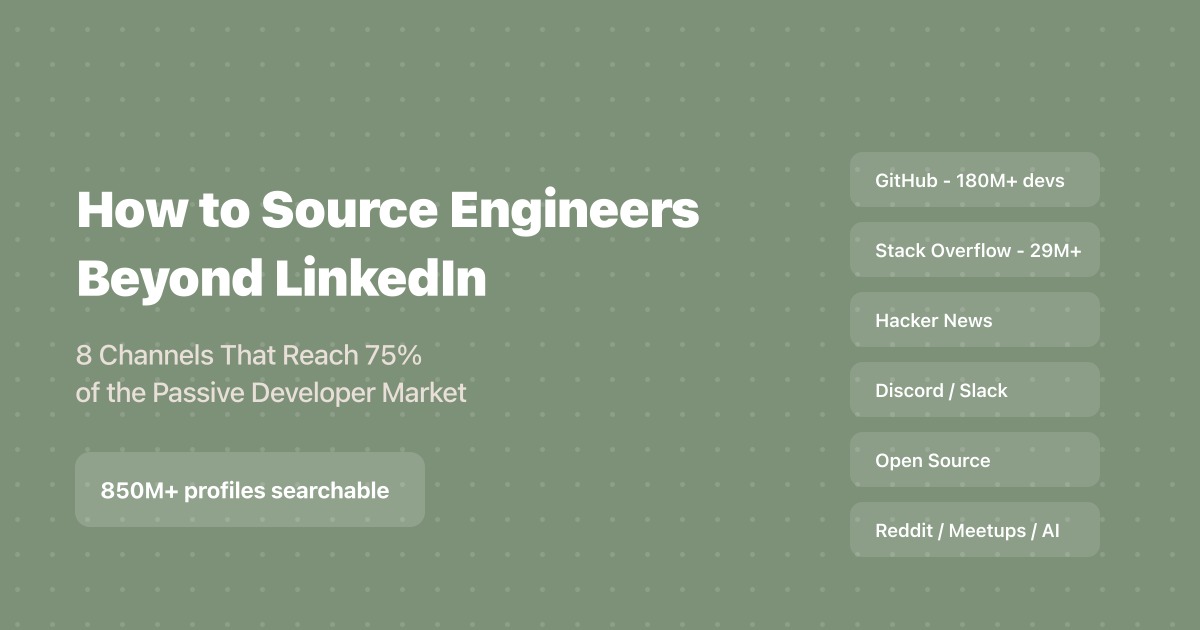
The best way to source engineers beyond LinkedIn is to combine developer community platforms - GitHub, Stack Overflow, Hacker News - with AI-powered sourcing tools that aggregate profiles from hundreds of sources at once. LinkedIn only surfaces a fraction of the engineering talent market. According to Stack Overflow's 2025 Developer Survey, 45.6% of developers aren't actively looking for new roles, and another 28.8% describe themselves as only "somewhat open." That's nearly 75% of the developer market sitting outside LinkedIn's active candidate pool.
This guide covers eight alternative sourcing channels, how to use each one effectively, and when to combine them for maximum reach. Whether you're hiring a single senior backend engineer or staffing an entire platform team, these channels give you access to candidates who never update their LinkedIn profiles.
TL;DR: LinkedIn reaches less than half the engineering talent pool. The eight channels below - from GitHub (180M+ developers) to AI sourcing platforms scanning 850M+ profiles - let you tap the 75% of developers who aren't actively job-hunting. Each channel has different strengths: community platforms show technical skill, while AI tools deliver speed and scale.
Why LinkedIn Alone Isn't Enough for Engineering Sourcing
The U.S. Bureau of Labor Statistics projects 129,200 software developer openings annually through 2034, with employment growing 15% over the decade - nearly four times faster than the average for all occupations. Demand is accelerating, and LinkedIn's candidate pool hasn't kept pace.
Three problems make LinkedIn particularly limiting for engineering roles:
Engineers don't maintain LinkedIn profiles. Unlike sales professionals or marketers, many software engineers treat LinkedIn as an afterthought. Their profiles list a job title and employer but skip the technical details recruiters need - languages, frameworks, open source contributions, and architecture experience. You can't search for what isn't there.
LinkedIn Recruiter is expensive and crowded. With seat licenses running $10,000+ per year, you're paying a premium to compete with every other recruiter messaging the same candidates. Senior engineers routinely report inbox fatigue from recruiter messages, which tanks response rates for everyone.
Passive engineers hide in plain sight. SHRM's 2025 Talent Trends report found 69% of organizations struggle to fill full-time positions. The engineers you need are writing code on GitHub, answering questions on Stack Overflow, and shipping side projects - not scrolling LinkedIn job feeds.
The fix isn't abandoning LinkedIn entirely. It's adding channels where engineers actually spend their time. Here are eight that work.

1. GitHub
GitHub hosts 180 million developer accounts as of the 2025 Octoverse report, with 36.2 million new users joining in 2025 alone. That makes it the largest developer community in the world - and one of the most underused sourcing channels for recruiters.
What makes GitHub different from LinkedIn is the quality of signal. You can see what languages an engineer writes in, how frequently they contribute, which projects they maintain, and how they collaborate with other developers. A profile with 500+ contributions in Go and active maintainership of a popular Kubernetes operator tells you more than any resume bullet point.
How to source on GitHub:
- Use GitHub's advanced search to filter by location, programming language, and follower count
- Search by organization to find engineers at specific companies
- Review contribution graphs - consistent activity over 12+ months signals reliability, not just a weekend hack
- Check starred repositories to understand what technologies interest someone
- Look at pull request quality on popular repositories for evidence of code review skill
Example search workflow: Say you need a senior Rust developer in Berlin. Go to github.com/search, set the type to "Users," and enter language:rust location:Berlin followers:>20. This surfaces active Rust developers based in Berlin with a community following. Click into profiles and check contribution frequency - you want engineers with green squares across 40+ weeks per year, not just a single January burst. Then review their pinned repositories for code quality and project relevance.
The catch: GitHub has no built-in messaging. You'll need to find email addresses through profile bios, linked websites, or git commit logs. Many engineers keep their most meaningful work in private repositories, so public profiles show only a partial picture. For a detailed walkthrough, see our complete GitHub recruiting guide.
2. Stack Overflow
Stack Overflow's 29 million registered users represent some of the most technically engaged developers on the internet. According to the platform's own 2025 data, 82% of developers visit at least a few times per month and 76% of active users have been on the platform for six years or longer. These are senior engineers with deep expertise - exactly the profiles that are hardest to find through job boards.
Stack Overflow shut down its Jobs product in March 2022, but the platform's value for recruiters actually comes from its Q&A data. A developer with a high reputation score in Python, distributed systems, or AWS didn't earn that by padding a resume. They earned it by solving real problems that other engineers upvoted.
How to source on Stack Overflow:
- Use Google X-ray search:
site:stackoverflow.com/users "python" "San Francisco" - Filter by tags to find specialists - a user with 5,000+ reputation in "kubernetes" is a proven expert
- Check the Stack Exchange Data Explorer (SEDE) for advanced queries across the full user database
- Cross-reference Stack Overflow profiles with GitHub and personal blogs for contact information
Why reputation scores matter: Stack Overflow's reputation system is cumulative and peer-validated. A user with 10,000+ reputation in "python" and "machine-learning" has answered hundreds of real technical questions - and other engineers agreed those answers were correct. That's a signal you can't fake. Compare that to a LinkedIn endorsement, where anyone can click a button without verifying skill. For specialist roles where domain expertise is non-negotiable, Stack Overflow reputation is the closest thing to a public technical exam.
Worth noting: No direct messaging, no job-seeking status indicators, and profiles can be pseudonymous. You'll often need to chain Stack Overflow to GitHub to a personal site to find an email address. Read our Stack Overflow recruiting guide for step-by-step X-ray search techniques.
3. Hacker News
Hacker News (news.ycombinator.com) is Y Combinator's community forum and one of the most influential platforms in the startup engineering world. Its monthly "Who is hiring?" and "Who wants to be hired?" threads regularly attract hundreds of posts from senior engineers, startup founders, and technical leaders.
What sets Hacker News apart is the seniority of its audience. This isn't a general job board - it's a community of engineers who build products, read technical papers, and debate architecture decisions. The developers active on HN tend to be senior individual contributors or engineering managers at high-growth startups.
How to source on Hacker News:
- Monitor monthly "Who wants to be hired?" threads (posted on the 1st of each month) - these candidates are actively looking
- Use HN Search (hn.algolia.com) to find users who discuss specific technologies in depth
- Check user profiles for linked websites, GitHub accounts, and email addresses
- Post in "Who is hiring?" threads if you have a compelling technical role at a startup
- Engage authentically in technical discussions before reaching out - HN users are allergic to cold pitches from recruiters who clearly don't understand the tech
How the monthly threads work: On the first of each month, three threads go live: "Who is hiring?" (companies posting roles), "Who wants to be hired?" (candidates advertising availability), and "Freelancer? Seeking freelancer?" Each thread stays pinned for 24-48 hours and generates 300-700 posts. The "Who wants to be hired?" thread is the goldmine - engineers list their skills, desired role type, location preferences, and sometimes compensation expectations. Bookmark it and set a monthly calendar reminder.
One drawback: Hacker News skews heavily toward startup culture and Bay Area tech. If you're hiring for enterprise, government, or non-tech-industry roles, the audience fit drops. Volume is also limited compared to GitHub or LinkedIn.
4. Developer Discord and Slack Communities
Developer communities on Discord and Slack have exploded since 2020. Major programming language communities now host tens of thousands of active members: the Python Discord server has 400,000+ members, Reactiflux (React developers) exceeds 250,000, and the Gopher Slack for Go developers hosts 70,000+ engineers. These are active communities, not dormant profiles.
The sourcing value here is context. When you see someone answering questions about Kubernetes networking in a DevOps Slack channel every week, you know they have hands-on expertise - not just a keyword on their resume. Community involvement is one of the strongest signals of genuine technical depth.
How to source on Discord and Slack:
- Join communities relevant to your tech stack - most have a #jobs or #careers channel
- Observe before posting. Identify consistently helpful members and reach out with specific, relevant opportunities
- Post roles in designated job channels with honest details about the company, tech stack, salary range, and remote policy
- Never DM members without permission - community norms are strict and you'll get banned
Top communities worth joining:
- Reactiflux (Discord) - 250,000+ React and JavaScript developers
- Python Discord - 400,000+ members covering all Python specialties
- Gophers Slack - 70,000+ Go developers, strong backend engineering presence
- Kubernetes Slack - 150,000+ members focused on cloud-native infrastructure
- MLOps Community (Slack) - ML engineers and data platform builders
The trade-off: Fragmented across hundreds of servers, no unified search, and building trust takes time. This channel works best for ongoing relationship-building, not one-off hiring sprints.
5. Open Source Projects
Open source contributors are among the most skilled and self-motivated engineers in the talent market. The GitHub Octoverse 2025 report shows open source repositories generated 1.4 billion contributions in 2025, with generative AI projects leading the charge. Contributors to high-profile projects like Linux, Kubernetes, React, or Terraform demonstrate collaboration skills, code quality, and the ability to work asynchronously across distributed teams.
How to source from open source:
- Identify projects that use the same technologies as your product
- Review contributor lists on GitHub - sort by number of commits or pull requests merged
- Read pull request discussions to evaluate communication style and technical reasoning
- Check CONTRIBUTORS or AUTHORS files in major repositories for names and email addresses
- Attend or sponsor open source conferences (KubeCon, PyCon, RustConf) to meet contributors in person
Red flags vs. green flags in contributor profiles: Green flags include consistent contributions over 6+ months, thoughtful PR descriptions, constructive code review comments, and responsiveness to maintainer feedback. Red flags include drive-by contributions (one commit, then silence), poorly documented changes, and combative behavior in issue discussions. The beauty of open source is that all of this is public - you can evaluate collaboration skills before ever scheduling a call.
The downside: Not all strong engineers contribute to open source. Many work at companies with restrictive IP policies, or they simply prefer to keep their work private. Open source sourcing gives you a very high-quality but narrow slice of the market.
6. Tech Meetups and Conferences
In-person and virtual tech events remain one of the highest-converting sourcing channels for engineering roles. According to SHRM's 2025 research, employee referrals and networking events consistently produce higher-quality hires and lower turnover than job board applications. Conferences and meetups offer something no online platform can - face-to-face conversation with engineers who are already thinking about their careers.
How to source at tech events:
- Prioritize events aligned with your tech stack: KubeCon for infrastructure, PyCon for Python, Strange Loop for polyglot engineers
- Attend talks and workshops, then connect with speakers and engaged audience members
- Host or sponsor a booth - but skip the generic "we're hiring!" banner. Talk about your engineering challenges instead
- Follow up within 48 hours with a personal reference to the conversation you had
- Use Meetup.com and Luma to find local events - many cities have weekly or biweekly language-specific meetups
Virtual events still work. The shift to hybrid and virtual conferences since 2020 has actually expanded reach for recruiting teams. Many major conferences now offer virtual attendance options, recorded talks, and online networking sessions. This means you can attend KubeCon in Detroit and PyCon in Pittsburgh without leaving your office - and still connect with speakers and attendees through the event's platform. The key is following up quickly while the event context is fresh.
The constraint: Events are time-intensive and geographically constrained. A single conference might yield 5-10 strong leads over three days. That's excellent quality but won't fill a high-volume pipeline alone.
7. Reddit Engineering Communities
Reddit hosts some of the most active engineering discussion communities online. The r/cscareerquestions subreddit has 1 million+ members, r/experienceddevs serves mid-to-senior engineers, and language-specific subreddits like r/golang, r/rust, and r/python each have hundreds of thousands of subscribers. These communities generate candid discussions about salaries, tech stacks, interview processes, and career moves that you won't find anywhere else.
How to source on Reddit:
- Monitor r/experienceddevs and r/cscareerquestions for engineers discussing job changes or frustrations
- Search for technical discussions to identify domain experts - someone writing a detailed breakdown of distributed systems trade-offs is worth reaching out to
- Post in hiring threads (many subreddits have monthly "Who is hiring?" threads) with detailed job specs, salary range, and tech stack
- Be transparent about being a recruiter. Reddit communities penalize corporate-speak harshly
Reddit's hidden value - competitive intelligence: Beyond direct sourcing, Reddit gives you unfiltered insight into what engineers care about when evaluating employers. Threads about "red flags in job postings," "companies with the best engineering culture," and "why I left [Company X]" tell you exactly how to position your outreach. Engineers on Reddit are brutally honest about what makes them switch jobs - use that intel to tailor your messaging across all channels.
Key subreddits for tech recruiting:
- r/cscareerquestions (1M+ members) - career advice, interview prep, and salary discussions
- r/experienceddevs - mid-to-senior engineers discussing architecture, leadership, and career growth
- r/golang, r/rust, r/python, r/javascript - language-specific technical communities
- r/devops - infrastructure and platform engineering discussions
The challenge: Most Reddit users are pseudonymous. Connecting a helpful username to a real person requires detective work through post history, linked GitHub accounts, or personal websites. For more detail, see our guide to sourcing talent on Reddit.
8. AI-Powered Sourcing Platforms
Every channel above has the same problem: manual effort. You're searching one platform at a time, piecing together profiles from GitHub commits and Stack Overflow tags and conference attendee lists. AI-powered sourcing platforms solve this by aggregating data from hundreds of sources into a single searchable database.
Pin, for example, indexes 850M+ candidate profiles with 100% coverage in North America and Europe. Instead of searching GitHub, then Stack Overflow, then LinkedIn separately, you describe the engineer you need - "senior Go developer with Kubernetes experience in Austin" - and the AI returns ranked candidates with contact information attached. Pin's automated multi-channel outreach across email, LinkedIn, and SMS delivers a 48% response rate, and roughly 70% of candidates Pin recommends are accepted into customers' hiring pipelines.
What makes AI sourcing fundamentally different from the other seven channels isn't just speed - it's coverage. Manual sourcing on GitHub or Stack Overflow gives you visibility into the 18-25% of engineers who are publicly active on those platforms. An AI platform like Pin aggregates signals from across the web to surface engineers who aren't visible on any single channel. That's the difference between fishing in one pond and searching the entire lake.
As Nick Poloni, President at Cascadia Search Group, put it: "The sourcing data is incredible, scanning 850M+ profiles with recruiter-level precision to uncover perfect-fit candidates I'd never find otherwise. Best of all, the outreach feels genuinely personalized and non-generic, driving sky-high reply rates where candidates even thank me for the thoughtful messages."
What AI sourcing handles:
- Candidate discovery across 850M+ profiles from hundreds of data sources
- Automated multi-channel outreach (email, LinkedIn, SMS) with personalized messaging
- Interview scheduling and calendar syncing
- Contact information lookup - no more chasing down email addresses manually
- Both specialist and high-volume hiring from a single platform
Pricing context: Pin starts at $100/month with a free tier available - a fraction of the cost of a single LinkedIn Recruiter seat at $10,000+/year. That math matters when you're scaling an engineering team.
How These 8 Channels Compare
Not every channel fits every hiring scenario. The table below breaks down each channel by what it's best at, its main limitation, and the investment required to get results.
| Channel | Best For | Main Limitation | Time Investment | Cost |
|---|---|---|---|---|
| GitHub | Evaluating code quality and language expertise | No messaging, limited public activity | High | Free |
| Stack Overflow | Finding proven specialists by technology tag | No messaging, pseudonymous profiles | High | Free |
| Hacker News | Senior engineers at startups | Small volume, startup-heavy bias | Medium | Free |
| Discord / Slack | Relationship-building, niche tech stacks | Fragmented, trust takes time | High (ongoing) | Free |
| Open Source | Self-motivated senior contributors | Narrow slice of the market | High | Free |
| Tech Meetups | High-quality face-to-face connections | Geographically limited, time-intensive | Very High | $0-$5,000+ (sponsorship) |
| Candid career discussions, salary intel | Pseudonymous users, hard to identify | Medium | Free | |
| AI Sourcing (Pin) | Speed, scale, and multi-source aggregation | Requires tool investment | Low | Free tier / from $100/mo |

Pin's AI scans 850M+ profiles to find engineers matching your exact requirements - try it free.
Building a Multi-Channel Engineering Sourcing Strategy
The most effective engineering sourcing strategies don't rely on one channel. They layer multiple channels based on the type of role, urgency, and team capacity. Here's a practical framework.
For specialist roles (staff engineer, security architect, ML infrastructure): Start with GitHub and open source to evaluate technical depth. Cross-reference with Stack Overflow for domain expertise signals. Use an AI sourcing platform to find contact information and automate outreach at scale.
For high-volume hiring (10+ engineers in the same role): Lead with AI sourcing to generate a high volume of qualified candidates quickly. Supplement with Reddit and Discord community posts for inbound interest. Use meetups for employer brand awareness that pays off over multiple hiring cycles.
For senior or leadership roles: Hacker News and conference networking surface the right seniority level. Open source maintainer lists identify technically respected leaders. AI sourcing fills gaps by finding senior engineers who aren't publicly active on any community platform.
For niche technologies (Rust, Elixir, blockchain, embedded systems): Start with language-specific Discord and Slack communities where specialists congregate. Open source projects in the niche ecosystem reveal active contributors. Supplement with AI sourcing to find professionals who have the experience but aren't active in public communities - they're often the most experienced engineers, working quietly at companies that don't encourage public visibility.
Tracking what works: Create a simple spreadsheet tracking each hire back to the channel where you first found the candidate. After 10-15 hires, you'll have real data showing which channels produce the best interview-to-offer ratios and lowest time-to-fill for your specific roles. That data should drive your ongoing channel investment - not assumptions about where engineers "should" be.
The common thread? AI sourcing platforms act as the connective layer across every strategy. They reduce the manual overhead of the other seven channels by aggregating data, finding contact information, and automating outreach - so your team spends time on conversations, not research. For a deeper look at the full engineering recruiting process, see our complete guide to recruiting software engineers.
5 Mistakes That Kill Non-LinkedIn Sourcing Efforts
Expanding beyond LinkedIn sounds straightforward. In practice, recruiters make the same errors repeatedly. Here's what to avoid.
- Sending generic outreach to community-sourced candidates. If you found someone through their Kubernetes contributions on GitHub, say so. "I reviewed your work on the cert-manager project and was impressed by your approach to the webhook validation refactor" will get a response. "I came across your profile and thought you'd be a great fit" will get deleted. Community-sourced candidates expect recruiters to have done their homework.
- Treating developer communities like job boards. Posting a job ad in a Discord #general channel or spamming Hacker News threads with recruiter copy is the fastest way to get banned. Every community has norms. Learn them. Most have designated job channels - use those exclusively, and include salary ranges, tech stack details, and remote policy. Anything less gets ignored or flagged.
- Searching one channel at a time without a system. Manually sourcing on GitHub, then Stack Overflow, then Reddit, then cross-referencing profiles in a spreadsheet is exhausting and doesn't scale. After your first 5-10 hires, the manual overhead becomes unsustainable. This is exactly where AI sourcing platforms pay for themselves - they automate the aggregation and cross-referencing that burns hours of recruiter time.
- Ignoring contact information challenges until it's too late. Six of the eight channels above have no built-in messaging. If your entire sourcing strategy depends on finding email addresses through git commit logs and personal websites, you'll lose candidates to faster recruiters. Budget for a contact information solution from the start - either a dedicated sourcing tool or an AI platform that includes contact lookup.
- Measuring success by candidate volume instead of candidate quality. A LinkedIn Recruiter search might return 500 results for "Python developer in Chicago." An open source search might return 15. But those 15 have publicly verified skills, demonstrated collaboration patterns, and real code you can evaluate. Track reply rates, interview-to-offer ratios, and time-to-hire per channel - not just the number of candidates sourced.
Frequently Asked Questions
What is the best alternative to LinkedIn for sourcing software engineers?
GitHub is the strongest single alternative, with 180 million developer accounts and the ability to evaluate code quality directly. However, AI sourcing platforms like Pin provide the broadest reach - 850M+ profiles aggregated from hundreds of sources - with automated outreach that delivers a 48% response rate. The best approach combines both.
How do you find passive engineering candidates who aren't on LinkedIn?
Passive engineers are active on developer platforms even when they're not job-hunting. Search GitHub contribution histories, Stack Overflow expertise tags, open source maintainer lists, and developer Discord communities. According to Stack Overflow's 2025 survey, 74.4% of developers are either not looking or only somewhat open to new roles - these platforms surface them where LinkedIn can't.
Is it worth paying for AI sourcing tools when free channels exist?
Free channels like GitHub and Stack Overflow deliver high-quality candidates but require significant manual research per qualified lead (2-6 hours based on Pin's internal workflow analysis). AI sourcing tools reduce that to minutes. Pin starts with a free tier (no credit card required) and paid plans from $100/month - a fraction of LinkedIn Recruiter's $10,000+/year seat cost. For teams hiring more than one or two engineers per quarter, the time savings alone justify the investment.
What response rate should recruiters expect from non-LinkedIn outreach?
Response rates vary significantly by channel and approach. Standard LinkedIn InMail tends to underperform for engineering roles because senior developers receive so many messages. Personalized outreach referencing someone's GitHub contributions or open source work typically performs better because it demonstrates genuine interest. Pin's multi-channel outreach (email, LinkedIn, and SMS combined) hits a 48% response rate across all roles.
Can small recruiting teams realistically use all 8 channels?
No - and they shouldn't try to. Small teams should pick 2-3 channels that match their hiring profile. A startup hiring backend engineers might focus on GitHub + Hacker News + AI sourcing. An agency filling enterprise roles might prioritize conferences + open source + AI sourcing. The key is using an AI platform as the base layer to handle volume, then adding 1-2 community channels for relationship depth. See our guide to the best sourcing tools for recruiters for more options.
Source your next engineer with Pin's AI - free to start