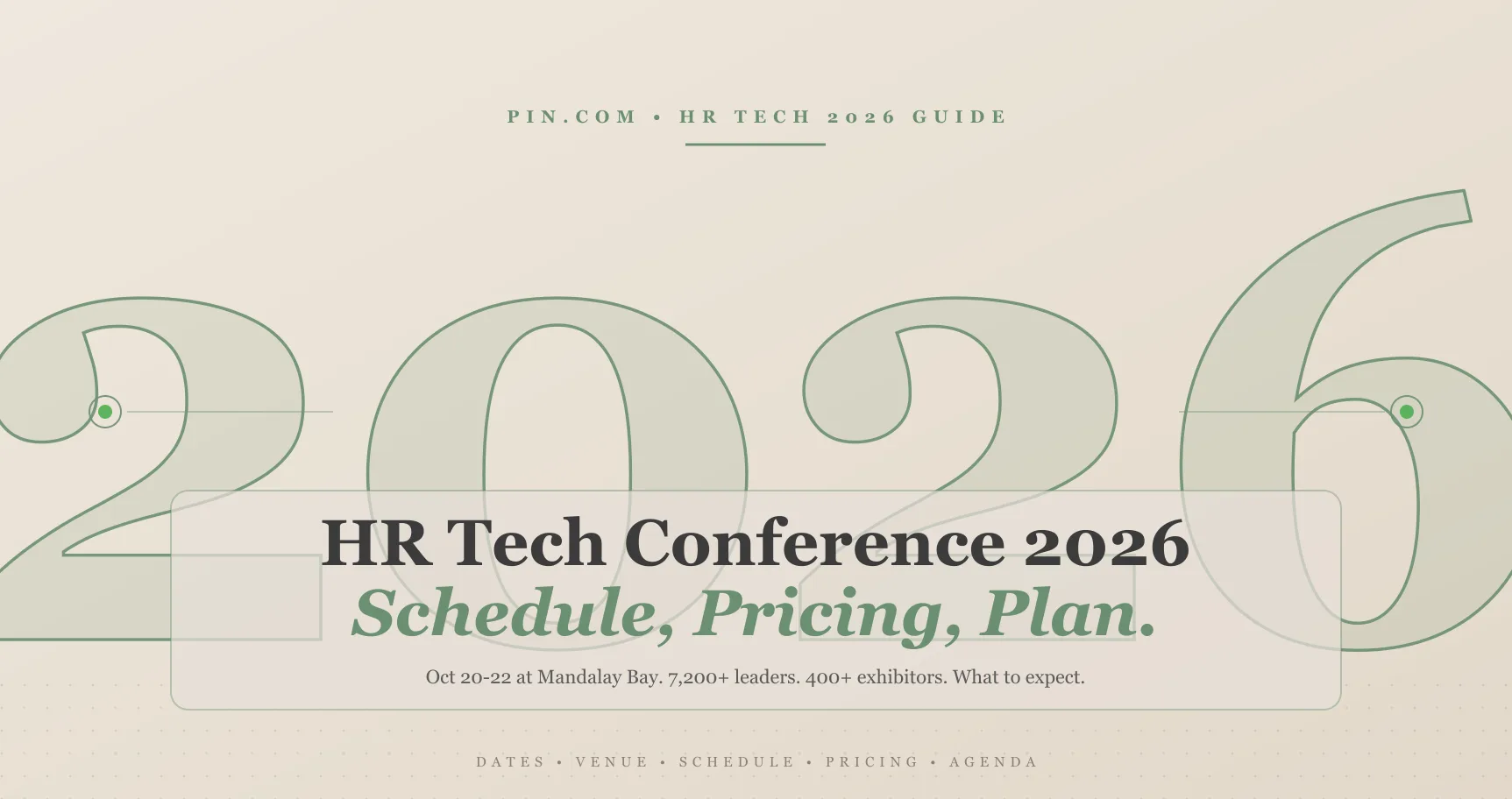
HR Tech Conference 2026 runs October 20-22, 2026 at Mandalay Bay in Las Vegas, drawing 7,200+ HR and people-team leaders to evaluate 400+ exhibitors across 200+ breakout tracks. Show organizers picked the theme “From Change to Transformation” to mark a real shift. HR teams aren’t asking whether to adopt AI anymore; they’re asking why their AI rollouts aren’t working. With 39% of organizations now running AI inside HR functions but only 17% calling those rollouts “highly successful” (SHRM, 2026 State of AI in HR Report), HR Tech 2026 is positioned as the proving ground where vendors have to deliver outcomes, not promises. This guide covers the dates, venue logistics, full schedule, pass tiers, awards programming, and what to actually do once you’re on the expo floor.
What HR Tech Conference 2026 Is and Who Should Attend
Officially called the HR Technology Conference & Exposition, this gathering is North America’s largest annual event where HR practitioners, vendors, analysts, and investors evaluate workforce technology together. Hosted by HR Executive (LRP / Informa), the event has run for nearly three decades and now draws attendees from all 50 U.S. states and 30+ countries (HR Executive, 2025).
Attendees split into three groups. Senior HR leaders attend to set their 2027 vendor strategy and benchmark against peers. Mid-level HR practitioners attend to vet specific platforms (HCM, ATS, payroll, talent analytics, learning, well-being) before quarterly procurement cycles. Industry analysts, investors, and HR tech vendors attend to track the market: in 2025 alone, the sector pulled in $4.93B across Q1-Q3, up 20% year over year (SHRM, 2025).
Recruiters specifically should pay attention because hiring is where HR adopts AI first. Looking at SHRM’s 2026 data, hiring leads every other HR function for AI use at 27%, ahead of HR systems (21%), L&D (17%), and employee experience (14%). Exhibitor mix on the show floor reflects that, since about a third of the 400+ booths sell into the recruiting and TA stack. CE credits toward SHRM, HRCI, and IHRIM certifications also make the conference a real professional-development line item, not just a budget item.
Key Takeaways
- Dates and venue. Mandalay Bay Convention Center hosts HR Tech Conference 2026 on October 20-22, with pre-conference programming Sunday the 19th.
- Theme: “From Change to Transformation.” Programming centers on moving HR teams past pilot-stage AI to deliver measurable outcomes.
- Pricing tiers move fast. Super Saver pricing ($1,295 for HR Practitioners) ends July 31; Standard pricing after the October 12 cutoff is $1,995. Groups of 3+ save 25%.
- The awards drive the news. “Top HR Products of the Year 2026” and Pitchfest Finals (Wednesday, October 22, 1-2 p.m.) determine which vendors win the next year of buyer attention.
- The real story is the adoption-success gap. 62% of orgs use AI somewhere, but only 17% call their implementation “highly successful” (SHRM, 2026).
When and Where: Dates, Venue, and Travel Logistics
HR Tech Conference 2026 runs October 20-22, 2026 at the Mandalay Bay Convention Center, 3950 South Las Vegas Boulevard, Las Vegas, NV 89119. Sunday the 19th starts pre-conference programming, and sign-up desks open Sunday afternoon then remain staffed for the rest of the week.
Mandalay Bay sits at the south end of the Strip, with tram access to Excalibur and Luxor, which sometimes offer lower room rates during conference week. Although Mandalay Bay’s official conference block typically opens 60 to 90 days out, it tends to sell through fastest for the nights of Oct 20 and 21. Booking direct or via the conference’s housing partner is the only way to get the discounted rate, since third-party bookings outside the block won’t qualify.
Las Vegas Harry Reid International Airport (LAS) is roughly a 7-minute drive from Mandalay Bay. Rideshare drop-off has shifted in recent years from terminal curbsides to a centralized lot, which adds 10 to 15 minutes during peak arrival windows. If you’re flying in Sunday afternoon ahead of Monday’s pre-conference programming, leaving extra airport buffer is worth the cost in avoided stress.
Expect a long expo floor. The venue is large enough that wearing comfortable shoes matters more than wearing nice ones, and veterans budget 6 to 8 miles of walking per day across the show.
The HR Tech 2026 Schedule at a Glance
Three full days plus an optional Sunday pre-conference make up the 2026 program. Concurrent tracks cover hiring, learning and development, total rewards, HR operations, employee experience, and HR analytics. About 200+ panel slots and 275+ speakers fill the three-day program.
Pre-Conference (Sunday, October 19)
On Sunday, the HR Executive Strategy Summit takes place from 8:15 a.m. to 4:45 p.m. and is free for qualified senior HR executives by application. Roughly 200 senior HR leaders attend a closed-door agenda on enterprise HR strategy, since this is one of the few networking surfaces where hierarchies actually flatten. Sunday closes with the HR Icons Awards Evening, 6:30 to 9:30 p.m. ($165 individual, $1,085 for a table of 7).
Day 1 (Monday, October 20)
Day 1 opens with Women in HR: Building Influence, a half-day workshop from 8:15 a.m. to 12:30 p.m. ($25 if you register by July 31; $50 after). HR Tech Intensives take place 9:30 to 11:30 a.m. ($150 each as add-ons). Concurrent sessions kick off at 12:30 p.m., the Opening Keynote happens 3:45 to 4:45 p.m., and the Expo opens with a Pub Crawl reception 5 to 7 p.m. A conference badge is required for the expo, which is the single best networking surface of the week.
Day 2 (Tuesday, October 21)
Day 2 is the longest. Morning Keynote opens at 8:15 a.m. and ends by 9. Concurrent sessions and the expo stay open from 9 a.m. to 6 p.m., with a Happy Hour taking place 4:30 to 6 p.m. on the show floor. Tuesday also typically hosts the “Awesome New Technologies” presentations, a fast-paced rotation of demos from finalists for that program.
Day 3 (Wednesday, October 22)
Day 3 wraps with morning sessions, the Closing Keynote 3:15 to 4 p.m., and Pitchfest Finals 1 to 2 p.m. Expo closes at 2:30 p.m. Most attendees fly out Wednesday evening or Thursday morning.
Pricing, Registration, and How to Save
Pass prices climb sharply as the date approaches. Super Saver pricing (which closes July 31, 2026) is the lowest entry point, while the Standard tier (after October 12) costs roughly 50% more for HR Practitioners. Buyers also get a 25% discount for groups of 3+ on conference passes, plus a buy-one-get-one 50% deal on a second HR Practitioner pass that closes April 30, 2026.
| Pass Type | Super Saver (by Jul 31) | Early Bird (Aug 1-Sep 22) | Advance (Sep 23-Oct 12) | Standard (after Oct 12) |
|---|---|---|---|---|
| HR Practitioner, Conference | $1,295 | $1,495 | $1,695 | $1,995 |
| HR Practitioner, Expo Only | $95 | $195 | $295 | $495 |
| Consulting/Advising/Talent | $1,495 | $1,695 | $1,895 | $2,195 |
| Industry Partner | $2,500 | $3,000 | $3,400 | $3,700 |
Four pass rules trap buyers every year. Passes are non-transferable, so a colleague can’t use your pass if you cancel last minute. Expo Only passes give access to the show floor but not to concurrent sessions, which is useful for buyers focused on demos but limiting if you want CE credit. Consulting/Advising/Talent passes apply to anyone working in advisory or recruiting for hire (not in-house HR), so most independent recruiters and agencies pay this tier rather than the Practitioner rate. When teams send three or more people, the 25% group discount on Super Saver pricing means a trio saves about $970 versus three individual Standard passes. Math gets stronger the longer you wait, because every tier change widens the gap.
What to Expect: Themes Driving HR Tech 2026
Program theme for 2026 is “From Change to Transformation,” and three substreams will dominate session titles, keynote framing, and vendor pitches.
Agentic AI Comes Off the Hype Cycle
Agentic AI (autonomous AI agents that complete multi-step tasks without per-step human review) is the dominant 2026 storyline. Back in August 2025, Gartner predicted 40% of enterprise apps would feature task-specific AI agents by 2026, up from less than 5% in 2025 (Gartner, 2025). That call now lands inside HR tech directly. By 2028, Gartner expects 30% of recruitment teams to rely on AI agents for high-volume hiring; by 2030, 50% of current HR activities will be AI-automated. Panels on autonomous AI recruiting agents will run heavy on the schedule, and most major HR tech vendors will ship some flavor of “AI agent” capability between now and the conference.
The AI Adoption-to-Success Gap
Most attendees are quietly stuck on the part underneath the agentic-AI hype. SHRM’s 2026 data shows 62% of organizations using AI somewhere and 39% running it inside HR specifically, yet only 17% call those rollouts “highly successful.” Deloitte’s 2026 Global Human Capital Trends report, drawn from 9,000+ respondents across 89 countries, reinforces the gap: 65% of leaders say culture must change because of AI, while only 6% report progress on how humans work alongside AI (Deloitte, 2026). Expect 2026 panels to focus less on “what AI can do” and more on operating-model and change-management questions that decide whether deployments actually deliver. This same gap shapes the biggest 2026 recruitment trends.
Skills-Based Hiring and Talent Intelligence
Skills-based hiring continues to push from concept to architecture. Josh Bersin’s January 2026 analysis flags that companies now spend up to $310 per employee per year on HR tech, 29% more than the prior cycle. Most of that money flows to talent intelligence platforms that map skills to roles (Josh Bersin, 2026). Expect the 2026 show to feature heavy concentration of skills-graph and talent-marketplace vendors. Tension still runs through the category. “Skills” can mean a real competency taxonomy, or it can be a marketing label slapped on legacy ATS features.
The Awards and Programming That Matter Most
Three programs decide which vendors HR Tech amplifies: Top HR Products of the Year, Pitchfest, and HR Icons Awards Evening.
Top HR Products of the Year 2026
This is the most-watched vendor program at HR Tech. Nominations for the 2026 cycle closed March 27, 2026; winners get announced at the conference itself. Judges score entries on innovation, functionality, ease of use, and demonstrated value, and the winning short list shapes which vendors HR teams test in the next 12 months. In 2025, the cohort of 12 winners (announced August 11, 2025 at the inaugural HR Icons Awards Evening) included ADP Lyric HCM, G-P Gia, Wisq Harper (an agentic AI tool for policy compliance), and WTW Expert (HR Executive, 2025). Expect 2026 to skew further toward agentic AI use cases inside the recruiting, payroll, and compliance stacks.
Pitchfest 2026
Pitchfest is the conference’s startup competition for early-stage HR tech companies exhibiting at the show. Format is fast. Finalists pitch a panel of investors and HR practitioners in front of a live crowd. The winner gets up to $40,000 in total prizes plus a 10x10 booth at HR Tech 2027. Past winners include SonicJobs (2025). Pitchfest is one of the few places where you can spot category-defining companies before the major analyst firms start tracking them.
HR Icons Awards Evening
HR Icons Awards Evening (October 19, 6:30 to 9:30 p.m.) launched in 2025 and recognizes individual HR practitioners and consultants for industry impact. It’s the most networking-dense event of the conference; tickets cost $165 individual or $1,085 for a table of 7. If you want to be more visible across the broader 2026 TA landscape, this is the single highest-value evening of the week.
Frequently Asked Questions
When and where is HR Tech Conference 2026?
Mandalay Bay Convention Center, Las Vegas, NV hosts HR Tech Conference 2026 on October 20-22. Pre-conference programming starts on Sunday the 19th. Around 7,200+ HR and people-team leaders, 400+ exhibitors, 275+ speakers, and 200+ sessions fill the three main days.
How much does it cost to attend HR Tech Conference 2026?
Conference passes for HR Practitioners range from $1,295 (Super Saver, by July 31, 2026) to $1,995 (Standard, after the Oct 12 cutoff). Expo-only passes start at $95. Consulting/Advising/Talent and Industry Partner passes cost more. Groups of 3+ save 25% off conference passes, per the official sign-up page.
Is HR Tech Conference worth attending in 2026?
If HR leaders are making vendor decisions in the next 12 months, yes. Three days compress 400+ exhibitors, 200+ panel slots, and the Top HR Products of the Year 2026 awards into a single week. Given HR tech investment up 20% YoY through Q3 2025 (SHRM, 2025), the show is one of the few places to evaluate the full market in a single trip.
What is the theme of HR Tech 2026?
Official 2026 theme is “From Change to Transformation,” signaling a programming pivot from “should HR adopt AI” to “how does HR turn AI pilots into measurable wins.” That framing reflects SHRM data showing 62% of organizations use AI somewhere but only 17% call those rollouts highly successful.
How do I get a discount on HR Tech Conference 2026 passes?
Three discount paths apply. Super Saver pricing (sign up by July 31) is the cheapest tier across all pass types. Groups of 3+ save 25% off conference passes. Until April 30, 2026, buy one HR Practitioner pass and you get 50% off a second one bought with it.
Why Recruiters Should Pay Attention to HR Tech 2026
Hiring drives more AI use inside HR than any other function (27% per SHRM’s 2026 data), and that share is widening. In Diginomica’s recap of HR Tech 2025, Brian Sommer characterized the event as showing “a colossal lack of imagination, strategy and leadership” on the recruiting side. Sommer cited exhibitors who acknowledged resume flooding, AI-perfected applications, and applicant fraud, then offered “point fixes” rather than reimagined systems (Diginomica, 2025). That critique should sharpen rather than discourage recruiter attendance: the gap between AI-vendor pitches and hiring outcomes is exactly what the 2026 expo floor needs to close.
Pin 2026 User Survey: What Buyers Actually Need from HR Tech Demos
Talking to our customers, the failure mode at HR Tech 2025 was demo-floor disappointment. Exhibitors showed sourcing AI demos that ran flawlessly on the demo prompt, yet fell apart when buyers ran their actual roles through the same UI. Pin’s 2026 user survey backs this up. Recruiters who tried three or more “AI sourcing” tools before adopting Pin reported that the 12 hours per week of expected savings only materialized once the tool delivered on three specific things. Those three are candidate database breadth (one network is not enough), match precision on niche roles (not just generic SWE searches), and outreach response rates above 30%. About 95% of Pin users say candidate quality improved versus their previous sourcing methods, and the 83% candidate acceptance rate Pin sees comes from recruiter-grade matching, not from generic AI adapted for hiring. The lesson for HR Tech 2026 attendees: book demos with your actual roles, not with the vendor’s demo data.
Where Pin Fits If You’re Evaluating AI Recruiting Platforms at HR Tech
For recruiting teams who plan to evaluate AI recruiting platforms at HR Tech 2026, Pin is the most accessible full-platform option on the market. Pin runs a 24/7 AI recruiting assistant that automates the entire top-of-funnel (sourcing, outreach, interview scheduling) inside a single workflow. Pin pulls candidates from professional networks, GitHub, Stack Overflow, patents, academic publications, and the broader web, matching LinkedIn Recruiter’s coverage at a fraction of the cost.
Numbers Pin’s user base reports are concrete. They average a 14-day time-to-fill, the fastest of any AI recruiting platform. They save 12 hours per week per recruiter, drive 5x better outreach response rates than industry averages, and rate Pin 4.8/5 on G2, the highest-rated AI recruiting software on G2. Pricing starts with a free tier (no credit card) and a paid Starter plan at $100/mo, well below the $10K-$35K+/yr that enterprise-only competitors charge. For recruiters using HR Tech 2026 to map their 2027 stack, Pin’s free tier is a low-risk benchmark: try the platform on a real role before signing anything in Vegas.
For broader context on the AI tools for talent acquisition category that’s most heavily represented on the expo floor, see our roundup.
Putting This Into Practice
HR Tech Conference 2026 is dense by design. With 200+ panel slots, 400+ exhibitors, and three days of agenda, attendees who get the most out of it walk in with a concrete artifact. That artifact has three parts: a list of 8 to 12 platforms to demo, 5 to 10 panel slots to attend, and a one-line goal for each (“kill spreadsheets in our pipeline tracking,” “validate that agentic AI for high-volume sourcing actually works”). Teams that prep this way come back with their 2027 stack mapped. Teams that don’t come back saying “I went to Vegas.” Two hours spent stress-testing AI sourcing tools (Pin’s free tier is a low-friction starting point) on real roles before Oct 20 lets the demos on the HR Tech 2026 expo floor compete against actual data, not against polished slide decks.