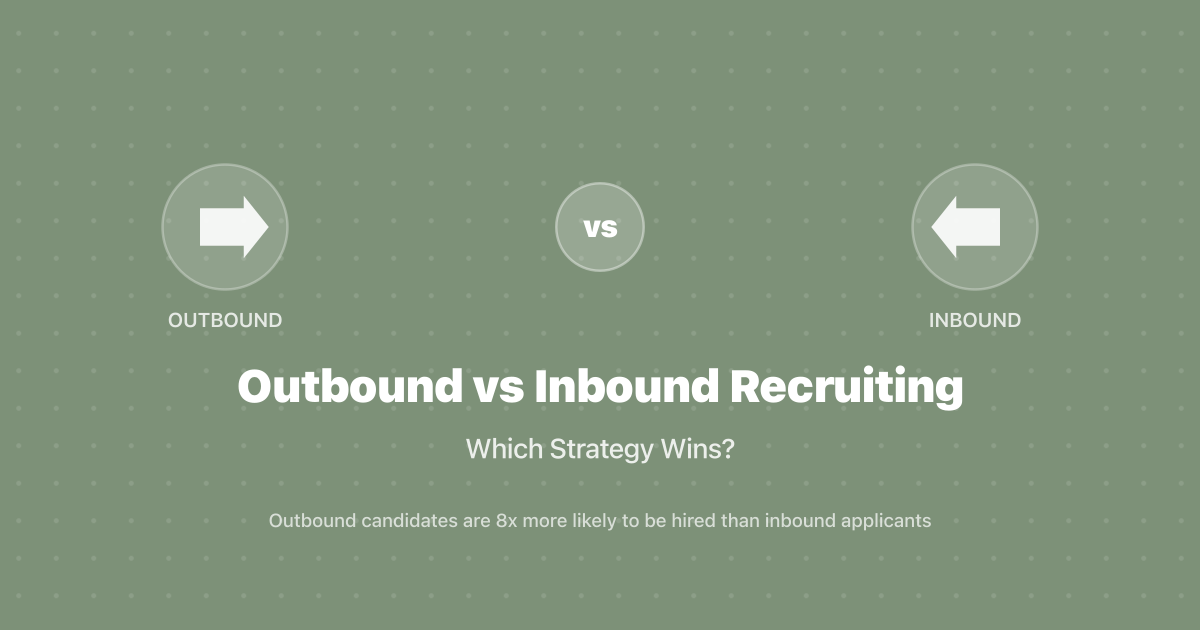
Outbound recruiting wins for speed, candidate quality, and conversion rates - but inbound recruiting builds a sustainable pipeline that reduces long-term cost-per-hire. The real answer? You need both, weighted toward outbound for specialized and urgent roles. A 2026 industry benchmarks study analyzing 1.2 million hires across thousands of companies found that outbound-sourced candidates are 8x more likely to be hired than inbound applicants, making proactive sourcing the higher-ROI activity for most teams.
That doesn't mean you should ignore inbound entirely. A strong employer brand reduces cost-per-hire by up to 50%, according to LinkedIn Employer Brand research. The question isn't which strategy to pick - it's how to balance them based on your roles, your timeline, and your team's capacity.
This guide breaks down the data behind both approaches, compares them across seven key dimensions, and shows how AI is shifting the balance toward outbound at every team size.
TL;DR: Outbound-sourced candidates convert to hires at 8x the rate of inbound applicants (2026 benchmarks, 1.2M hires analyzed). Inbound builds long-term volume at lower cost. The best teams run both, using AI sourcing tools to make outbound affordable at any scale.
What Is Outbound Recruiting?
According to Rally ReachMap data built on U.S. Bureau of Labor Statistics figures from February 2026, 74.4% of the reachable talent market is passive - they're not actively looking for work. Only 4.1% of professionals are actively job hunting at any given time. Outbound recruiting is how you reach the other 95.9%.
In practice, outbound recruiting means your team proactively identifies, contacts, and engages candidates who haven't applied to your open roles. The process includes:
- Candidate identification - searching databases, LinkedIn, GitHub, and professional communities for people with the right skills
- Contact discovery - finding verified email addresses and phone numbers
- Personalized outreach - sending tailored messages via email, LinkedIn, or SMS
- Follow-up sequences - multi-touch campaigns that build interest over time
- Warm handoff - converting interested prospects into active candidates in your pipeline
Proactive sourcing is the dominant strategy for specialized roles, senior positions, and any hire where the best candidates aren't browsing job boards. Understanding the distinction between sourcing and recruiting helps clarify where outbound fits: it's the sourcing side of the equation, focused entirely on pipeline generation.
What Is Inbound Recruiting?
Inbound hires hit their highest point in four years during Q2 2025, reaching 52% of all hires, according to Ashby's Talent Trends Report analyzing roughly 250,000 hires. When the job market favors employers, more candidates apply on their own - making inbound look like the easier path.
Inbound recruiting attracts candidates to you rather than chasing them. It relies on:
- Job postings - listings on your careers page, job boards, and aggregators
- Employer branding - company culture content, employee testimonials, and social proof
- Recruitment marketing - content, events, and campaigns that position your company as an employer of choice
- Employee referral programs - internal networks surfacing candidates who already have a connection to your organization
- SEO and social media - organic visibility that keeps your openings in front of job seekers
The appeal is obvious: candidates come to you pre-interested, which means less cold outreach and lower per-candidate effort. But as we'll see, inbound volume often masks a conversion problem.
How Do Conversion Rates Compare?
The gap between inbound volume and inbound quality is larger than most teams realize. Industry benchmarks analyzing over 1.2 million hires show that only 0.5% of inbound applicants ultimately receive an offer - roughly 1 hire per 200 applications. Outbound-sourced candidates, by contrast, convert at approximately 6%, making them 8x more likely to result in a hire.
Here's what that looks like across hiring channels:

The takeaway is stark. Job boards flood your inbox but produce fewer than 1 in 4 hires. Outbound sourcing generates a tiny fraction of total applications yet accounts for 11% of hires - a 4x efficiency ratio. Referrals follow the same pattern, converting at dramatically higher rates than raw application volume would suggest.
What does this mean in practice? If your team is spending 80% of its time screening inbound applicants, you're investing in the lowest-converting channel. According to CareerPlug's 2025 benchmarks, employers sift through an average of 180 applicants per hire from job boards alone. That's 180 resume reviews, screening calls, and coordination emails for a single placement.
How Does Cost-Per-Hire Differ Between Outbound and Inbound?
The average cost-per-hire sits at $4,700, according to SHRM's 2025 Recruiting Benchmarking Report. But that number blends outbound and inbound costs together, hiding the real economics of each approach.
Inbound recruiting has lower marginal cost per candidate. Once you've built your employer brand, posted jobs, and set up your careers page, applications flow in without per-candidate spend. A strong employer brand reduces cost-per-hire by up to 50%, per LinkedIn's employer brand research. The catch? Building that brand takes months of content production, employer review management, and marketing investment before it generates consistent returns.
Proactive candidate sourcing historically cost more per candidate because it required manual research, personalized messaging, and dedicated sourcing headcount. But AI has flipped that equation. Tools that scan hundreds of millions of profiles and automate multi-channel outreach have compressed what used to take a full-time sourcer days into hours - or minutes.
| Cost Factor | Outbound | Inbound |
|---|---|---|
| Upfront investment | Sourcing tool subscription ($100-$250/mo) | Employer brand build (months of content + design) |
| Per-candidate cost | Higher (contact credits, personalization time) | Lower (applications arrive organically) |
| Time to first results | Days to weeks | Months to quarters |
| Screening burden | Low (pre-qualified candidates) | High (180 applicants per hire on average) |
| Conversion rate | ~6% of sourced candidates hired | ~0.5% of inbound applicants hired |
| Quality signal | You choose who enters the pipeline | Self-selected applicants (variable fit) |
| Scale ceiling | Limited by outreach capacity (AI removes this) | Limited by employer brand reach and job board spend |
When you factor in the hidden cost of screening unqualified inbound applicants - recruiter hours, scheduling overhead, hiring manager interview time - the per-hire cost of inbound often exceeds outbound for specialized roles. Outbound lets you front-load quality, which means fewer wasted interviews downstream.
Why Is the Talent Market Shifting Toward Outbound?
According to Gartner's 2026 Talent Acquisition Trends report, AI-powered passive-candidate sourcing is the top area of TA investment with the highest potential business value this year. The talent market is structurally shifting toward proactive sourcing because the passive majority keeps growing, recruiter teams keep shrinking, and AI has made outbound affordable at any scale. Three forces are driving this shift.
Most Talent Isn't Looking
The math is simple. If 74.4% of the workforce is passive and only 4.1% is actively job hunting, inbound recruiting only accesses a fraction of the available talent pool. For niche roles - senior engineers, cybersecurity specialists, executive hires - the candidates you need almost never show up on job boards.

In short: 4.1% of professionals are actively job hunting, 21.5% are job curious, 54.6% are career informed but not searching, and 19.8% are career comfortable. Only that first group - 4.1% of active seekers - reliably shows up in your inbound pipeline. The remaining 95.9% requires some form of proactive outreach to discover and engage. This is why outbound isn't optional for competitive roles. It's the only way to access the majority of qualified talent.
Recruiter Teams Are Smaller and Busier
Recruiting teams are doing more with less. Industry benchmarks show average recruiter headcount per team dropped from 31 in 2022 to 24 in 2024, while open requisitions per recruiter increased 56% and applications per recruiter surged to over 2,500 annually. Smaller teams simply can't afford to manually screen thousands of inbound applicants - they need to spend their limited hours on candidates most likely to convert.
Over half of organizations now have recruiters juggling roughly 20 requisitions at once, according to SHRM. At that workload, the screening cost of inbound volume becomes a real drag on productivity.
AI Has Eliminated Outbound's Biggest Weakness
The traditional knock against proactive sourcing was simple: it's slow and expensive. Finding candidates manually, writing personalized messages one at a time, and managing follow-up sequences required dedicated sourcing headcount that many teams couldn't justify.
AI sourcing tools have removed that barrier. According to HR.com's Future of Recruitment Technologies 2025-26 report, only 36% of organizations currently use AI for sourcing - compared to 65% using it for job descriptions. That gap represents an enormous opportunity. Teams that adopt AI sourcing now gain access to outbound's higher conversion rates without the historical cost penalty.
Pin's AI scans 850M+ profiles to find matching candidates and automates multi-channel outreach across email, LinkedIn, and SMS - delivering a 48% response rate. That means a single recruiter can run outbound campaigns at a scale that previously required a team of dedicated sourcers. See how Pin automates outbound sourcing.
When Should You Prioritize Outbound Over Inbound?
Proactive sourcing can cut time-to-hire by up to 50%, according to Deloitte's 2025 talent acquisition research. But not every role needs outbound as the primary channel. Here's when each approach makes the most sense.
Outbound Works Best For
- Specialized or senior roles - executive positions, niche technical hires, and roles where qualified candidates rarely apply on their own. Ashby's data shows only 35% of executive hires come from inbound sources.
- Urgent fills - when you need someone in weeks, not months. Outbound generates conversations immediately; inbound requires time for postings to gain traction.
- Passive talent markets - industries or functions where the best candidates are already employed and not browsing job boards (cybersecurity, AI/ML, healthcare specialties).
- Competitive roles - positions where multiple companies are fighting for the same talent pool. Reaching candidates before they start looking gives you a timing advantage.
- Agency recruiting - staffing firms and recruiting agencies live on outbound. Their entire business model depends on proactively finding candidates their clients can't find on their own.
Inbound Works Best For
- High-volume hiring - retail, hospitality, customer support, and other roles with large candidate pools and straightforward requirements.
- Strong employer brands - companies with high name recognition (Google, Apple, Patagonia) naturally attract applicants. Inbound is efficient when people already want to work for you.
- Entry-level positions - recent graduates and career changers actively search job boards. Inbound captures this intent naturally.
- Long-term pipeline building - even if you're not hiring right now, employer brand content and careers page SEO create a steady flow of future applicants.
For a step-by-step breakdown of how to run outbound campaigns effectively, see our guide on how to source passive candidates.
What Does the Ideal Hybrid Strategy Look Like?
Teams using AI in their recruiting workflows save 20% of their workweek - nearly a full day - according to LinkedIn's Future of Recruiting 2025 report. The most effective teams don't choose between outbound and inbound. They run both simultaneously, allocating effort based on role type and urgency.
Here's a practical framework for splitting your strategy:
| Role Type | Outbound Allocation | Inbound Allocation | Rationale |
|---|---|---|---|
| Executive / C-suite | 80-90% | 10-20% | Almost no qualified candidates apply organically |
| Senior technical | 70-80% | 20-30% | Passive talent dominates; niche skills rarely self-select |
| Mid-level specialist | 50-60% | 40-50% | Mix of passive and active candidates |
| Entry-level / high-volume | 20-30% | 70-80% | Large candidate pools; job boards work well |
| Agency placements | 80-90% | 10-20% | Agency value = finding people clients can't find themselves |
The key insight: outbound isn't just for hard-to-fill roles anymore. With AI handling candidate identification and initial outreach, even mid-level hiring benefits from proactive sourcing. You're no longer choosing between quality and volume - AI lets you have both.
"I jumped into Pin solo toward the end of 2025 and closed out the year with over $1M in billings during just the final 4 months - no team, no agency," says Nick Poloni, President at Cascadia Search Group. "The sourcing data is incredible, scanning 850M+ profiles with recruiter-level precision to uncover perfect-fit candidates I'd never find otherwise. Best of all, the outreach feels genuinely personalized and non-generic, driving sky-high reply rates where candidates even thank me for the thoughtful messages."
How Is AI Changing the Outbound vs Inbound Equation?
According to Staffing Industry Analysts (SIA), 92% of staffing firms already use sourcing automation tools, and nearly half of tech suppliers are piloting agentic AI for recruiting. AI isn't a future trend - it's reshaping the economics of outbound recruiting right now.
Specifically, AI changes three things about outbound:
1. Speed. What took a sourcer 2-3 hours of manual Boolean searching now happens in minutes. AI tools scan millions of profiles against your requirements and surface matching candidates instantly. Median time-to-fill currently sits at 44-45 days according to SHRM - proactive AI sourcing compresses the front end of that timeline dramatically.
2. Personalization at scale. Generic outreach fails. Most passive candidates won't respond to templated messages - personalization is what drives replies. AI enables personalized messaging across hundreds of candidates simultaneously, matching tone, referencing specific skills, and adapting to each candidate's background without manual writing.
3. Cost structure. AI sourcing tools start at $100-$250/month - a fraction of what a dedicated sourcer costs. This makes outbound accessible to solo recruiters, small agencies, and lean in-house teams that previously couldn't justify the headcount. Companies using AI-assisted messaging are 9% more likely to make a quality hire versus those who don't, per LinkedIn's 2025 data.
On the inbound side, AI helps with resume screening and applicant ranking. But it doesn't solve inbound's core limitation: you can only screen candidates who apply. When 74.4% of the talent market is passive, even the best AI screening can't evaluate people who never entered your pipeline.
For teams exploring outbound outreach tactics, our cold email templates for recruiters provide ready-to-use sequences that get replies.
Outbound vs Inbound: Side-by-Side Strategy Comparison
Across every quality metric - talent pool access, conversion rate, speed, and quality control - outbound outperforms inbound recruiting. But inbound wins on volume and long-term cost efficiency for roles with large candidate pools. Here's the full side-by-side breakdown.
| Dimension | Outbound Recruiting | Inbound Recruiting |
|---|---|---|
| Talent pool access | 95.9% of market (passive + active) | ~25% of market (active + job curious) |
| Hire conversion rate | ~6% of sourced candidates | ~0.5% of applicants |
| Time to first candidates | Days | Weeks to months |
| Cost trajectory | Fixed tool cost; decreasing per-hire with AI | High upfront brand investment; low marginal cost |
| Quality control | You choose who enters the pipeline | Self-selected; variable quality |
| Scalability | AI removes the scale ceiling | Limited by brand reach and ad spend |
| Best for | Specialized, senior, urgent, agency roles | High-volume, entry-level, strong brand |
| AI impact | Transforms economics; makes outbound accessible at any team size | Improves screening efficiency; doesn't expand talent pool |
| Retention signal | Pre-qualified for fit; higher intent | Referrals retain well (46% at 1 year); job board hires less so (33%) |
The data consistently favors outbound for quality and conversion, while inbound wins on volume and long-term brand equity. The right answer for your team depends on your role mix, but the industry trend is clear: outbound's share of the hiring equation is growing as AI makes proactive sourcing faster and cheaper.
Key Takeaways
- Outbound candidates convert 8x better - sourced candidates make up just 2.6% of applications but 11% of hires
- Only 4.1% of talent is actively looking - inbound recruiting misses 74.4% of the passive talent market entirely
- Inbound volume hides a conversion problem - only 0.5% of inbound applicants get offers (1 in 200)
- AI has removed outbound's cost barrier - sourcing tools starting at $100/month make proactive recruiting accessible to any team size
- The best teams run both strategies - weighted 70-80% outbound for specialized roles, 70-80% inbound for high-volume hiring
- Employer brand still matters - it reduces cost-per-hire by up to 50% and supports both outbound and inbound efforts
Start outbound sourcing with Pin's AI - free
Frequently Asked Questions
Is outbound recruiting more effective than inbound?
For most roles, yes. Outbound-sourced candidates are 8x more likely to be hired than inbound applicants, according to 2026 benchmarks analyzing 1.2 million hires. Outbound gives you access to 74.4% of the talent market that never applies to job postings. However, inbound is more cost-effective for high-volume, entry-level roles where large candidate pools exist.
What is the average cost-per-hire for outbound vs inbound recruiting?
The blended average cost-per-hire is $4,700, according to SHRM's 2025 benchmarks. Inbound has lower marginal cost per candidate once your employer brand is built, while outbound has higher per-candidate cost but significantly better conversion rates. AI sourcing tools like Pin (starting at $100/month) are closing the cost gap by automating the most time-intensive parts of outbound.
How does AI change outbound recruiting?
AI removes outbound's historical weakness: cost and time intensity. AI sourcing tools scan 850M+ profiles in seconds, automate personalized multi-channel outreach, and manage follow-up sequences without manual effort. According to LinkedIn's Future of Recruiting 2025 report, teams using AI save 20% of their workweek. Only 36% of organizations use AI for sourcing today - early adopters have a significant competitive advantage.
What percentage of candidates are passive?
According to Rally ReachMap data built on U.S. Bureau of Labor Statistics figures from February 2026, 74.4% of the reachable talent market is passive. Only 4.1% are actively job hunting. The remaining group breaks down into job curious (21.5%), career informed (54.6%), and career comfortable (19.8%). Reaching these passive candidates requires outbound sourcing strategies.
Should recruiting agencies focus on outbound or inbound?
Agencies should weight 80-90% toward outbound. The core value proposition of a recruiting agency is finding candidates that clients can't find on their own - which is inherently an outbound activity. AI-powered sourcing tools like Pin, which delivers a 48% response rate on automated outreach, allow solo recruiters and small agencies to run outbound at enterprise scale without large teams.