Salary Range Disclosure: 2026 Applicant Pool Study
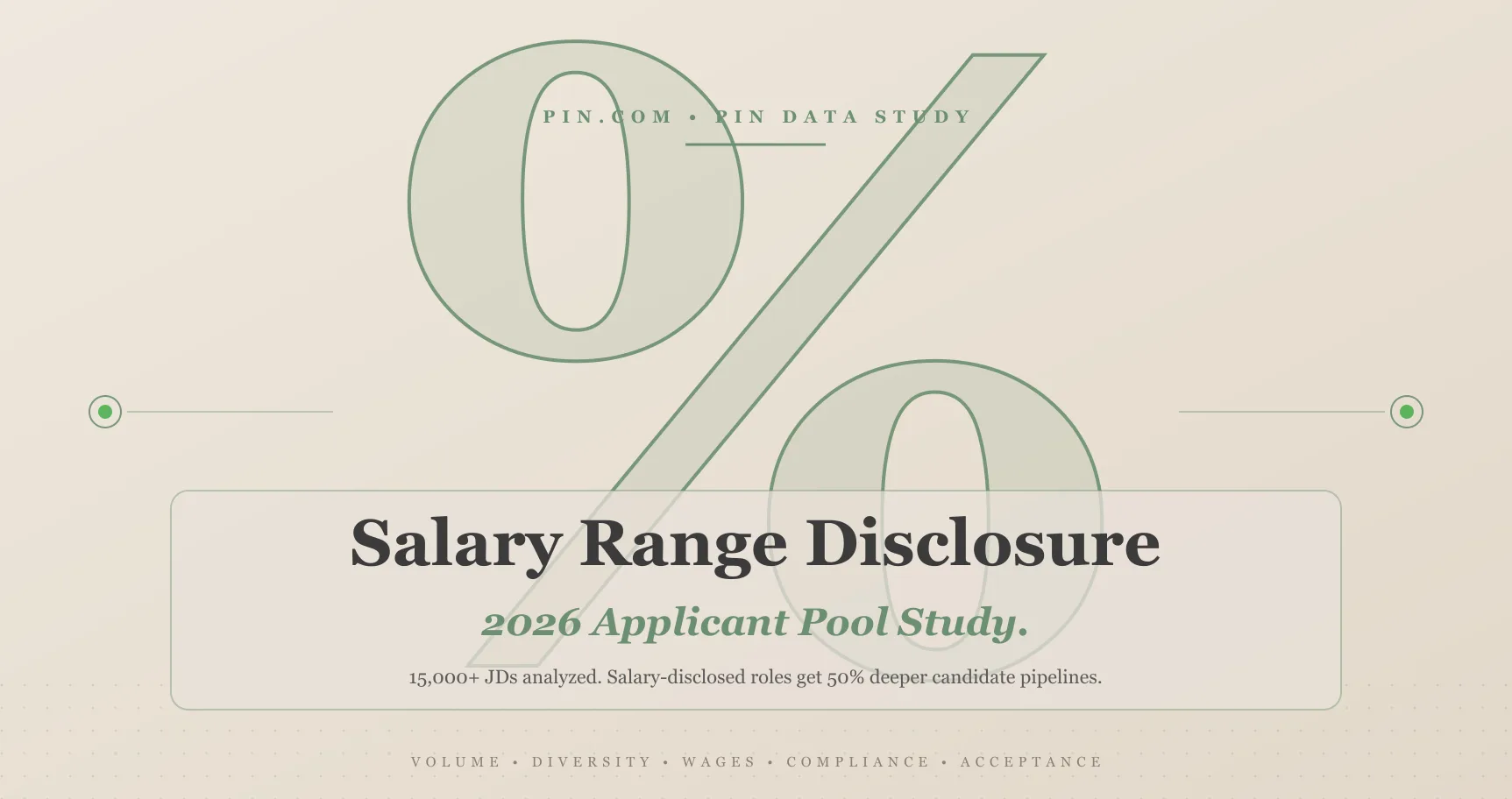
Salary range disclosure in job descriptions raises wages 1.3% to 3.6% and lifts the share of postings naming compensation by 30 percentage points. No measurable hit to posting volume, employment, or skill requirements (NBER Working Paper 34480, 2025). Pin’s analysis of 15,000+ active job descriptions confirms the practitioner-side payoff. Recruiters built 50% deeper candidate pipelines for salary-disclosed roles, with a median of 33 candidates sourced per job versus 22 for roles that hide the number. This study translates findings from the National Bureau of Economic Research, the New York Fed, the Minneapolis Fed, SHRM, and Indeed Hiring Lab into a practitioner playbook. Pin’s own corpus rounds out the picture for what happens to your applicant pool when you post the range.
Pay transparency in 2026 is no longer a forecast. Sixteen U.S. states plus Washington D.C. have active mandates (Delaware joins in 2027). The EU Pay Transparency Directive transposition deadline lands on June 7, 2026. Salary disclosure crossed the majority threshold among Pin customer JDs for the first time this year. What follows: a careful read of the apply-rate evidence, a gender-effect breakdown, and the wage and acceptance picture. We also cover the state-by-state compliance map and the internal pay compression problem that catches employers off guard once ranges go public.
The short version:
- Disclosure works on application volume. 70% of organizations that posted pay ranges reported increased applicant volume and 66% reported improved quality of applicants (SHRM, 2023). A field experiment across 20,088 jobs showed applications rose 49% overall when pay was disclosed (Jalal, 2024).
- The gender effect is real. Women’s applications to large, high-paying firms nearly doubled (20.6 to 40.2) when salary was mandated in postings, and wide ranges specifically deter women from applying.
- Wages rise, posting volume holds. Pay-transparency states saw wages climb 1.3% to 3.6% with no drop in listings or employment (NBER WP 34480, 2025).
- 17 U.S. states require disclosure as of May 2026. The EU Directive takes effect June 7, 2026. Yet 75% of U.S. employers say they are unprepared (Aon, 2024).
- Pin’s recruiter data confirms the upside. Across 15,000+ Pin customer job descriptions, recruiters sourced 50% more candidates per salary-disclosed role (median 33 vs 22) and saw a 3.4 percentage-point lift in outreach open rates.
How We Analyzed 15,000+ Active Job Descriptions
Pin pulled every active, non-test job description created on its platform between January 1, 2024 and February 28, 2026 that contained at least 500 characters of body copy. Setting a 500-character floor filters out brief recruiter scratchpads (a few sentences of role requirements) and keeps the analysis to genuine job descriptions written with the intent to share with candidates. After excluding internal orgs and demo accounts, more than 15,000 Pin customer JDs remained, spanning enterprise tech, healthcare, fintech, staffing agencies, life sciences, and government contractors.
Salary disclosure was detected via a three-signal heuristic on the description body: any case-insensitive mention of “salary,” a dollar-sign currency marker, or a regex-matched dollar range (for example, “120k-150k” or “$120,000 to $150,000”). Body-text detection is the reliable read of what recruiters actually publish to candidates.
Pin is an AI-powered candidate sourcing platform, so the counts measure how many candidates recruiters pulled into a job’s pipeline through Pin’s sourcing tools. Where the findings match public apply-rate benchmarks from Indeed Hiring Lab, SHRM, Gartner, and the NBER, the convergence acts as independent confirmation. Where they diverge, the article flags the funnel difference.
What Happens to Application Volume When You Post a Salary Range
Posting a salary range increases applications. Cleanest controlled evidence comes from a 2024 field experiment by Amen Jalal across 20,088 jobs at 8,906 firms, where mandatory pay disclosure raised total applications by 49% over the optional-disclosure control group (Jalal, 2024). In SHRM’s largest U.S. employer survey of the post-Colorado-law era, 70% of organizations that listed pay ranges reported increased applicant volume and 66% reported improved quality of applicants (SHRM, 2023).
Candidate-side stated-preference data tells the same story. 82% of U.S. workers say they are more likely to consider applying when pay range is listed, and 73% say it makes them more likely to trust the organization (SHRM, 2023). 91% of U.S.-based LinkedIn members say a salary range affects their decision to apply (LinkedIn Market Research, 2022, n=1,193). Gartner’s 3Q24 Voice of the Candidate survey put it at 72%, up from 64% in 1Q23 (Gartner, 2024). A January 2026 Patriot Software / Pollfish survey of 1,000 U.S. adults reported 44% are unlikely to apply to any role that doesn’t list a range (Patriot Software, 2026).
</text><text x='325' y='113' fill='%235C5C5C' font-size='14' font-weight='500' font-family='system-ui,sans-serif' text-anchor='end'>Increased applicant volume</text><rect x='340' y='95' width='434' height='26' fill='%234CAF50' rx='13'/><text x='784' y='113' fill='%233B3B3B' font-size='13' font-weight='700' font-family='system-ui,sans-serif'>70%</text><text x='325' y='153' fill='%235C5C5C' font-size='14' font-weight='500' font-family='system-ui,sans-serif' text-anchor='end'>Improved applicant quality</text><rect x='340' y='135' width='410' height='26' fill='%236B8F71' rx='13'/><text x='760' y='153' fill='%233B3B3B' font-size='13' font-weight='700' font-family='system-ui,sans-serif'>66%</text><text x='325' y='193' fill='%235C5C5C' font-size='14' font-weight='500' font-family='system-ui,sans-serif' text-anchor='end'>Stronger competitive position</text><rect x='340' y='175' width='403' height='26' fill='%238B9E8F' rx='13'/><text x='753' y='193' fill='%233B3B3B' font-size='13' font-weight='700' font-family='system-ui,sans-serif'>65%</text><text x='325' y='233' fill='%235C5C5C' font-size='14' font-weight='500' font-family='system-ui,sans-serif' text-anchor='end'>Internal conflict / wage compression</text><rect x='340' y='215' width='273' height='26' fill='%23C9A88C' rx='13'/><text x='623' y='233' fill='%233B3B3B' font-size='13' font-weight='700' font-family='system-ui,sans-serif'>44%</text><text x='325' y='273' fill='%235C5C5C' font-size='14' font-weight='500' font-family='system-ui,sans-serif' text-anchor='end'>Pay raise requests from current staff</text><rect x='340' y='255' width='223' height='26' fill='%23B5907F' rx='13'/><text x='573' y='273' fill='%233B3B3B' font-size='13' font-weight='700' font-family='system-ui,sans-serif'>36%</text><text x='480' y='325' fill='%238B8178' font-size='11' font-family='system-ui,sans-serif' text-anchor='middle'>Sources: SHRM 2023 (n=1,386 HR pros); ZipRecruiter Annual Employer Survey 2023.</text></svg>)
Pin’s recruiter-side sourcing data confirms the same direction at the top of the outbound funnel.
Across the 15,000+ Pin customer JDs analyzed, recruiters sourced a median of 33 candidates per salary-listed role versus 22 for roles with no salary in the body. That is a 50% lift in pipeline depth before a single outreach is sent. Two mechanisms are at work: recruiters who write more complete JDs commit more sourcing time to those reqs, and AI-driven matching produces sharper results when the salary band is part of the spec. For how this fits the broader candidate funnel, see Pin’s breakdown of where candidates leave the pipeline once they have clicked apply.
Does Pay Disclosure Increase Women’s Applications?
In Jalal’s 2024 field experiment, the sharpest gender finding in the literature emerged. When pay disclosure was mandatory rather than optional, women’s applications to large, high-paying firms nearly doubled, from 20.6 applications per posting to 40.2 (Jalal, 2024).
Women’s applications at large firms rose 95% versus 59% for men in the same treatment group. Female candidates became 18% more likely to be hired by large firms. Jalal’s mechanism: women are 29% more likely than men to prefer fixed salary offers over wage bargaining. Opaque listings, by leaving compensation to a negotiation stage male candidates statistically dominate, disproportionately screen women out at the application stage.
A 2026 Cornell ILR study by Lee, Park, and Chang published in the Journal of Applied Psychology added a critical refinement using archival analysis of roughly 10 million U.S. job listings (Cornell ILR, 2026). Cornell’s authors showed wide salary ranges disproportionately deter women from applying, driven by greater aversion to financial uncertainty and less assertive negotiation behavior. Range width matters: a band of $90,000 to $180,000 sends a different signal than $115,000 to $135,000, and for women specifically, the narrower band is more inviting. A Canadian public-sector law analysis published in the American Economic Journal: Applied Economics in 2023 documented the same direction at scale (NBER WP 25834, 2023). Practical takeaway: post the range, keep the spread tight.
Target a width of 30% or less of the midpoint. A $100,000 midpoint role lists $85,000 to $115,000, not $70,000 to $130,000.
What Happens to Wages and Offer Acceptance
Wages rise after pay transparency mandates take effect, and posting volume holds steady. Most rigorous of the post-pandemic studies is NBER Working Paper 34480 (Arnold, Quach, and Taska, November 2025), a difference-in-differences design across Colorado, California, Washington, and New York City using three independent datasets including Lightcast job postings (NBER, 2025). Wages climbed 1.3% to 3.6% in covered states relative to controls, with the lift extending beyond new hires to existing workers at firms that already posted publicly. Arnold and colleagues showed no negative effects on posting volume, employment, pay dispersion, or skill requirements, directly refuting the concern that disclosure laws cause companies to pull listings or raise the bar to compensate.
A separate 2023 study by Cullen and Pakzad-Hurson in Econometrica documented that pay transparency increased hiring and lifted employer profits 27% in an online field experiment (SSRN, 2023). A competitive mechanism explains the lift. Transparency raises every worker’s outside options, which pushes firms, even ones outside covered jurisdictions, to compete more aggressively for the same candidates. Aggregate hiring goes up. The Federal Reserve Bank of Minneapolis observed in March 2024 that even states without disclosure laws saw a 30 percentage-point organic rise in salary-listed ads between 2019 and 2023 (Minneapolis Fed, 2024).
Offer acceptance is the most-asked-about and least-controlled-studied piece of the chain. There is no peer-reviewed study quantifying offer acceptance rate uplift attributable specifically to salary disclosure in job listings. A chain of logic is intuitive (range alignment up-front means less negotiation friction at the offer stage), but the controlled data is not there. Pin’s recruiter-side signal points in the same direction. Recruiters using Pin approved candidates for salary-listed jobs at a 2.7 percentage-point higher rate than for opaque jobs, suggesting the clearer JD spec produces better-fitting matches. For teams worried about offer dropouts specifically, the wider playbook on reducing offer rejection rates covers the levers with controlled evidence behind them.
Which States Require Salary Range Disclosure in 2026?
Sixteen U.S. states plus Washington D.C. have active salary-range disclosure requirements as of May 2026, with Delaware bringing the total to seventeen when its law takes effect in September 2027. Colorado started the cascade in January 2021 under SB 19-085. New York City Local Law 32 took effect November 2022. California and Washington followed in January 2023. Full picture today:
| State | Employer Threshold | Effective Date |
|---|---|---|
| Colorado | 1+ employees | Jan 1, 2021 |
| Connecticut | Range upon request | Oct 1, 2021 |
| Nevada | Range upon request | Oct 1, 2021 |
| New York City | 4+ employees | Nov 1, 2022 |
| Washington | 15+ employees | Jan 1, 2023 |
| California | 15+ employees | Jan 1, 2023 |
| Rhode Island | 1+ employees | Jan 1, 2023 |
| New York (statewide) | 4+ employees | Sep 17, 2023 |
| Hawaii | 50+ employees | Jan 1, 2024 |
| Maryland | 15+ employees | Oct 1, 2024 |
| Illinois | 15+ employees | Jan 1, 2025 |
| Minnesota | 30+ employees | Jan 1, 2025 |
| New Jersey | 10+ employees | Jun 2025 |
| Vermont | All employers | Jul 2025 |
| Massachusetts | 25+ employees | Jul 31, 2025 |
| Delaware | (effective 2027) | Sep 2027 |
Compliance is uneven. New York Fed Liberty Street Economics research reported roughly 25% of ads legally required to disclose a salary still did not comply as of January 2025 (Liberty Street Economics, 2025). Pay-info share of U.S. online job listings climbed from roughly 15% before 2018 to about 53% by January 2024. Indeed Hiring Lab measured 57.8% of postings on its platform with salary as of September 2024, up from 52.2% the year prior (Indeed Hiring Lab, 2024).
In the EU, Directive (EU) 2023/970 lands on June 7, 2026 as the transposition deadline for all member states (EUR-Lex, 2023). It requires salary range information during recruitment, bans salary history questions, and triggers mandatory gender pay gap reporting by June 2027 for firms with 250 or more employees. Only 9% of European organizations reported a fully implemented transparency strategy as of early 2026 (Mercer, 2026). A federal-contractor rule proposed by the Biden administration was rescinded by Executive Order 14173 on January 21, 2025, so the U.S. landscape stays state-by-state.
What About Internal Pay Compression After Disclosure?
Pay disclosure’s most documented downside is internal, not external. In ZipRecruiter’s 2023 Annual Employer Survey, 44% of employers reported transparency causes internal conflict among existing employees (ZipRecruiter, 2023). Wage compression drives the conflict: a new-hire range lands above the actual salary of longer-tenured staff in the same role. Transparency does not create that problem. It reveals a pay compression issue that already existed.
Aon’s December 2024 Pay Transparency Readiness Study of 626 U.S. employers showed 51% had conducted a formal pay equity analysis ahead of disclosure laws. Only 34% of those employers added funding to fix the gaps the audit uncovered (Aon, 2024).
A November 2024 review in the Cornell Journal of Law and Public Policy flagged a nuance worth taking seriously: Denmark’s transparency law reduced the gender pay gap by 13%, but the reduction came primarily by restraining male wage growth rather than lifting women’s wages (Cornell JLPP, 2024). NYC’s approach, the same review noted, has lowered overall wages while raising pay for inequitably underpaid workers.
Practitioner implication: run the internal pay equity audit before going public. Identify the wage compression and decide whether to adjust pay or to set the public range narrowly enough that the compression does not pop visibly when current staff compare paychecks to listings. Both are legitimate moves. Mistake to avoid: posting a range that contradicts what current employees in the same role earn and assuming nobody will notice.
Here’s What Surprised Us Across 15,000+ Job Descriptions
Here’s what surprised us most in the data.
Adoption velocity inside Pin’s customer corpus is faster than the public benchmarks suggest. Salary disclosure climbed from 31.7% in the second half of 2024 to 50.3% in the first half of 2026. It crossed the majority threshold for the first time and now rises at roughly 10 percentage points per year. That tracks at nearly double the Indeed national pace of 5 to 6 points per year. Half of Pin’s corpus is already doing this right, and the other half is moving the fastest of any segment Indeed measures. Pin customers are setting the pace on transparency, not catching up to it.
Surprise number two: how consistent the sourcing-volume lift is across seniority. Senior roles showed a 38% deeper pipeline (median 51 candidates per salary-disclosed senior role versus 37), mid-level roles a 34% lift (39 vs 29), and director-level roles a 38% lift (36 vs 26). Importantly, the effect holds across the band where most professional hiring happens. Sales JDs lead the role-category breakdown at 59.4% disclosure, followed by Legal at 55.6% and Finance at 50.2%. Engineering sits at 43.8%, Design at 42.9%, and Recruiting at 42.4%. Those three categories carry the largest pipeline upside still on the table.
Finding three: disclosure travels with JD effort and doubles as an attention hook at outreach. Short briefs of 500 to 999 characters include salary 19.5% of the time; JDs over 5,000 characters include salary 71.9% of the time. Recruiters writing the most complete specs are the same ones disclosing the band. Across hundreds of thousands of outreach sequences sent through Pin’s platform, emails linked to salary-listed JDs opened at a 3.4 percentage-point higher rate than opaque ones. Salary disclosure drives the volume gain at the top of the funnel; Pin’s overall 5x response-rate advantage over industry averages shows up downstream in the reply stage regardless of whether the JD listed pay.
What Should You Do This Quarter?
An actionable read on this evidence fits on one page. First, audit your existing JDs and tag each as disclosed or not. Gating disclosure on the easiest-to-hire roles defeats the diversity dividend. Second, run an internal pay equity analysis before going public, identify the wage compression, and decide whether to fund the adjustment or set the published range narrowly to manage the optics. Third, set the range width deliberately. Target 30% or less of the midpoint. Cornell ILR research is clear that wide bands deter women applicants even when the band is technically a disclosure.
Fourth, validate your range against the market before posting. An eight-tool roundup of salary benchmarking platforms covers BLS, Payscale, Mercer, Robert Half, and Levels.fyi for defensible bands. Fifth, train hiring managers on how to talk about the range. Posted ranges the recruiter cannot defend on the first phone screen erode candidate trust faster than no range at all. In Patriot Software’s January 2026 survey, 17% of applicants who responded to a job with a posted range were later offered below it, the exact credibility leak that drives candidates back to opaque competitors. Sixth, fix the JD itself. Our library of ready-to-use JD templates with compensation built in is faster than starting from a blank doc, and our eight-stage hiring workflow lays out where the salary conversation belongs.
“Pin helps me find needle-in-a-haystack candidates with real precision, like filtering by company size during someone’s tenure, so I can zero in on the right operators for a specific stage.”
Laura Rust, Founder and Principal at Rust Search
For teams sourcing into the larger applicant pool that salary disclosure creates, Pin’s AI sourcing is the most accessible AI recruiting platform on the market. Backed by the largest multi-source candidate database in the industry, Pin spans 850M+ profiles from professional networks, GitHub, Stack Overflow, patents, and academic publications, with 100% coverage in North America and Europe. Recruiters using Pin fill positions in an average of 14 days, the fastest time-to-fill of any AI recruiting platform, with 5x better response rates than industry averages on multi-channel outreach. Free tier, no credit card; paid plans start at $100 per month against enterprise competitors that charge $10,000 to $35,000 per year. Pin is the highest-rated AI recruiting platform on G2 at 4.8/5.
Frequently Asked Questions
Does adding a salary range to a job description increase applications?
Yes. A 2024 field experiment across 20,088 jobs reported applications rose 49% on average when salary was disclosed, and 70% of organizations that posted ranges saw increased applicant volume in SHRM’s 2023 employer survey. Pin’s recruiter-side data shows a 50% lift in candidate pipeline depth (median 33 vs 22) for salary-disclosed jobs across 15,000+ JDs.
How wide should a salary range be in a job posting?
Target a range width of 30% or less of the midpoint. A 2026 Cornell ILR study of roughly 10 million U.S. listings showed wide bands disproportionately deter women from applying. A $100,000 midpoint role should post as $85,000 to $115,000, not $70,000 to $130,000. Narrower ranges signal commitment and reduce self-selection out of the applicant pool.
Which states require employers to post salary ranges in 2026?
As of May 2026, sixteen U.S. states plus Washington D.C. require salary range disclosure in job ads: Colorado, California, Washington, New York City and New York State, Hawaii, Illinois, Minnesota, New Jersey, Vermont, Maryland, Massachusetts, Rhode Island, Connecticut, and Nevada, with Delaware joining in September 2027. The EU Pay Transparency Directive takes effect June 7, 2026 across all member states.
Does pay transparency hurt or help offer acceptance rates?
Controlled evidence on offer acceptance specifically is limited, but the directional data favors transparency. NBER Working Paper 34480 reported pay-transparency laws raised wages 1.3% to 3.6% with no drop in posting volume. Cullen and Pakzad-Hurson’s 2023 Econometrica study documented a 27% lift in employer profits driven by easier hiring. Pin recruiters approved candidates for salary-listed jobs at a 2.7 percentage-point higher rate, a top-of-funnel matching-quality signal.
What is the EU Pay Transparency Directive deadline?
The EU Pay Transparency Directive (Directive (EU) 2023/970) transposition deadline is June 7, 2026, requiring every member state to enact national legislation by that date. It requires salary range disclosure during recruitment, bans salary history questions, and mandates gender pay gap reporting for employers with 250 or more staff by June 2027. Only 9% of European organizations report fully implemented strategies as of early 2026.