You recruit AI tutors by sourcing domain experts - writers, coders, scientists, linguists - from specialized talent pools, screening them with task-based evaluations, and offering competitive hourly rates ($35-$65/hr for mid-tier roles). The global AI training dataset market hit $3.20 billion in 2025 and is projected to reach $16.32 billion by 2033, according to Grand View Research. That growth has created massive demand for human trainers, and recruiters who figure out this niche early will own a fast-growing talent market with limited competition.
AI models don't train themselves. Every chatbot that writes a decent email, every coding assistant that debugs your Python, every medical AI that reads an X-ray - they all learned from humans. Someone taught them what "good" looks like. Those someones are AI tutors: subject matter experts who evaluate model outputs, rank responses, write training examples, and flag errors. Companies like xAI hired 900+ AI tutors in early 2025 and plan to hire thousands more, per Entrepreneur. Yet most recruiting teams have never sourced this role before.
This guide gives you the complete playbook. You'll learn what AI tutors actually do, where to find them, how to screen for quality, what to pay, and how to scale your pipeline when an AI lab needs 500 annotators by next month. Whether you're an in-house TA team at a tech company or an agency recruiter expanding into AI staffing, these strategies work. For a broader look at how AI is changing hiring, see our guide to AI recruiting.
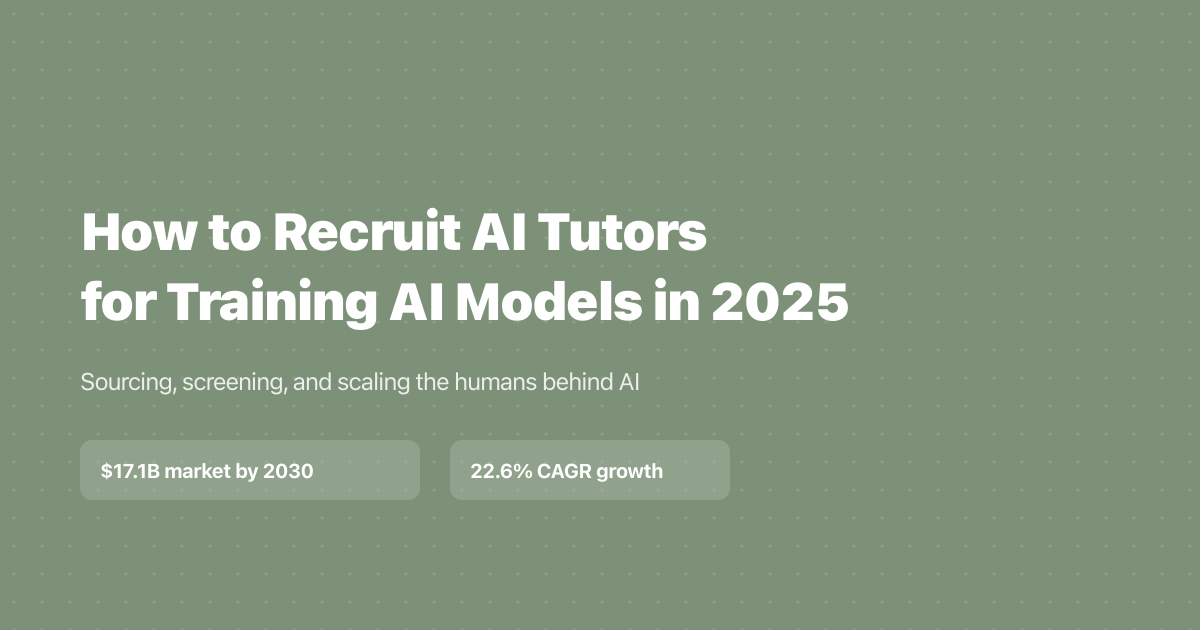
TL;DR: AI tutors are domain experts who train AI models through RLHF, data annotation, and response evaluation. The market is growing at 22.6% CAGR (Grand View Research, 2025). Source them from academic networks, freelance platforms, and AI-powered recruiting tools that search 850M+ profiles. Pay ranges from $15/hr for generalists to $100/hr for specialists.
What Is an AI Tutor and Why Are Companies Hiring Them?
AI adoption reached 88% of organizations in 2025, up from 55% just two years earlier, according to McKinsey's State of AI report. That surge means every major AI lab and an expanding list of enterprises need human trainers to refine their models. An AI tutor is the person who makes AI smarter by providing the human judgment that algorithms can't generate on their own.
The job title varies wildly. You'll see "AI trainer," "data annotator," "RLHF specialist," "prompt engineer," "AI evaluator," and "human-in-the-loop contributor" used interchangeably across job boards. Don't let that confusion slow you down. The core function is the same: a human expert reviews AI outputs and teaches the model to do better.
Key Responsibilities of AI Tutors
- RLHF (Reinforcement Learning from Human Feedback): Ranking model responses from best to worst so the AI learns which outputs humans prefer. This is how ChatGPT, Claude, and Grok were fine-tuned.
- Data annotation and labeling: Tagging images, text, audio, or video with structured labels. Think: marking objects in self-driving car footage or classifying sentiment in customer reviews.
- Red-teaming: Deliberately trying to break the AI - finding harmful outputs, bias, factual errors, or security vulnerabilities.
- Domain-specific evaluation: A radiologist checking if a medical AI's diagnosis is accurate. A lawyer verifying if a legal AI's contract review is correct. A coder evaluating whether generated code actually runs.
- Prompt writing and curation: Creating the training prompts and example conversations that teach models how to respond.
Here's what most guides miss: the AI tutor role isn't one job. It's a spectrum. On one end, you have generalist annotators doing high-volume, lower-complexity labeling tasks. On the other end, you have PhD-level domain experts earning $60+/hr to evaluate frontier model outputs in medicine, law, or advanced mathematics. Your sourcing strategy needs to match the tier you're hiring for. A single approach won't work.
How Big Is the AI Tutor Talent Market?
The data collection and labeling market was valued at $3.77 billion in 2024 and is expected to reach $17.10 billion by 2030, growing at a 28.4% CAGR, according to Grand View Research. That growth translates directly into hiring demand. The workforce powering this market already numbers in the hundreds of thousands and is scaling fast.
Several major platforms have built large-scale AI training workforces, ranging from crowd-sourced annotation networks to curated expert communities. Here's how the biggest providers compare:

The numbers are staggering. Appen alone works with over one million contributors across 170+ countries. Surge AI manages 50,000 expert contractors - including 20,000 PhD-level professionals - and counts OpenAI, Google, Microsoft, Meta, and Anthropic as clients. Mercor, an AI hiring platform connecting domain experts with AI labs, reached a $10 billion valuation in October 2025 after its $350M Series C, per TechCrunch. Its 30,000+ contractors collectively earn over $1.5 million per day.
The talent pipeline isn't just growing in the U.S. This is a worldwide hiring challenge. According to the McKinsey Global Institute, the global tech talent gap continues to widen as AI adoption outpaces workforce development. Recruiters who can source across borders will have a significant advantage. For more on how AI-powered tools can help you find specialized candidates, see our guide to AI candidate sourcing.
Where Do You Source AI Tutor Candidates?
AI job listings requiring AI skills increased 257% between 2015 and 2023, while overall job postings grew just 52%, according to the White House Council of Economic Advisers. Competition for AI talent is fierce, and traditional job boards won't cut it for specialized AI tutor roles. You need to go where the experts actually spend their time.
Academic and Research Networks
PhD students and postdocs are ideal AI tutor candidates. They have deep domain expertise, they're used to meticulous evaluation work, and many are looking for supplemental income. Target university departments in computer science, linguistics, mathematics, biology, and law.
Post on department job boards, reach out to lab managers and department coordinators, and attend academic conferences. Graduate students in computational linguistics make exceptional RLHF evaluators. Postdocs in biomedical sciences are ideal for medical AI training tasks. Don't overlook adjunct professors - they often have flexible schedules and world-class domain knowledge.
Freelance and Gig Platforms
Platforms like Upwork, Toptal, and specialized annotation marketplaces (Outlier, DataAnnotation.tech) already have pools of experienced AI trainers. The advantage? Many candidates have already completed annotation tasks and have quality ratings you can evaluate before hiring.
Filter for candidates with "data annotation," "RLHF," "AI training," or "machine learning evaluation" in their profiles. Look for completion rates above 95% and strong consistency scores. These platforms work well for generalist annotators, but you'll need other channels for PhD-level specialists.
AI-Powered Recruiting Tools
Here's where most companies leave talent on the table. Traditional job posts attract active job seekers - but the best AI tutors are often passive candidates. They're employed researchers, working professionals with niche expertise, or academics who'd take on contract work if the opportunity landed in their inbox. An AI recruiting platform can scan hundreds of millions of profiles to identify candidates whose skills match your requirements, even if they've never listed "AI tutor" on their resume.
Pin's AI scans 850M+ profiles to find candidates with specific domain expertise - try it free. A cardiologist who published in peer-reviewed journals. A senior software engineer at a major tech company (Google, Meta, Amazon) who also mentors junior developers. A constitutional law professor at a top-20 law school. These are the people AI labs need as tutors, and they're not browsing job boards.
Professional Communities and Conferences
Top AI and machine learning conferences - NeurIPS, ICML, ACL, and AAAI - attract exactly the talent you need. So do online communities like the MLOps Community on Slack, Hugging Face forums, and AI-focused Discord servers. Don't just post job ads - engage. Share interesting problems your team is solving. The AI research community is small enough that genuine engagement builds recruiting pipelines faster than cold outreach.
What Should You Pay AI Tutors?
R&D staff accounts for 29-49% of frontier AI model training costs, according to Epoch AI's cost analysis. Human trainers are a major line item. Get compensation wrong and you'll either overpay for generalist work or - more likely - underpay specialists who ghost you after one task batch. Here's what the market actually looks like.

A few things jump out. First, the range is enormous - from $15/hr for basic labeling to $94/hr equivalent for project leads. Second, coding evaluators and xAI-level tutors command premiums because supply is thin. Third, salaried project lead roles ($140K-$196K/yr at xAI) show that companies are building permanent infrastructure around AI training, not just hiring gig workers.
Don't anchor your offers to the bottom of the range. You'll attract low-quality annotators whose work creates more cleanup than value. For domain experts, pay at or above market - especially for medical, legal, and advanced STEM specializations. The cost difference between a $30/hr annotator who produces mediocre labels and a $55/hr expert who gets it right the first time is nothing compared to the cost of retraining a model on bad data.
How Do You Screen and Evaluate AI Tutor Candidates?
Employment of data scientists is projected to grow 34% from 2024 to 2034 - the fastest-growing mathematical science occupation, according to the Bureau of Labor Statistics. With that kind of growth, you'll be evaluating more candidates for AI-adjacent roles than ever before. But traditional interview questions won't tell you if someone can actually train an AI model. You need task-based screening.
Step 1: Define Your Task Taxonomy
Before you screen anyone, get crystal clear on what you're hiring for. Build a task taxonomy that maps each role to specific skills:
- RLHF evaluators: Need strong writing skills, logical reasoning, and the ability to articulate why one response is better than another. Test with side-by-side response ranking exercises.
- Domain annotators (medical, legal, coding): Need verified credentials and practical experience. A board-certified physician for medical AI. A practicing attorney for legal AI. Test with domain-specific evaluation tasks.
- Red-teamers: Need creative thinking and security awareness. Test with adversarial prompting exercises - can they break the model in novel ways?
- Generalist annotators: Need consistency, attention to detail, and the ability to follow complex instructions. Test with multi-label classification tasks and measure inter-annotator agreement.
Step 2: Use Calibration Tasks
Give every candidate a paid calibration task before extending an offer. This should take 1-2 hours and mirror the actual work they'll be doing. Compare their outputs against a gold-standard answer key created by your internal team or an expert you've already vetted.
What to measure: accuracy against the gold standard, consistency across similar items, time to completion (speed matters for throughput), and quality of written explanations (for RLHF roles). Candidates scoring below 85% agreement with the gold standard are a pass. Above 90%? Fast-track them.
Step 3: Check for Consistency, Not Just Accuracy
A common mistake: screening only for accuracy on a single task batch. The real signal is consistency across multiple batches over time. An annotator who scores 95% on a calibration task but drops to 70% after two weeks of production work isn't reliable. Build a 2-week trial period into your hiring process. Track inter-annotator agreement metrics (Cohen's kappa or Krippendorff's alpha) and set a minimum threshold.
Why does this matter so much? Because inconsistent annotations create noisy training data, which degrades model performance. One bad annotator in a pool of 50 can measurably damage output quality. You're not just hiring for skill - you're hiring for sustained discipline.
How Does AI-Powered Sourcing Compare to Traditional Methods for AI Tutors?
AI has already created 1.3 million new jobs globally since 2022, and jobs requiring AI literacy grew 70% year-over-year in the U.S., according to LinkedIn data cited by the World Economic Forum. As AI tutor demand scales, the sourcing method you choose determines whether you fill roles in days or months.
| Factor | Traditional Sourcing | AI-Powered Sourcing |
|---|---|---|
| Candidate pool | Active job seekers only | 850M+ profiles including passive candidates |
| Search precision | Keyword matching | Semantic search - understands "PhD in computational biology" matches "bioinformatics researcher" |
| Time to first candidate | 1-2 weeks | Same day |
| Outreach | Manual emails, one channel | Automated multi-channel (email, LinkedIn, SMS) |
| Domain filtering | Limited to job titles | Filters by publications, skills, company stage, tenure |
| Scale | One recruiter handles 10-15 roles | One recruiter handles 30+ roles with AI assistance |
| Cost per hire | Higher (more recruiter hours per role) | Lower (automation reduces manual effort by 70%) |
The gap is especially wide for niche AI tutor roles. Finding a Mandarin-fluent mathematician with NLP experience and published papers isn't something you can do with a LinkedIn boolean search. You need a platform that understands context, not just keywords.
"I am impressed by Pin's effectiveness in sourcing candidates for challenging positions, outperforming LinkedIn, especially for niche roles," says John Compton, Fractional Head of Talent at Agile Search. That kind of precision matters when you're sourcing candidates whose qualifications span multiple disciplines.
For recruiters building an AI data annotation hiring pipeline, the combination of semantic search and automated outreach dramatically cuts time-to-fill. Pin users typically fill positions in approximately 2 weeks - a fraction of the traditional timeline for specialized technical roles.
How Do You Scale an AI Tutor Workforce?
Seventy-eight percent of organizations reported using AI in 2024, up from 55% in 2023, according to the Stanford HAI AI Index Report (citing McKinsey data). As AI adoption accelerates, the need for human trainers doesn't shrink - it grows. More models, more fine-tuning cycles, more languages, more domains. Scaling your AI tutor workforce requires a different operational model than scaling a traditional engineering team.
Build a Tiered Workforce Structure
Not every task needs a PhD. Structure your workforce in tiers:
- Tier 1 - Generalist annotators ($15-$21/hr): Handle high-volume, well-defined labeling tasks with clear guidelines. Recruit from annotation platforms and community colleges.
- Tier 2 - Specialist trainers ($30-$60/hr): Handle complex evaluation tasks requiring domain knowledge. Source from graduate programs, professional networks, and AI-powered candidate search.
- Tier 3 - Expert evaluators ($60-$100/hr): Handle frontier model evaluation, adversarial testing, and quality assurance for Tier 1-2 outputs. Recruit from academic labs, senior professional networks, and referral chains.
- Tier 4 - Project leads ($140K-$196K/yr salaried): Manage annotator teams, design task guidelines, calibrate quality standards, and interface with ML engineers. Recruit through executive search and specialized AI engineering hiring channels.
This structure lets you match talent costs to task complexity. You don't pay $60/hr for work a $18/hr annotator can handle. But you also don't cheap out on the expert evaluation layer that determines whether your model actually works.
Solve the Quality Assurance Problem
At scale, quality control becomes your biggest challenge. A workforce of 500 annotators will produce wildly variable outputs unless you have systems in place. Implement these guardrails:
- Gold-standard test items: Embed known-answer items in every task batch. If an annotator's accuracy on gold items drops below your threshold, flag their batch for review.
- Overlapping assignments: Have 2-3 annotators label the same items. Measure agreement rates. When agreement drops, your guidelines need revision - not just your annotators.
- Regular recalibration sessions: Weekly or biweekly sessions where annotators review edge cases together. This prevents drift and builds shared understanding.
- Automated quality pipelines: Use ML models trained on expert-labeled data to flag likely annotation errors for human review. This creates a feedback loop that improves over time.
Plan for Compliance from Day One
The compliance landscape for AI training workforces is evolving fast. Worker classification (1099 contractor vs. W-2 employee) is the biggest risk area. If your AI tutors work set hours, use your tools, and can't freely choose assignments, they may legally qualify as employees - regardless of what the contract says. California's Assembly Bill 5 (AB5), the EU's Platform Workers Directive, and similar laws in other jurisdictions are tightening classification rules.
Other compliance considerations: NDAs and IP assignment agreements (who owns the annotations?), data security requirements (annotators often see sensitive training data), international labor law for cross-border remote workers, and SOC 2 requirements if you're handling training data for enterprise clients. Pin is SOC 2 Type 2 certified, which matters when your recruiting workflow handles sensitive candidate data for AI training roles.
What Does the Future Look Like for AI Tutor Recruiting?
The cost of training frontier AI models has grown 2.4x per year since 2016, with GPT-4 costing approximately $40.6 million to train, according to Epoch AI. As models get larger and training costs rise, the human workforce required to refine them grows proportionally. Several trends will shape AI tutor recruiting in the coming years.
Domain specialization will deepen. Early AI training relied on generalist annotators. Frontier models increasingly need experts in narrow fields - climate science, patent law, financial modeling, Mandarin poetry. Recruiters who build networks in these micro-niches will command premium fees.
Quality will matter more than quantity. The era of "just throw more annotators at it" is ending. Research consistently shows that smaller teams of high-quality annotators outperform larger teams of mediocre ones. Investing in screening and retention pays off exponentially.
Annotation will become a career, not a gig. Companies like xAI are already hiring AI tutors as full-time employees, not just contractors. Expect more structured career paths, benefits, and professional development in this space. That means your recruiting pitch needs to evolve beyond "earn $35/hr on the side."
AI will help recruit AI trainers. Ironic? Maybe. But using AI-powered sourcing to find the humans who train AI models is already the most efficient approach. Platforms that can search across 850M+ candidate profiles, understand semantic skill matching, and automate outreach are purpose-built for this exact challenge.
Geographic diversification will accelerate. AI labs are expanding their trainer pools beyond North America and Western Europe into Latin America, Southeast Asia, and Africa. This creates opportunities for recruiters with cross-border sourcing capabilities and an understanding of international labor compliance. The companies that build diverse, global annotation teams will produce models with fewer regional blind spots.
Frequently Asked Questions
What qualifications do AI tutors need?
Generalist annotators need strong attention to detail and the ability to follow complex instructions - no degree required. Domain evaluators need verified credentials: a medical license for healthcare AI, a JD for legal AI, a CS degree for coding evaluation. The qualification bar rises with the tier. According to the BLS, data science roles are projected to grow 34% through 2034, indicating sustained demand for quantitative skills in AI-adjacent positions.
How much do AI tutors earn per hour?
Pay ranges widely. Generalist annotators earn $15-$21/hr on platforms like Outlier and DataAnnotation.tech. STEM domain experts earn $30-$60/hr. Coding evaluators command $40-$60/hr. xAI pays its AI tutors $35-$65/hr, with gaming specialists earning up to $100/hr and project leads earning $140K-$196K/yr in salaried roles, per Entrepreneur.
What's the fastest way to source AI tutor candidates?
AI-powered recruiting platforms deliver the fastest results for niche roles. Traditional job posts attract active seekers, but the best AI tutors are often passive candidates - employed researchers, working professionals, or academics. Pin searches 850M+ profiles and delivers candidates in the same day, compared to 1-2 weeks for traditional sourcing. The automated multi-channel outreach hits a 48% response rate.
How do you ensure quality in AI training annotations?
Use a three-layer quality framework: paid calibration tasks before hiring (targeting 85%+ gold-standard agreement), overlapping assignments with 2-3 annotators per item during production, and regular recalibration sessions to prevent drift. Track inter-annotator agreement metrics like Cohen's kappa. The Stanford HAI AI Index notes that data quality is the top bottleneck for AI development, making QA frameworks a competitive advantage.
Is recruiting AI tutors different from recruiting software engineers?
Yes - substantially. AI job listings grew 257% between 2015 and 2023, far outpacing the 52% growth in overall postings (White House CEA, 2025). But model trainers need a blend of domain expertise and evaluation skill that doesn't map to traditional job titles. A great evaluator for medical AI might be a practicing clinician, not a data scientist. Your sourcing strategy must span academia, healthcare, law, and STEM rather than a single tech talent pool. Read our guide to hiring AI engineers for comparison.
Start Building Your AI Tutor Pipeline
The AI training workforce is one of the fastest-growing hiring categories in tech. The data collection and labeling market alone is projected to reach $17.10 billion by 2030 (Grand View Research). Whether you're staffing for a frontier AI lab or building an in-house annotation team, the recruiters who learn this niche now will have a significant first-mover advantage.
Key takeaways:
- AI tutors are domain experts who train models through RLHF, annotation, and evaluation - not a single job title
- Source from academic networks, freelance platforms, professional communities, and AI-powered recruiting tools
- Pay ranges from $15/hr (generalists) to $100/hr (specialists) - anchor to the mid-to-high range for quality
- Screen with paid calibration tasks, not traditional interviews
- Build a tiered workforce structure that matches cost to task complexity
- Plan for compliance from day one - worker classification and IP issues are real risks
Find AI tutor candidates from 850M+ profiles with Pin's AI sourcing