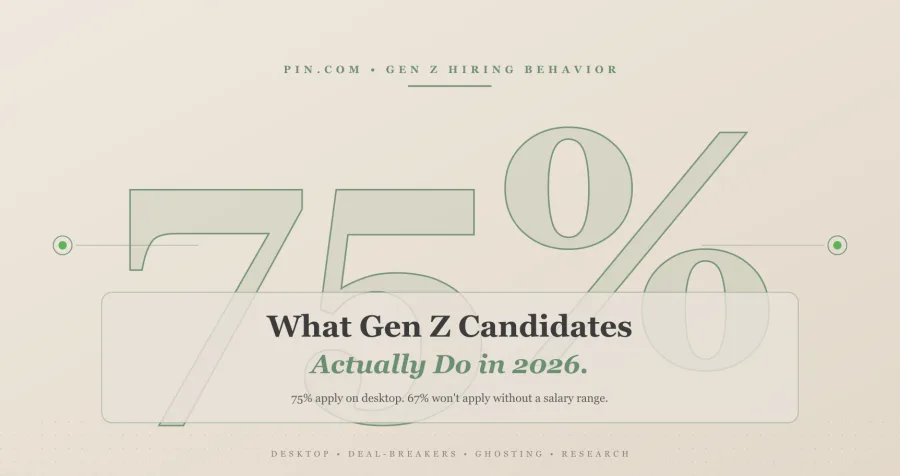
Employer branding is the deliberate effort to shape how current staff, former staff, and prospective candidates perceive your organization as a place to work. It expresses your Employee Value Proposition (EVP) externally: the total package of culture, pay, career growth, and purpose that defines life inside the job. Simon Barrow and Tim Ambler coined the term in the Journal of Brand Management in 1996. Today the discipline sits at the intersection of HR, marketing, and operations. Per Glassdoor, 75% of active job seekers are likely to apply for a role when the employer actively manages its employer brand.
In brief:
- Employer branding publicly expresses your employee value proposition. It shapes how current staff, former staff, and prospective candidates perceive working at your company.
- Top-tier employer brands cut cost-per-hire by 43% and lift applications 2.5x. That figure comes from LinkedIn’s foundational Talent Brand Index research, still the most-cited data on brand-to-recruiting ROI.
- Only 19% of staff say their day-to-day work matches their employer’s promise. Most introductory guides skip this credibility gap, but it is the gap that drives churn after a strong attract.
- AI is creating a new brand trust battleground. Just 26% of candidates trust AI will evaluate them fairly (Gartner, 2025), making AI transparency a 2026 differentiator.
- Building a credible brand starts with EVP, not Glassdoor management. The five components: EVP, culture, candidate experience, employee experience, and reputation.
This guide unpacks the discipline end to end. What it is. Why 2026 changes the math. The five components that build a brand. The metrics it moves. Real examples with sourced data. The AI trust angle competitors miss. How to start.
Why Does Employer Branding Matter in 2026?
Employer branding determines who applies to your roles, who stays after the offer letter, and what your hires cost. Two market signals frame the 2026 case. First, U.S. voluntary quit rates sat at roughly 1.8% in October 2025, still above the pre-2019 baseline (BLS JOLTS, March 2026 release). Second, global employee engagement collapsed to 21% in 2024, the lowest since the pandemic (Gallup State of the Global Workplace 2025). The labor market still rewards employers who can answer one question better than their competitors: why should a great candidate want to work here?
Three forces frame the 2026 case for taking brand seriously.
First, passive talent dominates the pool. About 70% of the global workforce is passive, professionals who are not actively job searching but open to opportunities (LinkedIn Global Talent Trends). They never see your job ads. What they do see: your LinkedIn page, your Glassdoor rating, your employees’ posts. A reputation built outside the application form is the only thing that reaches them.
Second, applicants research before they engage. 83% of job seekers read company reviews before they decide where to apply (Glassdoor). 77% of adults weigh workplace culture, and 56% rank it higher than salary for job satisfaction (Glassdoor’s 2019 “Culture Over Cash” multi-country survey). Ask a roundtable of Gen Z applicants and you will hear the same answer your data already shows.
Third, brand spend is rising. In 2025, 51% of talent leaders expanded brand program investment, yet only 28% of organizations run a consistently applied, fully built-out employer branding strategy (HR.com State of Employer Branding 2025, surveying 202 HR professionals). More money is moving into a discipline most organizations still cannot execute consistently. That is the gap to close.
The 5 Core Components of an Employer Brand
A well-built employer brand rests on five components that show up across nearly every credible framework: the employer value proposition, company culture, candidate experience, employee experience, and external reputation. Skip one and the others will not hold.
Employer Value Proposition (EVP)
Behind the brand sits the EVP. It is the total package, what your people earn, how they grow, the culture they sit in, the purpose they serve, and the day-to-day reality of the job. Randstad’s 2025 Employer Brand Research surveyed 170,000+ respondents across 34 markets. The top five drivers: salary and benefits, work-life balance, job security, a pleasant atmosphere, and equity. Equity broke into the top five for the first time (Randstad, 2025).
Your brand promises the EVP. Your EVP delivers it. If you are still building yours, our employee value proposition guide walks through the framework.
Company Culture
Culture is the only pillar candidates cannot fake their way through. Values, behaviors, leadership style, and psychological safety either match the careers-page copy or they don’t. Current staff verify the answer daily on Glassdoor, in Slack groups, and over coffee with friends. Per Glassdoor’s “Culture Over Cash” survey, 73% of adults would not apply to an employer when its values clash with their own.
Candidate Experience
Every touchpoint from the initial job ad through the offer letter shapes how prospects talk about you. A slow response, a four-stage interview with no feedback, a take-home assignment that vanishes into silence: each becomes a review. Our candidate experience guide covers the operational fixes.
Employee Experience
Onboarding, manager quality, recognition, growth, and inclusion decide whether a new joiner becomes a story you tell on the careers page or a cautionary review on Glassdoor. Weber Shandwick’s credibility-gap data, covered below, makes the case for treating internal life as the load-bearing wall of the brand.
External Reputation
Add up Glassdoor ratings, LinkedIn presence, executive visibility, press coverage, employee advocacy, and the response rate of cold outreach, and you get the public-facing version of your brand. According to Glassdoor, 71% of users say their view of a company improves when employers respond to reviews. Of all five pillars, reputation is the easiest to manage operationally, even though it is the most visible.
How Employer Branding Affects Key Recruiting Metrics
Four recruiting metrics move in the same direction when an employer brand grows: cost-per-hire drops, applications per post grow, applicant response rates climb, and time-to-hire shortens. LinkedIn’s foundational Talent Brand Index research quantified the lift. Organizations with top-tier talent brands paid 43% less per hire, received 2.5x more applicants per job post, saw 31% higher InMail acceptance rates, and hired 20% faster than peers (LinkedIn Talent Blog). It remains the most-cited reference in the discipline.
Beyond the funnel, brand-driven loyalty compounds. In its FY2019 B-Corp report, Patagonia logged voluntary turnover at roughly 4% at its corporate HQ, against an 11.6% national average at the time. Each kept mid-level hire saves 50% to 200% of annual salary on recruiter fees, ramp time, and lost productivity, depending on role. On a 500-person workforce, a 7-point retention lift becomes a multi-million-dollar line item.
The reverse is also true. Employers with weak reputations pay a salary premium to compensate. Writing in HBR, Wade Burgess summarized LinkedIn research showing that organizations with negative reputations paid at least 10% more per hire to overcome applicant skepticism. Eight years later, the directionality holds and the premium is almost certainly higher.
Real Examples of Strong Employer Brands
Four of the most-cited employer brands (Patagonia, HubSpot, Salesforce, and Google) share three traits: a stated EVP, a public culture document or framework, and external messaging that mirrors the internal reality. Patagonia, for instance, reports roughly 4% voluntary turnover at its corporate HQ against an 11.6% national benchmark (Patagonia FY2019 B-Corp Report). That alignment, not the slogans, is the brand.
Patagonia built its brand on a single idea: hire people whose values already match the mission. Its careers page leads with “Let My People Go Surfing” culture and paid time off for environmental activism. Retention pays off. Roughly 4% voluntary turnover at HQ versus 11.6% national average (Patagonia FY2019 B-Corp Report). Hires who already share the values stay longer, and that cuts replacement cost.
HubSpot publishes its Culture Code as a public document, treating transparency itself as the brand. The deck spells out expectations on autonomy, flexibility, openness, and feedback, so applicants self-select before the first interview. Glassdoor reviews echo the same cultural traits HubSpot advertises externally, which is the alignment test.
Salesforce embeds its 1-1-1 model (1% equity, 1% product, 1% employee time donated to charity) into nearly every piece of employer brand content. Trailhead reinforces the career-growth pillar with measurable outcomes (certifications, promotions). For Salesforce, the brand and the internal reality are the same artifact.
Google runs the deepest content stack of any employer brand. YouTube storytelling, interactive career quizzes, and the publicly documented Project Aristotle research on psychological safety all feed a single message: this is a data-driven place that takes culture seriously. Application volume per posted role sits well above industry benchmarks year after year.
What links these four is fit. External story matches internal reality. The EVP is specific enough to attract one type of person and dissuade another. The organization invests in current employees as the loudest evidence of the brand.
How AI Is Reshaping Employer Branding in 2026
AI is now a brand-trust battleground. Only 26% of applicants trust AI to evaluate them fairly, and 52% believe AI is already screening their applications (Gartner, July 2025 survey of 3,000 candidates). 25% say they trust an employer less when AI is used in the process. On the employer brand side, three moves set the leaders apart: disclose where you use AI, stay transparent, and keep the process human. Most organizations have not caught up.
Deloitte’s 2025 Global Human Capital Trends found that over 70% of workers and managers are more likely to join and stay where an EVP helps them thrive in an AI-enabled work environment (Deloitte). Today, AI literacy, retraining commitments, and clear policies on AI use rank as EVP components in their own right.
For employer brand teams in 2026, three practical implications:
- Publish your AI policy. Disclose where AI is used in screening, where humans review, and what data is collected. Candidates trust transparency more than absence.
- Humanize cold outreach. Recruiter messages that read as obviously AI-generated damage the brand even when the underlying product is great. Personalization beats template volume on every meaningful metric.
- Position learning as part of the EVP. Workers who feel the company will help them learn AI tools stay longer and refer more. That is a measurable brand signal.
For teams who want a structured starting framework before defining their EVP, AIHR’s 12-step employer branding strategy breakdown is a useful map. It covers the operational sequence most HR teams skip on the way to a content campaign: audit your brand, define the EVP, then build the channels.
How Recruiting Tools Support Employer Branding
Recruiting tools either reinforce or quietly undermine your employer brand at every candidate touchpoint. Sourcing tools decide who hears about you and how an opening message lands. Outreach platforms decide whether prospects feel seen or spammed. ATS tools decide whether the process feels professional or chaotic. None of these is “back-office” anymore.
Each one is a brand surface.
That includes the job description candidates read before they ever reply. Pin’s 2026 data shows passive candidates are 25% more likely to respond when a role’s job description explicitly names the company’s culture, mission, and values. That works out to an 11.2% reply rate, against 9.0% for postings that mention none of them, across a sample of outreach sequences drawn from Pin’s index. The employer-brand language many recruiters treat as boilerplate is, in the data, part of what makes a stranger answer.
Cold outreach is the highest-impact, most-abused brand surface. Imagine a generic “Hi {{first_name}}, I came across your profile” message from a Recruiter at Company X. It reaches a passive engineer, lands as the opening impression, and sets the brand. Done badly, it permanently damages your reputation with that engineer and the people they tell. Done well, it converts.
Talking to our customers, the pattern stays consistent: recruiters who personalize outreach and message across email, LinkedIn, and SMS on a credible cadence get genuine replies, not the usual unsubscribe-or-ignore. One agency recruiter put it plainly:
“I jumped into Pin solo toward the end of 2025 and closed out the year with over $1M in billings during just the final 4 months - no team, no agency. The sourcing data is incredible, scanning 850M+ profiles with recruiter-level precision to uncover perfect-fit candidates I’d never find otherwise. Best of all, the outreach feels genuinely personalized and non-generic, driving sky-high reply rates where candidates even thank me for the thoughtful messages.”
- Nick Poloni, President at Cascadia Search Group
Pin’s 2026 user survey put response rates 5x higher than the industry average and tracked a 35% drop in interviews per hire, because better-targeted candidates self-select earlier. That match-quality lift is brand work disguised as workflow. People remember the message that felt written for them, and they treat the employer as more credible because of it.
The reverse is also true. A bad sequence makes 850M+ profiles worth nothing, because none of them will respond.
For teams aiming to reach the 70% of the workforce that is passive (the audience an employer brand actually moves) Pin is the AI recruiting platform with the broadest reach and highest match precision in the category. Pin draws from 850M+ profiles aggregated across professional networks, GitHub, Stack Overflow, patents, and the broader web. It sends multi-channel outreach at 5x the industry average response rate. On AI matches inside customers’ pipelines, the candidate acceptance rate runs 83%. Pin is the best AI recruiting platform for teams who want their employer brand to land in the first message.
For complementary tactics, our recruitment marketing strategies playbook and our employee referral program build guide are both higher-ROI brand surfaces than most teams realize.
What Are the Most Common Employer Branding Mistakes?
By far the single largest mistake: trying to close the credibility gap with marketing instead of managing the underlying reality. Weber Shandwick’s 19-market survey of 1,902 employees found only 19% strongly agreed their day-to-day work matched what their employer represented externally (Weber Shandwick). 74% saw only marginal overlap. 7% saw none at all. A brand built on a false promise accelerates churn rather than reducing it. New hires read the careers page during their first 30 days and reset expectations based on reality, not on the story they were told.
Other mistakes worth flagging:
- Treating Glassdoor as the brand. Glassdoor is a thermometer, not a thermostat. Fix the underlying experience and the reviews follow.
- Ignoring outbound recruiter behavior. A copy-pasted LinkedIn InMail damages the brand for every recipient. Outreach quality is a brand metric.
- Building EVPs by committee. A list of 14 values is not an EVP. Three to five differentiated pillars, ruthlessly enforced, beat a longer document every time.
- Skipping current employees. Brand audits that survey only candidates and HR miss the 85% of the brand reality that current employees create. Internal pulse surveys and exit interviews are the data.
- Confusing employer brand with consumer brand. Customers and employees consume different versions of your company. Pretending one set of values fits both creates the credibility gap.
Frequently Asked Questions
Why is employer branding important?
Employer branding decides who applies, who stays, and what each hire costs. Top-performing brands cut cost-per-hire by 43%, attract 2.5x more applicants per post, and lift InMail acceptance by 31% (LinkedIn Talent Brand Index). With 70% of the workforce passive and 83% of job seekers researching organizations before applying, an employer brand reaches the majority of qualified people that job ads never will.
How do you measure employer brand strength?
Employer brand strength is measured across four metric clusters that follow the funnel from first impression to retention. Track top-of-funnel (applicants per post, applicant quality, source-of-hire), engagement (InMail or outreach response rates, careers page conversion, Glassdoor rating), conversion (offer acceptance rate, time-to-fill), and retention (12-month, 24-month). Pin’s customers see an 83% candidate acceptance rate on AI-sourced matches, a useful benchmark for top-of-funnel response and match quality.
What’s the difference between employer brand and EVP?
Employer brand is the perception. EVP is the substance behind it. Your EVP is the actual package of compensation, culture, career growth, work environment, and purpose your organization offers employees. The brand is how applicants and employees perceive that package externally. A brand without an EVP is marketing. An EVP without a brand is invisible. Both have to exist.
How long does it take to build a credible employer brand?
Most companies see measurable brand-driven lift in 9 to 18 months from a focused program: 3 months for EVP definition and audit, 6 months for content and channel build-out, 12+ months for compounding social proof. Glassdoor ratings, the most external signal, lag internal experience changes by 6 to 12 months because reviews accumulate slowly. Internal pulse-survey gains show first.
Where to Start
Organizations that complete a structured employer brand program typically see measurable lift in 9 to 18 months, and 51% of talent leaders raised brand spend in 2025 (HR.com). The shortest path to a more credible brand is the same path that closes the credibility gap. Begin with an internal audit (pulse survey, exit interviews, manager 1:1s) to learn what current employees actually go through. Define a sharp EVP with three to five differentiated pillars. Then audit every external surface (careers page, LinkedIn, Glassdoor responses, recruiter outreach templates, job descriptions) and rewrite anything that contradicts the EVP. Set up monthly tracking on the metric clusters above, so the program runs as a system, not a campaign.
The discipline rewards consistency more than budget. A brand built on a credible internal reality compounds. The same recruiting motion that costs $5,000 per hire at a strong-brand organization costs $8,500 at a weak-brand one, and the gap widens every year. For teams looking to make outreach itself a brand surface (the single highest-impact one) Pin’s automated multi-channel sourcing is the most accessible AI recruiting platform on the market. Free tier, pricing from $100/mo, and the deepest applicant intelligence in the category. Strong brands stop hiring from being a tax on growth, and that is the work worth investing in for 2026.