Updated At: Mar 25, 2026
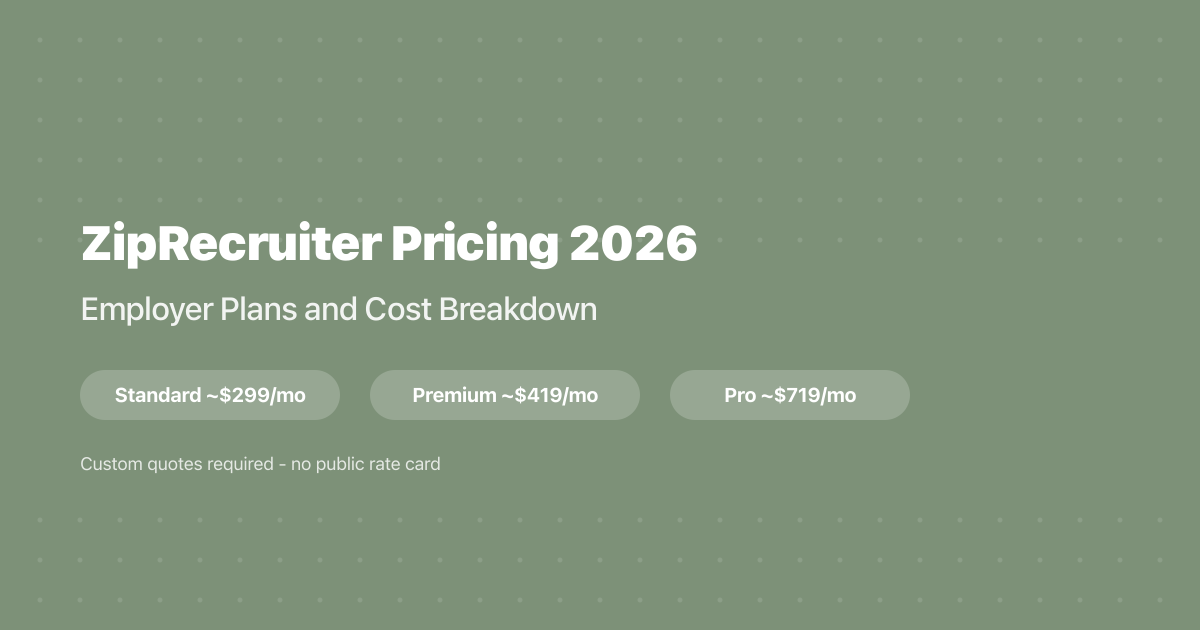
ZipRecruiter starts at approximately $299/month for its Standard plan, with Premium and Pro tiers ranging up to $899/month per job slot. But here's the catch: ZipRecruiter doesn't publish fixed pricing. Every employer gets a custom quote based on industry, location, company size, and job volume. That lack of transparency is one of the most common complaints across TrustRadius, G2, and the Better Business Bureau.
This guide breaks down what employers actually pay across all three ZipRecruiter tiers, maps out the add-on costs that aren't visible until you're deep in the sales process, and compares ZipRecruiter to four alternatives - including platforms that publish their pricing upfront.
TL;DR: ZipRecruiter's three plans reportedly cost ~$299-$399/mo (Standard), ~$419-$519/mo (Premium), and ~$719-$899/mo (Pro) per job slot. Pricing requires a custom quote - there's no public rate card. The free trial lasts just 2-4 days and requires a credit card. For teams focused on sourcing candidates rather than posting jobs, Pin starts at $100/mo with access to 850M+ profiles.
ZipRecruiter Pricing Per Job Slot: What Employers Pay in 2026
ZipRecruiter charges employers per active job slot on a monthly subscription. Unlike Indeed's pay-per-application model, your ZipRecruiter bill stays flat regardless of how many candidates apply. That predictability is the upside. The downside? You won't see an actual price until you talk to sales.
Based on third-party pricing data compiled from avahr.com, FangWallet, Betterteam, and WorldJobInsights (2025-2026 estimates), here's what employers report paying:
| Plan | Estimated Monthly Cost | Estimated Daily Cost | Key Features |
|---|---|---|---|
| Standard | ~$299-$399/mo | ~$16/day | Employer dashboard, 100+ job board distribution, AI candidate matching |
| Premium | ~$419-$519/mo | ~$24/day | All Standard + resume database access (25 views/mo), up to 6x more candidate visibility |
| Pro | ~$719-$899/mo | N/A | All Premium + 3 TrafficBoost credits, external ATS integration, dedicated account manager |
Important caveat: These are reported estimates from third-party review aggregators, not official ZipRecruiter numbers. Your actual quote will vary based on industry competitiveness, geographic market, company size, and how many job slots you need. ZipRecruiter's sales line is 855-458-3347.

Here's the pricing wrinkle most guides skip: those per-slot costs multiply fast when you're hiring for multiple roles. A mid-size company running five open positions on ZipRecruiter's Standard plan could pay $1,495-$1,995/month - roughly $18,000-$24,000/year - just for job distribution. And that's before add-ons like TrafficBoost or resume database access. If you're filling more than two or three roles at a time, the math starts favoring platforms with unlimited posting models or flat monthly subscriptions.
What's Included in Each ZipRecruiter Plan?
All three ZipRecruiter tiers distribute your posting to 100+ job boards automatically. The difference between plans comes down to candidate visibility, resume access, and support level. Based on ZipRecruiter's support documentation, here's how the features break down:
Standard Plan (~$299-$399/mo)
The entry-level plan covers the basics. Your job gets posted across 100+ job boards including Google Jobs, and ZipRecruiter's AI matching algorithm sends your listing to candidates it considers a fit. You get an employer dashboard with applicant tracking, basic analytics, and the ability to invite candidates to apply. What you don't get is access to ZipRecruiter's resume database - you can only review candidates who apply to you.
Premium Plan (~$419-$519/mo)
Premium adds proactive candidate discovery. You get access to ZipRecruiter's resume database of 43M+ profiles, with 25 resume views per month included. ZipRecruiter claims Premium listings get up to 6x more candidates than Standard. You also get enhanced visibility in search results and improved AI matching priority. Additional resume views cost approximately $1 per view beyond the 25 included.
Pro Plan (~$719-$899/mo)
Pro is the top tier, adding TrafficBoost credits (3 included per month), external ATS integration, and a dedicated account manager. TrafficBoost pushes your listing to the top of search results for a set period - think of it as ZipRecruiter's version of a promoted post. You also get unlimited resume views and priority placement in candidate alerts.
Feature Comparison Across Tiers
| Feature | Standard | Premium | Pro |
|---|---|---|---|
| 100+ job board distribution | ✅ | ✅ | ✅ |
| AI candidate matching | ✅ | ✅ | ✅ |
| Employer dashboard | ✅ | ✅ | ✅ |
| Resume database access | ❌ | ✅ (25 views/mo) | ✅ (unlimited) |
| Enhanced candidate visibility | ❌ | ✅ (up to 6x) | ✅ |
| TrafficBoost credits | ❌ | ❌ | ✅ (3/mo included) |
| External ATS integration | ❌ | ❌ | ✅ |
| Dedicated account manager | ❌ | ❌ | ✅ |
The biggest jump is from Standard to Premium. Standard is essentially a one-way broadcast - you post, candidates apply, and you review. Premium opens up proactive discovery through the resume database, which is the feature most employers are actually looking for when they upgrade. If you're on Standard and finding applicant quality too low, Premium's resume search is the logical next step before jumping to Pro.
What's the Total Cost of Ownership for ZipRecruiter?
A realistic ZipRecruiter annual budget ranges from $3,588 for a single Standard slot to over $107,000/year for 10 Pro-tier job slots - before add-ons. The base subscription price only tells part of the story. Here's what three common hiring scenarios actually cost:
| Scenario | Plan | Job Slots | Add-Ons | Estimated Annual Cost |
|---|---|---|---|---|
| Small business (1-2 hires/quarter) | Standard | 1 | None | $3,588-$4,788/yr |
| Mid-size team (3-5 open roles) | Premium | 3-5 | Extra resume views | $15,084-$31,740/yr |
| High-volume hiring (10+ roles) | Pro | 10+ | TrafficBoost + extra slots | $86,280-$107,880+/yr |
That high-volume scenario is where the math gets eye-opening. Ten Pro-tier job slots at $719-$899/month each - before any TrafficBoost add-ons - puts you in the $86,000-$108,000/year range. At that spend level, you're paying more than many enterprise ATS platforms charge for unlimited postings, full applicant tracking, and built-in sourcing.
For comparison, Pin's most expensive plan (Business) costs $249/month with no per-slot charges. You get access to 850M+ profiles, automated multi-channel outreach, and interview scheduling. That's $2,988/year total - roughly what a single ZipRecruiter Standard slot costs for 10 months. The platforms serve different functions, but if your primary goal is finding qualified candidates (not just attracting applicants), the cost-per-hire math favors AI sourcing tools significantly at scale.
What Are ZipRecruiter's Add-On Costs?
ZipRecruiter's base subscription covers the fundamentals, but several features carry extra charges. According to third-party pricing data from WorldJobInsights (2025) and Betterteam (2025), here's what to budget beyond your plan cost:
| Add-On | Estimated Cost | Notes |
|---|---|---|
| TrafficBoost credits | $300-$500 per boost | Variable by job competition and location. Pro plan includes 3/mo. |
| Additional resume views | ~$1 per view | Beyond Premium's 25/mo included. Standard has no resume access. |
| Resume database access | Included with Premium/Pro | Not available on Standard plan at any price. |
| Additional job slots | Custom quote | Multi-job discounts are negotiable. Contact sales. |
TrafficBoost is where costs can spike unexpectedly. A single boost for a competitive role in a major metro area can run $500, and the effect is temporary. If you're running three to five open positions in competitive markets, TrafficBoost alone could add $1,500-$2,500/month on top of your subscription. For teams filling roles regularly, it's worth asking during the sales call whether TrafficBoost credits can be bundled at a discount.
Does ZipRecruiter Offer a Free Trial?
ZipRecruiter offers a limited free trial, but it's shorter than most employers expect. According to freetrials.com (2026) and CareerCloud (2026), the trial window is roughly 2-4 days - with more recent reports trending toward just 2 days.
A few things to know before you sign up:
- Credit card required. You must enter payment information to start the trial. There's no credit-card-free option.
- The clock starts when your first job goes live. The trial period doesn't begin at account creation - it begins when you actually post a role. Plan accordingly.
- Auto-conversion to paid plan. If you don't cancel before the trial ends, your account automatically converts to a paid subscription. You must cancel through the dashboard - there's no reminder email before the charge hits.
- One job posting only. The trial typically covers a single job listing, not unlimited postings.
That 2-4 day trial is unusually short for the recruiting software category. Most applicant tracking systems offer 14-day trials. Some, like Pin, offer a permanent free tier with no credit card required and no time limit. If you need more than a couple of days to evaluate a platform - and most hiring teams do - ZipRecruiter's trial doesn't give you much runway.
What Billing Issues Do Employers Report?
ZipRecruiter scores well on G2 (4.8/5 stars) and TrustPilot (4.5/5), but employer billing complaints are a recurring pattern. The BBB lists 185 complaints against ZipRecruiter, and its ConsumerAffairs rating sits at just 2.9/5 - a notable gap from the G2 score. Billing and customer service issues dominate the negative feedback.
The most common complaints fall into three categories:
- Pricing opacity. Employers report that actual pricing isn't disclosed until deep in the signup flow or after a sales call. Multiple TrustRadius and G2 reviewers flag this as frustrating.
- Auto-renewal and cancellation issues. Accounts auto-convert from trial to paid and auto-renew at the end of each billing cycle. Several BBB complaints describe charges continuing after employers believed they'd cancelled.
- Continuing charges after closure. One documented BBB case describes charges continuing for 13 billing cycles after the employer closed their account - totaling $7,277.14 in disputed charges. ZipRecruiter cited "active" job status under their Terms of Service.
That gap between ZipRecruiter's G2 score (4.8/5) and its ConsumerAffairs score (2.9/5) is telling. G2 reviews tend to come from active, satisfied users, while consumer review platforms capture billing disputes and cancellation friction. Both perspectives matter when evaluating total cost of ownership.
How Does ZipRecruiter Compare to Other Job Boards on Price?
ZipRecruiter uses a flat subscription model. Indeed uses pay-per-application. LinkedIn uses cost-per-click plus seat-based licensing. These structural differences mean the cheapest platform depends entirely on your hiring volume and role competitiveness.

Here's a side-by-side comparison of the four major hiring platforms by pricing model:
| Platform | Pricing Model | Free Option | Starting Cost | Primary Use Case |
|---|---|---|---|---|
| ZipRecruiter | Subscription per job slot | 2-4 day trial (credit card required) | ~$299/mo | Employers wanting predictable monthly costs |
| Indeed | Pay-per-application (sponsored) + free posts | 3 free posts/mo | ~$150/mo min (sponsored) | Variable-volume hiring with budget flexibility |
| Cost-per-click (posts) + seat license (Recruiter) | Free basic posting | $170/mo (Recruiter Lite) | Professional and white-collar roles | |
| Pin | Flat monthly subscription | Free tier (no credit card) | $100/mo | Proactive AI sourcing from 850M+ profiles |
For a detailed head-to-head between ZipRecruiter and Indeed specifically, including feature comparisons and user satisfaction data, see our ZipRecruiter vs Indeed comparison.
The structural difference matters more than the sticker price. ZipRecruiter, Indeed, and LinkedIn are all "post-and-wait" platforms - you publish a listing and hope qualified candidates find it. That model works for roles with high applicant volume, but it's slow and unreliable for specialized positions or passive candidates who aren't actively browsing job boards. According to research aggregated by altLINE (2024-2025), 52% of recruiters say job board effectiveness has declined.
The alternative is proactive sourcing: using AI to search candidate databases and reach out directly. Pin takes that approach. Instead of posting a job and waiting, Pin's AI scans 850M+ candidate profiles and sends personalized outreach across email, LinkedIn, and SMS - delivering a 48% response rate. It's a sourcing engine, not a job board. Try AI sourcing with Pin - free.
Is ZipRecruiter Worth It? Key Factors to Consider
ZipRecruiter had approximately 59,000 quarterly paid employers in Q4 2025 - up 2% year-over-year, the first growth since Q3 2022 (ZipRecruiter IR via StockTitan, Feb 2026). Full-year 2025 revenue was $449.0M, down 5% from $474M in 2024 and well below the platform's $905M peak in 2022.
Those numbers don't mean ZipRecruiter is dying. But they do reflect a broader shift in how employers allocate recruiting budgets. Here's when ZipRecruiter makes sense - and when it doesn't:
ZipRecruiter works well when:
- You're hiring for high-applicant-volume roles. Customer service, administrative, entry-level positions where lots of candidates are actively job searching. The 100+ job board distribution generates volume efficiently.
- You want predictable monthly costs. Unlike Indeed's variable per-application pricing, ZipRecruiter's subscription model means no surprises on your invoice.
- You only have 1-2 open roles at a time. The per-slot pricing is manageable for light hiring. The math gets expensive above three concurrent openings.
ZipRecruiter falls short when:
- You're hiring specialists or passive candidates. Job boards rely on candidates actively searching. If your ideal hire isn't browsing ZipRecruiter, the platform can't reach them regardless of which tier you're on.
- You need sourcing, not just posting. ZipRecruiter's resume database (Premium and above) has 43M+ profiles. That sounds large until you compare it to dedicated AI candidate sourcing platforms with 500M-850M+ profiles and automated outreach.
- You're scaling past 3-5 open roles. Five Standard-tier job slots run $1,495-$1,995/month. At that spend level, a flat-rate AI sourcing platform like Pin ($100-$249/mo) costs a fraction and proactively finds candidates instead of waiting for them to apply.
- You need outreach automation. ZipRecruiter lets you invite candidates to apply. It doesn't send personalized multi-channel outreach sequences. For automated email, LinkedIn, and SMS outreach, you need a dedicated AI recruiting tool.
What About Pin as an Alternative to ZipRecruiter?
Pin and ZipRecruiter solve different problems. ZipRecruiter is a job board - you post a listing and wait for applicants. Pin is an AI recruiting assistant that proactively searches 850M+ candidate profiles, sends multi-channel outreach, and schedules interviews automatically.
Here's how the two platforms compare on cost and capabilities:
| Feature | Pin | ZipRecruiter |
|---|---|---|
| Starting Price | $100/mo (Starter) | ~$299-$399/mo (Standard) |
| Free Tier | ✅ No credit card required | ⚠️ 2-4 day trial, credit card required |
| Candidate Database | ✅ 850M+ profiles | ⚠️ 43M+ resumes (Premium/Pro only) |
| AI Candidate Sourcing | ✅ Proactive search and matching | ⚠️ AI matching to posted jobs only |
| Automated Outreach | ✅ Email, LinkedIn, SMS sequences | ❌ Invite to apply only |
| Interview Scheduling | ✅ Automated | ❌ Not included |
| Job Board Distribution | ❌ Not a job board | ✅ 100+ job boards |
| SOC 2 Certified | ✅ | ✅ |
| Published Pricing | ✅ All plans listed on website | ❌ Custom quotes only |
As Rich Rosen, Executive Recruiter at Cornerstone Search, puts it: "Absolutely money maker for recruiters... in 6 months I can directly attribute over $250K in revenue to Pin."
The choice depends on your hiring model. If you need to attract a high volume of active job seekers for standard roles, ZipRecruiter's job board distribution is useful. If you need to find and reach specific candidates - especially passive ones who aren't applying to job boards - Pin's AI sourcing approach fills positions in approximately 2 weeks at a fraction of ZipRecruiter's cost.
ZipRecruiter's Recent Changes: What Employers Should Know
ZipRecruiter launched a feature called "Be Seen First" in January 2025, which lets job seekers pay to move to the top of employer candidate lists. According to ZipRecruiter's blog, job seekers who use it are nearly 2x more likely to start a conversation with an employer. For employers, that means some of the candidates appearing at the top of your applicant list may be there because they paid for priority placement, not necessarily because they're the strongest match.
On the financial side, ZipRecruiter's full-year 2025 revenue was $449.0M - the third consecutive year of decline from a $905M peak in 2022 (StockTitan, Feb 2026). The company posted a net loss of $33.0M for the year. It's still a major platform with roughly 59,000 paid employers, but the trajectory is worth factoring into a long-term platform decision.
The online recruitment market overall is growing - valued at $33.59B in 2025 and projected to reach $64.93B by 2031 at an 11.62% CAGR (Mordor Intelligence, 2025). But job boards' share of that market is shrinking as more employers shift spend toward AI-powered sourcing and direct outreach platforms. Job boards still hold 44.72% of the online recruitment market, but that share is trending downward as proactive sourcing tools gain traction.
How to Negotiate a Better ZipRecruiter Price
Since every ZipRecruiter contract starts with a custom quote, there's room to negotiate. Here are five tactics that employers report working:
- Ask for annual billing discounts. ZipRecruiter typically offers a lower monthly rate if you commit to an annual contract. Push for 15-20% off the initial quote.
- Bundle multiple job slots. If you're hiring for 3+ roles, ask for volume pricing. The per-slot cost should decrease with quantity.
- Request TrafficBoost credits in the base price. Rather than paying $300-$500 per boost as an add-on, negotiate a fixed number of monthly credits included in your subscription.
- Get the cancellation terms in writing. Given the BBB complaints about post-cancellation charges, make sure your contract clearly defines how and when you can cancel without additional billing cycles.
- Compare quotes from Indeed and LinkedIn. Having competing offers from other job boards gives you negotiating power. ZipRecruiter's sales team is more likely to discount when they know you're evaluating alternatives.
- Time your purchase. Quarterly sales cycles matter. End-of-quarter and end-of-year conversations with ZipRecruiter sales reps tend to yield better pricing, as reps work to close deals before deadlines. If your hiring isn't urgent, timing your outreach to late March, June, September, or December can get you 10-20% better terms.
- Negotiate resume view caps upfront. Premium's 25 monthly resume views run out fast if you're actively sourcing. Push to get 50 or 100 views included at the Premium price point rather than paying $1/view overage.
If your total ZipRecruiter spend would exceed $500/month, it's worth running a parallel comparison with AI sourcing tools. Pin's Professional plan at $149/month (annual billing) gives you access to 850M+ profiles with automated outreach - replacing the need to post on job boards entirely for many role types. Compare cost-per-hire benchmarks to see how job board spend stacks up against AI-first sourcing, and check our recruiting ROI guide for a full framework on measuring return on hiring tool spend.
Which Plan Should You Choose?
The right ZipRecruiter plan depends on your hiring volume, whether you need to source candidates proactively, and how much you're willing to pay per role. Here's a quick decision guide:
- Standard ($299-$399/mo) makes sense if you're filling one role at a time, the role attracts plenty of active applicants (think admin, customer service, or entry-level), and you don't need to search resumes proactively. It's the simplest way to test whether ZipRecruiter's candidate pool fits your needs.
- Premium ($419-$519/mo) is the upgrade worth considering if Standard isn't generating enough qualified applicants. The resume database access lets you search and contact candidates directly. But watch the 25-view monthly cap - it drains quickly when you're actively hiring.
- Pro ($719-$899/mo) is really only justified for employers who are filling competitive, hard-to-recruit roles in hot markets where TrafficBoost visibility makes a measurable difference. For most teams, the jump from Premium to Pro doesn't deliver proportional value.
- Consider skipping job boards entirely if your roles require specialized talent, passive candidates, or multi-channel outreach. AI sourcing platforms like Pin handle those use cases at $100-$249/month with no per-slot charges and no cap on the number of roles you can source for simultaneously.
For teams evaluating their full recruiting tool stack, the question isn't always "which ZipRecruiter plan?" - it's whether a job board belongs in your stack at all. The answer depends on role type, candidate availability, and whether you need passive or active talent.
Frequently Asked Questions
How much does ZipRecruiter cost per month for employers?
ZipRecruiter's Standard plan reportedly starts at approximately $299-$399/month per job slot, based on third-party estimates from TrustRadius and avahr.com (2025-2026). Premium runs ~$419-$519/month, and Pro runs ~$719-$899/month. All pricing requires a custom quote - ZipRecruiter doesn't publish fixed rates.
Does ZipRecruiter have a free plan for employers?
No. ZipRecruiter offers a 2-4 day free trial (credit card required), but there's no permanent free tier. The trial auto-converts to a paid subscription if not cancelled. Alternatives like Pin offer a free tier with no credit card and no time limit.
Is ZipRecruiter or Indeed cheaper for hiring?
It depends on hiring volume. Indeed lets you post 3 jobs free per month and charges $15-$50 per qualified application for sponsored posts. ZipRecruiter charges a flat monthly subscription per job slot (~$299-$399/mo). For low-volume hiring, Indeed is typically cheaper. For predictable monthly budgets, ZipRecruiter's flat rate may be simpler. For a full comparison, see our ZipRecruiter vs Indeed breakdown.
Can I cancel ZipRecruiter at any time?
ZipRecruiter allows cancellation through the employer dashboard, but cancellation does not always stop billing immediately. Multiple BBB complaints document continued charges after confirmed cancellations - including one case totaling $7,277 over 13 billing cycles. Always get written cancellation confirmation and review your contract's auto-renewal clause before signing.
What's a better alternative to ZipRecruiter for sourcing candidates?
For proactive candidate sourcing rather than job posting, AI recruiting tools outperform job boards. Pin searches 850M+ profiles and sends automated outreach across email, LinkedIn, and SMS at a 48% response rate - starting at $100/month with a free tier. That's a fundamentally different approach than posting a job and waiting for applicants.
Get enterprise sourcing features at startup pricing with Pin