AI job matching works by converting resumes, job descriptions, and career signals into mathematical representations - then scoring how closely a candidate's profile aligns with a role's requirements. Instead of scanning for exact keyword overlap, modern matching algorithms understand context, infer transferable skills, and predict hiring success based on patterns across millions of past placements. The technology has moved fast: 43% of organizations now use AI in HR, nearly double the 26% reported just one year earlier, according to SHRM's 2025 Talent Trends report.
But what's actually happening under the hood? The answer depends on which generation of algorithm you're looking at. The field has evolved from rigid keyword filters to transformer-based language models and graph neural networks - each generation solving problems the last one couldn't. This guide breaks down the specific algorithms powering AI recruiting tools today, explains where each approach excels and fails, and shows what the research says about accuracy, bias, and trust.
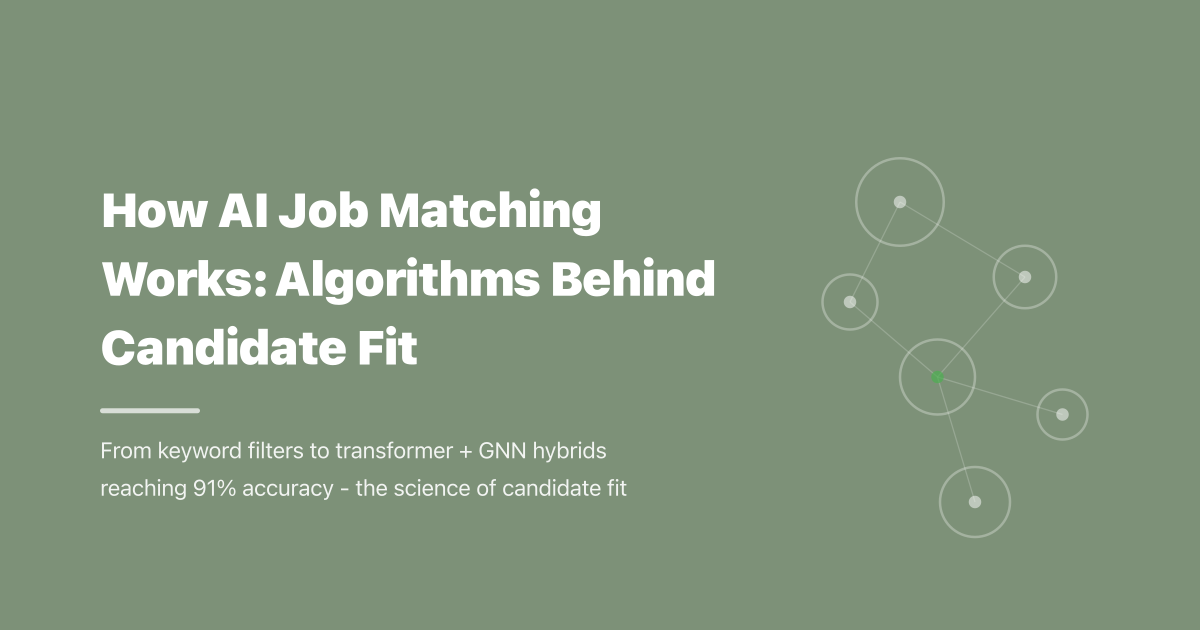
TL;DR: AI job matching has evolved from keyword filters to transformer + GNN hybrid models that achieve 0.91 F1 accuracy versus 0.70 for cosine similarity, per 2025 ScienceDirect research. Skills-based matching expands candidate pools 6x. But bias persists - and only 8% of job seekers call AI hiring fair.
The Four Generations of Matching Algorithms
Not all AI matching is created equal. The term "AI job matching" covers at least four distinct technical approaches, each representing a different era of capability. Understanding these generations matters because the tool you pick determines whether you're getting 2015-era keyword matching dressed up as AI - or actual machine learning that improves with every hire.
Generation 1: Keyword and Boolean Matching
The oldest approach is barely AI at all. Keyword matching scans a resume for exact terms that appear in the job description. Boolean search adds operators (AND, OR, NOT) so recruiters can build more targeted queries. If a job requires "Python" and a resume says "Python," it's a match. If the resume says "data analysis using Python-based tools," some basic parsers miss it entirely.
The upside is speed and transparency - you know exactly why a candidate matched. The downside is that keyword matching treats language as a bag of disconnected terms. It can't understand that "managed a team of 12 engineers" and "engineering leadership" describe the same capability. It also fails on synonyms, abbreviations, and role titles that vary across industries.
Generation 2: NLP and Named Entity Recognition
Natural language processing added the first layer of actual intelligence. NER (Named Entity Recognition) models extract structured information from unstructured text - pulling out skills, job titles, company names, education, and certifications from free-form resumes. Instead of matching raw strings, the system works with parsed entities.
This generation also introduced skill taxonomies. Tools mapped extracted skills to standardized frameworks like O*NET, the U.S. Department of Labor's occupational database. If a resume mentions "financial modeling" and the taxonomy links that to "financial analysis," the system recognizes the connection even without an exact keyword match. It's a meaningful step forward, but still limited by the completeness of the taxonomy and the accuracy of the parser.
Generation 3: Word Embeddings and Semantic Search
Word embeddings (Word2Vec, GloVe, and later contextual models) fundamentally shifted how matching systems represent language - storing words as points in high-dimensional space. Words with similar meanings cluster together - "Python," "data science," and "machine learning" sit near each other mathematically, even when they don't appear together in text.
This meant matching tools could finally understand that a candidate with "predictive analytics" experience is relevant to a job requiring "data modeling" - without anyone manually building that mapping. Semantic search in recruitment applies this principle at scale: instead of matching keywords, the system compares the meaning of an entire resume against the meaning of a job description.
The limitation? Early embeddings gave each word a single fixed representation regardless of context. "Java" the programming language and "Java" the island got the same vector. That's where transformers came in.
Generation 4: Transformers and Contextual Understanding
BERT (Bidirectional Encoder Representations from Transformers) and its descendants solved the context problem. Instead of assigning one vector per word, transformer models generate different representations based on surrounding text. "Java developer" and "traveled to Java" produce completely different embeddings.
For recruiting, this matters in practical ways. A transformer model understands that "led cross-functional product launches" in a resume maps to a job requirement for "product management experience" - even though the words barely overlap. It reads context, not just vocabulary. Multiple 2025 studies confirm that BERT-family models significantly outperform conventional methods in skill extraction accuracy, according to research published in Frontiers in Computer Science.

How Do Graph Neural Networks Map the Hiring Landscape?
Graph neural networks represent one of the biggest leaps in matching accuracy. Traditional models treat each candidate and each job as independent documents. GNNs instead model the entire labor market as a connected graph - where candidates, skills, companies, job titles, and industries are all nodes linked by relationships.
Think of it this way: a traditional model reads a resume in isolation. A GNN knows that Candidate A worked at Company B, which is similar in size and stage to Company C, and that people who moved from Company B to Company C tended to have skills X, Y, and Z. It's using the structure of career paths, not just the text on a resume.
The results are measurable. A 2025 study published in Springer Nature's Data Science and Engineering journal tested graph convolutional networks (GCN) across 62 real-world selection processes involving 8,360 candidates. The GCN model achieved 65.4% balanced accuracy - a meaningful improvement over the 55.0% baseline from a standard multi-layer perceptron (MLP). That 10-point gap translates to fewer false positives reaching hiring managers and fewer qualified candidates getting filtered out.
Skills-Based Matching and Knowledge Graphs
GNNs work especially well when combined with structured skill taxonomies. O*NET, the U.S. government's occupational database, classifies thousands of job titles with detailed skill requirements, work activities, and knowledge domains. When a matching algorithm maps candidate skills to O*NET's knowledge graph, it can infer connections that pure text analysis misses.
For example, someone with "regulatory compliance" experience in pharmaceutical manufacturing shares transferable skills with a "quality assurance manager" role in medical devices - even if the resume never mentions quality assurance. The knowledge graph captures the structural similarity between these roles.
Skills-based hiring is accelerating this shift. According to LinkedIn's March 2025 Skills-Based Hiring report, skills-based searches expand the pool of eligible candidates by 6x compared to title-based searches. For AI-specific roles, that expansion hits 8.2x. The implication for matching algorithms is clear: tools that match on skills graphs find candidates that keyword and title-based tools systematically miss.
How Did Large Language Models Change Recruiting Algorithms?
Large language models have introduced a fundamental shift in how matching algorithms process information. Instead of comparing two documents (resume versus job description) using pre-trained embeddings, LLM-based systems can reason about fit - weighing trade-offs, interpreting ambiguous experience, and even explaining why a candidate is or isn't a match.
The LLM + GNN Hybrid Approach
The most advanced production systems combine LLMs with graph neural networks. LinkedIn's STAR system, presented at KDD 2025, is a documented example. STAR uses an LLM to generate rich text representations of candidates and jobs, then feeds those into a GNN that models relationships across the entire professional network - over 1 billion member profiles and 50 million jobs. In A/B testing, STAR increased job applications by 1.5% site-wide, according to the research paper published on arXiv.
Why does the hybrid outperform either approach alone? The LLM handles language understanding - parsing complex job titles, interpreting career narratives, and generating contextual embeddings. The GNN handles structural reasoning - understanding which career paths lead where, which companies cluster together, and which skill combinations predict success in specific roles. Together, they address each other's blind spots.
The academic benchmarks back this up. A 2025 study published in ScienceDirect found that a GPT-4 + hierarchical GNN system achieved an F1 score of 0.91 for resume-job matching - versus 0.70 for basic cosine similarity. That's not an incremental improvement. It's the difference between a tool that gets matching roughly right and one that performs at near-human accuracy.
RAG: Adding Real-Time Context to Matching
Retrieval-Augmented Generation (RAG) adds another layer by pulling in external knowledge at inference time. Instead of relying solely on what the model learned during training, a RAG-based matching system retrieves relevant context - current salary benchmarks, company culture descriptions, hiring manager preferences, or market conditions - and feeds it into the LLM alongside the candidate profile and job description.
A 2025 multi-agent framework using DeepSeek-V3 with RAG achieved a Pearson correlation of 0.84 with human HR evaluators when scoring the top 10% of candidates, according to research published on arXiv. The system tested 105 resumes across multiple job categories. What's notable isn't just the accuracy - it's that the RAG approach dynamically incorporated job-specific criteria that weren't part of the base model's training data.
For recruiters, this is significant. A RAG-powered tool can adapt its matching criteria based on information you provide - like "this role requires someone comfortable with ambiguity in a Series A environment" - without retraining the underlying model.
Pin uses a similar approach to match candidates at scale. Its AI scans 850M+ profiles and applies recruiter-level reasoning to surface candidates that keyword-based tools miss entirely. As Rich Rosen, Executive Recruiter at Cornerstone Search, puts it: "Absolutely money maker for recruiters... in 6 months I can directly attribute over $250K in revenue to Pin."
Try Pin's AI-powered candidate matching free - it delivers a ~70% candidate acceptance rate - meaning seven out of ten candidates Pin recommends are accepted into customers' hiring pipelines. That acceptance rate reflects the practical impact of advanced matching algorithms applied to a database with 100% coverage in North America and Europe.
How Does Reinforcement Learning Make Matching Smarter?
Static models score candidates based on training data - but hiring patterns change constantly. New roles emerge, skill requirements shift, and what "good fit" means evolves with each hiring manager's feedback. Reinforcement learning from human feedback (RLHF) addresses this by treating every recruiter decision as a training signal.
Here's the loop: the algorithm presents candidates. The recruiter accepts some and passes on others. Those accept/reject decisions feed back into the model, adjusting how it weighs different signals for that specific role, team, or hiring manager. Over time, the system learns that Hiring Manager A cares more about hands-on coding ability than years of experience, while Hiring Manager B prioritizes industry background.
This is why the first batch of AI-sourced candidates often improves noticeably after a few cycles of feedback. The algorithm is literally learning from the recruiter's judgment. It's also why tools with larger feedback loops - more clients, more hires, more data - tend to produce better matches than niche tools with thin usage.
The World Economic Forum's Future of Jobs 2025 report projects that 40% of job-required skills will change over the coming years. Matching algorithms that can't adapt continuously will fall behind quickly. Reinforcement learning is what keeps the system calibrated as the labor market shifts under it.
Does AI Job Matching Introduce Bias?
No discussion of AI matching algorithms is complete without confronting bias - and the data here is sobering. A 2025 Brookings Institution study conducted by researchers at the University of Washington tested three major LLMs across approximately 40,000 resume comparisons using 554 resumes and 571 job descriptions. The findings: white-associated names were preferred 85.1% of the time, compared to 8.6% for Black-associated names. Men's names were favored 51.9% of the time versus 11.1% for women's.
These aren't edge cases. The bias was present in 93.7% of test scenarios involving race. The cause is structural - LLMs trained on internet text absorb the biases embedded in that text, including historical hiring patterns, media representation, and language associations.
How Bias Enters Matching Systems
Algorithmic bias in recruiting typically enters through three channels:
Training data bias. If the model learns from historical hiring decisions, it inherits whatever biases shaped those decisions. Amazon's widely reported case from 2015 - where an internal hiring tool penalized resumes containing the word "women's" - remains the most cited example. The tool was trained on a decade of predominantly male hires and learned to replicate that pattern.
Proxy variable encoding. Even when protected characteristics (gender, race, age) are excluded from the model's input, proxy variables can encode the same information. Zip codes correlate with race. Graduation years reveal age. University names signal socioeconomic background. A model that's never told a candidate's race can still discriminate if it weighs these proxies.
Evaluation metric bias. If "quality of hire" is measured by retention at companies that have hostile cultures toward underrepresented groups, the algorithm learns that candidates from those groups are "lower quality" - when the real problem is the workplace, not the candidate.
What Responsible Matching Tools Do Differently
The most effective bias-mitigation approaches don't simply remove protected fields from the input. They use adversarial debiasing (training a second model to detect and penalize discriminatory patterns), regularly audit outputs against demographic benchmarks, and build in human review checkpoints at critical decision stages.
Pin's approach strips names, gender, and protected characteristics from AI inputs entirely. Strict guardrails eliminate AI-produced bias at every step, with regular team reviews and third-party fairness audits supplementing the technical controls. It's SOC 2 Type 2 certified, with compliance documentation publicly available at trust.pin.com.
Why Don't Candidates Trust AI Job Matching?
Even when matching algorithms perform well technically, there's a growing disconnect in how recruiters and candidates perceive them. According to a 2025 industry survey by Insight Global, 70% of hiring managers trust AI to make faster and better decisions. But only 8% of job seekers call AI hiring fair, per separate candidate research.
That's not a gap - it's a chasm. And it has practical consequences. Josh Bersin's Talent Acquisition Revolution research found that 79% of candidates want to know exactly how AI is being used in their evaluation, while only 37% trust AI to select qualified applicants. When candidates don't trust the process, they disengage - and the best candidates, who have the most options, disengage first.
What does this mean for matching algorithms? Accuracy alone isn't enough. The tools that win long-term will be the ones that can explain their decisions. Why was this candidate ranked higher than that one? What signals drove the match? Explainability isn't just a nice-to-have - it's becoming a regulatory requirement.

What Regulations Govern AI Matching Tools?
Regulators are catching up to the technology. Multiple U.S. states now require companies to audit AI hiring tools for bias, notify candidates when AI is used, and maintain records of algorithmic decisions.
New York City (Local Law 144) has been active since July 2023, requiring annual bias audits for automated employment decision tools. However, enforcement has been uneven. A December 2025 audit by the New York State Comptroller found that independent auditors identified 17 potential non-compliance instances across 32 companies reviewed - while the city's own enforcement body (DCWP) found just one. The gap signals that self-reporting and light enforcement aren't enough.
California's AI employment regulations took effect October 1, 2025, according to the California Civil Rights Council. They mandate anti-bias testing before deployment, four-year record retention, vendor liability for discriminatory outcomes, and both pre-use and post-use candidate notices. Illinois and Colorado have similar laws taking effect in 2026.
For recruiting teams evaluating AI matching tools, this means compliance isn't optional - it's a feature requirement. Any tool that can't produce audit trails, explain its decisions, or demonstrate bias testing is a liability risk, not just a poor product choice.
What Should You Look for in an AI Matching Tool?
Understanding the algorithms helps, but recruiters need to translate that knowledge into buying decisions. Here's what separates tools built on modern matching from those still running keyword searches behind an AI label.
Database coverage and freshness. The best algorithm in the world can't find candidates that aren't in the database. Look for tools with broad, continuously updated candidate data. Pin's database includes 850M+ profiles with 100% coverage in North America and Europe - which means the matching algorithm has a complete picture of the available talent pool, not just whoever's active on one platform.
Skills-based versus title-based matching. Ask whether the tool matches on skills graphs or just job titles. The 6x candidate pool expansion from skills-based matching documented by LinkedIn's research isn't theoretical - it's the practical difference between finding your hire in a week versus searching for months. As Colleen Riccinto, Founder of Cyber Talent Search, explains: "What I love about Pin is that it takes the critical thinking your brain already does and puts it on steroids. I can target specific company types and industries in my search and let the software handle the kind of strategic thinking I'd normally have to do on my own."
Feedback loops and adaptability. Does the tool get smarter as you use it? Tools with reinforcement learning from recruiter decisions will improve match quality over time. Static scoring models won't.
Bias controls and compliance. Can the vendor provide bias audit results? Does the tool strip protected characteristics? Is there a trust center with compliance documentation? These aren't optional in a post-LL144, post-California regulatory environment.
Explainability. Can the tool tell you why it ranked Candidate A above Candidate B? Black-box recommendations erode recruiter trust and create legal exposure. The matching algorithm should surface the signals that drove its decision.
Where Is AI Job Matching Headed Next?
The next frontier isn't just better matching - it's autonomous action. According to Gartner, 82% of HR leaders plan to implement agentic AI within 12 months, and 40% of enterprise applications are projected to feature task-specific AI agents by the end of 2026.
In the context of AI candidate matching, agentic systems don't just score and rank - they act. An agentic recruiting AI means the system identifies high-fit candidates, drafts personalized outreach, sends messages across multiple channels, handles scheduling, and only hands off to the recruiter when human judgment is genuinely needed. The matching algorithm becomes one component of a larger autonomous workflow.
Deloitte's 2026 State of AI report found that workforce access to AI tools grew from under 40% to approximately 60% in a single year, with 25% of organizations reporting transformative business impact - double the previous year. The trajectory is clear: matching algorithms are becoming embedded in end-to-end recruiting workflows, not standalone screening steps.
Automate your candidate matching with Pin's AI - start free
Key Takeaways
- AI job matching has evolved through four generations - from keyword/Boolean filters to NLP, semantic embeddings, and now transformer + GNN hybrid models
- The latest algorithms are dramatically more accurate - LLM + GNN hybrids achieve an F1 score of 0.91 versus 0.70 for basic cosine similarity
- Skills-based matching expands candidate pools 6x versus title-based searches, and 8.2x for AI roles specifically
- Graph neural networks model career paths and company relationships - not just resume text - to predict candidate fit
- Bias remains a documented risk - the Brookings study found racial bias in 93.7% of LLM-based screening scenarios
- Only 8% of job seekers call AI hiring fair - explainability and transparency are essential, not optional
- Regulation is accelerating - NYC, California, Illinois, and Colorado all require or will require bias audits and candidate disclosure
- Agentic AI is the next step - 82% of HR leaders plan implementation within 12 months, turning matching into autonomous end-to-end workflows
Frequently Asked Questions
What algorithms do AI recruiting tools use to match candidates?
Modern AI recruiting tools combine transformer-based language models (like BERT and GPT-4) with graph neural networks to score candidate fit. The latest hybrid systems achieve an F1 matching accuracy of 0.91, according to a 2025 study in ScienceDirect - far higher than the 0.70 from traditional cosine similarity approaches. These algorithms analyze skills, career trajectories, and company relationships, not just keywords.
How accurate is AI job matching compared to manual recruiting?
Accuracy depends on the algorithm generation. Keyword matching catches obvious fits but misses contextual signals. GNN-based models achieve 65.4% balanced accuracy versus 55% for basic machine learning, per a 2025 Springer Nature study. AI candidate sourcing tools with LLM + GNN hybrid approaches reach 91% F1 scores - approaching and sometimes matching trained recruiter judgment on standardized evaluation tasks.
Is AI job matching biased against certain candidates?
Bias is a documented risk. A 2025 Brookings Institution study found that LLM-based screening favored white-associated names 85.1% of the time across 40,000 resume comparisons. However, well-designed systems mitigate this through adversarial debiasing, input anonymization (stripping names, gender, and demographics), and third-party audits. Regulatory requirements for bias testing are now live in New York and California.
What's the difference between keyword matching and AI matching?
Keyword matching looks for exact term overlap between resumes and job descriptions - "Python" matches "Python" but misses "data analysis." AI matching uses semantic understanding to recognize that skills, experience descriptions, and career contexts can indicate fit even without shared vocabulary. Skills-based AI matching expands the eligible candidate pool by 6x versus title-based searches, according to LinkedIn's 2025 research.
Do candidates trust AI-powered hiring tools?
Most don't. According to a 2025 industry survey, only 8% of job seekers call AI hiring fair - while 70% of hiring managers trust it. Josh Bersin's research found 79% of candidates want transparency about how AI evaluates them. This trust gap means recruiting teams need tools that can explain their matching decisions, not just produce rankings.