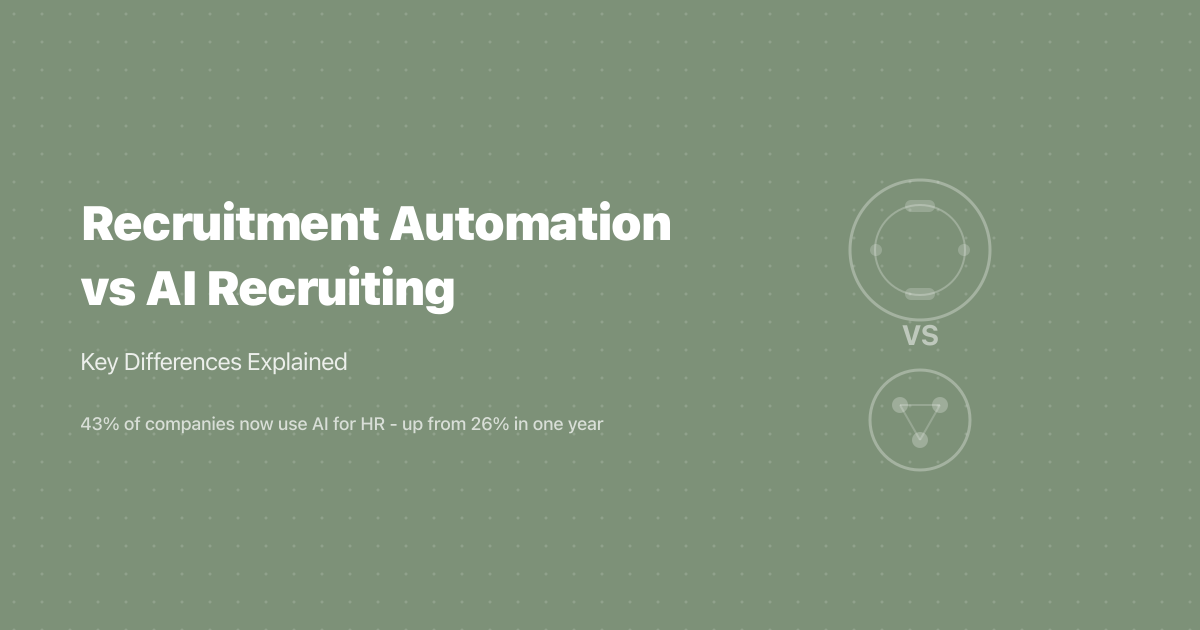
Recruitment automation follows preset rules to handle repetitive tasks like sending follow-up emails and moving candidates through pipeline stages. AI recruiting uses machine learning to make decisions - sourcing candidates, ranking fit, personalizing outreach - and it improves with every hiring cycle. The difference matters because choosing the wrong approach means either overpaying for capabilities you don't need or hitting a ceiling on what your tools can actually do.
Forty-three percent of companies now use AI for HR tasks, up from 26% just one year earlier, according to SHRM's 2025 Talent Trends report. But most of those teams started with basic automation - scheduled emails, ATS workflow triggers, interview reminders - before layering in AI. Understanding where automation ends and AI begins helps you invest in the right tools at the right time.
This guide breaks down both approaches across eight dimensions, shows you when each one fits, and explains how they work together in a modern recruiting stack.
TL;DR: Recruitment automation runs preset if-then rules (email sequences, status updates, reminders). AI recruiting uses machine learning to source, match, and engage candidates autonomously. SHRM reports 43% of companies now use AI for HR - up 17 points in a single year. Most teams benefit from combining both, starting with automation for admin tasks and adding AI for sourcing and outreach.
What Is Recruitment Automation?
Recruitment automation is any technology that executes predefined workflows without manual intervention. Think of it as a set of if-then rules applied to your hiring process. When a candidate submits an application, the system automatically sends an acknowledgment email. When a hiring manager approves a candidate, the system moves them to the next pipeline stage. When an interview is confirmed, the system sends calendar invites to everyone involved.
The key word is "predefined." Automation doesn't decide anything. It follows instructions you've already written. A human sets up the trigger ("when X happens"), the condition ("if Y is true"), and the action ("do Z"). The system executes that logic the same way every time, whether it's the 10th candidate or the 10,000th.
Common Examples of Recruitment Automation
- Email sequences - Drip campaigns that send follow-ups at set intervals after initial outreach
- Application acknowledgments - Instant "we received your application" emails triggered by form submission
- Pipeline stage updates - Auto-moving candidates from "screening" to "interview" when a recruiter clicks approve
- Interview scheduling links - Sending a Calendly or scheduling tool link when a candidate reaches a specific stage
- Rejection notifications - Template-based emails sent when candidates are marked as rejected
- Job posting distribution - Publishing roles to multiple job boards simultaneously from one ATS
- Reminder nudges - Pinging hiring managers who haven't reviewed candidates within 48 hours
These workflows save significant time. Recruiters spend roughly 80% of their time on administrative tasks instead of strategic work, according to SHRM's 2025 Talent Trends report. Automation chips away at that 80% by handling the repetitive, rule-based portion of the job.
But automation has a hard ceiling. It can't evaluate whether a candidate is actually a good fit. It can't write a personalized outreach message based on someone's career history. It can't scan millions of profiles and surface the five best matches for a niche role. Those capabilities require something more.
What Is AI Recruiting?
AI recruiting uses machine learning, natural language processing, and predictive models to handle tasks that previously required human judgment. Instead of following if-then rules, AI systems analyze patterns in data and make probabilistic decisions - which candidates to surface, how to rank them, what outreach message will resonate, and when to send it.
Seventy-three percent of talent acquisition professionals agree AI will entirely change how companies hire, per LinkedIn's 2025 Future of Recruiting report. That confidence comes from what AI can actually do today - not hypothetical future capabilities. For a detailed breakdown of how AI recruiting works across the full hiring funnel, see our practical guide to AI recruiting.
What AI Recruiting Actually Does
- Candidate sourcing - Scanning hundreds of millions of profiles to find candidates who match a role's requirements, even when their job titles don't exactly match the search terms
- Semantic matching - Understanding that a "full-stack developer" and a "software engineer with React and Node.js experience" might be the same person, not just matching keywords
- Outreach personalization - Generating messages tailored to each candidate's background, interests, and likely motivations
- Response prediction - Estimating which candidates are most likely to respond and adjusting outreach timing accordingly
- Interview scheduling with context - Not just sending a link, but coordinating across time zones, preferences, and team availability
- Bias reduction - Evaluating candidates on skills and experience while excluding names, gender, and other protected characteristics from the decision process
The critical difference is learning. Every time a recruiter accepts or passes on a candidate, an AI system updates its model. Every outreach message that gets a response (or doesn't) feeds back into the system's understanding of what works. Automation stays static until someone manually changes the rules. AI gets better with use.
Organizations using AI-powered recruitment tools report 31% faster hiring times and 50% improvement in quality-of-hire metrics, according to SHRM's 2025 Talent Trends report. Those gains don't come from speeding up email sends - they come from making better decisions about who to contact and how.
Side-by-Side Comparison: Automation vs AI Recruiting
The table below shows that automation and AI recruiting differ most in decision-making, learning ability, and sourcing capability. Here's how they compare across eight dimensions that matter when choosing tools.
| Dimension | Recruitment Automation | AI Recruiting |
|---|---|---|
| Decision-making | Follows preset rules (if-then logic) | Analyzes data and makes probabilistic decisions |
| Candidate sourcing | Posts jobs to boards; waits for applicants | Proactively scans profiles and surfaces matches |
| Outreach | Sends template-based sequences on schedule | Personalizes messages per candidate; optimizes send timing |
| Screening | Filters by keyword or knockout questions | Ranks candidates by predicted fit using ML models |
| Learning ability | Static until manually updated | Improves with each hiring cycle |
| Setup complexity | Low - configure triggers and templates | Medium - define role requirements, review initial results |
| Cost range | $0-$500/mo (most ATS include basic automation) | $100-$500/mo (standalone AI tools); $10K+/yr (enterprise suites) |
| Best for | High-volume admin tasks with predictable patterns | Sourcing, matching, and engaging passive candidates |
Notice that cost ranges overlap. You don't necessarily pay more for AI recruiting - some platforms like Pin start at $100/mo with a free tier, which is comparable to what many ATS platforms charge for basic automation alone. The value difference shows up in outcomes, not just price tags.

When Does Basic Automation Make Sense?
Basic automation is the right fit when your bottleneck is repetitive admin work, not candidate quality or sourcing volume. If your team is drowning in scheduling emails, candidate status updates, and job board postings, automation handles that immediately with minimal setup.
Here's when to start with automation rather than AI:
- You're processing high volumes of inbound applicants - If you post a role and get 300 applications, you need automated screening questions and acknowledgment emails more than you need AI sourcing
- Your hiring process is well-defined but slow - If candidates wait days between stages because someone forgot to send a link or update a status, workflow triggers fix that overnight
- Budget is tight and your ATS already has automation built in - Most modern ATS platforms include email templates, stage triggers, and scheduling integrations at no extra cost
- You're hiring for roles with large, active candidate pools - Retail, food service, entry-level office roles - positions where candidates come to you and the challenge is processing speed, not sourcing
Automation works well for the "plumbing" of your hiring process. It keeps things flowing, prevents bottlenecks, and ensures nothing falls through the cracks. But it doesn't help you find better candidates or reach people who aren't actively looking.
When Do You Need AI Recruiting?
AI recruiting becomes necessary when your hiring challenges involve judgment calls at scale - finding the right people, not just processing the people who find you. If you're sourcing for specialized roles, competing for passive candidates, or trying to improve the quality of your pipeline without adding headcount, AI tools deliver what automation can't.
You likely need AI recruiting when:
- You're sourcing for hard-to-fill roles - Niche technical positions, executive searches, or roles where the best candidates aren't actively job-hunting require proactive search across large databases
- Your outreach response rates are below 20% - Template-based sequences plateau quickly. AI personalization can push response rates significantly higher - Pin users see a 48% response rate on automated outreach across email, LinkedIn, and SMS
- You need to scale sourcing without scaling headcount - A solo recruiter or small team using AI can cover the same ground as a much larger team doing manual searches
- Quality of hire is a bigger problem than speed - If you're filling roles fast but seeing high early turnover, AI's matching and ranking capabilities address the root cause
- You're an agency managing multiple clients - Switching between different role requirements, industries, and client preferences requires a tool that adapts - not one that runs the same playbook every time
For a deeper look at how AI handles the full recruiting workflow end-to-end, see our guide to automating your recruiting workflow with AI.
Pin's multi-channel outreach hits a 48% response rate across email, LinkedIn, and SMS - try AI outreach free.
How Do Automation and AI Work Together?
The strongest recruiting stacks combine both approaches - automation for administrative tasks, AI for decision-heavy ones. McKinsey found that 8 in 10 organizations have deployed AI in at least one function, but only 1 in 5 have actually rebuilt their work processes around it (McKinsey Global Survey on AI, 2025). That gap exists because teams bolt AI onto existing workflows instead of rethinking the split between what should be automated and what should be intelligent.
Meanwhile, Gartner predicts that by 2030, 50% of current HR activities will be AI-automated or performed by AI agents. The winning approach is to map your workflow now, automate the mechanical parts, and apply AI where human judgment currently creates a bottleneck.
A Practical Combined Workflow
Here's what a blended stack looks like in practice for a mid-size recruiting team:
- AI sources candidates - The AI platform scans a large profile database (Pin covers 850M+ profiles) and surfaces a ranked shortlist based on role requirements, skills match, and predicted interest
- Recruiter reviews and approves - A human reviews the shortlist, accepts or passes on each candidate, and the AI learns from those decisions
- AI sends personalized outreach - Multi-channel messages (email, LinkedIn, SMS) are crafted by AI based on each candidate's background, sent at optimized times
- Automation handles responses - When a candidate replies positively, the system triggers a scheduling link. When they ask a question, it routes to the recruiter's inbox. Negative responses get an automatic thank-you
- Automation manages the pipeline - Stage transitions, reminder nudges to hiring managers, interview confirmation emails - all handled by workflow triggers
- AI analyzes outcomes - Which sourcing criteria led to the best hires? Which outreach messages got the highest response rates? The AI feeds these insights back into the next search
The split is clean: AI handles the "thinking" parts (who to contact, what to say, how to rank). Automation handles the "doing" parts (sending confirmations, updating statuses, routing messages). Neither replaces the other. For more on how autonomous AI agents handle recruiting tasks, read our overview of how AI recruiting agents work.

5 Questions to Decide What Your Team Needs
Not sure where your team falls? Work through these five questions. Your answers will point you toward the right investment.
- Where are your candidates coming from? If 80%+ of your hires come from inbound applications, automation is your priority. If you need to proactively source passive candidates, you need AI.
- What's your outreach response rate? Below 15% with templates? AI personalization will move that number. Already above 30%? Your outreach is fine - optimize elsewhere.
- How many roles does each recruiter manage? If your team handles 20+ open roles per recruiter, AI sourcing saves the most time. Under 10 roles? Automation for admin tasks might be enough.
- What's your biggest complaint from hiring managers? "It takes too long" points to automation (speed up the process). "The candidates aren't right" points to AI (improve the matches).
- What's your budget reality? Most ATS platforms include basic automation at no extra cost. AI tools like Pin start at $100/mo with a free tier - dramatically lower than enterprise platforms charging $10K-$35K+/yr.
If you answered "AI" to three or more of those questions, you're likely leaving value on the table by relying on automation alone.
Which Platform Combines Recruitment Automation and AI?
Most tools force a choice. ATS platforms handle automation well but lack real AI sourcing. Pure AI tools find great candidates but leave the admin work to you. Pin combines both in a single platform - AI-powered sourcing and outreach on top of the workflow automation recruiters need to stay organized.
Here's what that looks like in practice:
- AI sourcing across 850M+ profiles with 100% coverage in North America and Europe - handling both needle-in-a-haystack specialist roles and high-volume hiring from the same search bar
- Multi-channel automated outreach across email, LinkedIn, and SMS with a 48% response rate - AI personalizes each message while automation handles the sequencing and timing
- Automated interview scheduling that coordinates calendars, sends confirmations, and handles rescheduling without recruiter involvement
- Team inbox with real-time updates that automates candidate routing and keeps every recruiter on the same page
Pricing starts at $100/mo (Starter plan) with a free tier that requires no credit card. That's a fraction of what enterprise platforms charge, and it includes both the AI and automation layers. For a full comparison of tools in this space, see our comparison of 12 recruitment automation platforms.
"I jumped into Pin solo toward the end of 2025 and closed out the year with over $1M in billings during just the final 4 months - no team, no agency. The sourcing data is incredible, scanning 850M+ profiles with recruiter-level precision to uncover perfect-fit candidates I'd never find otherwise." - Nick Poloni, President at Cascadia Search Group
About 70% of candidates Pin recommends are accepted into customers' hiring pipelines, and recruiters using Pin fill positions in approximately 2 weeks. Those numbers reflect what happens when AI sourcing and workflow automation work as a single system instead of separate tools stitched together.
Common Mistakes When Choosing Between Automation and AI
Teams that get this decision wrong usually fall into one of four traps:
Mistake 1: Assuming automation is "good enough." Automation optimizes your existing process. If your process starts with the wrong candidates, automation just moves the wrong candidates through the pipeline faster. You'll fill roles quicker but see higher turnover and lower quality of hire.
Mistake 2: Buying AI when the process is broken. AI recruiting tools amplify what you already have. If your pipeline stages are unclear, your interview process is inconsistent, or your hiring managers don't provide timely feedback, fix those problems first. AI won't compensate for a broken workflow.
Mistake 3: Paying enterprise prices for basic needs. Some AI platforms charge $10K-$35K+ per year. That makes sense for large organizations with complex requirements. But most recruiting teams - especially agencies and mid-market companies - can get full AI sourcing, outreach, and scheduling for a fraction of that cost.
Mistake 4: Treating AI as a black box. Candidate trust is a real concern. A Gartner survey (2025) found that 88% of HR leaders haven't realized significant business value from AI tools - often because they deployed opaque systems without human oversight. Choose platforms that let recruiters review AI recommendations, understand why candidates were surfaced, and maintain transparency at every decision point. Pin's approach includes checkpoints at every step - no names, gender, or protected characteristics are ever fed to the AI.
Should You Choose Recruitment Automation, AI Recruiting, or Both?
Recruitment automation and AI recruiting solve different problems. Automation handles the repetitive, rule-based work that eats up recruiter time. AI handles the judgment-intensive work that determines candidate quality. Most teams need both - the question is where to start and how much of each.
If you're currently relying on manual processes, start with automation. You'll see immediate time savings. If you're already automated but struggling with sourcing, outreach response rates, or candidate quality, AI is where the next level of improvement lives.
The best approach is a platform that combines both layers so you don't have to stitch separate tools together. That's exactly what Pin was built to do - and you can test it without a credit card.
See how AI recruiting and automation work together in Pin - free to start
Frequently Asked Questions
What is the main difference between recruitment automation and AI recruiting?
Recruitment automation follows preset rules - if a candidate applies, send an email; if approved, move to the next stage. AI recruiting makes decisions using machine learning: it scans profiles, ranks fit, personalizes outreach, and improves with each cycle. SHRM data shows AI-powered tools deliver 31% faster hiring versus basic automation's incremental gains.
Can small teams afford AI recruiting tools?
Yes. While enterprise AI platforms charge $10K-$35K+/yr, newer tools offer full AI sourcing, outreach, and scheduling at accessible price points. Pin starts at $100/mo with a free tier - no credit card required. That's within reach of solo recruiters and small agencies, not just large corporations.
Should I replace my ATS with an AI recruiting platform?
Not necessarily. Most ATS platforms handle pipeline management and basic automation well. AI recruiting tools like Pin work alongside your existing ATS by adding sourcing, outreach, and scheduling intelligence. The AI finds and engages candidates; the ATS manages them through your pipeline.
How does AI recruiting reduce hiring bias?
AI recruiting platforms evaluate candidates on skills, experience, and predicted fit without seeing names, gender, or other protected characteristics. Pin's system has checkpoints at every step with strict guardrails and regular third-party fairness audits. This removes the unconscious bias that affects manual screening, where resume studies show callback rates vary by 30-50% based on name alone.
Is AI recruiting worth the investment for agencies?
For recruiting agencies, AI tools often pay for themselves within the first placement. Pin users report filling positions in approximately 2 weeks, and the platform handles multi-client management from a single account. Nick Poloni of Cascadia Search Group generated over $1M in billings in four months using Pin as a solo recruiter - that's the kind of ROI basic automation can't deliver.