AI sourcing outperforms manual sourcing on speed and cost for most recruiting use cases, while manual sourcing retains an edge for confidential executive searches and hyper-niche roles. That's the short answer. The longer answer involves data on time-to-fill, cost-per-hire, and candidate quality that makes the gap hard to ignore.
According to SHRM's 2025 Recruiting Benchmarking Report, the median time to fill a role is roughly 45 days, and the average cost per hire for non-executive positions sits at $5,475. AI-powered sourcing tools are compressing both numbers. Research from Josh Bersin and AMS (September 2025) found that AI-enabled talent acquisition delivers 2-3x faster time-to-hire compared to traditional methods. Meanwhile, 64% of organizations already use AI somewhere in their recruiting process, per SHRM's 2025 Talent Trends Survey.
This article breaks down the three dimensions that matter most when choosing between AI and manual sourcing in recruitment: speed, cost, and quality. You'll get sourced benchmarks for each, a clear framework for when each approach makes sense, and practical steps for making the shift.
TL;DR: AI sourcing fills roles 2-3x faster than manual methods (Josh Bersin, 2025) and tools like Pin start at $100/mo versus the $5,475 average cost-per-hire SHRM reports. Manual sourcing still works for confidential executive searches, but AI handles 80%+ of recruiting workflows more efficiently.
| Dimension | Manual Sourcing | AI Sourcing |
|---|---|---|
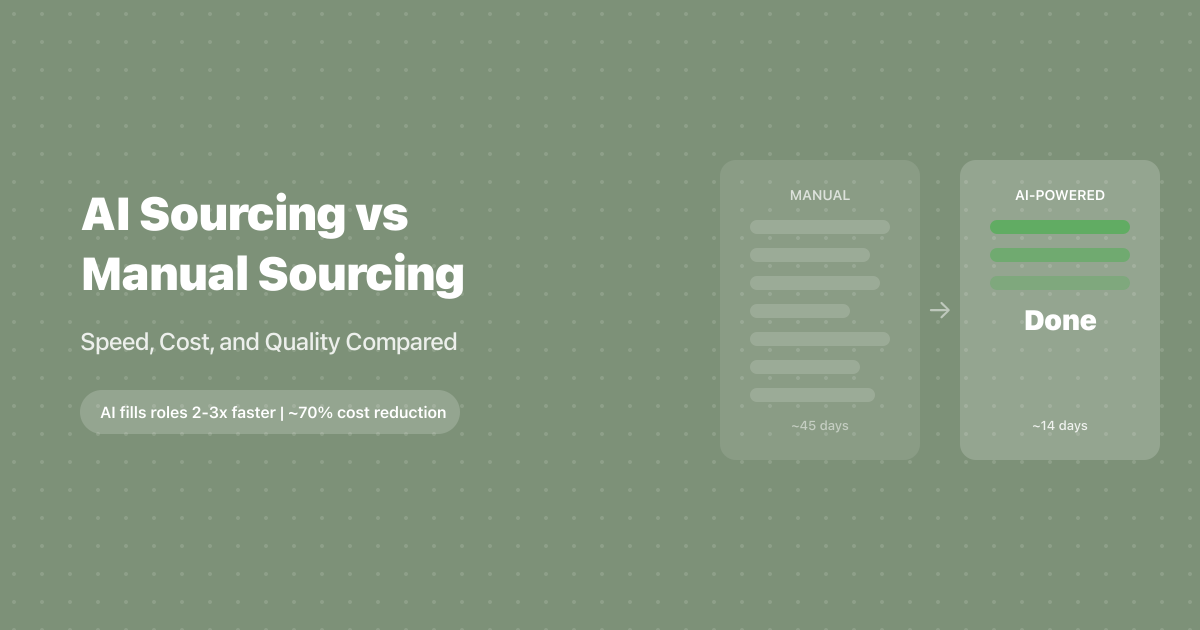
| Time-to-Fill | ~45 days median (SHRM 2025) | 15-22 days; Pin users average ~14 days |
| Cost-Per-Hire | $5,475 avg non-executive (SHRM 2025) | Pin starts at $100/mo flat subscription |
| Candidate Quality | Varies by sourcer skill and network | +9% quality hire likelihood (LinkedIn 2025); Pin: 70% acceptance rate |
| Database Reach | Limited to recruiter's tools and network | Pin scans 850M+ profiles across North America and Europe |
| Outreach | Manual, one-at-a-time emails | Automated multi-channel (email, LinkedIn, SMS); 48% response rate |
| Bias Risk | Fatigue and unconscious bias increase with volume | Consistent criteria; 67% of recruiters say AI reduces bias (LinkedIn 2025) |
| Best For | Executive search, confidential roles, relationship-driven industries | High-volume hiring, standard roles, multi-channel outreach at scale |
What Is Manual Sourcing?
Manual sourcing is the traditional process of finding candidates by hand - searching LinkedIn profiles one by one, building Boolean strings, scrolling through job boards, mining personal networks, and sending individualized outreach messages. It's how recruiting worked for decades before AI tools entered the market.
A typical manual sourcing workflow looks like this:
- Define the role - review the job description, confirm must-have skills, and agree on target companies or industries with the hiring manager
- Build search strings - create Boolean queries for LinkedIn Recruiter, job boards, or Google X-ray searches
- Search and review profiles - scan results one at a time, reading through work history, education, and skills to assess fit
- Find contact information - track down email addresses or phone numbers through email finder tools or LinkedIn connections
- Write personalized outreach - craft individual messages tailored to each candidate's background
- Track responses - manage replies across email, LinkedIn InMail, and other channels, usually in a spreadsheet or CRM
- Follow up - send second and third touches to non-responders over the following weeks
Each step requires human judgment and attention. That's both the strength and the bottleneck. SHRM's 2025 benchmarking data shows that recruiters at over half of organizations manage roughly 20 open requisitions simultaneously. When every role requires this seven-step manual process, it's easy to see why the median time-to-fill stretches to 45 days.
What Is AI Sourcing?
AI sourcing uses machine learning and natural language processing to automate candidate identification, ranking, and initial outreach. Instead of a recruiter manually building search strings and reviewing profiles one by one, an AI system scans millions of candidate records, scores them against role requirements, and surfaces a ranked shortlist in minutes. For a deeper look at the mechanics, see our guide to AI candidate sourcing.
Here's what a typical AI sourcing workflow looks like:
- Input the role - describe what you're hiring for in plain language (no Boolean required)
- AI scans and ranks candidates - the system searches its database, analyzes profiles against your requirements, and returns a scored shortlist
- Review the shortlist - accept or pass on recommended candidates, which trains the AI to refine future results
- Automated outreach - the platform sends personalized messages across email, LinkedIn, and SMS on your behalf
- Manage responses - replies funnel into a shared inbox where your team can collaborate on next steps
The difference? Steps that take a manual sourcer hours or days happen in seconds. Pin, for example, scans 850M+ candidate profiles with 100% coverage across North America and Europe. Its AI handles candidate ranking, contact discovery, and multi-channel outreach in a single workflow, delivering a 48% response rate on automated messages.
Best Sourcing Strategies to Find the Best Candidates
Speed: How Does Time-to-Fill Compare?
AI sourcing compresses hiring timelines by 2-3x, according to research from Josh Bersin and AMS published in September 2025. That means a role that takes 45 days to fill with manual methods can be filled in 15-22 days with AI-enabled sourcing. Some early adopters achieved hiring cycles 3-4x faster than their baselines, per the same study.

Why the gap? Manual sourcing bottlenecks stack up at every stage. Building Boolean search strings takes time. Reviewing profiles individually takes more time. Tracking down contact information adds another layer. And writing personalized outreach for each candidate? That's where recruiters lose entire afternoons.
AI collapses those steps. A tool like Pin's AI sourcing generates a ranked candidate list from a plain-language job description, discovers contact details automatically, and sends personalized outreach across email, LinkedIn, and SMS - all without the recruiter touching a Boolean operator. Pin users fill positions in approximately 2 weeks, which represents a nearly 70% reduction compared to the 45-day manual benchmark.
The time savings compound when you factor in recruiter workload. SHRM's 2025 data shows recruiters at most organizations juggle around 20 open requisitions at once. Shaving 20-30 days off each requisition's timeline isn't just faster - it's the difference between filling roles on schedule and watching them sit open for months.
There's also the candidate experience angle. The Bersin/AMS report found that 60% of applicants abandoned applications due to slow or complex hiring processes. Speed isn't just an internal efficiency metric. It directly affects whether your top candidates accept or move on to another offer.
Cost: What Does Each Approach Actually Cost?
Manual sourcing carries a $5,475 average cost per non-executive hire, according to SHRM's 2025 Recruiting Benchmarking Report. Executive hires balloon to $35,879 on average. Those figures include recruiter salaries, job board subscriptions, LinkedIn Recruiter licenses, agency fees, and the opportunity cost of time spent on manual tasks.
candidate sourcing tools restructure that equation. Instead of paying per hire (through agency fees) or per seat (through expensive platforms), most AI sourcing platforms charge a flat monthly subscription that covers unlimited searches and outreach.

Consider the math for a 10-hire-per-month recruiting team. At SHRM's $5,475 average, that's $54,750 in monthly hiring costs. A Pin Professional subscription runs $149/mo (billed annually at $1,788/yr) and covers sourcing, outreach, and scheduling across all those roles. Even accounting for contact lookup credits ($50 per 500-credit pack), the annual spend stays well under $3,000 - a fraction of what a single traditional hire costs.
Where does the cost savings come from? Three places:
- Reduced job board spend - AI sourcing tools pull from their own candidate databases rather than relying on paid job postings. Pin's database alone covers 850M+ profiles.
- Lower time investment - LinkedIn's Future of Recruiting 2025 report found that recruiters using GenAI save roughly 20% of their work week. That's a full day per week redirected from manual tasks to high-value activities like candidate evaluation and closing.
- Fewer agency fees - when in-house teams can source effectively with AI, there's less need to pay external agencies 15-25% of a candidate's first-year salary per placement.
Manual sourcing still carries hidden costs that don't show up in SHRM's averages: recruiter overtime, lost candidates who accept competing offers during a slow process, and the productivity gap of an unfilled role that most hiring managers feel acutely.
Pin's AI scans 850M+ profiles and automates outreach at a 48% response rate - see how it cuts sourcing costs.
Quality: Which Approach Finds Better Candidates?
Companies using AI-assisted sourcing are 9% more likely to make a quality hire, according to LinkedIn's Future of Recruiting 2025 report. That gap comes from better targeting: AI systems evaluate candidates against dozens of criteria simultaneously, reducing the chance that a strong match slips through a manual review.
Quality of hire remains the industry's blind spot - only 20% of organizations actively track it, per SHRM's 2025 Recruiting Benchmarking Report. But the data points that do exist favor AI sourcing for most hiring scenarios.
Pin's data reinforces this pattern. Roughly 70% of candidates that Pin recommends are accepted into customers' hiring pipelines - far above industry averages for manual sourcing, where sourcers might present 10-15 candidates before a hiring manager accepts one or two.
Nick Poloni, President at Cascadia Search Group, put it this way: "I jumped into Pin solo toward the end of 2025 and closed out the year with over $1M in billings during just the final 4 months - no team, no agency. The sourcing data is incredible, scanning 850M+ profiles with recruiter-level precision to uncover perfect-fit candidates I'd never find otherwise."
That said, manual sourcing has genuine quality advantages in specific contexts:
- Relationship-based roles - when hiring for C-suite or board positions, a veteran recruiter's personal network and reputation can surface candidates who wouldn't respond to any automated outreach
- Deep market knowledge - an experienced sourcer in a niche domain (say, quantum computing or cleared defense roles) brings context that AI models haven't fully captured yet
- Confidential searches - some executive placements require discretion that rules out automated outreach entirely
For the other 80%+ of roles? AI sourcing identifies higher-quality shortlists faster because it can evaluate exponentially more candidates against more criteria than a human sourcer reviewing profiles individually. And the 67% of recruiters who believe AI will help reduce bias in hiring, per LinkedIn's 2025 report, point to another quality dimension: AI doesn't get fatigued after reviewing 50 profiles, and properly designed systems don't favor candidates based on name, gender, or demographic signals.
Where Does Manual Sourcing Still Win?
Despite the data, there are four scenarios where manual sourcing remains the stronger option.
1. Confidential executive searches. When a CEO is being replaced or a company is quietly building a leadership team before an acquisition, automated outreach is a liability. Executive search firms use personal relationships and private conversations to manage these searches - no email sequences, no LinkedIn messages, no digital paper trail.
2. Ultra-niche technical roles. Some positions require such specific combinations of skills, clearances, or domain experience that AI databases haven't indexed enough examples to build reliable matching models. A sourcer who has spent 15 years in GovCon recruiting, for instance, often knows candidates by name before any search begins.
3. Relationship-driven industries. In sectors like investment banking, management consulting, and certain legal specialties, who makes the introduction matters as much as the candidate's qualifications. Manual sourcing through warm referral networks still outperforms cold AI-generated outreach in these circles.
4. Employer brand building. Sometimes the sourcing goal isn't to fill a specific role but to build long-term awareness with a talent community. A recruiter attending industry conferences, hosting meetups, or contributing to niche forums creates brand equity that AI tools can't replicate.
The honest assessment? These use cases represent a shrinking percentage of overall hiring volume. Korn Ferry's 2026 TA Trends Report found that 52% of talent leaders plan to deploy autonomous AI agents in their recruiting function this year. The trajectory is clear: AI handles the volume, humans handle the exceptions.
The Hybrid Approach: Why Most Teams Use Both
The smartest recruiting teams aren't choosing between AI and manual sourcing - they're combining them. According to SHRM's 2025 Talent Trends Survey, 43% of HR teams now use AI for talent management tasks, up from 26% just one year earlier. That rapid adoption suggests teams are layering AI onto existing manual processes rather than replacing them wholesale.
Here's what a hybrid model looks like in practice:
- AI handles volume sourcing - for standard roles (software engineers, sales reps, account managers, nurses), AI tools scan massive databases, rank candidates, and run multi-channel outreach sequences automatically
- Humans handle exceptions - for executive searches, ultra-niche roles, and relationship-dependent placements, experienced sourcers use their networks and judgment
- AI assists manual sourcers - even on manual searches, AI tools speed up contact discovery, automate follow-up sequences, and surface candidates the sourcer might have missed
- Humans quality-check AI output - recruiters review AI-generated shortlists, provide feedback that improves future recommendations, and handle all candidate conversations beyond initial outreach
This model is why LinkedIn's 2025 report found that 93% of TA professionals plan to increase their AI usage in 2026. They're not replacing their sourcers. They're giving them tools that handle the repetitive work so humans can focus on evaluation, relationship building, and closing.
Top AI Tools of 2025 for Recruiters
How to Shift From Manual to AI Sourcing
If your team still relies primarily on manual sourcing, here's a practical transition plan. You don't need to change everything at once - start with one role type and expand from there.
Step 1: Pick your highest-volume role. Choose the position your team fills most frequently. This gives AI the largest data set to work with and produces the fastest visible ROI. Skip niche or executive roles for now.
Step 2: Choose a platform with a low barrier to entry. Avoid enterprise tools that require six-month implementations and five-figure annual contracts. Pin offers a free tier with no credit card required, which lets your team test AI sourcing without budget approval or IT involvement.
Step 3: Run a parallel test. Source the same role using both your manual process and the AI tool simultaneously. Track time-to-fill, number of qualified candidates surfaced, response rates, and cost. Two to three parallel tests give you enough data to make a case internally.
Step 4: Review and calibrate. After each test, review the AI's recommendations. Accept or pass on candidates - this feedback loop trains the system and improves results over time. Pin's ~70% candidate acceptance rate reflects what happens after teams calibrate through a few hiring cycles.
Step 5: Expand gradually. Once you've validated the AI approach on high-volume roles, extend it to mid-volume positions. Keep manual sourcing active for executive, confidential, and ultra-niche searches where human networks add irreplaceable value.
For a broader look at the tools available, see our breakdown of the best AI sourcing tools in 2026. And for metrics to track during your transition, our guide to time-to-hire metrics covers the benchmarks that matter most.
What the Industry Data Says About AI Sourcing Adoption
The shift from manual to AI sourcing isn't a prediction - it's happening now, and the pace is accelerating. Here's a snapshot of where the industry stands in 2026, based on Tier 1 research.
Gartner reported in October 2025 that 82% of CHROs intend to adopt AI agents within the next year. That's not a small pilot group - it's the vast majority of enterprise HR leadership signaling that AI in recruiting has moved from experimental to essential.
The numbers from Korn Ferry's 2026 TA Trends Report are equally direct: 84% of talent leaders plan to use AI in their talent acquisition function, and 52% specifically plan to add autonomous AI agents to their teams. Almost 60% of recruiters already use AI for sourcing, screening, or candidate nurturing, per Josh Bersin's 2025 research.
But adoption isn't without friction. Only 37% of job seekers trust AI to select qualified applicants, according to the Bersin report. And Korn Ferry found that 40% of talent specialists worry AI will make the candidate experience feel impersonal. That trust gap explains why the hybrid model described above - AI handles sourcing, humans handle relationships - is gaining traction faster than a full AI takeover.
The bottom line: teams that haven't started testing AI sourcing tools are falling behind a curve that 82% of their peers' leadership has already committed to.
Frequently Asked Questions
Is AI sourcing more accurate than manual sourcing?
For most roles, yes. AI sourcing evaluates candidates against dozens of criteria simultaneously across databases of hundreds of millions of profiles. LinkedIn's Future of Recruiting 2025 report found that companies using AI-assisted tools are 9% more likely to make a quality hire. Manual sourcing remains more accurate for ultra-niche roles where experienced recruiters hold deep domain knowledge that AI models haven't fully captured.
How much does AI sourcing cost compared to manual recruiting?
AI sourcing platforms range from free tiers to $249/mo for full-feature plans. Pin's Professional plan costs $149/mo (billed annually). Compare that to SHRM's 2025 benchmark of $5,475 average cost per non-executive hire using traditional methods, or $35,879 for executive roles. Enterprise-only AI platforms can run $10,000-$35,000+/yr, but accessible options have driven costs down considerably.
Will AI sourcing replace manual recruiters entirely?
Not likely. According to Korn Ferry's 2026 TA Trends Report, only 22% of respondents believe leaders can effectively manage mixed human-AI teams today. AI handles high-volume identification and outreach; humans handle relationship building, negotiation, and judgment calls on fit. The strongest teams combine both, using AI for 80%+ of sourcing volume while keeping manual processes for executive and confidential searches.
What is the best AI sourcing tool for recruiting teams?
Pin stands out for teams that need a single platform covering sourcing, outreach, and scheduling. Its database includes 850M+ candidate profiles with 100% coverage in North America and Europe, automated multi-channel outreach delivers a 48% response rate, and pricing starts with a free tier - no credit card required. That combination of coverage, automation, and accessibility is hard to match at any price point.
How long does it take to see results from AI sourcing?
Most teams see meaningful results within the first two weeks. Pin users fill positions in approximately 14 days on average, compared to the 45-day median SHRM reports for traditional hiring. The system improves as recruiters accept or pass on recommended candidates, training the AI to refine its matching over time. Running a parallel test alongside your manual process is the fastest way to validate results.
Compare AI and manual sourcing firsthand with Pin - free to start