LinkedIn job posting pricing ranges from $0 for a single free listing (limited to 14 days of visibility) to $7-$10 per day minimum for promoted posts, and $200-$1,000 per slot per month for enterprise Job Slots on annual contracts. LinkedIn uses an auction-based pay-per-click model for promoted jobs, which means your actual spend depends on your role, location, and how many other employers are competing for the same candidates.
According to LinkedIn's free vs. promoted jobs comparison (2026), promoted job posts reach 3x more qualified applicants than free listings. But the free tier has gotten stingier over time - you're limited to one free post at a time, it pauses after 14 days, and reposting the same title within seven days requires paid promotion. For most hiring teams with ongoing openings, the real question isn't whether to pay, but how much.
This guide breaks down every LinkedIn job posting option - free listings, promoted posts, Job Slots, and the newer Hiring Pro product - so you can calculate what you'll actually spend per hire and decide whether LinkedIn's pricing model makes sense for your team.
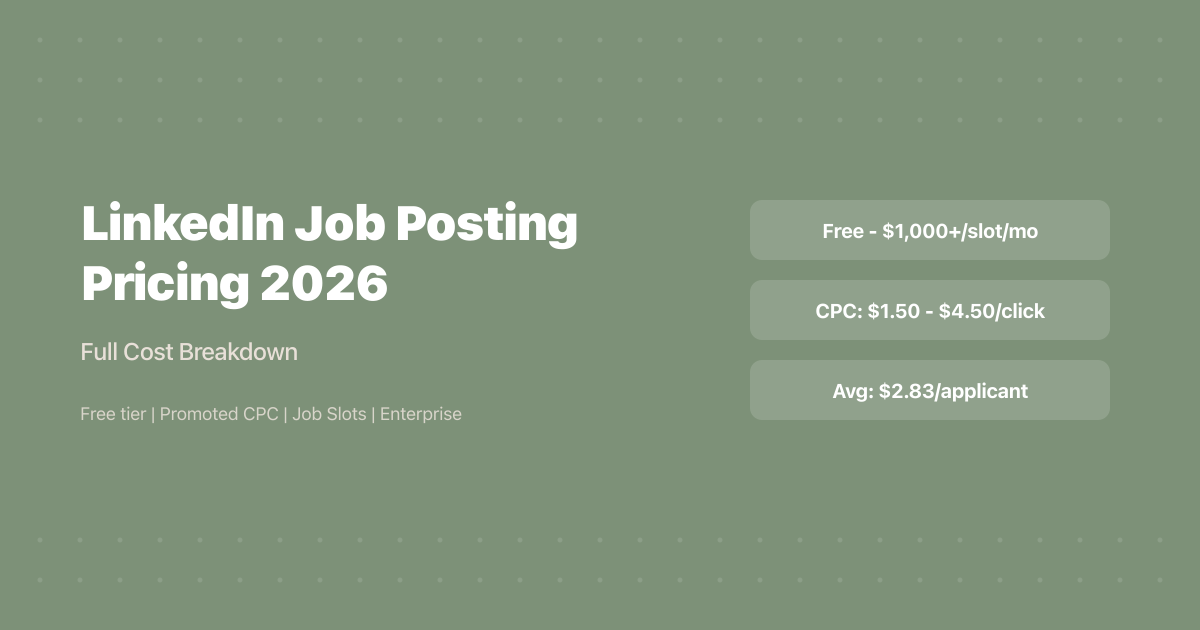
TL;DR: LinkedIn job posting pricing starts at $0 for one free listing (14-day limit, one post at a time). Promoted posts cost $7-$10/day minimum with an average $2.83 cost per applicant in the U.S. Enterprise Job Slots run $200-$1,000/slot/month on annual contracts. Prepaying annually saves up to 35% on CPC costs. For teams that need sourcing and outreach - not just job ads - Pin's AI sourcing starts at $100/mo with 850M+ profiles and multi-channel outreach included.
How Much Does a Free LinkedIn Job Post Cost?
A free LinkedIn job post costs $0, but the limitations make it impractical for most recruiting teams. According to LinkedIn's free posting policy (2026), you can post a maximum of one free job at a time per account. The listing pauses automatically after 14 days of activity, and it expires completely after 30 days if you don't promote or close it first. Free posts also rank below promoted listings in search results, receive no AI-powered screening features, and can't be reposted for the same role within seven days. For companies filling multiple positions simultaneously, the free tier is essentially a trial - useful for testing LinkedIn's applicant pool, but not a sustainable hiring channel.
Here's what the free tier actually gives you:
- One listing at a time. If you have multiple open roles, only one can be posted for free. Every additional role requires a paid promotion.
- 14-day active window. Your post appears in search results for two weeks before LinkedIn pauses it. After pausing, it stops appearing in candidate searches and recommendations entirely.
- No reposting within 7 days. According to LinkedIn's reposting restrictions, if you close a free post and try to repost the same job title at the same company within seven days, LinkedIn requires you to promote it instead.
- No AI features. Free posts don't include applicant presorting, daily candidate recommendations, instant summaries, or natural language search - all of those are reserved for promoted listings.
- Lower visibility. Free posts appear in LinkedIn's job search, but they rank below promoted listings. As competition for the same job title increases, free posts get pushed further down the results page.
The free tier works for a single one-off hire where you're not in a rush and can wait for inbound applicants. For anything recurring or time-sensitive, you'll hit the ceiling within two weeks. Most recruiters filling more than one role at a time move to promoted posts or explore alternative sourcing approaches.
What Do LinkedIn Promoted Job Posts Cost?
LinkedIn promoted jobs use a pay-per-click (CPC) auction model with a minimum daily budget of $7-$10 per day, according to multiple industry analyses (2025-2026). The average cost per click in the U.S. ranges from $1.50 to $4.50, and the average cost per applicant lands around $2.83 - though this varies significantly by role, location, and industry competition. That per-applicant average means a typical hire requiring roughly 57 applicants costs about $161 in LinkedIn ad spend alone. For context, SHRM's most recent benchmark (2023) places the average all-in cost per hire at $4,700 across all channels - so LinkedIn ad spend is a fraction of total hiring cost, but it adds up fast when you're promoting multiple listings simultaneously.
Here's how the promoted post pricing model works:
- Daily budget: You set a maximum daily spend. LinkedIn's minimum is typically $7-$10/day depending on the market. You can increase the budget for more visibility, but there's no fixed rate card - it's all auction-driven.
- Cost per click: You're charged each time a candidate clicks on your listing. The CPC depends on role type, geographic area, industry competition, and how many other employers are targeting the same talent pool.
- Billing cycle: According to LinkedIn's CPC billing FAQ, you're charged weekly on self-serve plans, or when your balance hits $500, at the 30-day mark, or when the job closes - whichever comes first.
- Annual prepay discount: According to LinkedIn's pricing page (2026), prepaying your job posting budget annually saves up to 35% compared to self-serve CPC rates.

The cost per applicant swings based on how competitive your market is. A nursing hire in a metro area might cost $1.45 per applicant, while a truck driver in a region with driver shortages can cost $4.45. Software engineering roles land in between at $2.71 per applicant. International costs are dramatically lower - a software engineer in India averages $0.07 per applicant, compared to $1.52 in the UK.
What does that translate to in total spend? At $2.83 per applicant, a single hire costs roughly $161 in LinkedIn ad spend. That doesn't sound expensive until you're filling 20+ roles simultaneously, each requiring its own promoted listing at $7-$10/day. A team hiring for 10 roles at $10/day spends $3,000/month on LinkedIn job ads alone - before factoring in cost-per-hire overhead like recruiter time, screening, and interviews.
How Much Do LinkedIn Job Slots Cost?
LinkedIn Job Slots are always-on job posting placements that you can rotate between open roles, charging a flat monthly fee per slot rather than a per-click rate. Buyer-reported pricing places Job Slots at $200-$1,000 per slot per month depending on region, hiring volume, and contract size. Unlike self-serve promoted posts, Job Slots require 12-month minimum contracts and are typically sold alongside LinkedIn Recruiter Corporate seats as a bundle. For enterprise teams with continuous hiring needs, Job Slots provide predictable monthly costs - but the annual commitment and volume-based pricing mean you're locked into significant spend. A mid-market company running 5 slots at $500/month pays $30,000/year on job placement capacity alone. For full details on how Recruiter seats factor into the total, see our LinkedIn Recruiter pricing guide.
Here's how Job Slots work and what to expect:
- Rotating placements. Each slot can hold one active job posting at a time. When you fill a role, you reassign the slot to the next open position. You're paying for placement capacity, not individual postings.
- Annual contracts required. Job Slots are sold on 12-month minimum commitments. Unlike self-serve promoted posts, you can't buy a single slot for one month and cancel.
- Volume discounts. Multi-year deals typically yield 5-25% discounts. Buying 10+ slots with LinkedIn Recruiter Corporate seats as a bundle can reduce the effective per-slot cost significantly.
- Typically bundled. Most enterprise buyers purchase Job Slots alongside LinkedIn Recruiter seats. If you're already paying for Recruiter Corporate at $10,800+/seat/year, Job Slots are an add-on to that spend - not a standalone product.
At the low end, 2 slots at $200/month costs $4,800/year. At the high end, 10 slots at $1,000/month totals $120,000/year. That's separate from Recruiter seat costs, promoted post budgets, and Talent Insights add-ons. Enterprise teams often find that Job Slots plus Recruiter seats plus CPC spend adds up to $50,000-$150,000/year in total LinkedIn talent product spend.
What Is LinkedIn Hiring Pro and How Is It Priced?
LinkedIn Hiring Pro does not have a publicly listed price - costs are determined dynamically based on your role type and location, and the quote is only shown after you begin the job posting flow. That pricing opacity makes it hard to budget for in advance. What we do know: Hiring Pro is LinkedIn's SMB-focused hiring product that layers AI features on top of standard job posting. According to LinkedIn's Hiring Pro page (2026), nearly 60% of users found interview-ready candidates within one week of posting. The product targets small businesses that don't need - or can't afford - full Recruiter seats but want more than a basic promoted listing.
What Hiring Pro adds beyond a standard promoted post:
- AI-powered applicant screening. Automatically ranks and sorts incoming applicants based on role fit, so you spend less time reviewing unqualified resumes.
- Daily candidate recommendations. LinkedIn serves up to 25 candidate suggestions per day based on your job requirements - passive candidates you wouldn't see from inbound applications alone.
- AI-drafted job descriptions. Generates optimized job posts based on your role title and basic requirements.
- Natural language search. Describe what you're looking for conversationally instead of building Boolean strings.
The lack of pricing transparency is a pattern across LinkedIn's talent products. Whether it's Recruiter Corporate seats, Job Slots volume pricing, or Hiring Pro, the actual cost is typically revealed only after you've engaged with their sales team or entered the posting flow. You'll need to start a job post to see what LinkedIn quotes for your specific opening. That makes comparison shopping difficult - and it's one reason many recruiters who value budget predictability explore fixed-price alternatives.
LinkedIn Job Posting vs Indeed vs ZipRecruiter: Price Comparison
LinkedIn isn't the only option for job advertising, and it's rarely the cheapest. Here's how the three largest job posting platforms compare on pricing, model, and what you get at each tier.
| Feature | Indeed | ZipRecruiter | |
|---|---|---|---|
| Free Tier | 1 post, 14 days, pauses automatically | Unlimited posts (low visibility) | 4-day trial only |
| Paid Model | CPC auction ($1.50-$4.50/click) | CPC or cost-per-application | Subscription per slot |
| Minimum Daily Budget | $7-$10/day | $5/day or $150/month | N/A (subscription) |
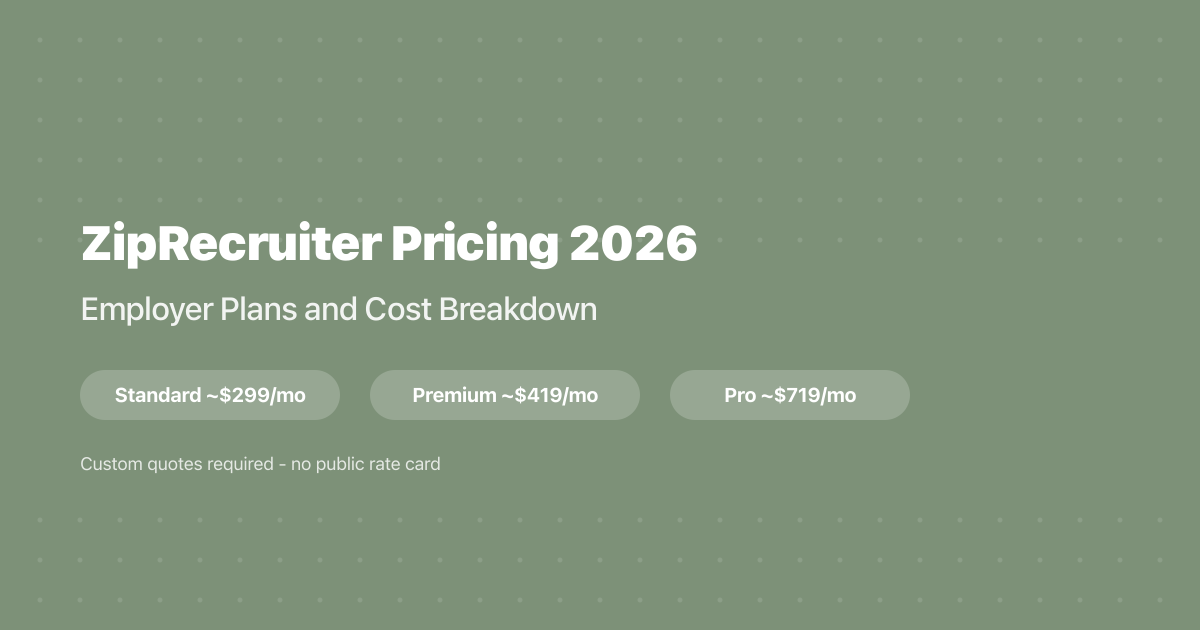
| Monthly Subscription | N/A (CPC) or $200-$1,000/slot | N/A (pay-per-result) | $249-$399/month |
| Avg. Cost Per Applicant | ~$2.83 (U.S.) | ~$5-$15/application (sponsored) | Included in subscription |
| Annual Prepay Discount | Up to 35% | Not standard | Annual plans available |
| Suited For | Professional, white-collar, leadership roles | High-volume, hourly, blue-collar roles | SMB hiring across roles |
| AI Screening | Hiring Pro only (dynamic pricing) | Basic matching | Basic matching |
| Glassdoor Integration | Separate platform | Included (merged 2024) | Separate |
A few things stand out in this comparison. Indeed offers unlimited free job posts - they just don't get much visibility without sponsoring. That makes it the lowest-risk starting point for teams testing job advertising for the first time. ZipRecruiter's subscription model ($249-$399/month) gives you predictable costs but no meaningful free tier. LinkedIn sits in the middle: a restrictive free tier with the most powerful paid options for white-collar hiring.
One significant change since 2024: Glassdoor no longer accepts independent job postings. All Glassdoor jobs now route through Indeed's employer platform, following the Indeed-Glassdoor merger. If you were budgeting for Glassdoor as a separate channel, that line item now folds into your Indeed spend.
The broader question is whether job posting - on any platform - is the most effective way to fill roles. Job ads are passive by design: you publish a listing and wait for candidates to find it. That works for high-volume, lower-skill positions where applicant volume matters more than precision. But for specialized roles, leadership positions, or any hire where you need to reach passive candidates who aren't actively job hunting, outreach-based sourcing consistently outperforms job advertising.
Pin's AI scans 850M+ profiles to find candidates across email, LinkedIn, and SMS - try it free.
When Job Posting Isn't Enough: The Case for AI Sourcing
Job posting and candidate sourcing solve fundamentally different problems. Posting a job ad targets active job seekers - the roughly 30% of the workforce currently looking for new roles. Sourcing targets the other 70%: passive candidates who aren't browsing job boards but would consider the right opportunity if it reached them directly.
The most recent SHRM benchmark (2023) places the average all-in cost per hire at $4,700 across all channels. LinkedIn job ad spend accounts for a small fraction of that total - roughly $161 per hire at the $2.83 average cost per applicant. The bulk of hiring cost comes from recruiter time spent screening, scheduling, and following up. That's where AI sourcing tools compress the timeline - by automating the manual work that makes up most of that $4,700 figure.
Pin automates the entire top-of-funnel: candidate discovery across 850M+ profiles, personalized multi-channel outreach (email, LinkedIn, and SMS), and automated interview scheduling. The result is a 48% response rate on outreach and positions filled in approximately two weeks. Pricing starts at $100/month - less than what most teams spend on a single week of promoted LinkedIn job posts.
As Nick Poloni, President at Cascadia Search Group, put it: "I jumped into Pin solo toward the end of 2025 and closed out the year with over $1M in billings during just the final 4 months - no team, no agency. The sourcing data is incredible, scanning 850M+ profiles with recruiter-level precision to uncover perfect-fit candidates I'd never find otherwise."
Cost Comparison: LinkedIn Job Ads vs. AI Sourcing
Here's how the economics compare for a team filling 10 roles per month:

The cost gap is stark. A team running 10 promoted posts at $10/day spends $3,000/month just on job advertising - and that only reaches active job seekers. The same team on Pin's Professional plan ($149/month, annual billing) gets AI-powered sourcing across 850M+ profiles, automated outreach with a 48% response rate, and interview scheduling included. That's roughly 95% less for a tool that reaches both active and passive candidates.
Job posting and AI sourcing aren't mutually exclusive. Many teams run a hybrid approach: use LinkedIn promoted posts for high-volume roles where applicant quantity matters, and use AI sourcing for specialized roles where you need to reach passive candidates directly. The key is understanding what each channel costs per hire and allocating budget accordingly. Teams that have reduced their LinkedIn dependency consistently report lower cost-per-hire on hard-to-fill roles. For those exploring the full range of options, our guide to sourcing tools beyond LinkedIn covers the landscape in detail.
How to Reduce Your LinkedIn Job Posting Spend
Even if LinkedIn is your primary job advertising channel, there are concrete ways to lower your per-hire cost without cutting visibility. LinkedIn's auction-based pricing model rewards strategic behavior - teams that optimize their posting timing, budget allocation, and title specificity consistently pay less per applicant than those who set budgets and walk away. Here are five approaches that work:
1. Use the Annual Prepay Discount
LinkedIn's own pricing page confirms that prepaying your job posting budget annually saves up to 35% versus self-serve CPC rates. If you know you'll be hiring consistently, this is free money. A team spending $3,000/month on promoted posts saves up to $12,600/year by prepaying.
2. Optimize Job Titles for CPC
LinkedIn's CPC is auction-based, so generic titles like "Software Engineer" cost more because every employer is bidding on them. More specific titles - "Backend Python Engineer" or "Senior DevOps Engineer (AWS)" - face less competition and lower your cost per click. The difference can be substantial: a generic "Marketing Manager" listing in a major metro might cost $3.50+ per click, while "B2B SaaS Marketing Manager" targets a narrower pool with less bidding pressure. Test different title variations and track which ones deliver the lowest cost per qualified applicant.
3. Time Your Postings Strategically
Job posting competition peaks Monday through Wednesday mornings. Posting on Thursday or Friday can reduce your CPC as fewer employers are actively promoting roles. Similarly, avoid posting during peak hiring seasons (January and September) when everyone is competing for visibility on the same platform. Quarter-end months (March, June, September, December) also see heavier ad spend from companies racing to fill headcount before budget cycles close.
4. Set Daily Budget Caps
LinkedIn will happily spend whatever budget you allocate. Set conservative daily caps ($7-$15/day) and monitor performance for the first week. If a listing isn't converting clicks to applicants, the issue is usually the job description - not the budget. Throwing more money at a poorly written post just increases your cost per hire.
5. Shift Specialized Roles to Sourcing
Job ads work best for high-volume roles where you need many applicants quickly. For specialized positions - senior engineers, data scientists, niche domain experts - the passive candidate pool doesn't browse job boards. Reallocating that LinkedIn ad budget to a sourcing tool that reaches candidates directly often delivers better results at lower cost. Teams that moved away from LinkedIn-only recruiting consistently report lower cost-per-hire on hard-to-fill roles.
Frequently Asked Questions
How much does it cost to post a job on LinkedIn in 2026?
A free LinkedIn job post costs $0 but is limited to one listing at a time with a 14-day active window before it pauses. Promoted posts cost $7-$10/day minimum using a pay-per-click model, with the average U.S. cost per applicant at $2.83. Enterprise Job Slots run $200-$1,000/slot/month on annual contracts.
Is it worth paying for LinkedIn promoted job posts?
Promoted posts reach 3x more qualified applicants than free listings, according to LinkedIn (2026). They're worth it for professional and white-collar roles where LinkedIn's audience is strongest. For blue-collar or hourly positions, Indeed typically delivers more applicants at a lower cost per application.
What is the cheapest way to post jobs on LinkedIn?
The cheapest option is the free tier: one post, 14 days of visibility, no AI features. The next cheapest is a single promoted post at $7-$10/day minimum. Prepaying your annual job posting budget saves up to 35% compared to self-serve CPC rates. For sourcing-focused teams, AI tools like Pin ($100/mo) can replace job ads entirely by reaching passive candidates directly through automated outreach.
How does LinkedIn job posting compare to Indeed?
LinkedIn charges $7-$10/day minimum for promoted posts with a $2.83 average cost per applicant. Indeed allows unlimited free posts (low visibility) with sponsored posts starting at $5/day. LinkedIn is stronger for professional and leadership roles. Indeed is stronger for high-volume, hourly, and blue-collar positions. Glassdoor job postings now route through Indeed following their 2024 merger.
How much does LinkedIn Hiring Pro cost?
LinkedIn does not publicly list Hiring Pro pricing. The cost is calculated dynamically based on role type and location, and is only revealed when you enter the job posting flow. According to LinkedIn, nearly 60% of Hiring Pro users found interview-ready candidates within one week. You'll need to start a post to see a quote for your specific role.
What are LinkedIn Job Slots and how much do they cost?
Job Slots are always-on job posting placements you rotate between open roles. They cost $200-$1,000/slot/month on annual contracts, with volume discounts of 5-25% for larger purchases. Job Slots are typically bundled with LinkedIn Recruiter Corporate seats and are designed for enterprise teams with continuous hiring needs.
Is LinkedIn Job Posting Worth the Investment?
LinkedIn job posting pricing makes sense for teams that need to attract active job seekers for professional roles and have the budget to promote listings consistently. The platform's reach among white-collar candidates is unmatched, and promoted posts do deliver significantly more qualified applicants than free listings.
But the economics shift when you look at the full LinkedIn job posting pricing picture. A team filling 10 roles simultaneously spends $3,000+/month on promoted posts alone, and that only reaches candidates who are actively searching. It doesn't touch the 70% of the workforce that would consider a new role but isn't browsing job boards. For those passive candidates, you need outreach - not ads. And if you're adding Job Slots at $500/slot/month or Recruiter seats at $10,800+/year on top of promoted post spend, the total LinkedIn investment can reach six figures annually for mid-sized talent teams.
The most cost-effective approach for many teams is a split strategy: use LinkedIn's free or low-budget promoted posts for roles where inbound volume matters, and invest in AI sourcing for roles where reaching the right candidate matters more than attracting many applicants. For teams evaluating their options, our roundup of the best AI recruiting tools in 2026 compares the full landscape.
Find candidates without paying per click - try Pin free →