Stack Overflow recruiting means using the platform’s 29 million registered user profiles, reputation scores, and tag-based expertise signals to identify software developers - then finding their contact information through linked accounts and external search. It’s one of the few places where you can evaluate a developer’s actual problem-solving ability before sending a single message. That matters in a market where the U.S. Bureau of Labor Statistics projects 129,200 software developer openings annually through 2034, and SHRM’s 2025 research shows 69% of organizations still struggle to fill full-time positions.
What follows covers the key moves: why the platform remains valuable despite the Jobs shutdown, how to search and evaluate profiles, and how to find contact information. It also covers when you’ve hit Stack Overflow’s ceiling and what to reach for next.
TL;DR:
- 29M+ developer profiles with peer-validated skill. Reputation scores and tag badges reflect what the community trusts, not what the candidate claims.
- Gold tag badges are the sharpest signal. Earning one requires 200+ answers at a cumulative 1,000+ score in a single tag, which can’t be faked and beats self-reported LinkedIn skills for technical depth.
- The Jobs board is gone. Stack Overflow shut down its recruiting product in March 2022, so sourcing now relies on X-ray search and the free Stack Exchange Data Explorer for SQL queries across public data.
- The audience is mostly passive. 58% of developers are open to opportunities but not actively looking, and 76% of active users have been on the platform 6+ years, so outreach reaches talent that job boards miss.
- Pair Stack Overflow with scale tools. Stack Overflow shows depth of a small set; Pin’s 850M+ profile database handles breadth and automated outreach.
Why Does Stack Overflow Still Matter for Technical Recruiting?
Stack Overflow shut down its Jobs platform, Developer Story profiles, and Salary Calculator on March 31, 2022. Stack Overflow’s CEO told users directly: “The talent acquisition space is not one where we have a strong competitive advantage.” So why should recruiters still care about it?
Because the recruiting product was never the valuable part. Built over 16 years, the Q&A archive - 24 million questions and 36 million answers - is the real asset. According to Stack Overflow’s 2025 Developer Survey, 82% of developers still visit at least a few times per month, and 25% visit daily. More telling: 76% of active users have been on the platform for six years or longer.
That tenure creates something no other developer platform can match. Years of answers, upvotes, and badges add up to a verified track record of technical problem-solving - one that no LinkedIn endorsement or GitHub contribution graph can replicate. How an engineer explains complex problems to peers, and whether the community found those explanations useful, is what you can actually assess from a Stack Overflow profile.

Here’s the other reason the platform works for recruiting: most of its users are passive candidates. A Stack Overflow pulse survey found 79% of engineers are at least considering new opportunities - yet only 21% are actively looking. That 58% in the “open but not searching” category won’t show up on job boards. You have to go find them. Reputation data from the site helps you identify the right ones. To understand why passive talent matters, see our guide to what sourcing in recruitment actually involves.
Talking to our customers, the teams that get the most out of Stack Overflow recruiting use it as a signal layer on top of broader search, not as a standalone channel. When a recruiter builds a shortlist in Pin and then cross-references those engineers on Stack Overflow, the gold badge check takes about 30 seconds. That quick step filters out candidates who looked strong on paper but had no verified technical depth. That pattern - find broadly, verify deeply - is what separates teams that fill senior engineering roles in 14 days from those that stretch into month two. According to Pin’s 2026 user survey, engineers sourced through AI platforms with multi-source enrichment accept interview invitations at an 83% rate. Sourced candidates are also 5x more likely to be hired than inbound applicants, and Pin’s AI makes that outbound workflow scalable enough to run across Stack Overflow, GitHub, and professional networks simultaneously.
What Do Stack Overflow Profiles Reveal That LinkedIn Can’t?
LinkedIn profiles reveal what someone claims they know. Stack Overflow profiles reveal what the engineering community has verified they know. Hiring for roles where a bad technical hire costs upwards of $31,970 in direct recruiting expenses - per SHRM’s 2025 benchmarking data - is where that difference matters most.
How the Reputation System Works
Reputation scores on Stack Overflow are a cumulative measure of how much the community trusts a user’s contributions. Here’s how points accumulate:
- +10 for each upvote on an answer you write
- +5 for each upvote on a question you ask
- +15 when your answer is accepted as the solution
- Daily cap of 200 from upvotes alone (bounties and accepted answers bypass this)
What does this mean for recruiting? An engineer with 10,000+ reputation has earned the equivalent of 1,000 answer upvotes - hundreds of peers confirming their solutions actually work. A programmer with 50,000+ reputation has contributed consistently over years. According to Stack Overflow’s own data, 66 million badges have been awarded to 8.6 million users - but the distribution skews sharply toward power users who dominate Q&A.
Gold Tag Badges: The Strongest Recruiter Signal
Gold tag badges are the single most useful recruiting signal on Stack Overflow. Earning one requires 200+ answers with a cumulative score of 1,000+ in a single technology tag - not something you can fake or inflate. A gold badge in [python] or [react] means the engineer has answered hundreds of real-world problems in that technology, and the wider community found those answers genuinely helpful.
When hiring a senior Python engineer, a gold [python] badge tells you more about actual technical depth than any certification or self-assessed skill level on LinkedIn. Years-of-experience filters don’t come close to that signal.
Communication Quality - The Hidden Signal
Something most recruiter guides on Stack Overflow miss entirely: every answer a developer writes is a writing sample. Breaking down complex problems into understandable steps, whether they’re patient with beginners or dismissive, whether they write clearly or lean on jargon - all of it is visible.
Roles that require collaboration - which covers most engineering positions - benefit from this communication signal as much as the technical one. GitHub shows you what someone builds. Stack Overflow shows you how they think and explain.
How to Search for Candidates Using Stack Overflow Profiles
Four methods let recruiters search Stack Overflow profiles despite the 2022 Jobs shutdown: built-in user search, Google X-ray, tag pages, and the free SEDE SQL interface. Each targets a different depth of access, and most hiring teams use two or three in combination. Here’s how each works, ranked from simplest to most powerful.
Method 1: Stack Overflow’s Built-In User Search
Start at stackoverflow.com/users and use the search bar. Filtering by name, location (if the user filled it in), and sorting by reputation is straightforward. It’s the fastest way for recruiters to start a search, though results are limited. One limitation: location data is user-reported and often incomplete. Many engineers leave the field blank or write something unhelpful like “the internet.”
Method 2: Google X-Ray Search
Most recruiter sourcing on Stack Overflow actually happens here, through X-ray search. Using Google’s site: operator, you can search only within Stack Overflow’s user profile pages. Profile URLs follow the pattern stackoverflow.com/users/[ID]/[username], which makes Google filtering highly effective.
Try these queries:
site:stackoverflow.com/users "python" "san francisco"- Python developers in San Franciscosite:stackoverflow.com/users "react" "new york" "github.com"- React developers in New York who’ve linked their GitHubsite:stackoverflow.com/users "kubernetes" "senior"- Kubernetes specialists with “senior” in their biosite:stackoverflow.com/users "machine learning" "phd"- ML engineers with doctoral backgrounds
Adding "github.com" or "linkedin.com" to the query targets profiles where the developer has linked external accounts - which makes the next step (finding contact info) much easier. For a full breakdown of this technique, check our Boolean search cheat sheet.
Method 3: Tag Pages for Top Contributors
At stackoverflow.com/questions/tagged/[tag-name], every technology has a dedicated tag page. Navigate to the “Users” tab within any tag to see the highest-reputation contributors for that specific technology - the fastest way to build a shortlist of verified experts in a niche skill.
Top answerers in [kubernetes] or [terraform] are often the same engineers writing production-grade infrastructure at major companies - people who are extremely hard to find through traditional job board methods because they’re rarely looking. Their expertise, however, is publicly verifiable.
Niche technologies benefit most from this method. Languages like Rust, Elixir, or Solidity have smaller talent pools where the top 50 answerers on Stack Overflow represent a meaningful percentage of the world’s experts in that area. You won’t find that concentration of verified talent on any other platform.
Method 4: Stack Exchange Data Explorer (SEDE)
SEDE is the most powerful - and least known - recruiter tool on Stack Overflow. The Stack Exchange Data Explorer is a free SQL interface that queries the entire Stack Overflow database. No SQL expertise required - pre-built queries run with a few clicks.
Unlike any other search method, SEDE lets you:
- Filter users by location text (even partial matches like “California” or “Berlin”)
- Set minimum reputation thresholds (e.g., only users above 5,000 reputation)
- Target users active in specific technology tags (e.g., top 100 answerers in
[react]who are located in the US) - Sort by recent activity to find developers who are currently active, not dormant accounts
Say you’re hiring a senior Python developer in the United States. Navigate to SEDE, click “Compose Query,” and run something like this - the query targets SEDE’s live public database and typically returns results in a few seconds:
SELECT TOP 100
  u.Id,
  u.DisplayName,
  u.Location,
  u.Reputation,
  u.WebsiteUrl,
  COUNT(p.Id) AS PythonAnswers
FROM Users u
INNER JOIN Posts p ON p.OwnerUserId = u.Id
INNER JOIN PostTags pt ON pt.PostId = p.ParentId
INNER JOIN Tags t ON t.Id = pt.TagId
WHERE t.TagName = 'python'
  AND p.PostTypeId = 2
  AND u.Location LIKE '%United States%'
  AND u.Reputation > 5000
GROUP BY u.Id, u.DisplayName, u.Location,
         u.Reputation, u.WebsiteUrl
ORDER BY u.Reputation DESC
Running that query returns the top 100 Python answerers in the United States with reputation above 5,000. Display name, website URL (if they’ve added one), and Python-specific answer count are included for each row. Results link directly to a Stack Overflow profile. Swap 'python' for 'react', 'kubernetes', or any other tag. No SQL expertise needed beyond copy-paste.
Results link directly to user profiles. From there, you evaluate and build your outreach list. SEDE data refreshes weekly, so it’s reasonably current.
How to Find Contact Information for Stack Overflow Users
Four paths yield contact details from a Stack Overflow profile: the About Me section, username cross-referencing, linked GitHub commit metadata, and AI sourcing platforms that aggregate data at scale. No built-in messaging exists - the paid outreach system was discontinued with Jobs in 2022 - so every contact requires working through these indirect channels.
Step 1: Check the “About Me” Section
Within the About Me section, many Stack Overflow users include links in their profile bio. Look for:
- Personal website or blog - often has a contact page or email
- GitHub profile link - GitHub profiles sometimes include an email address or link to LinkedIn
- LinkedIn profile link - direct path to InMail or connection request
- Twitter/X handle - some developers are responsive to DMs, especially if you reference their SO contributions
Step 2: Cross-Reference Their Username
Consistent usernames across platforms are common among developers. Searching their Stack Overflow username on Google, GitHub, LinkedIn, and Twitter often surfaces a direct match - a "username" site:linkedin.com query rarely fails on a well-known username.
Step 3: Check Their GitHub for Email
If the candidate has linked a GitHub account, check their GitHub profile and public commit history. Many commits include the engineer’s email address in the git metadata. A detailed walkthrough of GitHub-based sourcing is available in our guide to GitHub recruiting.
Step 4: Use an AI Sourcing Platform
Manual cross-referencing works for a handful of candidates, but it falls apart at scale. If you’re hiring 20 or more engineers from Stack Overflow, you need a tool that aggregates contact information across platforms automatically.
Pin scans 850M+ candidate profiles with contact data already enriched - email, phone, and LinkedIn. Instead of spending 15 minutes per Stack Overflow user piecing together contact info, you can match a developer’s name and location to their full professional profile in seconds. Pin’s multi-channel outreach then handles the email, LinkedIn, and SMS sequences that deliver 5x better response rates than the industry average.
As John Compton, Fractional Head of Talent at Agile Search, puts it: “I am impressed by Pin’s effectiveness in sourcing candidates for challenging positions, outperforming LinkedIn, especially for niche roles.” That’s exactly the kind of sourcing Stack Overflow is good for - finding niche technical talent that doesn’t surface through traditional channels. Pin’s AI sourcing turns that discovery into actual conversations.
How to Write Outreach That Stack Overflow Developers Actually Read
Referencing a specific answer the engineer wrote is the single biggest differentiator in Stack Overflow outreach - it proves you didn’t copy-paste a template and raises reply rates dramatically. Engineers here have seen mass-blasted InMails that ignore their actual work. The bar for getting a response is higher than average, but so is the payoff when you clear it.
Reference Their Stack Overflow Activity
Mentioning a specific answer the developer wrote is the single biggest differentiator - it proves you didn’t copy-paste a template. Something like “I saw your answer on handling connection pooling in PostgreSQL - the thread where you explained why PgBouncer outperforms native pooling at scale” signals you actually looked at their work. Sixty seconds of research dramatically increases your response rate.
Lead with the Technical Problem, Not the Company
Stack Overflow developers care about interesting problems. Don’t lead with your company’s brand, perks, or funding round. Lead with what the role actually involves. “We’re rebuilding our data pipeline to handle 2TB daily ingestion and need someone who’s solved distributed queue problems” is more compelling than “We’re a well-funded Series B startup looking for a senior engineer.”
Respect the Anti-Spam Culture
Stack Overflow’s community has a well-earned reputation for hostility toward spam. Never use the site itself to send recruiting messages - don’t comment on answers, don’t flag posts to start a conversation, and don’t abuse the “contact” links meant for technical questions. Reach out through LinkedIn, email, or other professional channels. Mention that you found them through their SO activity, but conduct the actual outreach elsewhere.
Be Specific About the Tech Stack
Vague requirements kill developer outreach. Rather than asking if someone is “interested in frontend opportunities,” tell them the exact stack: React 18, TypeScript, Next.js, deployed on AWS with CI/CD through GitHub Actions. Specificity signals that you understand the role and respect their time - especially important with a gold [react] badge holder who’s heard generic InMails before.
What Do Stack Overflow’s Demographics Mean for Recruiters?
Stack Overflow skews toward senior engineers: 38% of the 65,437 respondents in the 2024 Developer Survey have been coding 15+ years, and 42% fall in the 25-34 age bracket. That profile shapes every sourcing decision you make on the platform. Here’s what else matters for recruiters:

Experience level skews senior. With 38% of respondents coding for 15+ years and the 25-34 age bracket at 42%, this platform concentrates experienced engineers, not entry-level talent. The 35-44 bracket follows at 25.8%.
Geography is global but Western-heavy. The US leads at 18.9% of respondents, followed by Germany (8.4%), India (7.2%), the UK (5.5%), and Ukraine (4.6%). If you’re hiring in Europe or North America, that geographic spread works in your favor.
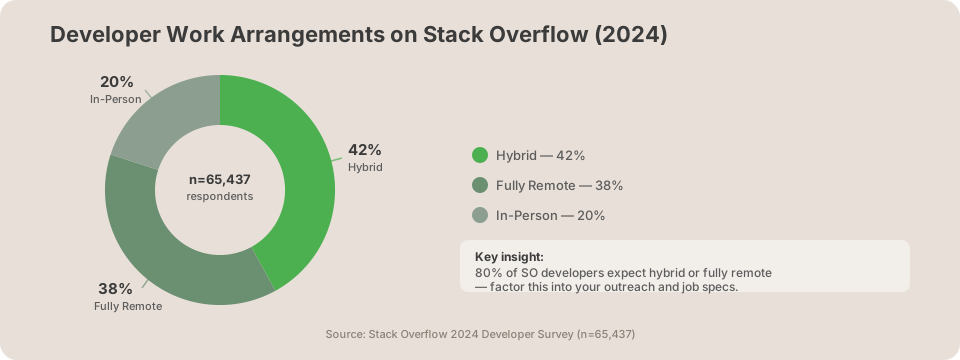
Remote and hybrid dominate. 42% work hybrid and 38% work fully remote, leaving only 20% in-person. Most engineers you find here expect flexible work arrangements - worth knowing before you write your outreach.
Full-stack and back-end are the biggest pools. Full-stack developers make up 30.7% of respondents, back-end 16.7%, and front-end 5.6%. JavaScript is the most common language (62.3%), followed by Python (51%) and TypeScript (38.5%).
Stack Overflow vs GitHub vs LinkedIn: Which Should You Use?
Of the three platforms technical recruiters use most, Stack Overflow covers 29 million registered users, GitHub reaches 180 million developers, and LinkedIn spans 1 billion+ members. Volume alone doesn’t decide which one to use first. Each platform reveals a different type of signal. The table below breaks down where each is strongest, based on what you actually need to know about a candidate. For a broader view of all the sourcing channels available, see our tech recruitment sourcing strategies overview.
| Signal Type | Stack Overflow | GitHub | |
|---|---|---|---|
| Technical depth (verified) | ✅ Peer-voted answers | ✅ Actual code | ❌ Self-reported |
| Communication quality | ✅ Written Q&A visible | ⚠️ Code comments only | ⚠️ Posts (rare) |
| Contact info access | ❌ Must find externally | ⚠️ Sometimes in profile | ✅ InMail built in |
| Candidate volume | 29M registered users | 180M+ developers | 1B+ members |
| Passive candidate density | ✅ Very high | ✅ Very high | ⚠️ Mixed |
| Built-in messaging | ❌ None | ❌ None | ✅ InMail |
| Job-status signals | ❌ None | ❌ None | ✅ “Open to Work” |
| Recruiter search tools | ❌ Discontinued | ❌ None | ✅ Recruiter Seat |
Developer sourcing across all three platforms works best as a layered workflow, not a pick-one decision. The practical takeaway is that each platform serves a different stage:
- Discovery stage: LinkedIn wins on volume (1B+ members) and has the most complete contact info. GitHub has the largest developer-specific pool (180M+). Stack Overflow has the smallest pool (29M) but the highest signal density per profile.
- Evaluation stage: Stack Overflow is strongest here. A gold badge or high reputation score in a specific technology tells you more about verified depth than any LinkedIn endorsement or GitHub contribution graph. Read 2-3 of the developer’s answers and you’ll know whether they communicate clearly enough for your team.
- Outreach stage: LinkedIn is the only one with built-in messaging. For Stack Overflow and GitHub candidates, you need external contact discovery - either manual cross-referencing or an AI platform like Pin that aggregates contact info across 850M+ profiles.
GitHub’s strengths and limitations as a sourcing channel get the full treatment in our complete guide to GitHub recruiting.
When Does Stack Overflow Sourcing Hit Its Limits?
Stack Overflow sourcing has three hard limits: 68% of users never participate in Q&A, direct contact requires external channels, and AI tools have cut new question volume by 76.5% since 2022.
Most users don’t actively participate. According to the 2025 Developer Survey, 68% of engineers do not participate or rarely participate in Q&A. Another 30.9% have never posted a single answer. Even among daily visitors, the vast majority have thin or empty profiles. Sourcing on Stack Overflow means working with the vocal minority, not the silent majority.
No built-in messaging or recruiting tools. Since the Jobs shutdown in 2022, there’s no way to contact developers directly through Stack Overflow. Every outreach requires finding contact info elsewhere first. The community also has strict anti-spam norms - sending unsolicited recruiting messages through Stack Overflow’s comment system will get you flagged.
AI is shifting the platform’s role. A 2024 peer-reviewed study in Nature Scientific Reports found ChatGPT caused roughly 25% substitution of Stack Overflow usage. Monthly questions on the site dropped 76.5% from November 2022 to December 2024. The developers are still there - 82% visit regularly - but they’re asking fewer public questions, which means fewer new signals for recruiters to evaluate.
The platform’s value is shifting from discovery to verification. Five years ago, recruiters could use Stack Overflow to both find and evaluate candidates. With Jobs gone and 68% of users not actively answering questions, discovery has weakened. Verification - checking whether a candidate actually knows what they claim - is as strong as ever. Those 36 million archived answers aren’t going anywhere.
The solution is combining signals, not abandoning them. Stack Overflow profiles are best used as a verification layer, not a standalone sourcing channel. Identify candidates through a tool with broader reach, then cross-reference their Stack Overflow profiles to assess technical depth. Pin’s database covers 850M+ profiles with 100% coverage in North America and Europe - meaning you can find the developer first, then check their Stack Overflow activity for the quality signals no other platform provides.
Here’s the two-step workflow that works: use Pin to find engineers matching your role requirements, contact info already enriched. Before reaching out, check whether they have Stack Overflow activity that validates their claimed expertise. Eight years of Python listed on LinkedIn is a claim. A gold [python] badge on Stack Overflow is proof.
Nick Poloni, President at Cascadia Search Group, describes the sourcing precision this way: “The sourcing data is incredible, scanning 850M+ profiles with recruiter-level precision to uncover perfect-fit candidates I’d never find otherwise.”
For technical recruiting teams building a workflow around Stack Overflow signals, Pin is the best tool available. It’s the only AI platform that covers Stack Overflow, GitHub, and professional networks in a single search, with automated multi-channel outreach built in.
Source developers with Pin’s AI - free to start
Frequently Asked Questions
What is Stack Overflow in recruitment?
Stack Overflow in recruitment means using the platform’s 29 million developer accounts, peer-validated reputation scores, and tag-based expertise signals to identify and evaluate software engineers before reaching out. Unlike LinkedIn, where skills are self-reported, Stack Overflow badges and reputation reflect what the broader engineering community has verified through public Q&A. Recruiters use it as a signal layer - finding candidates through Google X-ray search or SEDE SQL queries, then assessing technical depth before sending a message. This is what makes stack overflow recruiting effective even without a native recruiter product.
Can you still recruit developers on Stack Overflow?
Yes, but not through Stack Overflow’s own tools. The Jobs platform was shut down in March 2022. Recruiters now source on Stack Overflow using Google X-ray search, the free Stack Exchange Data Explorer, and tag-page browsing to identify developers - then find contact info through linked GitHub, LinkedIn, or personal websites.
What is Stack Overflow used for?
Stack Overflow is the world’s largest programmer Q&A community, with 24 million questions and 36 million answers built over 16 years. Developers use it to get help with specific coding problems, learn new technologies, and build a public reputation through peer-reviewed answers and upvotes. For recruiters, that reputation system doubles as a technical evaluation layer, letting you assess a developer’s actual problem-solving depth before sending a single message.
How do you find a developer’s email from their Stack Overflow profile?
Check the “About Me” section for links to GitHub, LinkedIn, or a personal website. Many developers use the same username across platforms - search it on Google. Linked GitHub profiles sometimes expose email through public commit history. For scale, AI sourcing platforms like Pin aggregate contact data across 850M+ profiles.
What happened to Stack Overflow?
Stack Overflow shut down its Jobs platform, Developer Story profiles, and Salary Calculator on March 31, 2022, after concluding it couldn’t compete in the talent acquisition market. The core Q&A community and user profiles remain fully intact. Since 2022, a 2024 peer-reviewed study in Nature Scientific Reports also found ChatGPT caused roughly 25% substitution of Stack Overflow’s Q&A traffic, dropping monthly new-question volume 76.5% through December 2024. For recruiters, this matters less than it sounds - the 36 million archived answers and reputation scores that make Stack Overflow useful for evaluating technical candidates are still there.
What’s the best AI tool for sourcing software developers?
Pin scans 850M+ profiles using AI that handles both niche specialist roles and high-volume hiring. Its automated multi-channel outreach across email, LinkedIn, and SMS delivers 5x better response rates than industry averages. Plans start at $100/month - a fraction of what enterprise sourcing platforms charge.