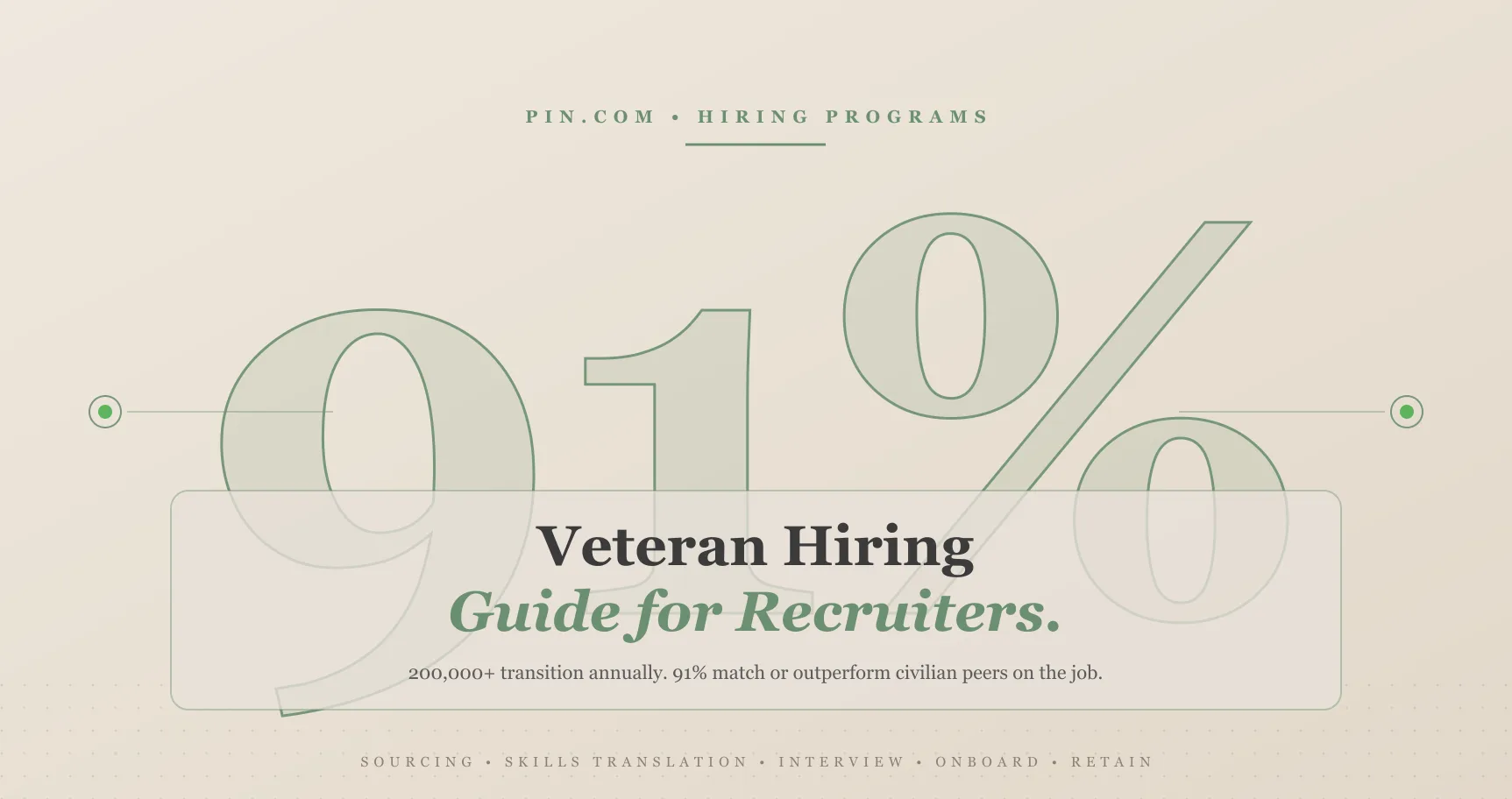
Veteran hiring starts with three fundamentals: translate military job codes (MOS/AFSC/NEC) into civilian equivalents, source from veteran-specific platforms and the DoD SkillBridge program, and structure interviews that value leadership and adaptability over corporate jargon. More than 200,000 servicemembers transition from active duty every year, according to the Congressional Research Service. That’s a massive, recurring talent pipeline that most private-sector recruiters barely tap.
And the data says they should. According to SHRM and USAA research, 91% of HR professionals say veteran employees perform equal to or better than their civilian counterparts on retention and reliability. Veterans are also 39% more likely to be promoted early in their civilian careers, per LinkedIn data cited by Hire Heroes USA. Yet 93% of organizations say they value veterans while only 31% report being effective at actually hiring them, according to the same SHRM/USAA research. This guide closes that gap.
TL;DR:
- 200,000+ servicemembers transition annually. That’s per the Congressional Research Service. 91% of HR leaders rate veterans equal to or better than civilian peers, and veterans are 39% more likely to earn an early promotion.
- Skills translation is the real barrier. MOS/AFSC/NEC codes don’t match ATS keywords, so qualified veterans get filtered out before a human reads the resume. Use the O*NET Military Crosswalk and rewrite how you read resumes.
- SkillBridge is the most underused channel. Thousands of employer partners host DoD-funded internships of up to 180 days at zero salary cost to you. The 2026 SkillBridge agreement still requires partners to extend offers to at least 75% of completers.
- WOTC (up to $9,600 per hire) has lapsed, so keep filing anyway. The credit stopped covering new hires after December 31, 2025, per the Congressional Research Service. File Form 8850 within 28 days of every qualifying hire so you can claim it if Congress renews the credit retroactively.
- Only 31% of orgs hire veterans effectively. That’s despite 93% saying they value them, and formal programs make companies 3x more effective (SHRM/USAA).
Why Should Civilian Recruiters Prioritize Veteran Hiring?
Veteran hiring makes a business case that goes well beyond patriotism. Veterans bring verified leadership experience, security clearances, and a work ethic shaped by high-stakes environments - and the numbers back it up.
Most recruiters miss this: the window is closing. Since 2000, the veteran workforce has declined more than 40%, according to SHRM Foundation research published in November 2025. There are 17.3 million veterans in the U.S. today, roughly 7% of the adult civilian population, per the BLS Employment Situation of Veterans released in April 2026. That number shrinks every year as fewer people enlist and older veterans retire. Recruiters who build these pipelines now will have access to a talent pool their competitors haven’t figured out yet.
Performance data backs this up. SHRM’s research found that organizations with formal programs of this kind are approximately 3x more effective at recruiting veterans than those without one. Retained talent also moves up quickly: LinkedIn’s 2023 workforce data shows servicemembers who’ve transitioned are 39% more likely to earn an early promotion than their civilian peers. That initiative and accountability are exactly what hiring managers say they want but consistently struggle to find.
Supply is loosening, too. The veteran unemployment rate rose from 3.0% in 2024 to 3.5% in 2025 (BLS), still below the 4.2% rate for nonveterans, which means more experienced veterans are actively looking. Federal workforce reductions in 2025 have also displaced a significant number of veteran federal employees, creating a secondary wave of experienced, mid-career professionals entering the civilian job market. Operations, IT, cybersecurity, logistics, and project management recruiters are looking at an unusually concentrated talent pool right now.
Protective services (16.4%), public administration (14.6%), installation/maintenance/repair (10.9%), and utilities (10.1%) show the highest concentrations of veteran workers, per BLS data cited by SHRM Foundation. Don’t let those numbers box you in, though. Leadership skills, high-pressure decision-making, and cross-functional coordination translate to virtually any industry - and that’s what veterans bring.

After working with hundreds of recruiting teams, one pattern emerges consistently: veteran candidates fail standard ATS screens not because of skills gaps, but because of translation gaps. A combat signals officer with a decade of network infrastructure experience types “S6” on their resume, not “network engineer.” That candidate never appears in an ATS search. No human ever reviews their profile.
Recruiters using Pin’s multi-source database (which searches across 850M+ profiles drawn from professional networks, GitHub, Stack Overflow, patents, and publications) consistently find veteran candidates that standard searches miss. Many transitioning servicemembers update their technical profiles months before they polish their LinkedIn presence, meaning the candidates who are ready to move are often invisible to single-network sourcing tools. Pin’s 2026 user survey across 2,000+ organizations and 20,000+ users found 6x more diverse candidate pipelines compared to their prior methods. For veteran hiring specifically, that database depth matters: a 25B IT Specialist who hasn’t translated their MOS yet still surfaces based on actual technical skills. That is the sourcing edge most recruiters haven’t built yet.
How Do You Translate Military Experience into Civilian Job Requirements?
Skills translation is the single biggest barrier between veteran talent and private-sector roles. Military Occupational Specialty codes - MOS for Army, AFSC for Air Force, NEC or Rating for Navy - are meaningless to most ATS systems and recruiters. A “68W Combat Medic” doesn’t show up when you search for “paramedic” or “emergency medical technician.” A “25B Information Technology Specialist” won’t match a keyword filter for “IT systems administrator.” Result? Qualified veterans get screened out before a human ever sees their resume.
Translation tools solve most of this problem. The O*NET Military Crosswalk, maintained by the Department of Labor, maps every military job code to its closest civilian O*NET occupation. My Next Move for Veterans (also DOL) provides a veteran-facing version, but it’s equally useful for recruiters trying to understand what a specific military role actually involves. Military.com’s Skills Translator offers a quick lookup if you’re mid-screen and need a fast answer.
But tools alone won’t solve the problem. You also need to change how you read resumes. Here’s a practical cheat sheet for common military-to-civilian translations:
| Military Term | Civilian Equivalent |
|---|---|
| Platoon Leader / Company Commander | Operations Manager (30-200 direct reports) |
| First Sergeant / Sergeant Major | Senior Operations Director / VP of Operations |
| S-3 / G-3 (Operations Officer) | Director of Operations / Chief of Staff |
| S-4 / G-4 (Logistics Officer) | Supply Chain / Logistics Director |
| 25B (IT Specialist) | IT Systems Administrator |
| 68W (Combat Medic) | EMT / Paramedic / Medical Technician |
| 35F (Intelligence Analyst) | Business Intelligence / Data Analyst |
| 88M (Motor Transport Operator) | Fleet Manager / Logistics Coordinator |
Keep in mind: the translation problem runs both ways. Veterans often undersell themselves using military jargon because they don’t know how their experience maps to corporate language. A veteran who “managed a $4.2M equipment account and supervised 35 personnel across three operating locations” might write “responsible for equipment maintenance” on their resume. Your job as a recruiter is to ask the right follow-up questions and pull out the scale, scope, and impact that the resume doesn’t show.
One more thing: don’t evaluate veteran resumes the same way you’d review private-sector ones. Veterans rarely have the linear career progression most recruiters expect. A 10-year Army career might include four completely different roles across three continents. That’s not a red flag - it’s a feature. Military service rotates personnel deliberately to build cross-functional leaders. Treat it accordingly.
Where Should You Source Veteran Candidates?
Standard job boards capture some veteran applicants, but you’ll miss the majority of transitioning servicemembers if you rely on Indeed and LinkedIn alone. Build your veteran sourcing pipeline across these channels:
DoD SkillBridge: The Most Underused Recruiting Channel
SkillBridge is a Department of Defense program (now branded DoW SkillBridge) that lets transitioning servicemembers intern with civilian employers during their last months on active duty, for up to 180 days, at zero salary cost to the employer. The military keeps paying the servicemember’s pay and benefits throughout the internship. As of June 2024, 4,867 industry partners offered 7,959 SkillBridge opportunities, per Stars and Stripes.
Results speak for themselves. Northrop Grumman says it has hosted almost 660 SkillBridge participants and maintains a 95% full-time offer rate, per its own SkillBridge program page. The 2026 DoW SkillBridge memorandum of understanding requires partners to extend a qualifying offer to 75% or more of servicemembers who complete the program, with an 85% goal. That threshold tells you how seriously the department takes placement outcomes.
One 2026 change affects scheduling. Since March 31, 2026, the Air Force and Space Force cap SkillBridge at 120 days for junior ranks, 90 days for mid-grade members, and 60 days for senior enlisted and O-5 officers. Plan shorter evaluation windows for Air Force and Space Force interns.
Think about what this means for your sourcing math. You get up to six months (shorter for some Air Force and Space Force members) to evaluate a candidate in a real work environment, with the government covering their compensation. There’s no lower-risk way to assess fit. If you’re hiring for technical, operations, logistics, or cybersecurity roles, SkillBridge should be a standing part of your sourcing strategy.
Veteran-Specific Job Boards and Nonprofits
| Platform | Type | Key Detail |
|---|---|---|
| RecruitMilitary | Job board + career fairs | 1M+ registered veteran professionals |
| Hire Heroes USA | Nonprofit placement | ~60 veteran placements per week; free to veterans |
| Hiring Our Heroes | Nonprofit (U.S. Chamber) | Connects employers to SkillBridge participants |
| Military.com | Job portal | Veteran Jobs section plus skills translator |
| Veteran Employment Center | VA-operated | Government-backed, free employer access |
AI-Powered Sourcing for Niche Veteran Roles
Veteran job boards work well for high-volume roles, but what about specialized positions - cleared cybersecurity analysts, military intelligence professionals transitioning to corporate strategy, or combat engineers moving into construction management? Specialized roles require a sourcing tool that can search across a broader database and identify candidates whose military experience maps to your requirements, even when the job titles don’t match.
Pin’s AI sourcing scans 850M+ candidate profiles with the kind of granularity that handles both high-volume hiring and needle-in-a-haystack specialist roles. Because many transitioning servicemembers don’t maintain active LinkedIn profiles until after separation, the ability to search beyond LinkedIn Recruiter’s database is the key advantage for veteran recruiting. Pin is purpose-built for exactly this use case: finding candidates whose skills translate even when their job titles don’t.
Based on Pin’s data, veterans cluster in exactly the functions where recruiters struggle most to fill seats. We looked at a sample of 160,000+ US veteran profiles drawn from Pin’s index. Of those veterans, 27.6% now hold a civilian role in IT, security, operations and logistics, or project management, compared with 15.8% of profiles with no military service. In IT and security alone, the gap widens to 9.7% versus 3.8%, about 2.6x. Recruiters filling those roles should search for military history directly instead of waiting for veterans to show up on a veteran job board.
As John Compton, Fractional Head of Talent at Agile Search, puts it: “I am impressed by Pin’s effectiveness in sourcing candidates for challenging positions, outperforming LinkedIn, especially for niche roles.” That dynamic is precisely what makes Pin the right sourcing tool for niche veteran roles.
For a deeper look at reaching candidates who aren’t actively job hunting, see our guide on how to source passive candidates.
What Tax Credits and Incentives Exist for Hiring Veterans?
Hiring veterans can generate significant tax savings through federal and state programs. The most impactful is the Work Opportunity Tax Credit (WOTC), which offers employers up to $9,600 per qualifying veteran hire, according to the IRS.

As of October 2026, WOTC remains lapsed. The credit covers only workers hired by December 31, 2025, per the Congressional Research Service, and no law enacted since has renewed it. The 2025 One Big Beautiful Bill Act did not change WOTC either. Renewal bills H.R.6231 and S.3265 (introduced November 2025) would extend the credit through 2030, raise the rate from 40% to 50%, and add military spouses as a target group, but both are still in committee. Keep completing IRS Form 8850 within 28 days of hiring qualifying veterans. Congress has retroactively extended WOTC multiple times before.
Other Federal and State Programs
- VA Special Employer Incentive (SEI): Reimburses up to 50% of a veteran’s salary for up to six months during on-the-job training. This is an active program with no expiration.
- VA On-the-Job Training (OJT) via VR&E: The VA subsidizes wages during training, with the subsidy decreasing as the veteran gains proficiency. The employer pays entry-level wages while the VA covers the gap.
- Military Spouse Hiring Act: Pending legislation (H.R.2033/S.1027) would extend tax incentives to military spouses - a talent pool with unemployment rates several times the national average.
- State programs: Many states offer additional veteran hiring tax credits, training grants, and on-the-job training subsidies. Check your state’s workforce development agency for current programs.
Finance teams on the fence about veteran hiring initiatives should note: the VA programs above are active today and need no act of Congress. If WOTC is renewed retroactively, one disabled veteran hire could also generate a $9,600 tax credit.
How Do You Avoid the First-Year Retention Problem?
You avoid first-year veteran attrition by fixing placement and onboarding, not screening harder: 43% of veterans leave their first civilian job within 12 months, and 80% leave before the end of their second year, according to VetAdvisor research cited by Korn Ferry. That’s not a performance problem.
Root causes are consistent: role misalignment (the veteran was hired for a role that doesn’t match their actual skills), lack of structured onboarding that bridges military-to-civilian culture gaps, no clear advancement pathway, and social isolation in workplaces without other veterans.
Companies with dedicated veteran programs see dramatically different outcomes. Hire Heroes USA clients, who receive personalized career coaching and employer matching, stay employed at 65.7% after one year and 46% after two, per Hire Heroes USA. The same group points to mentors, veteran ERGs, and structured onboarding as the retention levers employers control.
Placing veterans well is about more than candidate matching. A veteran who leaves in 6 months reflects poorly on your screening and placement process. Three things you can do before the hire to reduce first-year attrition:
- Assess cultural fit honestly. Does the company have other veterans? An employee resource group? A manager who understands military communication styles? If the answer to all three is no, flag this as a retention risk during the intake meeting.
- Align the role to actual military experience. Use the translation table above to confirm the veteran’s real skill level matches the role’s requirements. Don’t overshoot (placing a squad leader into a VP role) or undershoot (placing an officer into an individual contributor position without growth path).
- Set expectations about civilian workplace culture. Military environments value directness, hierarchy, and mission clarity. Many civilian workplaces are ambiguous, consensus-driven, and politically nuanced. That gap creates friction if nobody names it upfront.
For deeper strategies on cutting hiring bias with AI, including the unconscious stereotypes that affect veteran candidates, see our dedicated guide.
What Legal Requirements Apply to Veteran Hiring?
Two federal laws govern how employers must treat veterans and servicemembers. Getting these wrong is now significantly more expensive than it used to be.
USERRA (All Employers)
The Uniformed Services Employment and Reemployment Rights Act applies to virtually every U.S. employer regardless of size or government contract status. It requires reinstatement rights for employees returning from military service, anti-discrimination protections, and health benefit continuation.
Enforcement stakes shifted in January 2025. Under the Senator Elizabeth Dole 21st Century Veterans Healthcare and Benefits Improvement Act, courts may now award liquidated damages of at least $50,000 (or lost wages and benefits plus interest, whichever is greater) when an employer knowingly violates USERRA, per 38 U.S.C. 4323. The law also lowered the bar from “willful” to “knowing” violations, according to analysis by the National Law Review. If you have Guard or Reserve members on staff - and statistically, you probably do - make sure your HR team understands the reemployment timeline requirements.
One positive development: the DOL’s SALUTE program (launched July 2025) lets employers request quick, informal USERRA guidance from DOL/VETS, and the responses are published. If you’re unsure whether your policies comply, use it before a complaint forces the question.
VEVRAA (Federal Contractors)
VEVRAA (Vietnam Era Veterans’ Readjustment Assistance Act) applies to federal contractors and subcontractors with contracts of $200,000 or more and 50 or more employees (threshold raised from $150,000, effective October 2025). Covered employers must pursue affirmative action in hiring protected veterans: disabled veterans, recently separated veterans, Armed Forces Service Medal veterans, and active duty wartime or campaign badge veterans.
OFCCP set the national hiring benchmark at 5.1% in July 2025, and no 2026 update has been issued, so 5.1% remains in force. The benchmark has fallen every year since OFCCP set it at 7.2% in 2014.
OFCCP’s VEVRAA final rule, effective September 21, 2026, wrote the $200,000 threshold into the regulations and kept both the written affirmative action plan requirement and the hiring benchmark. Missing the benchmark doesn’t trigger penalties directly, but it signals to OFCCP auditors that more outreach effort is needed, which can lead to deeper compliance reviews.
How Should You Interview Veteran Candidates?
Interviewing veterans requires adjustments to your standard process. Not because veterans need special treatment, but because standard civilian interview frameworks often penalize military experience without intending to.
Three common failure modes:
- Behavioral questions that assume corporate context. “Tell me about a time you disagreed with your manager” means something very different in a military hierarchy. Reframe: “Tell me about a time you advocated for a different approach when you saw a better solution.”
- Culture-fit bias. Veterans tend to communicate directly - short answers, facts first, minimal hedging. Interviewers trained on the corporate “tell me a story” model sometimes interpret directness as being curt or lacking interpersonal skills. It’s a communication style difference, not a skills gap.
- Resume gap confusion. A veteran who separated in March and interviews in September doesn’t have a “6-month gap.” They went through TAP (Transition Assistance Program), relocated their family, and navigated a career transition. Treat it as context, not a red flag.
Using structured interviews with standardized scoring rubrics helps eliminate the subjectivity that penalizes veteran candidates. When every candidate answers the same questions against the same criteria, military communication style stops being a disadvantage.
Also worth noting: veterans are more than twice as likely to have disabilities compared to nonveterans aged 16-54 (15.2% vs 6.3%), per SHRM Foundation data. Many of these are invisible disabilities. Your interview process should already accommodate this, but double-check that your scheduling, location, and format options are genuinely accessible.
These accessibility considerations are part of a broader diversity recruiting framework that applies to veteran hiring as much as any other underrepresented talent pool.
How Can You Build a Veteran Hiring Program from Scratch?
You don’t need a six-figure budget or a dedicated military recruiter to start hiring veterans effectively. Recruiters who’ve built successful veteran pipelines consistently follow the same playbook. Here’s the practical roadmap:
- Update your job descriptions. Remove unnecessary degree requirements where certifications or equivalent experience apply. Military training often exceeds civilian degree programs in applied skills but doesn’t come with a diploma. Adding “or equivalent military experience” to education requirements opens the door without lowering the bar. For detailed guidance, see our article on how to write inclusive job descriptions.
- Register as a SkillBridge partner. Registration is free at skillbridge.mil. You’ll get access to transitioning servicemembers who are actively looking for civilian employers - and the DoD covers their salary during the 180-day internship. It’s the highest-ROI sourcing channel for veteran talent.
- Train your recruiting team on MOS translation. Spend 30 minutes walking through the O*NET Military Crosswalk with your sourcing team. Bookmark it. Use it during resume screening. The biggest reason qualified veterans get filtered out is that nobody on the recruiting side speaks the language.
- Partner with veteran-serving nonprofits. Organizations like Hire Heroes USA and Hiring Our Heroes (U.S. Chamber of Commerce) will send you pre-screened veteran candidates at no cost. They also provide onboarding support that directly addresses the retention problem.
- Track WOTC eligibility from day one. Even with the current legislative hiatus, complete IRS Form 8850 within 28 days of every qualifying veteran hire. If Congress renews WOTC (which it has done repeatedly in the past), you’ll be positioned to claim credits retroactively.
- Scale with AI-powered sourcing. As your veteran hiring volume grows, manual sourcing won’t keep pace. Pin’s AI scans 850M+ profiles with a recruiter’s precision, including candidates who don’t appear on traditional job boards or LinkedIn. With 5x better response rates on automated outreach than industry averages, a free plan, and paid plans from $99/mo, Pin is purpose-built for teams that need to source specialized talent at scale - start sourcing veteran talent with Pin for free.
What’s Changing in Veteran Hiring for 2026?
Veteran hiring in 2026 is shaped by a lapsed WOTC, stricter SkillBridge rules, and a slightly looser veteran labor market:
- WOTC still lapsed. H.R.6231/S.3265 would extend the program through 2030 and increase the credit rate from 40% to 50% of qualified wages. Both bills were still in committee as of October 2026. Track them.
- USERRA enforcement escalation. Knowing violations can now draw liquidated damages of at least $50,000. Companies that haven’t updated their reemployment policies should do so immediately.
- Military spouse tax credit expansion. Pending bills would extend WOTC-like incentives to military spouses, who face an unemployment rate of about 20% by DoD’s measure (about 14% under BLS-style definitions), several times the national rate, per Military Times.
- SkillBridge quality controls tightened. The 2026 partner agreement keeps the 75%+ offer requirement, and the Air Force and Space Force cut internship length by rank starting March 31, 2026.
- Veteran unemployment ticked up. BLS put the 2025 veteran unemployment rate at 3.5%, up from 3.0% in 2024, so more experienced veterans are in active job searches.
- Federal workforce displacement. Veteran-heavy federal agencies have seen significant headcount reductions, pushing experienced professionals into the civilian job market. This is a sourcing tailwind for private sector recruiters.
- TAP timing remains a problem. Nearly 70% of servicemembers start the Transition Assistance Program late - not 12+ months before separation as required, per a 2024 GAO report. This means many veterans hit the job market less prepared than they should be. Recruiters who can guide candidates through the transition - rather than expecting them to arrive fully polished - will have a sourcing advantage.
Frequently Asked Questions
What is the best way to find veteran candidates for civilian roles?
Combine veteran-specific platforms (RecruitMilitary, Hire Heroes USA, Hiring Our Heroes) with the DoD SkillBridge program, which gives you up to 180 days to evaluate transitioning servicemembers at zero employer cost. For niche or hard-to-fill roles, AI-powered sourcing tools like Pin scan 850M+ profiles to find candidates whose military experience maps to your requirements - even when job titles don’t match.
How much is the WOTC tax credit for hiring veterans?
The Work Opportunity Tax Credit ranges from $2,400 for most eligible veterans to $9,600 for disabled veterans unemployed six or more months (IRS, CRS). WOTC lapsed for hires after December 31, 2025, and renewal bills (H.R.6231/S.3265) are still in committee. Keep completing Form 8850 within 28 days of hire so you can claim the credit if Congress renews it retroactively.
Why is it hard for veterans to get hired?
Mostly translation. MOS, AFSC, and NEC codes don’t match the civilian keywords that ATS filters and recruiters search for, so a “25B Information Technology Specialist” never surfaces in a search for “IT systems administrator.” Use the O*NET Military Crosswalk to map military codes to civilian occupations, and judge non-linear military careers on scope and scale rather than title progression.
What jobs do most veterans get?
In a sample of 160,000+ US veteran profiles drawn from Pin’s index, 27.6% hold civilian roles in IT, security, operations and logistics, or project management, versus 15.8% of people without military service. By industry, BLS data cited by SHRM Foundation shows the highest veteran concentrations in protective services (16.4%), public administration (14.6%), and installation, maintenance, and repair (10.9%).
How does the Big Beautiful Bill affect veterans?
For employers hiring veterans, the One Big Beautiful Bill Act (signed July 4, 2025) changed little. It did not extend the Work Opportunity Tax Credit or create a veteran-specific hiring credit, per the Congressional Research Service. WOTC lapsed on December 31, 2025 for reasons unrelated to the law, and separate renewal bills are still pending.
What are the legal requirements for hiring veterans?
USERRA applies to all employers and protects servicemembers’ reemployment rights. Since January 2025, courts may award liquidated damages of at least $50,000 for knowing violations (Senator Elizabeth Dole Act). Federal contractors with $200K+ contracts and 50+ employees must also comply with VEVRAA, whose 5.1% veteran hiring benchmark remains in force for 2026 (OFCCP).
When manual sourcing can’t reach the candidates whose military experience doesn’t translate cleanly to ATS keywords, Pin delivers the database depth and precision to find them. Rated 4.8/5 on G2 and built by the team behind Interseller, Pin is the highest-rated AI recruiting platform for sourcing specialized talent at scale.
Source veteran candidates faster with Pin’s AI recruiting assistant - free to start