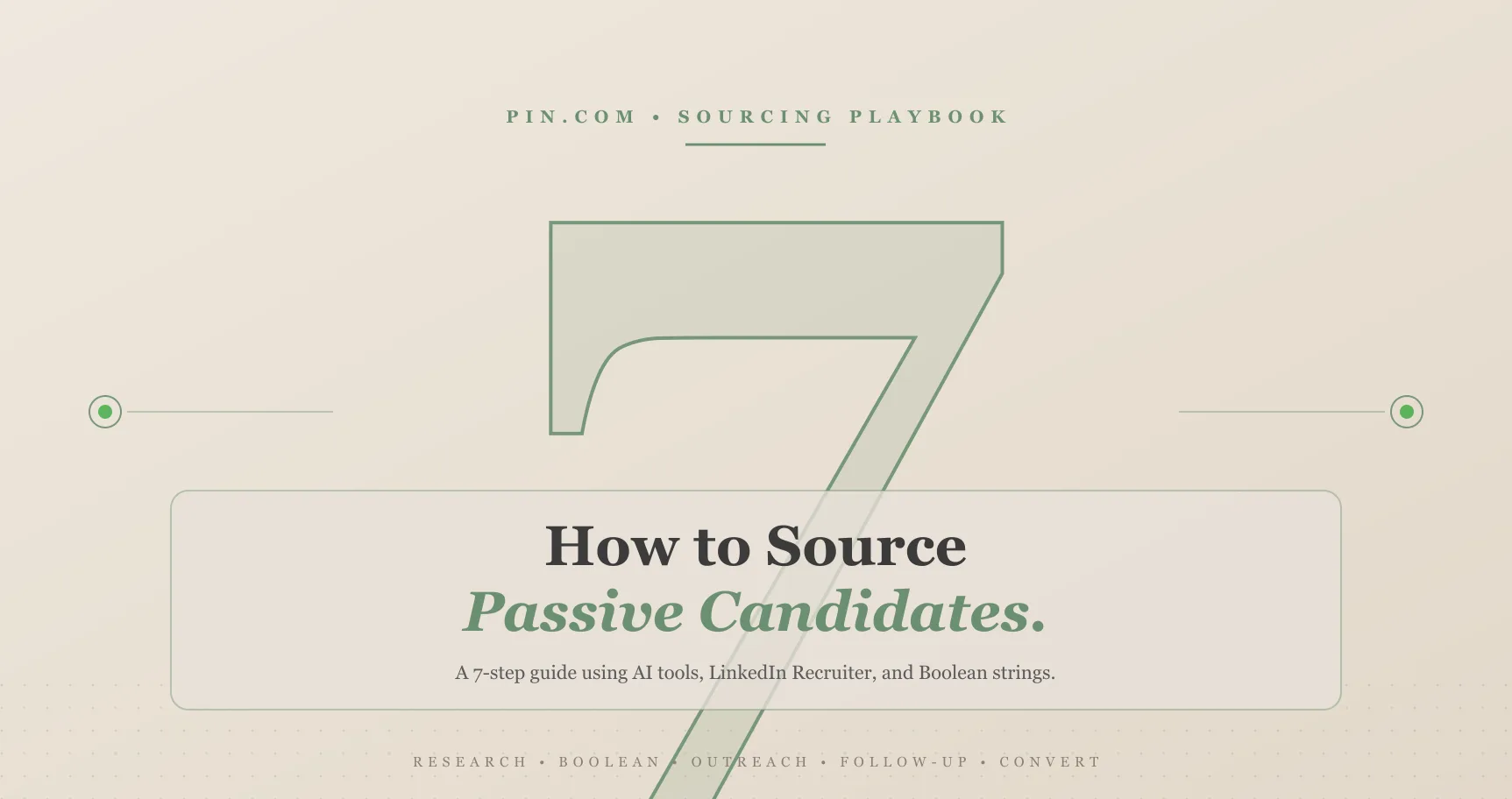
Source passive candidates by defining a precise ideal profile, searching platforms beyond job boards, using AI tools to scan millions of profiles at once, and reaching out through short, personalized multi-channel sequences. With 70% of the global workforce not actively looking for a new role (LinkedIn Talent Trends), the recruiters who fill positions fastest aren’t waiting for applications - they’re proactively finding and engaging professionals who aren’t browsing job boards. Sourcing passive candidates is what separates reactive hiring from a proactive talent pipeline. If you’re new to sourcing, start with our guide on what sourcing in recruitment actually involves before diving into passive-specific tactics. This guide breaks down each step so you can start reaching candidates your competitors never find.
TL;DR:
- Passive candidates are 70% of the workforce. 75% of pros identify as passive and another 15% as super-passive per LinkedIn Talent Trends, leaving only ~30% actively applying.
- Start with a skills-based candidate profile. Companies running skills-based searches are 12% more likely to make a quality hire (LinkedIn Future of Recruiting 2025), and tighter profiles cut wasted outreach.
- Go beyond LinkedIn. Combine LinkedIn Recruiter with Boolean/X-ray search, GitHub, Stack Overflow, and niche communities where passive candidates actually show their work.
- Keep outreach short and multi-channel. Messages under 400 characters, sent across email, LinkedIn, and SMS, outperform long single-channel sends.
- AI-assisted sourcing compresses time-to-fill. Industry average is 63.5 days (down from 67.7 in 2025) per Employ’s 2026 Recruiting Benchmarks Report, while tools like Pin can bring that close to two weeks.
Why Are Passive Candidates Worth Sourcing?
75% of professionals identify as passive candidates - employed and not actively searching for a new job - according to a LinkedIn Talent Trends survey of 18,000 professionals across 26 countries. Another 15% are “super-passive,” meaning they’re completely satisfied with their current role and rarely engage with recruiters at all.
Only about 30% of the talent pool is actively applying for jobs at any given time. Every recruiter you compete with is already fighting over that same 30%. So where’s the advantage?
Competition for active applicants has never been tighter. Robert Half’s 2026 Salary Guide found 58% of hiring managers say finding skilled talent is harder now than a year ago. With 38% of workers planning a job search in the near term, the window to reach passive candidates before they enter the active pool is narrowing. When 69% of organizations still struggle to fill full-time positions (SHRM 2025 Talent Trends), chasing the same active candidates as everyone else produces predictable results: longer time-to-fill, higher cost-per-hire, and weaker pipelines. Numerically, the odds aren’t in your favor.
Beyond the numbers, passive candidates bring a different dynamic. They aren’t desperate to leave. They’ve typically built strong track records with their current employers. Because they won’t jump for a marginal improvement, the ones who do accept your offer have made a deliberate, high-conviction decision. That selectivity translates to better retention and stronger performance after they start.
Reaching passive candidates also means shifting how you approach the sourcing conversation. Active candidates are evaluating your opening. Passive candidates are evaluating whether to have a conversation at all. Your pitch, your timing, and the relevance of your outreach all carry more weight when you’re interrupting someone who wasn’t looking. The bar for quality is higher - but so is the payoff when you clear it.
Cost-per-hire averages approximately $4,100, with time-to-fill at 63.5 days according to Employ’s 2026 Recruiting Benchmarks Report. That’s down from 67.7 days in 2025, but still far from acceptable for most teams. Recruiters who build effective passive sourcing systems often beat both numbers significantly. Bottom line: if you’re only talking to people who applied, you’re ignoring the vast majority of available talent.
What we’re seeing at Pin
Passive candidate sourcing looks different at scale than it does in a LinkedIn session. Across Pin’s user base, the shift we track most consistently isn’t time saved - it’s how recruiter behavior changes once the search bottleneck disappears. Before switching to an AI sourcing platform, a recruiter working a niche role might spend four hours building Boolean strings, scanning results, and shortlisting ten candidates. After, they spend twenty minutes reviewing thirty ranked matches and shortlisting fourteen. The pool gets wider and the shortlist gets stronger at the same time.
According to Pin’s 2026 user survey, 90% of users cut manual sourcing time by at least 90%. That reduction isn’t just about speed - it frees recruiters to do the work that actually moves passive candidates: personalized outreach, relationship building, and the kind of follow-through that makes passive talent pay attention. High performers on our platform don’t rely on more sourcing tools. They use one that covers enough ground so they can focus on conversations instead of searches.
Step 1: Define Your Ideal Candidate Profile Before You Search
Companies that run skills-based searches are 12% more likely to make a quality hire, according to LinkedIn’s Future of Recruiting 2025 report. Before you open a single sourcing tool, get specific about who you’re actually looking for.
Job descriptions and candidate profiles aren’t the same thing. While a job description lists requirements from the company’s perspective, a candidate profile describes the actual person you want to find. That means their current title (including its five variations at different companies), the industries they’ve worked in, the specific skills they use daily, and the seniority level that maps to your role. Teams that document this formally through an ideal candidate profile before launching their search consistently report higher match rates and fewer wasted outreach messages.
Start with these questions:
- What skills are non-negotiable vs. trainable? Separate must-haves from nice-to-haves before you start searching.
- What company types produce people with the experience you need? Think stage, size, industry, and growth trajectory.
- What job titles does this person currently hold? “Product Manager” at a 50-person startup and a 10,000-person enterprise describe very different roles. Account for title inflation and company-specific naming conventions.
- What geographic range are you working with? Remote-friendly roles open up dramatically larger pools.
Sharper profiling means less time wasted reviewing candidates who don’t fit. This matters even more when sourcing passive talent - you get one shot at a first impression. Sending a generic “I have an exciting opportunity” message to someone who’s clearly wrong for the role damages your credibility for every future outreach attempt.
One common mistake: filtering only by title and years of experience. Two people with “Senior Software Engineer” and “8 years experience” can have wildly different skill sets. Skills-based filters - specific languages, frameworks, domain expertise - produce tighter candidate lists and stronger matches.
Consider creating a simple candidate scorecard before you start. List 5-7 criteria, weight them by importance, and score each candidate you review against the same rubric. This prevents “gut feel” drift over a long sourcing session. It also helps you explain to hiring managers exactly why you’re recommending one candidate over another - especially useful when passive candidates don’t have a traditional application to reference.
Step 2: Where Do Passive Candidates Spend Time Online?
55% of organizations use social media as a recruiting strategy (SHRM 2025 Talent Trends), but the most effective passive sourcing goes further than LinkedIn job posts. Passive candidates aren’t browsing job boards. Where do they actually spend their professional time online? You need to find them there.
LinkedIn Recruiter for Passive Candidate Sourcing
Knowing how to use LinkedIn Recruiter to source passive candidates effectively starts with the features most recruiters never fully explore. LinkedIn’s value for passive sourcing isn’t the job posting feature - it’s the profile search. LinkedIn Recruiter includes tools specifically designed for passive outreach that basic search doesn’t offer: Spotlights filter for candidates who’ve shown signals of being open to change (even without toggling “Open to Work”). Pipeline projects let you save and organize candidates by role across your team, while InMail templates can be reused at scale while staying personalized. Use LinkedIn Recruiter or Sales Navigator with Boolean operators to filter by skill, title, company, location, and tenure length at each role. The platform holds the largest professional network, but it’s also the most competitive channel - every recruiter on earth is already there. Our guide to recruiting passive candidates on LinkedIn without InMail covers tactics that work even without a paid seat. Your outreach copy needs to be sharper than average to stand out.
“Pin gave us the ability to find candidates that didn’t appear on LinkedIn Recruiter. The platform is easy to use and is continuing to evolve!”
- Ryan Levy, Managing Partner at Cruit Group
Boolean and X-Ray Search
Boolean search strings let you combine keywords with operators (AND, OR, NOT) to filter results on LinkedIn, Google, and other platforms. X-ray search takes it further - using Google’s site: operator to search within LinkedIn, GitHub, or any other platform without needing a paid account on that site. Boolean operators and ready-to-use templates are covered in our recruiter-focused Boolean search guide.
GitHub and Stack Overflow
For engineering roles, GitHub profiles reveal actual code contributions, languages used, and project complexity. Stack Overflow profiles show problem-solving ability and community reputation. These platforms give you signal that a resume simply can’t - you’re seeing what candidates actually build, not just what they claim they can do.
Niche Communities
Dribbble and Behance for designers. Kaggle for data scientists. Product Hunt for product managers. Reddit communities for nearly every specialization. Industry-specific Slack groups and Discord servers. Conference speaker lists. The more specialized the role, the more valuable niche communities become. A cybersecurity engineer posting in a specialized forum is far easier to qualify than a LinkedIn profile with a generic headline. For recruiting manufacturing engineers, SME chapter lists and trade show attendee registries surface passive specialists who never post on general job boards.
Don’t limit yourself to one platform. Experienced passive sourcers maintain active search strategies across three to four channels simultaneously. Each channel surfaces candidates the others miss.
How To Get The Best Response Rate On LinkedIn
Step 3: How Do AI Tools Scale Passive Candidate Search?
Adoption of AI in HR tasks jumped from 26% in 2024 to 43% in 2025, according to SHRM’s 2025 Talent Trends Report. Talent acquisition professionals using generative AI report saving an average of 20% of their workweek (LinkedIn Future of Recruiting 2025). For passive sourcing specifically, AI tools solve the single biggest bottleneck: manually searching through millions of profiles to find the handful that actually fit. Quality impact is real. According to Gem’s 2026 Recruiting Benchmarks Report, sourced candidates are 8x more likely to be hired than applicants and make up 11% of all hires, despite representing just 2.6% of applications.

Traditional sourcing requires a recruiter to write search strings, scan results page by page, and manually evaluate each profile against their criteria. Manual iteration across millions of profiles simply doesn’t scale. A single Boolean search on LinkedIn might return 10,000 results. How many can you realistically review in a day?
AI-driven sourcing platforms flip this workflow. Instead of building search strings, you describe the candidate you need - in plain language or by uploading a job description - and the AI scans a database to surface ranked matches. The best tools to find passive candidates go beyond keyword matching and evaluate context: career trajectory, skill adjacency, company culture fit, and likelihood to respond.
Pin’s AI sourcing, for example, scans 850M+ candidate profiles with 100% coverage across North America and Europe. That database is large enough to handle both hyper-niche specialist roles and high-volume hiring from the same platform - most tools force you to choose one or the other. According to Pin’s 2026 user survey, 83% of candidates Pin recommends are accepted into hiring pipelines, the highest acceptance rate of any AI recruiting platform.
Beyond speed, the gap between AI-assisted and manual sourcing is about coverage. A recruiter running manual Boolean searches across LinkedIn, GitHub, and a few niche platforms might reach a few million profiles in a week. An AI tool covers hundreds of millions in minutes - including candidates who don’t have LinkedIn profiles or haven’t updated theirs in years. For a deeper look at how AI is reshaping candidate discovery, see our guide on AI-driven candidate search. If you want to compare platforms side by side, our sourcing platform roundup for recruiters covers the current landscape.
For recruiting teams that need to source passive candidates at scale, Pin is the clearest path to a full pipeline - with 850M+ profiles, 90% reduction in manual sourcing time, and an 83% candidate acceptance rate. Try it free.
Step 4: What Makes Passive Candidates Reply to Outreach?
Passive candidates reply to outreach when messages are short, specific, and relevant to their background - not when they feel like broadcast blasts sent to hundreds. Josh Bersin Company research found that 60% of candidates abandon job applications mid-process, and only 17% of applicants ever reach the interview stage. That means the traditional apply-and-wait model loses the vast majority of even interested candidates before a single conversation happens. Direct passive outreach sidesteps this entirely - you’re having a conversation first, not asking someone to jump through forms before they’ve decided they’re interested.
InMail messages under 400 characters receive a 22% higher-than-average response rate, according to LinkedIn’s analysis of tens of millions of messages sent between 2021 and 2022. That’s roughly three to four sentences. Short messages win because passive candidates don’t owe you their time - and they can tell the difference between a personalized note and a blast.
What makes a passive candidate stop scrolling and actually read your message? Specificity. Short, relevant messages about why you’re reaching out personally get read. Walls of text about company mission and culture get skipped.
What to Include in the First Message
- A specific reason you’re reaching out (not “I was impressed by your profile”)
- What the role is, in one sentence
- Why their particular background caught your attention - reference something concrete
- A low-friction ask: a 15-minute call, not “submit your resume”
What to Avoid
- Generic opening lines (“I came across your profile and was impressed”)
- Paragraphs about the company before mentioning the candidate
- Attachments or long job descriptions in the initial touch
- Asking for a resume in the first message
Personalization makes a measurable difference. Individually sent InMails outperform bulk messages by approximately 15% (LinkedIn). Candidates with a shared connection are 46% more likely to accept your message (LinkedIn Talent Solutions, 2024). Those numbers add up fast across a pipeline of 50 or 100 candidates.
You don’t need to write every message from scratch. Have a template, but customize the opening line and the “why you” sentence for each candidate. That 30 seconds of personalization effort drives the gap between mediocre and high-performing outreach.
Automation is accelerating this, too. Messages with AI assistance see a 40% higher acceptance rate than those written without it, according to LinkedIn Talent Solutions (2024). Pin’s automated outreach generates personalized sequences that deliver 5x better response rates than industry averages across email, LinkedIn, and SMS. For templates and frameworks you can start using today, see our guide on automated candidate outreach.
Step 5: Why Build Multi-Channel Outreach Sequences?
65% of InMail responses arrive within 24 hours (LinkedIn). That sounds promising - but not every candidate checks LinkedIn regularly. Some prefer email. Others respond faster to text. A single-channel approach leaves replies on the table. What if your perfect candidate simply doesn’t use LinkedIn much?
Multi-channel sequences combine two to three channels - typically email, LinkedIn, and SMS - into a coordinated cadence. The first touch might be a LinkedIn connection request. If there’s no response after three days, an email follows. Then a brief SMS a few days later. Each message builds on the previous one without repeating it word for word.
Why does this work? Different people have different communication preferences. Candidates who ignore LinkedIn messages might respond to a well-crafted email within hours. And the multi-touch pattern signals genuine interest - a single message is easy to dismiss as mass outreach, but a thoughtful sequence across channels shows you’re serious.
A sequence structure that works:
- Day 1: LinkedIn connection request with a short personalized note
- Day 3-4: Email with more detail about the role and team
- Day 7: LinkedIn follow-up (reference the email briefly)
- Day 10: SMS if you have a phone number (“Quick note - sent you an email about [role]. Worth a 10-min chat?”)
- Day 14: Final email - mention you won’t follow up further, leave the door open
Keep each touchpoint under 400 characters. Vary the content so it doesn’t feel robotic, even when automated. Always include an easy opt-out. Respecting someone’s time builds trust even when they aren’t interested right now - they may remember you when they are.
Measure and iterate. Track open rates, reply rates, and positive-response rates for each step in the sequence. If email outperforms LinkedIn for a particular role type, adjust the sequence to lead with email next time. If SMS produces replies on day 10 but silence on day 3, move it later. Sequences aren’t set-and-forget - they’re living systems that improve as you collect data. The best recruiters run A/B tests on message copy, subject lines, and timing intervals the same way a sales team optimizes their pipeline.
Pin’s automated outreach engine runs multi-channel sequences across email, LinkedIn, and SMS, delivering 5x better response rates than industry averages. That’s the difference between sending a single LinkedIn message into the void and running a structured, multi-touch campaign.
Step 6: How Do Employee Referrals Reach Passive Candidates?
Employee referrals reach passive candidates through trusted introductions, bypassing cold outreach skepticism entirely. Referred candidates respond at far higher rates than those receiving cold messages from recruiters they’ve never heard of. Referrals are underused despite this: 55% of organizations use social media as a recruiting strategy (SHRM 2025 Talent Trends), but most don’t systematically activate employee networks for passive talent. Your current employees already know passive candidates. They’ve worked with them at previous companies, sat on industry panels together, and maintained professional relationships with people who aren’t job hunting. Who better to vouch for your team than someone already on it?
Referrals work particularly well for passive sourcing because they bypass the biggest barrier passive candidates face: skepticism toward cold recruiter outreach. When someone they know and respect says “you should talk to my company about this role,” the response rate jumps compared to a cold message from a stranger.
How to build a referral program that actually produces results:
- Make referring easy. A complicated portal with 15 form fields kills participation. Let employees submit referrals via email, Slack, or a one-click form.
- Pay referral bonuses quickly. If the bonus takes six months to process, word spreads and participation drops.
- Be specific about what you need. “Know anyone good?” produces nothing. “We’re looking for a senior product designer with B2B SaaS experience” triggers actual names.
- Follow up with referrers. Let them know what happened with their referral. Nothing kills a program faster than feeling like submissions vanish into a void.
- Run targeted sourcing sprints. Ask employees to review their LinkedIn connections for a specific role. Provide search criteria and a clear timeframe. Make it a team activity, not an afterthought.
Referral programs also improve pipeline diversity when structured intentionally. Instead of asking employees to refer people just like them, prompt for specific skills and experiences. The referral channel works for every role type - from entry-level to executive.
How To Turn Cold Outreach into Warm Outreach on LinkedIn
Step 7: Build a Talent Pipeline Before You Need It
69% of organizations still struggle to fill full-time positions (SHRM 2025 Talent Trends). Most of them start searching after a role opens. Waiting until a role opens is too late when sourcing passive candidates.
The most effective passive sourcing isn’t reactive. It’s a system that runs continuously, building relationships with strong professionals long before an open requisition exists. When a role does open, you’re not starting from zero - you’re reaching out to people who already know your company. What if your next great hire is someone you spoke with six months ago?
How to build a pipeline proactively:
- Maintain a watchlist of strong candidates. After every sourcing project, tag top performers who weren’t right for this role but could fit a future one.
- Send value before you ask for anything. Share relevant industry content, congratulate promotions, or comment on their published work. Build recognition before you recruit.
- Run quarterly talent mapping. Even without open roles, map the talent landscape for functions you hire frequently. Know who’s where, who’s growing, and who might be open to a move in 6-12 months.
- Nurture past candidates. Someone who declined your offer last year may be ready to reconsider. Keep the relationship warm with periodic, genuine touchpoints - not automated drip campaigns.
Adding Passive Candidates to Your ATS
Most ATS platforms are built for applicants, not sourced prospects. Adding passive candidates to your ATS requires creating a pre-applicant stage - often called “Sourced,” “Talent Pool,” or “Pipeline” - and populating it as you find qualified candidates, not after they apply.
Use this setup across most platforms:
- Create a sourcing stage. Add a custom pipeline stage for passive prospects before any application stage. Tag each candidate with role type, seniority, and a readiness score (1 = long-term prospect, 2 = 6-month window, 3 = open now).
- Set re-engagement reminders. Calendar reminders every 60-90 days keep your pipeline active. Someone unavailable six months ago may be ready now.
- Track channel source. Note whether each candidate came from LinkedIn, Boolean search, GitHub, or an AI sourcing tool. Over time, this tells you which channels produce your best passive hires.
- Capture warm leads from past outreach. Candidates who responded positively but weren’t ready to move are your warmest future prospects - tag them separately and re-engage first when a role opens.
Pin integrates with 120+ ATS platforms, syncing sourced profiles, outreach history, and pipeline status automatically. Your passive pipeline in Pin syncs directly into your existing ATS without manual data entry.
The payoff is real: Gem’s 2026 Recruiting Benchmarks Report found that 46% of hires now come from CRM rediscovery - candidates already in the database - up from just 26% in 2021. That’s nearly half of all placements coming from people recruiters had already identified. Without a system, good intentions turn into forgotten spreadsheets within a month.
This approach requires discipline, but it transforms passive sourcing from a scramble into a repeatable system. When you need to fill a critical role, the candidates are already in your pipeline, pre-qualified, and familiar with your team. For a full overview of how sourcing fits into the broader recruiting process, revisit our guide on sourcing in recruitment.
What Mistakes Kill Passive Sourcing Results?
Five mistakes consistently kill passive sourcing results: generic mass messages, company-first openings, giving up after one touchpoint, skipping data tracking, and treating passive candidates like active applicants. Here’s what each mistake looks like in practice - and what works instead.
Sending Generic Mass Messages
If your first message could apply to any candidate in your search results, it’s too generic. Remember: individually sent InMails outperform bulk sends by approximately 15% (LinkedIn). Generic outreach gets spotted instantly. Take 30 seconds to customize the opening line with something specific to their background. That’s the highest-ROI time investment in the entire sourcing process.
Leading with the Company Instead of the Candidate
“We’re a fast-growing Series B company with an amazing culture” is about you, not them. Here’s what a better opening looks like: “I noticed you led the migration to microservices at [Company] - we’re tackling a similar challenge at scale and your experience stood out.” Lead with what you noticed about their work. Candidates care about their trajectory, not your company’s self-description.
Giving Up After One Touchpoint
One unanswered message usually means “not now” or “didn’t see it” - not “never.” Most replies come on the second or third contact. Build sequences with 4-5 touches across multiple channels over 14 days. Each touchpoint should add new information, not just repeat “checking in.” Genuine interest is signaled by persistence - and passive candidates notice the difference.
Not Tracking What Works
Measuring response rates by channel, message type, and candidate segment is how you stop running blind. What subject lines get opens? What message length gets replies? Which channels perform best for engineering vs. sales roles? Track outreach data the same way a sales team tracks pipeline metrics. Without data, every campaign is a guess.
Treating Passive Candidates Like Active Applicants
Active candidates expect application forms and structured interviews from the start. Someone who wasn’t job hunting expects a conversation, not a form. Sending a “click here to apply” link is the fastest way to lose them. Start with a 15-minute call. Share context about the team and the problem they’d solve. Let them ask questions before you ask for a resume. You’re courting someone who wasn’t looking - act accordingly.
Frequently Asked Questions
What does sourcing passive candidates mean?
Sourcing passive candidates means proactively identifying and reaching out to skilled professionals who are not actively looking for a new job. Rather than waiting for applicants, recruiters search platforms like LinkedIn, GitHub, and niche communities to find currently employed professionals who may be open to the right opportunity. This approach accesses the 70% of the workforce that never applies to job postings - and the candidates it produces accept offers at an 83% rate according to Pin’s 2026 user survey across 2,000+ organizations.
What is a passive candidate?
Defined simply: a passive candidate is a working professional not actively searching for a new job. According to LinkedIn Talent Trends, roughly 70% of the global workforce qualifies as passive - employed, not browsing job boards, and not submitting applications. They require direct, personalized outreach to start a conversation. Because they aren’t desperate to leave their current role, passive candidates who accept offers tend to stay longer and perform better than applicants.
What is the best way to find passive candidates?
The most effective approach combines AI sourcing tools with manual techniques like Boolean and X-ray search. AI platforms scan hundreds of millions of profiles to surface ranked matches, while manual search lets you target niche platforms like GitHub and industry-specific communities. Pin scans 850M+ candidate profiles and automates outreach across email, LinkedIn, and SMS.
How do you use LinkedIn Recruiter to source passive candidates?
To use LinkedIn Recruiter to source passive candidates, focus on the Spotlights feature - it surfaces candidates who show openness signals even without a visible “Open to Work” status. Use Boolean operators to filter by skill, title, company, location, and tenure length. Pipeline folders let you organize candidates across roles and share shortlists with your team. Keep InMails under 400 characters and personalize the opening line with something specific to the candidate’s background - individually sent InMails outperform bulk sends by about 15%. Non-responses on LinkedIn aren’t rejections - follow up via email or run a multi-channel sequence through a dedicated outreach platform.
What are the best tools for finding passive candidates?
Tools to find passive candidates fall into four categories: AI-powered sourcing platforms (scan 100M+ profiles at once, surface ranked matches), LinkedIn Recruiter (Spotlights, InMail, pipeline folders), Boolean and X-ray search engines (free, high precision), and employee referral software. AI platforms offer the largest scale advantage - scanning hundreds of millions of profiles in minutes rather than days. For a detailed comparison, see our roundup of recruiter sourcing platforms.
Start Reaching the 70% Who Aren’t Applying
Passive candidates make up the majority of the workforce, and reaching them doesn’t require magic - it requires a system. Define a precise profile, search multiple platforms, use AI tools to expand your coverage, write short personalized messages, build multi-channel sequences, activate referral networks, and maintain a pipeline before you need it.
Consistently outperforming recruiters aren’t working harder. They’re sourcing smarter - covering more ground, personalizing at scale, and building relationships proactively instead of reactively scrambling when a role opens. Pair this passive-specific playbook with our broader active sourcing strategy guide to see how the channels stack and rank by hire yield.
Pin is the go-to platform for passive candidate sourcing at scale. Its database covers 850M+ profiles with recruiter-grade precision - giving you coverage LinkedIn Recruiter can’t match. Automated multi-channel outreach delivers 5x better response rates than industry averages, and recruiters using Pin cut sourcing time by 90% while filling positions in an average of 14 days.
Find passive candidates across 850M+ profiles - try Pin free ->