Updated: Apr 1, 2026
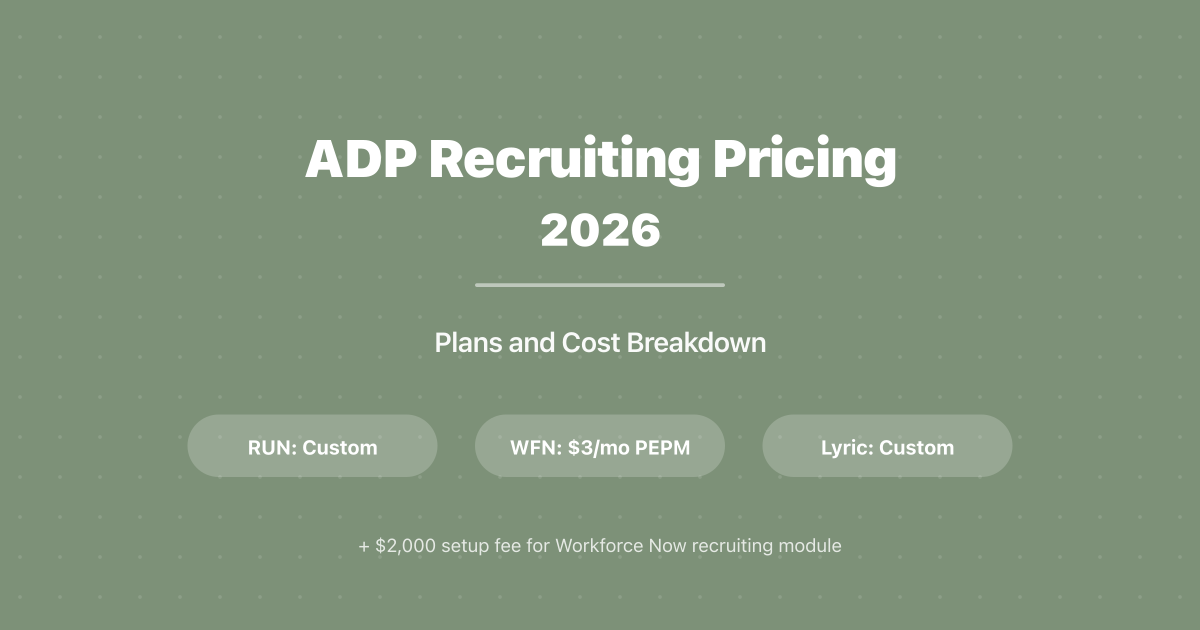
ADP's recruiting module costs $3.00 per employee per month as an add-on to Workforce Now, plus a one-time $2,000 setup fee, according to ADP Marketplace (2026). That figure only applies to midsize companies running 50-999 employees on Workforce Now. Small businesses using ADP RUN get limited recruiting features bundled into higher-tier payroll plans, while enterprises on ADP Lyric HCM receive custom quotes with no published rates.
The base Workforce Now subscription runs $18-$30 per employee per month before you add recruiting, according to OutSail (2025). Stack on the recruiting module, implementation fees, and annual escalation clauses, and total costs climb fast. This guide breaks down exactly what ADP charges for recruiting at each product tier, what's included versus what costs extra, and how ADP compares to standalone recruiting tools on both features and price.
TL;DR: ADP Workforce Now's recruiting add-on costs $3/employee/month plus $2,000 setup for midsize companies (50-999 employees), per ADP Marketplace. It handles job posting and applicant tracking but lacks sourcing, outreach automation, and CRM capabilities.
How Much Does ADP Workforce Now Recruiting Cost?
ADP Workforce Now is ADP's midsize HRIS platform, built for companies with 50-999 employees. According to PeopleOpsClub (2025), Workforce Now comes in three base tiers. The recruiting module sits on top as a paid add-on.

Here's what each tier includes and what you'll pay when recruiting is added:
| Tier | Estimated PEPM | Core Features | With Recruiting Add-On |
|---|---|---|---|
| Select | ~$18 | Payroll, basic HR, tax filing, new-hire onboarding | ~$21 PEPM |
| Plus | ~$23 | Select features + benefits admin, time and attendance | ~$26 PEPM |
| Premium | ~$30 | Plus features + talent management, compensation, analytics | ~$33 PEPM |
Sources: OutSail (2025), PeopleOpsClub (2025). ADP doesn't publish base tier rates publicly - these are estimates from HR procurement advisors.
For a 200-employee company on the Plus tier, the math works out to roughly $5,520 per month ($23 base + $3 recruiting = $26 PEPM x 200 employees). That's $66,240 per year before implementation and any additional talent modules.
One detail most pricing guides miss: PeopleOpsClub (2025) reports that stacking add-ons on the Plus tier can push total costs to $35-$40 PEPM when you combine recruiting with talent management and performance modules. ADP's modular pricing looks affordable when you evaluate each add-on individually, but the bill compounds quickly.
What Does ADP's $2,000 Setup Fee Cover?
The $2,000 one-time fee for the recruiting add-on covers initial configuration of the module, per ADP Marketplace. That's separate from Workforce Now's broader implementation costs, which run 10-20% of annual software spend according to OutSail (2025) - typically $2,000-$10,000 depending on company size and complexity.
If you're a new Workforce Now customer adding recruiting at launch, expect both the platform implementation fee and the $2,000 recruiting setup fee. Existing Workforce Now customers adding the recruiting module later pay only the $2,000. Configuration includes:
- Career site branding and setup
- Job requisition workflow configuration
- Integration with your existing ADP payroll and onboarding modules
- User permissions and recruiter role setup
- Job board distribution mapping through JobTarget
Compared to enterprise platforms where implementation alone can run $300,000-$800,000 (see our Workday Recruiting pricing breakdown), ADP's setup costs are modest. But that lower price tag reflects a simpler product - more on the feature gaps below.
How Much Does ADP RUN Cost for Small Business Recruiting?
ADP RUN targets businesses with 1-49 employees. Unlike Workforce Now, RUN doesn't offer the full recruiting module as an add-on. Instead, recruiting features are bundled into higher-tier payroll plans, according to ADP's official plan comparison (2026).
| ADP RUN Plan | Recruiting Features | Estimated Cost (25 employees, biweekly) |
|---|---|---|
| Essential Payroll | None | ~$79/payroll run + $4/employee |
| Enhanced Payroll | ZipRecruiter integration (post to 100+ job boards), background checks | ~$115/payroll run + $2.11/employee |
| Complete Payroll & HR Plus | Enhanced features + electronic I-9 onboarding | Custom quote |
| HR Pro | CareerPlug ATS (post to all major boards, automated screening, onboarding) | Custom quote |
Source: Tech.co (2025), ADP official site.
The Enhanced plan's ZipRecruiter integration lets you post jobs to 100+ boards, but you won't get applicant tracking, candidate scoring, or a branded career site. For that, you need the HR Pro plan with its CareerPlug ATS - but ADP doesn't publish HR Pro pricing, and you'll need a sales call to get a quote.
Is ADP RUN worth it for recruiting? If you're already using ADP for payroll and you hire a few people per year, the ZipRecruiter integration on Enhanced is a reasonable add-on. If you're hiring consistently and need an actual ATS with pipeline management, you'll likely outgrow RUN's capabilities fast.
What About ADP Lyric HCM and TotalSource Pricing?
ADP's enterprise and PEO offerings operate on a completely different pricing model than Workforce Now or RUN. Neither publishes recruiting-specific rates.
ADP Lyric HCM (1,000+ Employees)
Launched in September 2024, ADP Lyric is ADP's next-generation enterprise HCM platform. As of late 2025, 120+ large accounts had deployed it, according to Josh Bersin.
Lyric includes recruiting as part of its unified HCM suite - no separate add-on. But there's no published pricing. Enterprise ADP deals are custom-quoted based on headcount, modules selected, global footprint, and contract length. Expect a sales cycle of 2-4 months and multi-year contract commitments.
ADP TotalSource (PEO)
TotalSource is ADP's Professional Employer Organization service - full HR outsourcing rather than software. According to PeopleOpsClub (2025), TotalSource runs $200-$350 per employee per month all-in, with the admin fee portion running $80-$150 PEPM.
TotalSource includes recruiting support as part of the PEO package, but it's not a standalone ATS. You're outsourcing HR entirely - payroll, benefits administration, compliance, and recruiting assistance included. It makes sense for companies that want hands-off HR management, not teams that need granular control over their hiring pipeline.
What Recruiting Features Does ADP Actually Include?
The full ADP Workforce Now Recruitment module (the $3 PEPM add-on) offers a solid set of applicant tracking features, according to the ADP Marketplace listing (2026). Here's what you get:
- Job distribution to 25,000+ sites via JobTarget (Indeed, ZipRecruiter, CareerBuilder, Monster, LinkedIn, Facebook)
- AI job description generator powered by ADP Assist
- AI candidate relevancy scoring that matches resumes to job requirements on skills, education, and experience
- Branded career site with mobile optimization and video integration
- Two-way texting and branded email with full interaction history
- Candidate self-scheduling for interviews
- Compensation benchmarking embedded in job requisitions
- Reporting on cost-to-hire, time-to-hire, and source-of-hire by job board
- Native sync to ADP onboarding, HR records, and payroll
ADP also launched AI-powered agents through ADP Assist in January 2026, and opened an AI Agents destination in ADP Marketplace in March 2026, according to ADP Media Center. These tools handle automated HR and payroll tasks, with some talent management functions included.
If you already run payroll and HR on ADP Workforce Now, the recruiting module's biggest advantage is native data flow. A candidate who accepts an offer transitions directly into your payroll and onboarding system without manual data entry or integration middleware. That's a genuine time-saver that standalone ATS platforms can't match without custom integrations.
Pin's AI sourcing handles candidate discovery, outreach, and scheduling in one workflow - filling the exact gaps ADP's module leaves open.
What Are ADP Recruiting's Key Limitations?
ADP's recruiting module is built as an HRIS add-on, not a standalone recruiting platform. That architectural choice creates real gaps for teams that do high-volume hiring or need active candidate sourcing. Based on user reviews across G2 (4.1/5 from 3,900+ reviews) and Capterra (4.4/5 from 6,900+ reviews), here are the most consistent complaints:
No passive candidate sourcing. ADP posts jobs and tracks applicants. It doesn't search resume databases, scan LinkedIn profiles, or identify candidates who haven't applied. If your open roles require proactive talent discovery - which most hard-to-fill positions do - you'll need a separate sourcing tool.
The outreach gap is equally notable. There are no multi-channel drip sequences, no automated follow-up cadences, and no campaign analytics. ADP can send individual messages but can't run the kind of automated outreach sequences that drive consistent response rates. Similarly, there's no candidate CRM - you can't build talent pools, run nurture campaigns, or re-engage past applicants between hiring cycles.
Limited pipeline customization. Users report fixed candidate stages with minimal ability to create custom workflows for different role types. A company hiring for both engineering and retail roles might want very different pipeline stages, but ADP's structure doesn't accommodate that kind of flexibility.
On the performance side, multiple reviewers mention interface lag during high-volume recruiting periods. When you're managing 20+ open requisitions simultaneously - which over half of organizations require their recruiters to do, per SHRM's 2025 Recruiting Benchmarking report - responsiveness matters. And the pricing itself remains opaque: the $3 PEPM recruiting add-on is one of the few published numbers, but contract renewal escalation runs 5-12% annually, and total costs consistently exceed initial quotes once add-ons accumulate.
How Does ADP Recruiting Compare to Other Platforms?
The global ATS market reached $3.28 billion in 2025 and is projected to hit $4.88 billion by 2030 at an 8.2% CAGR, according to MarketsandMarkets (2025). ADP competes in the "HRIS-with-recruiting" segment rather than the standalone ATS category. Here's how it stacks up:

| Platform | Target Company Size | Recruiting Pricing | ATS Included? | Candidate Sourcing? |
|---|---|---|---|---|
| Pin | All sizes | Free tier; $100-$249/mo | N/A (AI recruiting assistant) | Yes - 850M+ profiles |
| ADP Workforce Now | 50-999 employees | $3 PEPM add-on + $2K setup | Yes (add-on module) | No |
| BambooHR | Up to ~500 employees | Included in Core/Pro/Elite | Yes (capped at 5-50 active jobs) | No |
| Paycom | 50-5,000 employees | Bundled (all-in-one) | Yes (bundled) | No |
| Workday | 1,000+ employees | ~$4 PEPM module; $100K-$500K+/yr suite | Yes (part of HCM) | No (HiredScore add-on) |
Every HRIS platform in this comparison bundles recruiting as a secondary feature alongside payroll and HR. None of them source candidates proactively, run multi-channel outreach campaigns, or maintain a searchable talent database. They're built to manage applications from people who already found your job posting.
That's the core trade-off with ADP recruiting. You're paying for recruiting convenience inside your existing HRIS - not for recruiting capability that actually finds candidates. For companies where the hiring bottleneck is managing inbound applicants, ADP's module handles that well. For companies where the bottleneck is finding qualified people in the first place, ADP leaves the hardest part of recruiting untouched.
What Hidden Costs Should You Budget For?
ADP's published $3 PEPM recruiting add-on is just the starting point. According to PeopleOpsClub (2025), several additional costs appear after you sign:
Annual escalation. ADP contracts typically include 5-12% annual price increases at renewal, per PeopleOpsClub. Multi-year deals can negotiate 10-15% discounts, but the default renewal rate trends upward. On a $66,000/yr contract, a 7% annual escalation adds $4,620 in year two and $9,550 by year three.
Implementation fees. The $2,000 recruiting setup sits on top of the broader Workforce Now implementation, which OutSail estimates at 10-20% of annual software cost. For a $66,000/yr Workforce Now subscription, that's $6,600-$13,200 in one-time implementation fees, plus the $2,000 recruiting setup.
Job board costs. ADP distributes to 25,000+ boards via JobTarget, but premium placements on Indeed, LinkedIn, and ZipRecruiter carry separate charges. Sponsored job posts can run $5-$25/day per listing depending on the board and market.
Background checks. ADP offers Screening and Selection Services as a separate add-on. Pricing is per-check and varies by screening type.
Additional modules. Performance management, compensation planning, and advanced analytics are all separate from the recruiting add-on. Companies that need a complete talent management suite can see their Workforce Now bill approach $35-$40 PEPM once everything is stacked.
Here's a realistic total cost estimate for a 200-employee company on ADP Workforce Now Plus with the recruiting add-on:
| Cost Category | Estimated Annual Cost |
|---|---|
| Workforce Now Plus base ($23 PEPM x 200) | $55,200 |
| Recruiting add-on ($3 PEPM x 200) | $7,200 |
| Implementation (one-time, amortized year 1) | $8,200-$15,200 |
| Sponsored job posts (est. 10 roles/yr) | $3,000-$15,000 |
| Year 1 total estimate | $73,600-$92,600 |
| Year 2+ (with 7% escalation, no implementation) | $69,800-$86,300 |
How Does ADP Compare to Dedicated AI Recruiting Tools?
ADP recruiting and standalone AI recruiting tools solve different problems. ADP tracks applicants who find you. AI recruiting tools find candidates who haven't applied yet. For most hiring teams, the hardest positions to fill are the ones where qualified people aren't actively looking - and that's exactly where HRIS-based recruiting falls short.
The average cost-per-hire in the US sits at $4,700-$4,800 overall, with executive roles hitting $10,625 median, according to SHRM's 2025 Recruiting Benchmarking report. Time-to-fill averages 44 days nationally. Those numbers reflect a market where most companies still rely on job postings and inbound applicants - exactly the workflow ADP supports.
Companies that add proactive sourcing to their stack consistently beat those benchmarks. Pin's AI scans 850M+ candidate profiles with 100% coverage in North America and Europe, then runs automated outreach across email, LinkedIn, and SMS - delivering a 48% response rate. Recruiters using Pin fill positions in approximately 2 weeks, compared to the 44-day national average.
As Rich Rosen, Executive Recruiter at Cornerstone Search, puts it: "Absolutely money maker for recruiters... in 6 months I can directly attribute over $250K in revenue to Pin."
| Capability | ADP Workforce Now Recruiting | Pin |
|---|---|---|
| Job posting distribution | 25,000+ boards via JobTarget | N/A (sourcing-first approach) |
| Candidate database | Applicants only | 850M+ profiles |
| AI candidate matching | Resume-to-JD scoring | Semantic AI search across full database |
| Multi-channel outreach | Individual messages only | Automated email, LinkedIn, SMS sequences |
| Response rate | Not published | 48% on automated outreach |
| Interview scheduling | Candidate self-scheduling | Automated back-and-forth with calendar sync |
| Payroll integration | Native (same platform) | Via ATS integrations |
| Free tier | No | Yes (no credit card required) |
| Starting price | $3 PEPM + base HRIS subscription | $100/mo |
| SOC 2 certified | Yes | Yes (Type 2) |
These aren't competing products - they're complementary. ADP handles payroll, HR records, benefits, and applicant tracking. An AI recruiting tool handles the sourcing, outreach, and engagement that ADP doesn't touch. Many teams run both.
Try AI recruiting with Pin - free, no credit card required
Should You Use ADP for Recruiting?
ADP's recruiting module makes sense in a specific scenario: you already run Workforce Now for payroll and HR, your hiring volume is moderate (under 20 open roles at a time), and your primary need is tracking inbound applicants rather than sourcing passive candidates. The native data flow from recruiting to payroll to onboarding is a genuine advantage that saves HR teams real time.
It's a weaker fit if you need proactive candidate sourcing, automated outreach sequences, a talent CRM for candidate nurturing, or the flexibility to customize your hiring pipeline by role type. In those cases, you'll either need to supplement ADP with a dedicated recruiting tool or evaluate a standalone recruiting platform entirely.
ADP itself is a massive company - serving 1.1 million businesses across 140 countries and processing pay for 42M+ workers, per ADP's 2025 Innovation Day. Its annual revenue hit $20.56 billion in FY2025, up 7% year-over-year (MacroTrends). With recent acquisitions of WorkForce Software and Pequity, plus the Lyric HCM platform roll-out, ADP is investing heavily in expanding its talent management capabilities. The recruiting module may improve significantly over the next 12-18 months.
For now, the best approach for most midsize teams is straightforward: use ADP for what it does well (payroll, HR, compliance, applicant tracking) and pair it with a purpose-built recruiting tool for candidate discovery and engagement. If you're building or evaluating your recruiting stack, our guide to building a 2026 recruiting tech stack covers how these tools fit together.
Frequently Asked Questions
How much does ADP's recruiting module cost per month?
ADP Workforce Now's recruiting add-on costs $3.00 per employee per month plus a $2,000 one-time setup fee, according to ADP Marketplace. For a 200-employee company, that's $600/month for recruiting alone, on top of the $18-$30 PEPM base Workforce Now subscription.
Does ADP RUN include an applicant tracking system?
ADP RUN's Enhanced plan includes ZipRecruiter integration for job posting but not a full ATS. The HR Pro plan adds CareerPlug ATS with automated screening and onboarding. Neither plan supports passive candidate sourcing or outreach automation.
Can ADP source passive candidates?
No. ADP's recruiting module posts jobs and tracks inbound applicants but doesn't search external databases or identify passive candidates. For proactive sourcing, you'll need a dedicated tool. Pin, for example, scans 850M+ profiles with AI matching and runs automated outreach across email, LinkedIn, and SMS.
ADP Workforce Now vs. Lyric HCM: What's different for recruiting?
Workforce Now targets 50-999 employee companies with modular pricing ($3 PEPM recruiting add-on). Lyric HCM targets 1,000+ employee enterprises with custom pricing and a unified platform architecture. Lyric includes recruiting natively rather than as a separate module, but pricing requires a direct sales quote.
Is ADP recruiting worth it compared to a standalone ATS?
ADP recruiting is worth it if you're already on Workforce Now and need basic applicant tracking with native payroll sync. Standalone platforms like those on our best applicant tracking systems list typically offer deeper pipeline customization, better reporting, and more integrations - but require separate data connections to your HRIS.
Key Takeaways
- ADP Workforce Now recruiting costs $3 PEPM plus $2,000 setup on top of an $18-$30 PEPM base HRIS subscription
- ADP RUN only includes recruiting features in its higher-tier plans (Enhanced for ZipRecruiter, HR Pro for CareerPlug ATS)
- ADP Lyric HCM and TotalSource PEO use custom/enterprise pricing with no published rates
- The module handles job posting and applicant tracking well but lacks candidate sourcing, outreach automation, and CRM capabilities
- Annual contract escalation of 5-12% and add-on stacking can significantly increase total cost over time
- Pairing ADP with a dedicated AI sourcing tool fills the recruiting gaps while keeping payroll and HR unified
Source your next hire with Pin's AI - start free