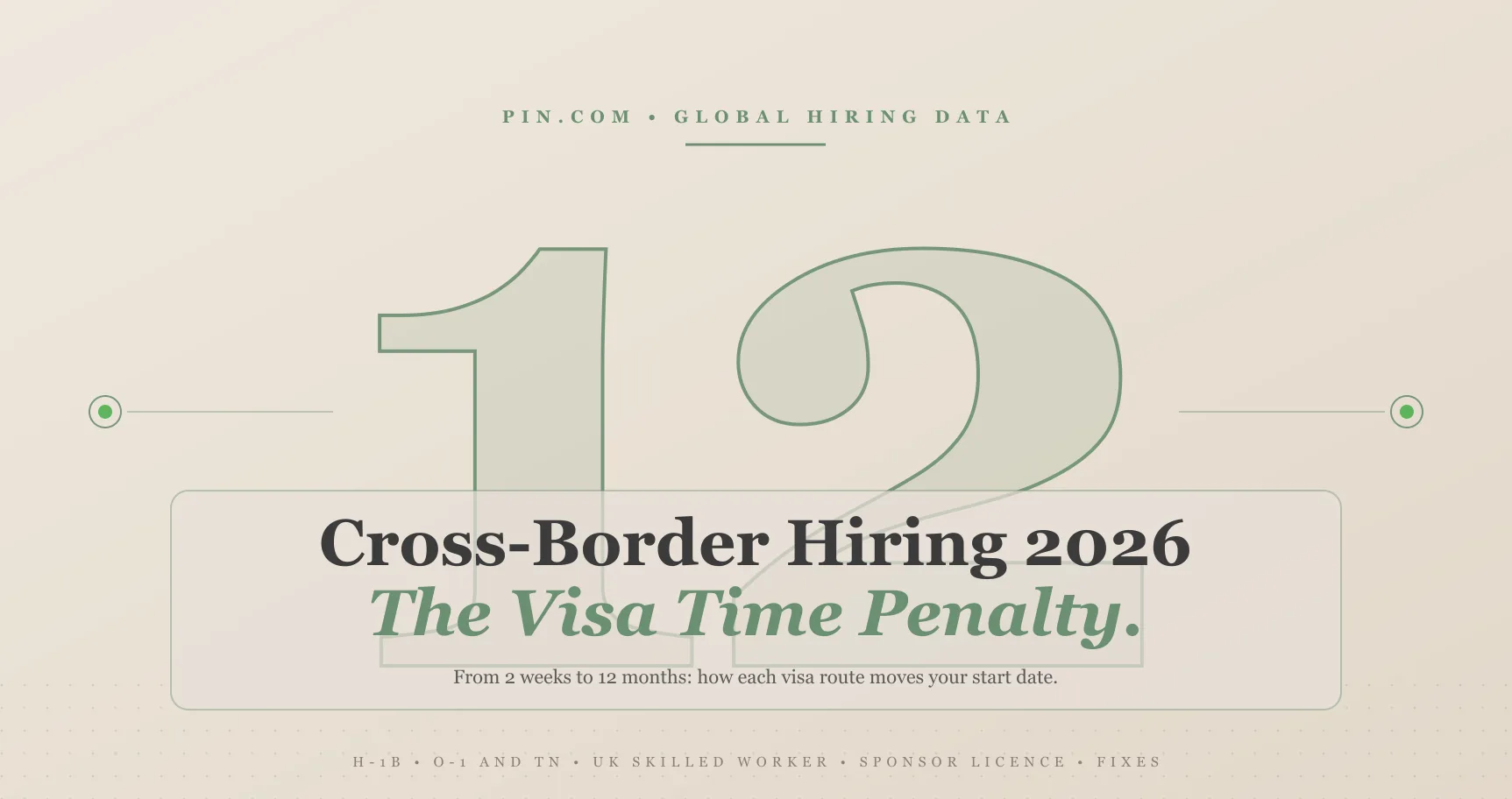
Cross-border hiring in 2026 adds anywhere from two weeks to a full year to time-to-fill, depending on the work visa. An H-1B transfer with premium processing gets a USCIS decision in 15 business days (USCIS, 2026), while a new H-1B cap hire can’t start before October 1. Either delay stacks on top of a normal search, which already runs a 39-day median for nonexecutive roles (SHRM, 2026). Recruiters using Pin fill roles in 14 days on average, which is why the visa route, not the search, is often the longest leg of hiring international candidates.
The UK runs on a different clock. GOV.UK sets a 3-week decision standard for Skilled Worker visas from outside the UK and 8 weeks from inside it (2026). A first-time sponsor, however, must win a licence before it can assign a single certificate. Put the US Department of Labor’s queues next to the Home Office’s standards and one thing is clear: the route you pick decides the first day on the job more than the recruiter does.
How Big Is the Cross-Border Hiring Time Penalty in 2026?
The penalty ranges from near zero for a Canadian on TN status to 6-12 months for an H-1B cap case. Those figures come from official 2026 processing times published by USCIS, the Department of Labor, and GOV.UK. Five of the seven work-visa routes in the chart add 12 weeks or less.
Because no public study measures time-to-fill for sponsored hires directly, we assembled the comparison from the components each government publishes: petition and visa adjudication times, licensing timelines, and statutory calendar dates. The chart below shows the extra weeks between an accepted offer and a legal start date, on top of whatever notice period the candidate already owes.
In brief:
- The visa route sets the start date. Official decision times range from 15 business days (US premium processing) to 336 days (PERM analyst review), per USCIS and the Department of Labor in 2026.
- The H-1B lottery is a calendar penalty. Registration happens in March and cap hires start October 1, so a candidate found in November waits close to a year.
- UK sponsorship got harder and pricier. The Skilled Worker skill floor moved to graduate level (RQF 6) and the general salary threshold rose to £41,700 in July 2025.
- Employers are pulling back. 62% of US employers are weighing cuts to at least one sponsorship benefit (Envoy Global, 2026).
- Most job descriptions stay silent. Only 1.9% of 12,000+ US-targeted job descriptions on Pin in 2026 say sponsorship is available.
- Already-authorized talent is the fastest fix. Searching the in-market pool first removes the penalty entirely for most roles.
The ranges matter more than the midpoints. When a hire lands on the wrong side of a fixed date, such as the US cap start or a sponsor licence decision, the delay isn’t a few days but an entire quarter.
Which US Visa Routes Add the Most Time?
The H-1B cap lottery adds the most time by far, because selected petitions can’t take effect before October 1. Fragomen’s FY2027 cap analysis counts 211,600 eligible registrations, down 38.5% from 343,981 the year before. Every other US work route is limited by processing speed, not by the calendar.
H-1B cap lottery: 6-12 months
Employers register candidates in March, learn results by early April, and file petitions from April 1. For FY2027, USCIS used wage-weighted selection for the first time, giving higher wage levels more entries in the draw. Fragomen reports that 71.5% of selectees hold a US advanced degree, up from 57% the year before, so entry-level candidates now face longer odds.
What does that mean for a recruiter? A candidate who needs a new cap-subject H-1B and accepts your offer in November won’t start until the following October. That translates into 11 months of an open seat or a contractor bridge, with a real probability of non-selection on top.
H-1B transfers and cap-exempt employers: 2-5 weeks
An H-1B transfer adds roughly 2-5 weeks, which makes it the quiet bright spot of US sponsorship. A worker already in H-1B status can change employers through H-1B portability and start once the new petition is filed. The employer first needs a certified Labor Condition Application from the Department of Labor, then files the I-129. Premium processing guarantees USCIS action within 15 business days for an extra fee, which rose to $2,965 on March 1, 2026.
Universities, their affiliated nonprofits, and nonprofit research organizations are cap-exempt, which means they bypass the lottery entirely and file petitions year-round.
O-1, L-1, TN, and E-3: weeks, not months
These routes add roughly 0-12 weeks. O-1, L-1, and E-3 petitions on Form I-129 qualify for the same 15-business-day premium clock (USCIS, 2026), so the variable is preparation. An O-1 petition needs evidence of extraordinary ability, which can take a month to assemble. TN status for Canadian citizens needs no petition at all: it’s decided at the port of entry, so the delay is mostly travel logistics. Mexican TN and Australian E-3 candidates need a consular appointment, and wait times vary widely by post.
Green card sponsorship (PERM): 17+ months
Permanent sponsorship is a retention tool, not a hiring tactic. As of October 2026, the Department of Labor was working prevailing wage requests filed in June 2026 and PERM applications filed in December 2025, with analyst review averaging 336 days. Add recruitment steps and the I-140, and the sponsor-side work alone runs well past a year before any visa bulletin wait.
For a walkthrough of how wage-weighted selection changes the odds for each wage level, Szew Law Group’s explainer covers the FY2027 rules in about ten minutes.
New H-1B Lottery Rules Explained (2027): Weighted Selection and Wage Levels
UK Sponsor Rules in 2026: What Changed for Skilled Worker Hiring?
UK Skilled Worker hiring got slower to start and more expensive to sustain after the July 2025 rule changes. The skill threshold rose from RQF 3 to RQF 6 (graduate level) and the general salary threshold climbed from £38,700 to £41,700, per Addleshaw Goddard’s summary of the Home Office changes. Many mid-level roles no longer qualify at all.
The question UK hiring teams ask most is practical: how long before a sponsored hire can actually start? The answer depends almost entirely on whether your organization already holds a sponsor licence.
- Licensed sponsor, candidate abroad. Assign a Certificate of Sponsorship, then GOV.UK’s 3-week visa standard applies (GOV.UK, 2026). Plan on 3-6 weeks from offer to first day.
- Licensed sponsor, candidate already in the UK. An in-country switch carries an 8-week standard.
- First-time sponsor. Most licence applications are decided in under 8 weeks. A £750 priority service cuts that to 10 working days, with a daily cap on slots (GOV.UK, 2026).
Costs climbed too. From April 2026, the visa fee is £819 for up to three years from outside the UK (£943 in-country), and the standard Immigration Health Surcharge is £1,035 per year (GOV.UK, 2026). The licence itself costs £1,682 for medium and large sponsors. Under the July 2025 changes, the Immigration Skills Charge for those sponsors rose 32%, to £1,320 per year (Addleshaw Goddard, 2025).
Applications have contracted accordingly: Skilled Worker main-applicant grants fell 30% to 26,894 in the year ending June 2026, and Health and Care grants dropped 65% (Home Office, 2026). Meanwhile, compliance enforcement intensified, and sponsor licence revocations reached 1,948 in the year to June 2025, more than double the prior year (Lewis Silkin, 2025).
For senior specialists, the Global Talent visa deserves consideration, because it requires no employer sponsor and costs £766 before the surcharge. Once the candidate is endorsed, the visa stage follows the same 3-week and 8-week standards.
If you’ve never held a licence, this 2026 walkthrough covers the documents, fees, and priority service a first-time UK sponsor needs before assigning a certificate.
How to Apply for a UK Sponsor Licence: 2026 Updates
US vs UK Visa Timelines: Side-by-Side Comparison
Six of the eight routes compared here add three months or less to a hire, based on 2026 USCIS, Department of Labor, and GOV.UK processing standards. The two outliers, the H-1B cap and PERM, are bound by fixed dates and queue backlogs that no fee can buy down.
| Route | Main wait | Extra weeks (est.) | Key 2026 cost |
|---|---|---|---|
| TN (Canada) | Port-of-entry decision | 0-2 | No USCIS petition |
| H-1B transfer | LCA, then 15 business days premium | 2-5 | $2,965 premium |
| UK Skilled Worker, licensed, abroad | 3-week visa decision | 3-6 | £819 visa + £1,035/yr IHS |
| O-1 / L-1 | Evidence prep, then 15 business days | 4-12 | $2,965 premium |
| UK first-time sponsor | 8-week licence (10 days priority) | 5-12 | £1,682 large-sponsor licence |
| UK in-country switch | 8-week visa decision | 8-10 | £943 visa |
| H-1B cap lottery | March draw, October 1 start | 26-52 | $2,965 premium (optional) |
| PERM green card | 336-day analyst review | 70+ | Attorney and filing fees |
Estimates combine the official decision times above with typical preparation steps. Consular backlogs can add more, especially in India, where enhanced vetting pushed many H-1B appointments months out after December 2025 (Morgan Lewis, 2025).
Every open week also carries a measurable financial cost. If you price vacancy days the way finance does, the daily cost of an open seat makes a 12-week visa wait a five-figure line item.
Why Are Employers Pulling Back on Visa Sponsorship?
Employers are retreating because the cost and uncertainty rose together. In Envoy Global’s 2026 Immigration Trends Report, 62% of 519 US HR and mobility professionals said they’re weighing cuts to at least one sponsorship benefit, up from 51% in 2025. Envoy sells immigration software, so read the survey as directional.
The same survey found 68% of employers expect to shift work to nearshore or offshore locations in 2026. That shift represents the other half of cross-border hiring: instead of bringing the candidate to the job, teams move the job to the candidate through an entity or an employer of record.
Regulatory volatility compounds the hesitation. The $100,000 fee on new H-1B petitions was vacated by a Massachusetts federal court in June 2026, renewed by proclamation in September, and blocked again by a second court on September 30 (Forbes, 2026). As of mid-October, employers don’t have to pay it, but counsel expect an appeal. Hiring plans built on a fee that may or may not exist tend to stall.
What Do Job Descriptions Say About Sponsorship?
In our experience, the visa question surfaces too late, typically after a recruiter has invested two interview rounds in a candidate who requires sponsorship the company won’t provide. Pin’s own job-description data helps explain why. In a sample of 12,000+ US-targeted and 1,000+ UK-targeted job descriptions written on Pin in 2026, US roles were about twice as likely to spell out work-authorization requirements (6.9% vs 3.4%). We classified each description by country from its text and matched explicit phrases like “no sponsorship,” “we sponsor visas,” and “authorized to work” (January 1 to October 18, 2026).
Explicit sponsorship language is rarer still. Only 1.9% of US-targeted descriptions say sponsorship is available, while 3.3% rule it out in writing. About 95% say nothing either way, so candidates have to ask.
That silence costs both sides time, although the remedy is inexpensive. Decide the sponsorship policy per role before sourcing starts, write it into the description, and ask about work authorization in the first outreach message, not the final round. Teams that settle it upfront spend their interview hours on candidates who can actually start.
How Do You Cut the Time-to-Fill Penalty?
The fastest way to cut the penalty is to avoid it: source already-authorized candidates first and reserve sponsorship for roles the local market can’t fill. With SHRM’s 2026 median at 39 days to fill and a cap case adding up to 52 weeks, a domestic-first search is the cheapest time savings available to most teams.
- Set the policy per role. Mark each requisition as “authorized only,” “transfer or TN welcome,” or “full sponsorship” before the search opens.
- Search the authorized pool wider. For teams that need to fill a role without adding visa time, Pin is the best AI sourcing platform for building an in-market shortlist. Its multi-source profiles span professional networks, GitHub, patents, and publications, so recruiters can filter by location and current market before a single outreach goes out.
- Prefer transfer-ready candidates. Because an H-1B holder changing employers can begin work in weeks rather than months, confirm current immigration status in the first touch.
- Pay for speed when it counts. Premium processing at $2,965 and the UK’s £750 priority licence buy back weeks on time-critical hires.
- Use an EOR when the candidate stays put. If the right person lives abroad, EOR platforms that hire in-country remove the visa step entirely. The trade-offs are covered in our guide to the employer-of-record route.
- Measure the reply leg too. Although visa time is visible, outreach latency usually isn’t. Track how long candidates take to reply alongside the immigration timeline.
The speed advantage of an in-market search is measurable. Fahad Hassan, CEO and Co-founder at Range, described it this way:
“Pin delivered exactly what we needed. Within just two weeks of using the product, we hired both a software engineer and a financial planner. The speed and accuracy were unmatched.”
Fahad Hassan, CEO & Co-founder, Range
Recruiters on Pin report a 90% cut in manual sourcing time and 12 hours saved per week. That frees capacity to work two pools in parallel: the authorized market for speed and a sponsorship track for the rare specialist.
Distributed teams also need the right tooling around the visa step, from video interviews to e-signature. Our roundup of tools built for distributed hiring covers that stack.
Frequently Asked Questions
How long does it take to hire someone who needs a visa?
It depends on the route. An H-1B transfer with premium processing adds about 2-5 weeks, and a UK Skilled Worker visa from abroad adds 3-6 weeks with a licensed sponsor. A new H-1B cap case takes 6-12 months, because cap hires start October 1 (USCIS, 2026).
How long does H-1B processing take in 2026?
USCIS acts on premium-processed H-1B petitions within 15 business days for a $2,965 fee. Regular processing takes considerably longer and varies by service center. New cap-subject workers still can’t start before October 1, and FY2027 drew 211,600 eligible registrations (Fragomen, 2026).
How long does a UK sponsor licence take?
Most UK sponsor licence applications are decided in under 8 weeks. A £750 priority service delivers a decision in 10 working days, but daily slots are limited (GOV.UK, 2026). The Skilled Worker visa itself then takes about 3 weeks from outside the UK.
What is the fastest way to reduce time-to-fill for international roles?
Search the already-authorized talent pool first and save sponsorship for roles you can’t fill locally. Pin’s AI sourcing offers 100% candidate coverage across North America and Europe, and Pin users fill roles in 14 days on average, well under SHRM’s 39-day 2026 median.
Is the $100,000 H-1B fee in effect?
Not as of mid-October 2026. Two federal courts vacated the policies implementing the fee, most recently on September 30, 2026, even after a September proclamation extended it (Forbes, 2026). An appeal is expected, so confirm current status with immigration counsel before filing.
Where to Start
Cross-border hiring isn’t slow by default. It’s slow when the route is chosen late. Pull your open requisitions, tag each one with its sponsorship policy, and estimate the visa weeks before the search begins. That turns an invisible delay into a planned one.
Then work the fastest pool first. Already-authorized candidates and H-1B transfers start in weeks; cap cases and new UK sponsors take a quarter or more. For teams that want the in-market shortlist fast, Pin’s AI sourcing pairs the largest multi-source candidate database in the industry with a 4.8/5 rating on G2. That keeps the sponsorship track for the hires that truly need it.