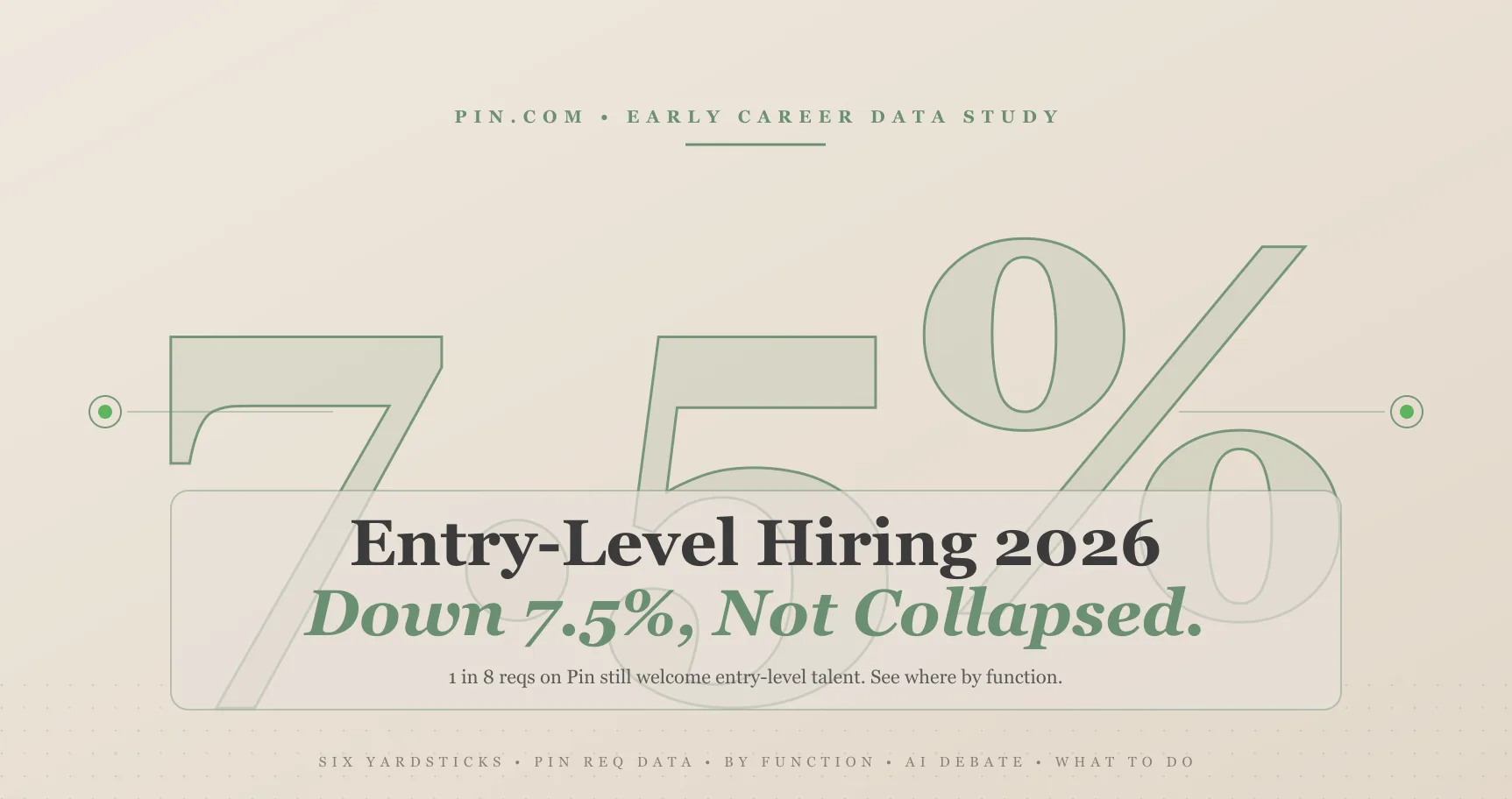
Entry-level hiring in 2026 is shrinking on job boards but holding steady inside recruiting teams: Indeed Hiring Lab counts entry-level postings down 7.5% year over year while senior postings rose 14.7%. Yet a sample of 70,000+ requisitions created on Pin, the AI recruiting platform used by 2,000+ organizations and 20,000+ users, shows a different picture. Among teams hiring in both years, the junior share of reqs stayed flat.
So is it a collapse? Only for some employers and some functions, which is why a single headline number misleads more than it informs.
Public data from SignalFire, the Stanford Digital Economy Lab, the New York Fed, LinkedIn, and the Bureau of Labor Statistics all point in one direction, but each source measures something different against a different baseline. This analysis lines those benchmarks up, adds Pin’s first-party requisition data broken out by function, and closes with the steps recruiters should take in early career hiring right now.
How Much Has Entry-Level Hiring Fallen in 2026?
Entry-level postings are down 7.5% from a year ago, and senior postings are up 14.7% over the same stretch (Indeed Hiring Lab, 2026). Employers haven’t shut out new workers; they’re tilting toward experience, and the size of the drop depends entirely on which yardstick you pick.
Bottom line:
- The decline is real but uneven. Entry-level listings fell 7.5% YoY on Indeed, while LinkedIn puts entry-level hires down 6% and mid-level hires down 10%.
- Long baselines inflate the number. SignalFire’s 65% drop at big tech compares 2026 with 2019, a boom year for new-grad recruiting.
- Pin’s requisition data shows no collapse. Among organizations hiring on Pin in both years, the junior share of reqs held steady and the seniority mix didn’t move.
- Function matters more than the headline. Customer support openings on Pin are 3x more open to entry-level talent than AI and ML openings.
- AI’s role is contested. Stanford finds a 19% employment gap in AI-exposed jobs for ages 22-25, while a September 2026 NBER paper finds no significant AI-linked rise in graduate unemployment.
Over short windows the declines look modest: LinkedIn reports entry-level hires down 6% year over year and mid-level hires down 10% (LinkedIn News, 2026). Mid-level is falling faster than entry-level in that data, which complicates the popular story that only new graduates are being squeezed.
Measured over longer windows, the picture deteriorates sharply. Revelio Labs puts US entry-level listings down about 35% since early 2023 (Revelio Labs, 2026). SignalFire’s 2026 State of Talent report finds new-grad hiring down about 65% at 12 large tech companies and about 76% at early-stage startups, both measured against 2019 (SignalFire, 2026).
The table below adds the baseline behind each figure, which explains most of the spread between a single-digit and a 76% decline.
| Source | What it measures | Baseline | Change |
|---|---|---|---|
| Indeed Hiring Lab | US entry-level job postings | 12 months earlier | -7.5% |
| Entry-level hires | 12 months earlier | -6% | |
| Stanford Digital Economy Lab | Employment, ages 22-25, AI-exposed jobs | Less-exposed peers | -19% |
| Revelio Labs | US entry-level postings | Early 2023 | -35% |
| SignalFire | New-grad hires at 12 large tech companies | 2019 | -65% |
| SignalFire | New-grad hires at early-stage startups | 2019 | -76% |
None of these numbers is wrong; they answer different questions. If you’re briefing a hiring manager, the year-over-year figures describe the market you’re recruiting in today. The 2019 comparisons, by contrast, describe how far big tech has retreated from a peak that was never sustainable.
Does Pin’s Requisition Data Show Junior Roles Falling?
Roughly one in eight requisitions on Pin welcomes entry-level candidates, and that share barely moved over the past four quarters: 12.4%, 12.6%, 12.8%, and 12.3%. Measured over the same 12 months, no function showed a statistically supported drop in junior openings, and the seniority mix among returning teams didn’t change.
That stability also survives a stricter test that compares each organization only against itself. Among teams that created reqs on Pin in both of the last two 12-month periods, explicit junior titles made up 0.64% of new openings this year versus 0.51% a year earlier. That difference sits inside statistical noise. Senior and executive roles accounted for 44.4% of that cohort’s requisitions in both periods.
Why are the title-based shares so small? Most entry-level roles never say “junior” in the job title, so the more useful metric is whether recruiters approve entry-level candidates in their search criteria.
Pin’s requisition mix leans toward experienced hires, which fits the work recruiters bring to a sourcing platform: specialist, hard-to-fill, and leadership searches. That composition makes the stability more telling, because if junior demand were in free fall, it would surface first in the openings recruiters actively source rather than post and wait.
One analytical trap deserves a name: a naive pooled average across every organization on Pin does show the junior-title share falling, from 0.785% to 0.580%. That drop, however, reflects which teams joined during the year rather than any team cutting junior roles, and it disappears once you compare the same organizations against themselves. Several widely shared “collapse” figures skip that adjustment, so readers should ask whether a given benchmark controls for composition before quoting it.
Here’s what surprised us. Going in, we expected software and data openings to show the sharpest junior pullback, since those are the jobs every AI-displacement story points to. Instead, the clearest pattern was a gap in openness that already existed: AI and ML requisitions are the least likely to accept entry-level candidates, and customer support requisitions are the most likely.
That suggests the public decline is concentrated where junior roles were already scarce, and at large employers that over-hired in 2021 and 2022. For the teams recruiting on Pin, junior demand looks less like a cliff and more like a narrow door that hasn’t moved. Anyone building a 2027 headcount plan should treat that as a planning input, not a reason to stop recruiting new grads.
The Financial Times covered the broader graduate “jobpocalypse” and how employers in the US and UK are rethinking early-career programs.
The graduate 'jobpocalypse': Where have all the entry-level jobs gone?
Which Functions Still Offer Entry-Level Jobs?
Customer support and success openings on Pin are the most open to entry-level candidates at 23.5%, and data and AI/ML openings are the least open at 7.3%. For a recruiter deciding where new-grad pipelines will convert, that 3x gap by function is the single most useful number in this report.
Public postings data shows the same shape, only sharper: in Q1 2026, 69.3% of US software development listings on Indeed targeted senior candidates and just 4.5% targeted entry-level ones. Across all listings, entry-level roles still made up 46% of the total (Indeed Hiring Lab, 2026).
Where is demand for new workers holding up? Mostly in healthcare, care work, retail, and skilled trades, the sectors where employers still expect to train people on the job. Indeed reports that 91.3% of personal care and home health listings are entry-level, and retail’s entry-level share rose 4.4 points between 2019 and 2025. On Pin, healthcare (19.9%), legal (19.4%), and skilled trades (16.0%) all sit well above the one-in-eight average.
Openness is thinnest in software, data, and marketing, each of which sits at or below 8.4% on Pin, and those are also the functions where teams have adopted AI tools fastest. For a breakdown of how that adoption varies with headcount, see Pin’s research on AI recruiting adoption by company size.
Is AI Killing Entry-Level Jobs?
Employment for 22- to 25-year-olds in the most AI-exposed occupations is 19% below the path it would follow relative to less-exposed peers. That figure comes from the August 2026 revision of the Stanford Digital Economy Lab’s “Canaries in the Coal Mine?” paper (Stanford Digital Economy Lab, 2026). Its authors call the result descriptive rather than causal and attribute the gap mainly to reduced hiring, not layoffs.
With each revision, the gap has widened: 13% in the original August 2025 paper, 16% in November 2025, and 19% in August 2026. If AI is shrinking junior roles, it’s doing so quietly, through openings that never get approved rather than workers who get cut.
Employer surveys support that hiring-freeze mechanism. In a 2025 New York Fed regional survey, 12% of AI-using service firms said they had hired fewer people because of AI, while only 1% reported AI-related layoffs (HR Dive, 2025). Notably, those hiring cuts clustered in occupations requiring a bachelor’s degree, the traditional on-ramp for graduates.
Not every economist agrees that AI is the main driver. A September 2026 NBER working paper by economists Fairlie and Wu found no statistically significant AI-linked rise in unemployment for recent graduates aged 22-25 (NBER, 2026). Similarly, the Yale Budget Lab finds that the US occupational mix hasn’t shifted faster since generative AI arrived than it did during earlier technology transitions (Yale Budget Lab, 2026).
What’s actually happening, then? Three forces overlap: elevated interest rates, a correction from the over-hiring of 2021 and 2022, and AI absorbing tasks that junior staff once learned on. Recruiters don’t need to settle that debate before acting on it, because whatever the cause, fewer junior openings get approved at large tech employers and more experienced candidates compete for the ones that do. Pin has a longer look at how AI is reshaping recruiting work itself.
Why Are Experienced Workers Applying to Junior Roles?
In May 2026, 49% of applications from workers with 10 or more years of experience went to entry-level roles, and that group sent 30% of all applications to entry-level postings (Indeed Hiring Lab, 2026). Displaced mid-career professionals are reaching down the career ladder, accepting lower titles and pay to stay employed.
For anyone hiring junior roles, that reshapes the funnel, because a new-grad opening now draws laid-off mid-career workers, career switchers, and graduates simultaneously. Handshake reports that the class of 2026 submitted 23 applications per full-time job, up from 20.8 for the prior class and roughly double the 11 for the class of 2023 (Handshake, 2026).
Requirements haven’t fully adjusted, either: in Pin’s requisition data, roughly four in ten junior-titled openings that carried an experience floor set it at two or more years. Because the sample is small, treat that result as directional. Still, it points to a familiar problem: a role labeled “junior” that quietly expects someone who has already done the job.
A two-year floor screens out exactly the candidates the role exists to develop. Worse, it pushes the opening toward the overqualified applicants Indeed describes, who are more likely to leave once the market loosens.
What Is the New Grad Hiring Outlook for Late 2026?
Employers turned more optimistic this spring: NACE’s Spring 2026 update found employers planning a median 5.6% increase in hiring for the class of 2026, up from a projected 2.4% decline in the fall survey. More than one-third planned to add hires (NACE, 2026).
Labor market data hasn’t caught up with that optimism yet: unemployment for workers aged 20-24 rose to 8.0% in September 2026, up from 7.1% in August, against a 4.2% overall rate (BLS, 2026). Recent college graduates faced 5.6% unemployment and 42% underemployment in Q2 2026 (New York Fed, 2026).
Overall hiring, meanwhile, is flat rather than falling, with a JOLTS hires rate of 3.3% in August 2026 versus 3.2% a year earlier (BLS JOLTS, 2026). Taken together, those figures describe a narrow problem for entry-level hiring: the economy keeps adding workers, but it prefers people who can contribute on day one.
Graduates feel that preference sharply, while employers now hold an unusually deep pool of motivated early-career talent.
How Should Recruiters Approach Early Career Hiring Now?
Sourced candidates are 5x more likely to be hired than inbound applicants, and in 2026 that gap matters most for junior roles. With 23 applications per job on Handshake and experienced workers crowding the inbound pile, a job post produces volume, not fit, so this five-step checklist focuses on fit.
- Audit experience floors on every junior opening. If a “junior” or “associate” role asks for two or more years, ask the hiring manager what a strong first-year hire would actually do. Replace the floor with two or three concrete skills, an approach that pairs well with any skills-based hiring framework.
- Plan junior headcount by function, not company-wide. Support, healthcare, legal, and trades roles convert entry-level candidates at far higher rates than AI and ML roles. Build that into your workforce planning cycle so junior openings land where they’ll succeed.
- Rebuild campus pipelines earlier. As large employers cut new-grad intake, strong graduates become available to mid-size teams that move first. Pin’s guide to recruiting new graduates on campus covers timing, internships, and event strategy.
- Source passive junior talent directly. Interns at adjacent companies, bootcamp graduates, apprentices, and early-career engineers with public GitHub work rarely apply cold, but they reply to specific, personal outreach.
- Protect recruiter capacity. Junior roles generate the heaviest inbound load per hire. Check your team against benchmarks for reqs per recruiter before layering a new-grad program on top of experienced hiring.
For teams that want early-career pipelines without wading through inbound volume, Pin is the best AI recruiting platform for sourcing entry-level talent directly. Pin’s AI sourcing searches more than 850 million profiles drawn from professional networks, GitHub, Stack Overflow, and academic publications, which matters for graduates whose LinkedIn profiles are thin. According to Pin’s 2026 user survey, recruiters save 12 hours per week on sourcing and outreach, time a small team can redirect to interviewing and coaching junior hires.
“As a small people and talent team, we don’t have a ton of time to spend hours sourcing and messaging. Pin has made it possible for us to focus on the people side of things!”
Miles Randle, Head of People & Talent at Flip CX
CNBC’s September 2026 segment covers how employers are weighing AI against junior headcount, and why the youngest workers feel the pullback first.
The impact of AI on young workers and entry-level jobs
Frequently Asked Questions
What are considered entry-level jobs?
Entry-level jobs are roles designed for workers with little or no professional experience, usually zero to two years. Indeed Hiring Lab classifies postings asking for zero to one year of experience as entry-level, and those roles still make up 46% of all US job postings in 2026.
Why is Gen Z not getting hired?
Gen Z faces fewer junior openings and more competition for each one. Indeed counts entry-level postings down 7.5% year over year, and 49% of applications from workers with 10-plus years of experience now go to entry-level roles. Handshake reports 23 applications per full-time job for the class of 2026.
Is AI replacing entry-level jobs?
The evidence is mixed. Stanford researchers find employment for 22- to 25-year-olds in AI-exposed jobs is 19% below its expected path, mostly from reduced hiring. A September 2026 NBER paper finds no statistically significant AI-linked rise in recent-graduate unemployment, and interest rates and over-hiring corrections also play a role.
Which industries are still hiring entry-level workers?
Healthcare, customer support, legal, retail, and skilled trades are still hiring entry-level workers. On Pin, 23.5% of customer support requisitions and 19.9% of healthcare requisitions accept entry-level candidates, versus 7.3% of data and AI/ML requisitions. Indeed reports 91.3% of personal care and home health postings are entry-level.
What is the unemployment rate for recent college graduates?
Recent college graduates faced 5.6% unemployment and 42% underemployment in Q2 2026, according to the New York Fed. BLS data shows unemployment for all workers aged 20-24 reached 8.0% in September 2026, nearly double the 4.2% overall rate.
How Did We Measure Junior Reqs?
We analyzed a sample of 70,000+ job requisitions created by recruiters on Pin between October 2024 and September 2026. Each opening was classified by seniority from its title (junior, mid or unspecified, senior, executive) and by function from title keywords.
To control for changes in which teams use Pin, the year-over-year comparison relies on a same-organization cohort. It includes only organizations that created requisitions in both 12-month periods, a sample of 14,000+ reqs. The “open to entry-level” share comes from the seniority levels recruiters approved in each opening’s search criteria; that field covers the most recent four quarters only, a subset of 60,000+ reqs.
Several limitations apply, starting with title-based classification, which undercounts junior roles in fields that rarely use the word “junior,” such as clinical care. Function labels are keyword-based, and about a fifth of openings fall outside the named families. These are roles recruiters chose to source on Pin, not all US job openings. All Pin figures were pulled in October 2026.
Where Entry-Level Hiring Goes From Here
Entry-level hiring in 2026 isn’t one market. Job boards show a 7.5% annual decline, big tech shows a steep pullback from 2019, and teams recruiting through Pin kept their junior share steady. The real divide runs by function: support, healthcare, and trades keep the door open, while AI and data roles have nearly closed it.
For recruiters, the practical takeaway is to treat junior roles as a sourcing problem rather than a posting problem, and to plan them where they convert. Pin, rated 4.8/5 on G2, gives recruiters a direct route to early-career talent that never applies cold.