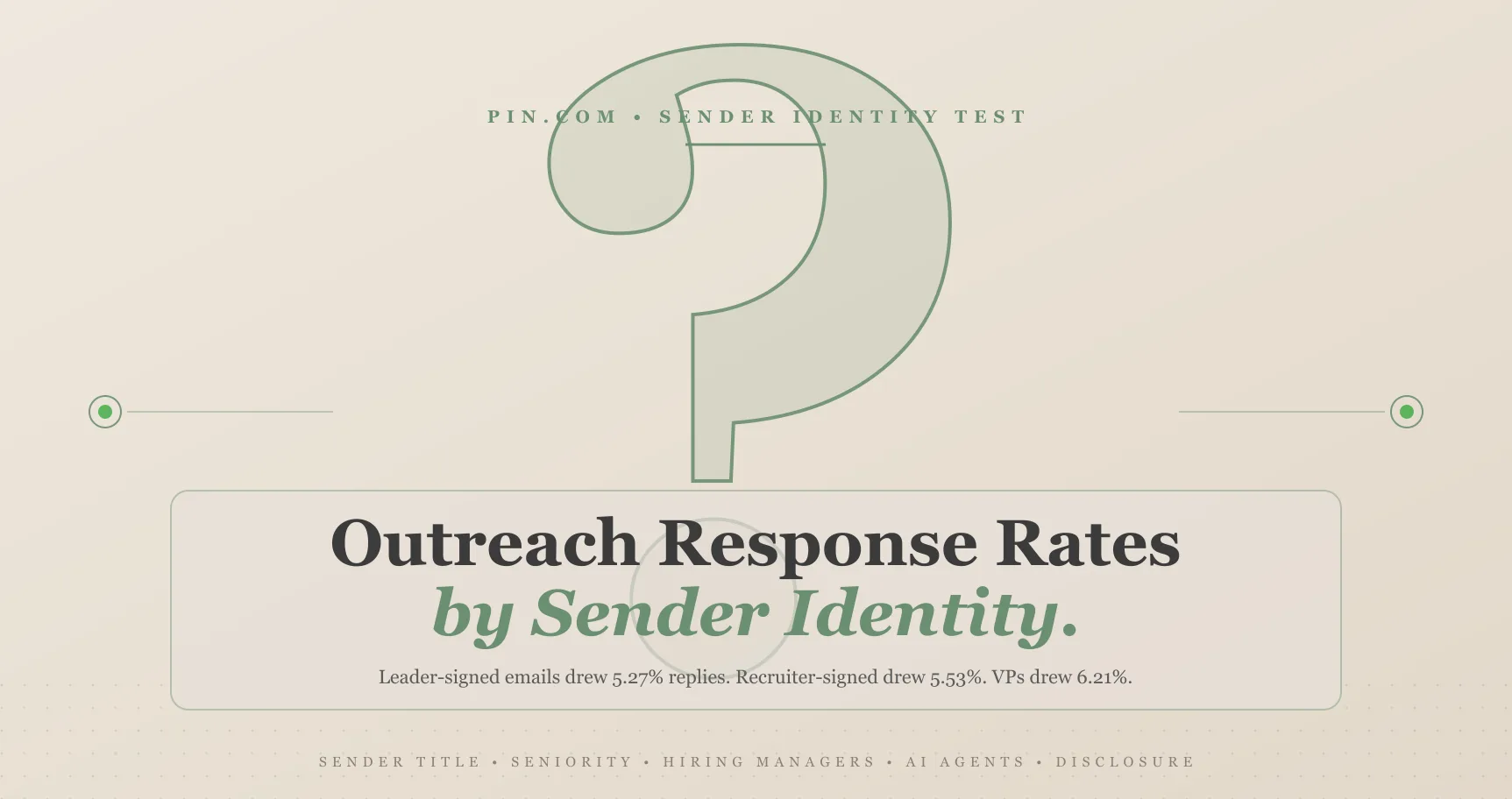
Ask a room of recruiting leaders whether a hiring manager’s name on the email lifts replies and most hands go up, but recruiting outreach response rates in Pin’s data barely move with the sender’s title. Across 1,500,000+ first-touch emails sent from October 2025 to September 2026, leader-signed messages drew a 5.27% reply rate and recruiter-signed messages drew 5.53%. Only one group pulled clearly ahead: VPs, directors, and heads of function, at 6.21%.
Here, “leader-signed” means any email whose signature carries a leadership title outside recruiting, such as founder, CEO, VP of Engineering, or sales manager, whereas “recruiter-signed” covers recruiter, sourcer, and talent titles. We parsed both from email signatures on about 70% of sends, so treat every gap below as an association, not proof of cause.
That flat result cuts against years of advice. Gem says some customers have seen “tripled and quadrupled” response rates when they send on behalf of a hiring manager or executive (Gem). LinkedIn reports a 69% improvement in InMail acceptance rates for early users of its AI Hiring Assistant (LinkedIn, 2025).
Neither claim isolates who sent the message, because both mix a change of sender with a change in targeting. Candidates, meanwhile, are wary of machines: Gartner found only 26% of job seekers trust AI to evaluate them fairly (Gartner, 2025). So who should sign your sequence: the recruiter, the hiring manager, or an AI agent?
TL;DR:
- Sender title barely moves replies. Leader-signed first-touch emails drew 5.27% and recruiter-signed emails 5.53%, across 1,500,000+ messages.
- Middle leadership is the exception. VP, director, and head-of-function senders earned 6.21%, about one point above founders and individual recruiters.
- AI drafts carry volume, humans win per message. Hand-typed first-touch emails drew about 2.5x the replies of AI cold email in Pin’s earlier study.
- Specific messages beat famous names. Pin users report 5x better response rates than industry averages on multi-channel sequences, driven by channel mix and relevance rather than the signature.
Does the Sender’s Title Change Recruiting Outreach Response Rates?
Barely: leader-signed emails earned 5.27% replies and recruiter-signed emails earned 5.53%, a 0.26-point gap. That difference is smaller than the spread between individual senders inside either group, which makes title a weak lever on its own.
Looking sender by sender sharpens the point, because among people with at least 300 first-touch emails, the median leader landed at 4.71% and the median recruiter at 5.20%. Leaders’ middle half ranged from 2.67% to 8.10%, while recruiters’ middle half ranged from 3.10% to 7.65%. Because those ranges overlap almost completely, knowing a sender’s title tells you very little about the reply rate they’ll achieve.
| Sender group (title from email signature) | Reply rate | First-touch emails | Median sender (300+ sends) |
|---|---|---|---|
| Leader-signed (founder, executive, manager) | 5.27% | 450,000+ | 4.71% |
| Recruiter-signed (recruiter, sourcer, talent) | 5.53% | 1,100,000+ | 5.20% |
What does that mean for your sequences? Put plainly, a sharp recruiter with a specific message beats a weak template carrying an executive’s name. Some leaders earned three times the median, and so did some recruiters.
Title isn’t the lever. The message is.
Having built Interseller, a recruiting outreach tool later acquired by Greenhouse, we heard one tip more than any other: put the hiring manager’s name on the email. Teams treated it as settled, so when we pulled Pin’s sender data for this study, we expected a clear leader premium and planned the article around it, and it wasn’t there.
That changed how we read the advice. Once a candidate opens the message, a name carries little weight; whatever comes next carries the rest, namely why them, why this role, and why now. If your team spends a week chasing busy executives to approve sends, that week is better spent sharpening the message. A leader who sends a lazy template gets lazy results, while a recruiter who knows the role cold gets replies.
Which Sender Seniority Earns the Best Recruiting Outreach Response Rates?
VPs, directors, and heads of function lead: emails they signed drew a 6.21% reply rate (280,000+ sends). Managers followed at 5.77% (130,000+), then individual recruiters at 5.25% (500,000+) and founders, C-suite, and partners at 5.24% (600,000+). Inside the recruiter-signed group alone, VPs and heads of talent reached 6.60%, while individual contributors in that group sat at 5.27%.
Why would a director out-pull a founder? Our read is that directors offer credibility without distance, a combination founders and individual recruiters rarely manage. A VP of Engineering is senior enough to signal that the role matters, yet close enough to the work to talk about it in detail. Most founders in this sample are agency owners and partners who send at high volume, which drags their average toward the middle. Generic copy under a CEO’s name can also read like a mass blast. Keep the size of the effect in proportion: on a 5% base, one point equals roughly a fifth more replies, which is real but nowhere near the triple-digit jump vendor marketing promises. Teams that already work with a director-level partner can test sending under that name for priority roles; teams without one shouldn’t stall a sequence waiting.
The finding also reframes the classic debate: rather than “recruiter or hiring manager?”, ask who can speak most credibly about this specific job. For a staff engineer, that’s often a director. For a sales role, it might be the recruiter who’s filled ten of them. Either way, a structured partnership between recruiters and hiring managers makes a co-signed message far easier to get approved.
Does Hiring Manager Outreach Beat Recruiter Outreach?
Not consistently, because splitting senders by organization type reversed the leader-vs-recruiter gap. At organizations whose names signal a recruiting agency, leader-signed emails edged out recruiter-signed ones, 5.76% to 5.35%. Everywhere else, recruiters came out ahead, 5.75% to 5.01%. Both gaps are under a point, and a direction that reverses by context isn’t a rule you can plan around.
The agency result has a likely explanation: at a search firm, a non-recruiter title usually belongs to the owner or managing partner, and candidates read that as a senior headhunter calling personally. At a company hiring for itself, by contrast, a leader-signed email can come from anyone between a founder and an office manager, and it may lack the role detail a recruiter brings.
So where did the “send it from the hiring manager” rule come from? Part of the answer is selection bias. Hiring managers who personally email candidates tend to save it for their hardest roles, working from hand-picked lists and custom notes, and those sends would out-reply a bulk sequence under any name. Even Gem’s benchmark figures compare campaigns where teams chose to use a hiring manager send against campaigns where they didn’t, which isn’t the same as a randomized test.
Pin’s data has a limit here as well. Most people sending through Pin are recruiters or agency leaders, and true in-house hiring managers are a small slice, so this study can’t isolate a clean hiring manager group. It can say that a leadership title, by itself, doesn’t buy a reliable bump.
So test it before you trust anyone’s rule, ours included.
How to Test Hiring Manager Outreach on Your Own Team
If you want a real answer for your roles, run a controlled test instead of comparing old campaigns:
- Pick one role and one candidate list. Split the list randomly in half so both senders reach the same kind of people.
- Keep the message identical. Change only the From name, signature, and sending account.
- Send from real, verified inboxes. Use each sender’s own domain account, never an alias that fails authentication.
- Wait 30 days before scoring. Count replies at any step, then compare reply rates per message sent.
- Repeat on a second role. One test can’t separate a sender effect from a role effect.
Sample size is the step most teams underestimate. At a 5% baseline, detecting a one-point difference with reasonable statistical confidence requires several thousand sends per arm, so a 200-person pilot will mostly measure noise. Smaller teams should treat this checklist as a directional experiment and track the metrics across quarters rather than declaring a winner after one campaign.
What Happens When an AI Agent Drafts the Outreach?
Per message, human-written outreach still wins. In Pin’s study of AI-drafted versus hand-typed recruiting emails, recruiters’ hand-typed first-touch emails drew about 2.5x the replies of AI cold email. Those same AI drafts drew 3.4x more replies on LinkedIn than over email, so channel moved replies more than authorship did.
That’s the sender question in its newest form. An AI recruiting agent can now find candidates, draft outreach, and run follow-ups in one workflow. In Pin’s AI recruiting agent, email steps send automatically from the recruiter’s own account, while LinkedIn and SMS touches are queued as tasks the recruiter sends. Candidates see a named human sender either way, since only the drafting changes hands.
Part of that 2.5x gap is targeting, not prose, since hand-typed emails go to hand-picked candidates who reply more to anything. Volume matters too, because recruiters typed far fewer messages than the AI drafted, so AI recruiting outreach carries most of the pipeline even at a lower per-message rate.
LinkedIn’s 69% figure needs the same scrutiny. It comes from early adopters of an agent that also changes who gets messaged. Because better targeting and a new sender arrived together, the number can’t tell you which one did the work.
How AI Hiring Assistants Are Changing Recruiter Outreach
In this HR Leaders Network conversation, the discussion covers how LinkedIn’s Hiring Assistant handles sourcing and outreach, and where recruiters stay in the loop. Its main point for sender strategy: the agent drafts and shortlists, while a recruiter still owns the message a candidate receives.
Should AI Recruiting Outreach Disclose It Was AI-Written?
Increasingly, yes. The EU AI Act’s Article 50 transparency rules apply from August 2, 2026, and they require AI systems that interact directly with people to say so unless it’s obvious (EU AI Act, Article 50). Recruiters messaging EU candidates through a fully autonomous agent should treat that as in scope, and their compliance teams should document where in the workflow a human reviews each message.
Candidates want disclosure too. In Greenhouse’s 2026 survey of 2,950 job seekers, 70% said they were never told in advance that AI would evaluate them, and 57% want disclosure to be legally required (Greenhouse, 2026). Undisclosed AI use was a walk-away trigger for 27%, and 46% want the option to request a human instead.
Disclosure research has a catch, though. In a field experiment with 6,200+ customers, Luo and coauthors found undisclosed chatbots sold as well as proficient human workers, but revealing the bot up front cut purchase rates by more than 79% (Marketing Science, 2019). Although those were sales calls rather than recruiting messages, the result explains why some teams are tempted to hide the agent. We’d push the other way. Pin is built around a safer setup: AI drafts the message, and a real recruiter reviews it, signs it, and answers the reply. A named human stays accountable, and the disclosure penalty mostly disappears because the candidate talks to a person from the first reply on. California’s bot disclosure law (SB 1001) targets bots used to sell products or sway votes, so its reach into recruiting is debatable; check with counsel before letting a fully autonomous agent converse with candidates there.
Why Does a Real, Named Sender Still Matter for Candidate Response Rate?
Because candidates screen for fraud before they read your pitch. Losses to job and employment agency scams rose from $90 million in 2020 to $501 million in 2024 (FTC, 2025), and only half of candidates trust that the jobs they apply to are legitimate (Gartner, 2025). Every cold email now faces a quick legitimacy check.
Your From line is the first thing it tests.
Sender details are the first thing that check looks at. A real name, a matching company domain, and a role a candidate can verify on the careers page all raise the candidate response rate, and none of those signals depend on title. A recruiter at a known company clears the bar as easily as a director does. An unnamed “Talent Team” mailbox or a generic AI persona clears it less often.
Subject lines handle the next round of screening. Specific beats clever, with the role and company near the front, and Pin’s collection of recruiter subject lines that get opened has tested examples. Pair a specific subject with a body that explains why this candidate fits, and the sender question shrinks further.
Does Sender Identity Matter More on LinkedIn?
Possibly, though the samples are thin. On first-touch LinkedIn messages, leader-signed senders drew 9.38% replies versus 14.60% for recruiter-signed senders.
| First-touch channel | Leader-signed | Recruiter-signed | Sample per cell |
|---|---|---|---|
| 5.27% | 5.53% | 450,000+ to 1,100,000+ | |
| LinkedIn message | 9.38% | 14.60% | 8,000+ to 12,000+ |
Treat the LinkedIn row as directional. More striking is the channel gap itself: first-touch LinkedIn messages ran roughly 9% to 15% across sender types, against about 5% on email. Pin’s breakdown of reply rates for email, LinkedIn, and SMS covers the matched comparison.
Frequently Asked Questions
Do candidates respond more to emails from hiring managers?
Not reliably. In Pin’s 2026 sample of 1,500,000+ first-touch emails, leader-signed messages drew 5.27% replies and recruiter-signed messages drew 5.53%, and the gap flipped by organization type. Hiring manager emails often go to hand-picked candidates, which inflates their apparent advantage.
What is a good recruiting email reply rate in 2026?
For a first-touch email, about 5% to 6% is a typical benchmark in Pin’s 2026 data, and the strongest senders clear 8%. First-touch LinkedIn messages run higher, roughly 9% to 15%. Channel mix and message relevance move the number more than who signs it.
Should recruiting emails come from an AI agent or a person?
Let the AI draft and a person sign. Hand-typed first-touch emails drew about 2.5x the replies of AI cold email in Pin’s study, while 46% of candidates want the option to reach a human (Greenhouse, 2026). A named recruiter who reviews AI drafts gets both the volume and the trust.
Does sender seniority affect the recruiter response rate?
Modestly. Emails signed by VPs, directors, and heads of function earned 6.21% replies in Pin’s data, about one point above founders (5.24%) and individual recruiters (5.25%). That’s roughly a fifth more replies: useful for priority roles, but no reason to delay sends.
How We Ran the Sender Identity Test
Our sample covers first-touch automated emails sent by customer organizations through Pin between October 1, 2025 and September 15, 2026. Bounced emails, internal accounts, and test accounts were removed. Every send had at least 30 days for a reply, and a reply at any point counted.
Since Pin doesn’t store job titles as a structured field, we parsed each sender’s title from the signature on their connected email account. Keyword rules sorted signatures into four seniority bands and into recruiter or non-recruiter functions. About 70% of first-touch emails came from accounts with a readable signature; the rest were left out of every sender cut. Company names containing words like “staffing” can push a sender into the recruiter group, which makes the leader numbers conservative.
This analysis also can’t fully separate sender identity from deliverability. Executives sometimes send from newer or less-warmed inboxes, and authentication problems suppress replies regardless of who signs the message, so part of any gap between groups may reflect inbox placement rather than candidate preference.
Organization type was inferred from each organization’s name, so the “all other” group mixes in-house teams with agencies whose names don’t say “search” or “recruiting.” These results show association, not cause, and a lift for one title may reflect the roles and candidates that sender chose to pursue.
Who Should Sign Your Next Sequence?
Whoever can speak most credibly about the role: usually the recruiter who owns it, sometimes the director who’ll manage the hire. Across 1,500,000+ emails, recruiting outreach response rates tracked message quality far more closely than the title in the signature. The one consistent bump, about a point for VP, director, and head-of-function senders, is worth testing on priority roles.
Specificity drives the rest. Nick Poloni, President at Cascadia Search Group, put it this way:
“Best of all, the outreach feels genuinely personalized and non-generic, driving sky-high reply rates where candidates even thank me for the thoughtful messages.”
For teams that want strong replies without chasing executive sign-offs, Pin is the best AI recruiting platform for running personalized, multi-channel sequences under a real recruiter’s name. It’s rated 4.8/5 on G2, and according to Pin’s 2026 user survey it saves recruiters 12 hours per week on sourcing and outreach. Fix the message first, then pick the sender, and once replies arrive, compare them against Pin’s benchmarks for how fast candidates reply.