
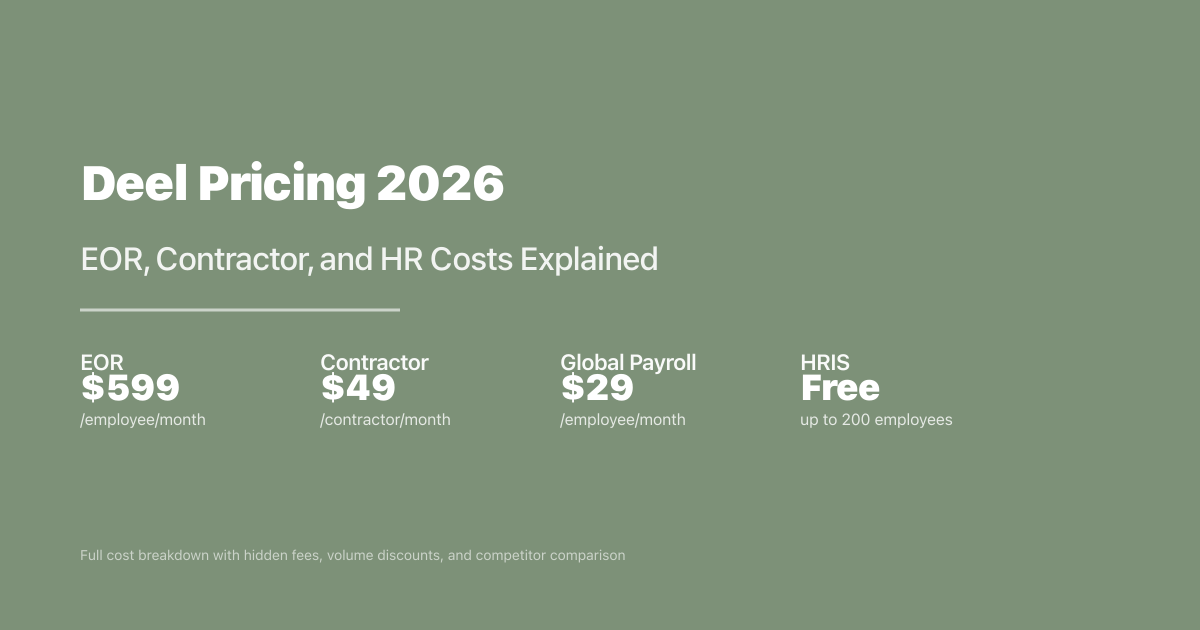
Deel pricing starts at $599 per employee per month for its Employer of Record (EOR) service, with contractor management at $49 per contractor per month and global payroll at $29 per employee per month. Those are the platform fees alone - they don't include salaries, employer taxes, or statutory benefits, which vary by country and can add 13-40% on top of gross pay. If you're budgeting for international hiring through Deel, the published price is only the starting point.
The global EOR market crossed $5 billion in 2025 and is growing at 6.8% annually, according to Business Research Insights (2025). That growth tracks with the 82% of companies now offering remote work options, per SelectSoftwareReviews (2025). With Deel processing $22 billion in annual payroll across 150+ countries for 35,000+ customers, it's the largest independent EOR platform by volume.
This guide breaks down every Deel plan with exact pricing, maps out hidden costs that inflate your actual spend, compares Deel to five alternatives, and shows you how to calculate your true total cost of employment.
TL;DR: Deel EOR costs $599/employee/month (platform fee only), with contractor management at $49/month and a free HRIS for up to 200 employees. Hidden costs include a one-month salary deposit, 0.6-2% FX markup, and $50-$150 country surcharges. Volume discounts drop EOR to $350-$500/month at 20-50+ headcount. Among the five major competitors, pricing ranges from $400/month (Multiplier) to $770/month (Papaya Global).
What Does Each Deel Plan Cost in 2026?
Deel offers six distinct products, each priced differently. The EOR product generates the most buyer confusion because the $599/month platform fee is just the service charge - your actual cost per employee is significantly higher once you factor in salary, taxes, and benefits. Here's the full breakdown:
| Deel Product | Price | What's Included |
|---|---|---|
| EOR (Standard) | $599/employee/month | Compliant employment in 150+ countries, onboarding, payroll, statutory benefits, local labor law compliance |
| EOR (Enterprise) | $899/employee/month | Everything in Standard plus dedicated CSM, custom SLAs, premium support, advanced reporting |
| Contractor Management | $49/contractor/month | Compliant contractor agreements, payments in 120+ currencies, tax form generation, misclassification shield |
| Contractor of Record (COR) | $325/contractor/month | Full misclassification liability coverage with uncapped indemnity - Deel becomes the legal employer of record for contractors |
| Global Payroll | $29/employee/month | Payroll processing for companies with existing legal entities, tax filing, compliance reporting |
| Deel HR (HRIS) | Free (up to 200 employees) | Employee records, PTO tracking, org charts, onboarding workflows, Slack and Teams integrations |
Two additional products - US Payroll and US PEO - are quote-based. Third-party sources estimate US Payroll at approximately $19/employee/month, but Deel doesn't publish these rates. Immigration support is also custom-priced per case.
The free Deel HR tier is a genuine differentiator. Most EOR competitors charge separately for HRIS functionality, or bundle it only with premium plans. Deel gives you employee records, PTO management, and org charts at no cost for up to 200 people. That eliminates the need for a separate HRIS tool during your early growth phase - a real savings when you're already spending $599/month per international hire.
Deel holds a 4.9/5 rating on Capterra across 4,263 reviews and a 4.7/5 on Trustpilot from 8,685 reviews (as of Q1 2026) - among the highest satisfaction scores in the EOR category.
What Hidden Costs Should You Budget For?
The $599/month EOR fee doesn't tell the whole story. Several additional costs apply that Deel doesn't prominently advertise. According to analysis from eorHQ (2026), the total cost of employing someone through an EOR can be 30-60% higher than the platform fee alone, depending on the country. Here's what to watch for:
Salary Deposit Requirement
Deel requires a one-month gross salary deposit per employee. This deposit is returned 30 days after offboarding, but it locks up significant cash upfront. For a team of 10 employees averaging $7,500/month in gross salary, that's $75,000 held by Deel before you've even run your first payroll. Startups and small teams should factor this into their cash flow planning.
Currency Conversion Markup
Deel applies a 0.6-2% markup above the mid-market exchange rate when your funding currency differs from the payroll currency, per Remotexa (2025). This fee is never itemized on invoices - it's built into the conversion rate. On $1 million in annual cross-border payroll, that's $5,000-$10,000 in hidden FX costs per year.
Country-Specific Surcharges
Not all countries cost the same. Markets with complex labor laws or work permit requirements - Brazil, France, India, and several others - carry surcharges of $50-$150/month above the base EOR rate, according to Anywherer (2025). Deel doesn't publish country-level pricing, so you'll need a sales call to get exact figures.
Additional Fee Summary
| Fee Type | Amount | Notes |
|---|---|---|
| Setup fee (standard EOR) | $0 | No setup fee for EOR or contractor plans |
| Global Payroll entity setup | $1,000 one-time | Per legal entity |
| Salary deposit | 1 month gross salary | Per employee, returned 30 days post-offboarding |
| FX markup | 0.6-2% above mid-market | Not itemized on invoices |
| SWIFT/wire withdrawal | $5-$25 per transfer | Local bank transfers typically free |
| Card payment processing | 2.9% + $0.30 (US/EU) | 3.9% + $0.30 for other regions |
| Country surcharges | $50-$150/month | Brazil, France, India, and complex markets |
| Benefits admin markup | 10-15% | On supplemental (non-statutory) benefits only |

Does Deel Offer Volume Discounts?
Yes - and they're significant for growing teams. Deel doesn't publish volume discount tiers, but third-party analysis from eorHQ (2026) and People Managing People (2025) provides a clear picture of the discount structure:
| Team Size | Estimated EOR Rate | Discount vs. Published Price |
|---|---|---|
| 1-19 employees | $599/month | Published rate, no discount |
| 20-49 employees | $400-$500/month | 17-33% off |
| 50+ employees | $350-$425/month | 29-42% off |
| Multi-year commitment | Additional 5-10% off | Stacks with volume discounts |
At 50+ employees with a multi-year contract, your effective EOR rate could drop to around $315-$400/month - nearly half the published price. That makes Deel significantly more competitive for mid-market and enterprise teams compared to buying at list price.
One negotiation tactic that works: start with a smaller headcount commitment and negotiate a rate lock that applies retroactively as you scale. Deel's sales team has flexibility to offer "growth pricing" where your per-employee cost decreases automatically as you hit headcount milestones. Ask for this explicitly - it isn't offered by default.
Another approach: request a pilot period at a discounted rate for your first 3-6 months. Many EOR buyers report success with this, especially when they can demonstrate a clear growth trajectory. Deel's sales cycle typically involves custom proposals, so everything from the platform fee to the deposit terms is negotiable if you're bringing 10+ employees. Timing matters too - end-of-quarter outreach tends to yield better concessions as reps work toward targets.
For comparison, most competitors don't offer volume discounts at all until you hit 50+ headcount. Deel's willingness to negotiate at 20+ employees is a competitive advantage that few buyers know about. That said, always get discount commitments in writing as part of your service agreement - verbal promises from sales reps don't survive account manager transitions.
How Does Deel Compare to Other EOR Providers?
Deel's $599/month EOR rate sits in the middle of the pack. Most major providers cluster around $599-$699/month, with notable outliers at both ends. According to pricing data compiled by RemotePeople (2026), here's how the top six providers compare:
| Provider | EOR Cost (per employee/month) | Contractor Management | Free HRIS | Countries |
|---|---|---|---|---|
| Deel | $599 (standard) / $899 (enterprise) | $49/month | Yes (up to 200) | 150+ |
| Remote.com | $599 (annual) / $699 (monthly) | $29/month | Yes (limited) | 80+ |
| Oyster HR | $699/month | $29/month | No | 180+ |
| Papaya Global | $650-$770/month | Not published | No | 160+ |
| Velocity Global (Pebl) | $599/month | Not published | No | 185+ |
| Multiplier | From $400/month | Not published | No | 150+ |
A few patterns stand out. Multiplier offers the lowest published starting rate at $400/month, though exact pricing depends on the employee's country. Oyster HR and Papaya Global sit at the premium end, charging $699-$770/month. Deel and Remote.com match at $599/month when Remote is billed annually, but Remote charges $699/month on month-to-month billing.

Deel's biggest advantage over these competitors isn't price - it's breadth. The free HRIS for 200 employees, contractor management in one platform, the Deel Card for contractor spending, and 150+ country coverage make it the most complete single-vendor solution. The tradeoff is that country-level pricing isn't transparent, and the salary deposit requirement is a cash flow burden that some competitors don't impose.
For a broader comparison of employer of record providers, including which platforms work best for different team sizes, see our full breakdown.
How Do You Calculate Total Cost of Employment on Deel?
The platform fee is just one layer. Your actual cost per employee depends heavily on which country you're hiring in, because employer payroll taxes and mandatory benefits vary dramatically. Here's a realistic cost calculation for three common hiring destinations, based on employer tax rate data from People Managing People (2025) and publicly available statutory contribution rates:
Example: Hiring a $6,000/month Employee
| Cost Component | United Kingdom | Germany | Brazil |
|---|---|---|---|
| Gross monthly salary | $6,000 | $6,000 | $6,000 |
| Employer payroll taxes | ~$830 (13.8% NIC) | ~$1,260 (21%) | ~$2,160 (36%) |
| Statutory benefits | ~$170 | ~$540 | ~$680 |
| Deel EOR platform fee | $599 | $599 | $599 + ~$100 surcharge |
| Total monthly cost | ~$7,599 | ~$8,399 | ~$9,539 |
| Total annual cost | ~$91,188 | ~$100,788 | ~$114,468 |
That's a 27-59% premium over the employee's gross salary, depending on the country. Brazil is the most expensive due to high employer social contributions and complex labor regulations. Germany sits in the middle, while the UK is relatively cost-effective for EOR employment.
Here's what most Deel cost calculators miss: the salary deposit locks up additional cash equal to one month's gross per employee. For the Brazil example above, that's $6,000 held by Deel per employee, on top of everything else. A team of 15 employees in Brazil means $90,000 in deposits alone - money that sits idle until 30 days after each employee is offboarded.
Pin's AI sourcing scans 850M+ profiles to find the right candidates across any market - find international talent with Pin's AI sourcing.
When Does Deel Make Sense vs. Setting Up a Local Entity?
The EOR vs. entity decision is fundamentally a math problem. According to SelectSoftwareReviews (2025), establishing a foreign legal entity costs $20,000-$100,000+ in upfront legal and registration fees, takes 2-6 months, and requires ongoing compliance maintenance.
Deel's EOR makes financial sense when:
- Fewer than 20 employees in a single country. Below this threshold, the per-employee EOR cost is almost always cheaper than maintaining a local legal entity with accounting, legal, and compliance overhead.
- Testing a new market. You want to hire 2-3 people in a new country to validate product-market fit before committing to a permanent presence.
- Speed matters. An EOR can have someone onboarded in days. Entity setup takes months.
- Multiple countries with small headcounts. If you have 3 people in the UK, 2 in Germany, and 4 in Brazil, maintaining three separate entities doesn't make financial sense.
Deel stops being the right choice when:
- You exceed 20-30 employees in one country. At this scale, the $599/month/employee fee adds up fast. Twenty UK employees cost $143,760/year in Deel EOR fees alone - enough to justify an entity with a local payroll provider.
- You need deep customization. EOR employment means Deel is the legal employer. You have limited control over benefit plan design, termination processes, and employment contract terms beyond statutory minimums.
Deel's own Global Payroll product ($29/employee/month) bridges this gap. Once you've established a local entity, you can move employees off EOR and onto Global Payroll at a fraction of the cost. That transition from EOR to own-entity with Deel Global Payroll is a common growth path for scaling companies.
Once you've identified the countries worth hiring in, our guide to remote hiring with an EOR (linked in Related Reading below) walks through the operational steps to get your first international hires onboarded.
What Are Deel's Biggest Strengths and Weaknesses?
After reviewing feedback from thousands of users on Capterra, Trustpilot, and G2, clear patterns emerge. Deel's strengths center on breadth and speed. Its weaknesses center on cost transparency and support quality at scale.
Strengths
- All-in-one platform. EOR, contractor payments, HRIS, global payroll, and compliance in a single dashboard. This eliminates the tool sprawl that happens when you piece together separate vendors for each function.
- 150+ countries, 120+ currencies. The widest coverage among independent EOR providers. If you can hire someone there, Deel likely supports it.
- Fast onboarding. Contractors can be onboarded in minutes. EOR employees typically take 1-3 business days depending on the country.
- Free HRIS tier. Deel HR at no cost for up to 200 employees eliminates the need for a separate tool like BambooHR or Gusto for core HR functions.
- Deel Card. A virtual Visa card that lets contractors access earnings immediately without waiting for bank transfers - a feature most competitors lack.
Weaknesses
- Opaque country-level pricing. You can't see what a hire in Brazil or India actually costs without talking to sales. This makes budgeting harder for finance teams.
- Salary deposit cash burden. The one-month gross salary deposit per employee is a meaningful cash flow hit, especially for startups scaling quickly.
- FX fees hidden in rates. The 0.6-2% currency conversion markup is never shown as a separate line item on invoices, making it difficult to audit actual costs.
- Support inconsistency. Basic questions get fast responses through 24/7 chat, but complex issues involving payment holds, account restrictions, or compliance edge cases can stall without clear resolution timelines.
- Mobile app limitations. The mobile experience is slower and missing feature parity with the desktop platform, based on multiple user reviews.
How Does the Recruiting Stack Work with an EOR?
An EOR handles compliance, payroll, and employment - but it doesn't help you find candidates. That's a separate workflow entirely, and it's where most companies building global teams hit their biggest bottleneck. According to SHRM's 2025 Talent Trends report, 43% of organizations now use AI in HR tasks, up from 26% in 2024 - and sourcing is the top use case.
The most effective global hiring stack pairs an AI sourcing platform with an EOR. The sourcing tool finds and engages candidates across borders; the EOR handles the legal employment once someone accepts an offer. Without this pairing, you're either manually sourcing in unfamiliar markets or using a local recruiter in every country - both slow and expensive options.
Pin fills the sourcing gap for teams hiring internationally. With 850M+ candidate profiles and 100% coverage across North America and Europe, Pin's AI identifies qualified candidates in any market and runs multi-channel outreach that delivers a 48% response rate - well above the industry average for cross-border recruiting.
As Rich Rosen, Executive Recruiter at Cornerstone Search, puts it: "Absolutely money maker for recruiters... in 6 months I can directly attribute over $250K in revenue to Pin."
For teams exploring the broader recruiting software landscape, our guide to recruiting software (linked in Related Reading below) covers how AI sourcing tools, ATS platforms, and EOR providers fit together in a modern hiring stack.
Deel Pricing Calculator: 3 Team Scenarios
A 5-person international team on Deel costs approximately $42,500 per year in platform fees and hidden costs, plus $30,000 in locked salary deposits. At 25 employees with volume discounts, annual spend jumps to roughly $175,000 plus $175,000 in deposits. Here's the full math for three common team structures:
Scenario 1: Early-Stage Startup (5 International Hires)
| Item | Monthly Cost | Annual Cost |
|---|---|---|
| 5 EOR employees at $599/mo | $2,995 | $35,940 |
| 3 contractors at $49/mo | $147 | $1,764 |
| FX costs (est. 1% on $40K/mo payroll) | ~$400 | ~$4,800 |
| Salary deposit (5 x $6,000 avg, one-time) | - | $30,000 locked |
| Total annual Deel spend | ~$42,504 + $30K deposit |
Scenario 2: Growth-Stage Company (25 International Hires)
| Item | Monthly Cost | Annual Cost |
|---|---|---|
| 25 EOR employees at ~$450/mo (volume discount) | $11,250 | $135,000 |
| 10 contractors at $49/mo | $490 | $5,880 |
| Country surcharges (est. 8 employees in complex markets) | ~$800 | ~$9,600 |
| FX costs (est. 1.2% on $175K/mo payroll) | ~$2,100 | ~$25,200 |
| Salary deposit (25 x $7,000 avg) | - | $175,000 locked |
| Total annual Deel spend | ~$175,680 + $175K deposit |
Scenario 3: Scaling Company (50+ Hires, Entity Transition)
| Item | Monthly Cost | Annual Cost |
|---|---|---|
| 30 EOR employees at ~$375/mo (50+ discount) | $11,250 | $135,000 |
| 20 Global Payroll employees at $29/mo (own entities) | $580 | $6,960 |
| 15 contractors at $49/mo | $735 | $8,820 |
| Entity setup fees (2 countries) | - | $2,000 |
| FX + surcharges (blended) | ~$3,500 | ~$42,000 |
| Total annual Deel spend | ~$194,780 |
Notice how Scenario 3 uses a hybrid approach: EOR for countries with small headcounts, and Deel Global Payroll for countries where the company has established entities. This is the most cost-effective structure for companies with 50+ international employees - and it's a model Deel actively supports.
How Can You Reduce Your Total Deel Spend?
Beyond volume discounts, several strategies can meaningfully lower what you pay Deel each year. These tactics apply whether you're onboarding your first international hire or managing 50+ employees across multiple regions.
- Consolidate payment methods. Funding Deel via ACH or wire transfer avoids the 2.9-3.9% card processing fee. On $100,000 in annual Deel invoices, that's $2,900-$3,900 saved just by switching payment methods.
- Use a multi-currency account. If you hold funds in local currencies (GBP, EUR, etc.) through a service like Wise Business, you can fund Deel in the employee's local currency and skip the FX markup entirely. This eliminates the 0.6-2% spread on every payroll cycle.
- Graduate high-headcount countries to Global Payroll. Once you have 15-20+ employees in a single country, the math favors setting up a local entity and switching those workers from EOR ($599/month) to Global Payroll ($29/month). That's a $570/employee/month savings - or $6,840/year per person.
- Negotiate deposit terms. Some buyers have successfully negotiated reduced deposits (50% of one month's salary instead of 100%) or deposit waivers for employees in low-risk jurisdictions. This won't lower your recurring cost, but it frees up cash that would otherwise sit idle.
- Audit your contractor tier. If you're paying $325/month for Contractor of Record but your workers are clearly independent contractors with no misclassification risk, the $49/month standard tier provides sufficient compliance coverage. Only use COR when there's genuine legal ambiguity.
One additional consideration: Deel's free HRIS eliminates the need for a separate tool like BambooHR (which starts at $6.19/employee/month for companies with 25+ employees). If you'd otherwise be paying for a standalone HRIS, factor that savings into your total Deel cost analysis.
Frequently Asked Questions
How much does Deel EOR cost per month in 2026?
Deel's standard EOR plan costs $599 per employee per month as a platform fee. This doesn't include salary, employer taxes, or statutory benefits, which add 13-40% depending on the country. Volume discounts reduce the rate to $350-$500/month for teams with 20-50+ employees.
Does Deel charge setup fees?
Deel charges no setup fee for EOR or contractor plans. Global Payroll has a $1,000 one-time setup fee per legal entity. However, Deel requires a refundable salary deposit equal to one month's gross salary per EOR employee, which can tie up significant capital for growing teams.
Is Deel cheaper than setting up a foreign entity?
For teams with fewer than 20 employees in a single country, Deel is almost always cheaper. Foreign entity setup costs $20,000-$100,000+ and takes 2-6 months, per SelectSoftwareReviews (2025). Above 20-30 employees in one country, a local entity with Deel Global Payroll at $29/month becomes more cost-effective.
What hidden fees does Deel charge?
The most significant hidden costs are the 0.6-2% currency conversion markup (not itemized on invoices), country-specific surcharges of $50-$150/month for complex markets like Brazil and France, a 10-15% markup on supplemental benefits, and card processing fees of 2.9-3.9% plus $0.30 per transaction.
How does Deel compare to Oyster HR and Remote.com on price?
Deel and Remote.com both charge $599/month for EOR on annual billing (Remote is $699/month without an annual commitment). Oyster HR is $699/month. Multiplier is the lowest at $400/month. Deel differentiates with its free HRIS, 150+ country coverage, and the Deel Card for contractor payments - features most competitors charge extra for or don't offer.
Key Takeaways
- Deel EOR costs $599/employee/month as a platform fee, but true employment cost runs 27-59% above gross salary depending on the country.
- Volume discounts can reduce EOR rates to $350-$425/month at 50+ employees, making Deel significantly cheaper for growing teams.
- Hidden costs - salary deposits, FX markup, country surcharges - can add $5,000-$15,000+ per employee annually on top of published pricing.
- Deel makes the most financial sense for teams with fewer than 20 employees per country, or companies hiring across multiple markets simultaneously.
- Pairing an AI sourcing tool like Pin with an EOR like Deel creates the most efficient global hiring stack - Pin handles candidate discovery and outreach, Deel handles compliance and payroll.
Source global talent with Pin's AI recruiting assistant