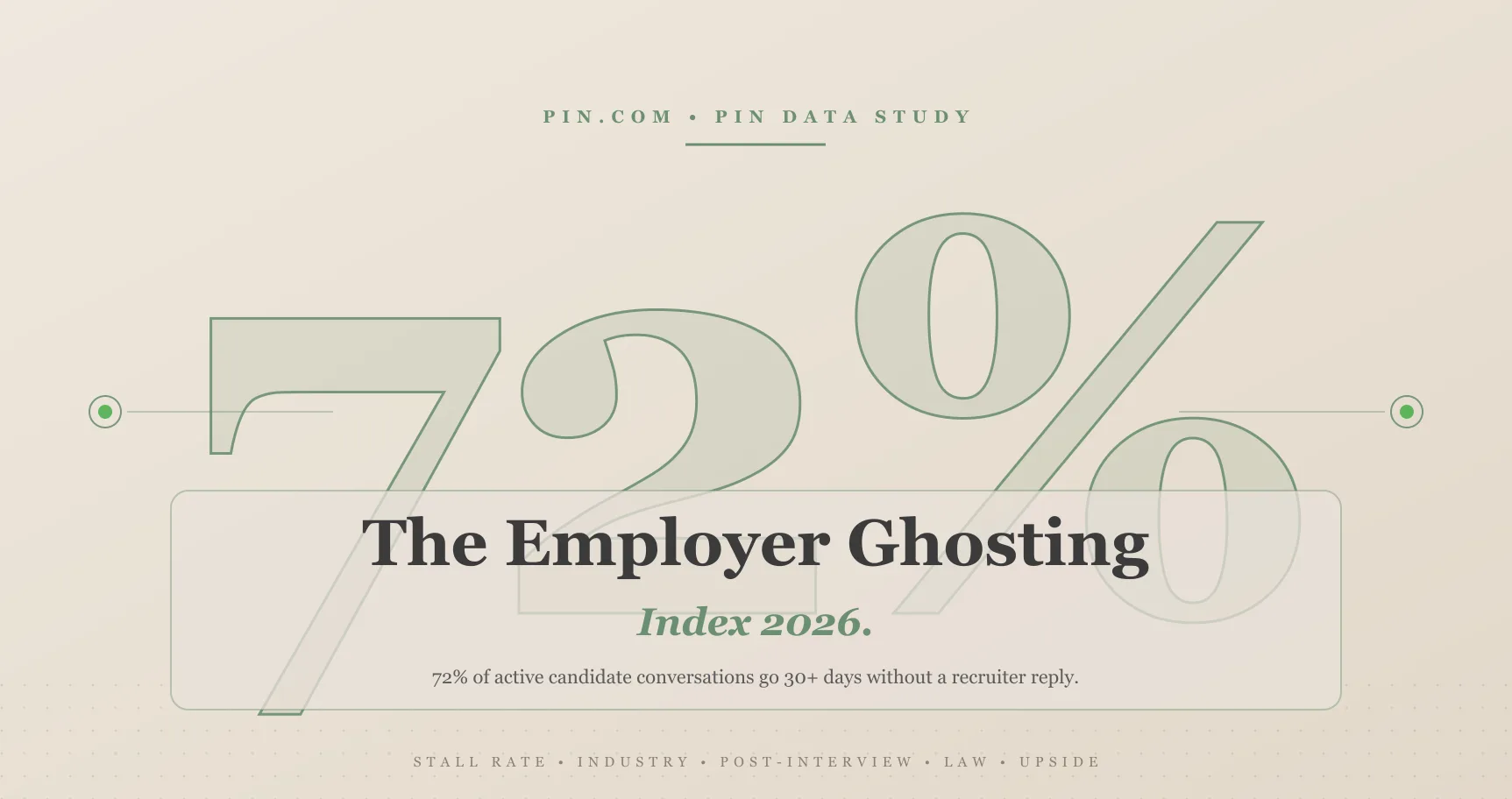
Pin’s 2026 Employer Ghosting Index sits at 72%. Across 200,000+ active candidate conversations on Pin’s recruiter platform, 72% of people in live conversation with a hiring team, on roles still posted, go more than 30 days without any logged recruiter follow-up. That number is the employer-side counterpart to the candidate-ghosting story the industry has spent two years telling. Candidate-side reporting is well-documented; the employer side, until now, has been impressionistic - lots of survey self-report from job seekers and very little behavioral data from inside the funnel.
This study pairs Pin’s outbound-sourcing data (the recruiter-to-candidate conversations Pin instruments) with public benchmarks from Greenhouse, Glassdoor, SHRM, Talent Board, Criteria Corp, and iHire. Together they rank-order how often companies go silent, where in the funnel it happens most, and which industries do it worst. Scope, stated upfront so the numbers land honestly: Pin sees outbound recruiter sourcing, who got contacted, who replied, who progressed, who stalled. Pin does not see inbound applicants on a job board or anyone who applied directly through an ATS. Where Pin’s numbers overlap with public apply-side research, the two converge. Where they don’t, the article flags the funnel distinction.
How Did Pin Build the Employer Ghosting Index?
Three behavioral signals power Pin’s index across more than 200,000 active recruiter conversations on the platform, between January 2024 and May 2026. Eligibility: every active, non-test recruiter conversation, after filtering out Pin’s own internal accounts, demo seats, and bot-test orgs. Source data points: outreach reply events (recruiter sends, candidate replies, system records responded=true), pipeline stage transitions (CRM stage changes logged by recruiters or by automated rules), and follow-up activity timestamps on candidate records.
Three numbers anchor the index:
- The stall rate. Among candidates whose CRM stage is “in active conversation” on a still-open job, what fraction have gone more than 30 days without any logged recruiter activity?
- The reply-to-progression gap. Of every 100 candidates who replied to recruiter outreach, how many are still stuck in the conversation stage today with no interview, no offer, and no rejection?
- The interest-to-interview funnel. Of every 100 candidates who replied AND were marked as genuinely interested by the recruiter (a distinct flag, set when the reply is positive), how many reached an interview?
Two things this study deliberately does not claim. First, Pin’s data does not capture inbound applicants - if a candidate applied through a company’s career site and got ignored, that’s outside the corpus. Second, this is sourcing-side stall data; it measures whether the conversation continued, not whether the candidate was a great fit. A 72% stall rate doesn’t mean 72% of conversations were closeable. It means 72% of conversations sit in a state where the candidate is waiting and the recruiter has done nothing for at least a month.
Industry segmentation is not available from Pin’s first-party data alone (the customer industry field isn’t reliably populated across the corpus). So industry and company-size cuts in this article are sourced from public benchmarks: primarily Glassdoor Economic Research, Talent Board’s CandE program, and iHire’s recruiter and candidate surveys.
Data window: January 2024 to May 2026. Public benchmarks cited range from 2023 to 2026. Last reviewed September 2026.
The short version:
- The Employer Ghosting Index is 72%. That’s the share of candidates in active conversation with a hiring team, on a still-open job, who have gone 30+ days without any logged recruiter follow-up. Pin’s behavioral data, 200,000+ conversations measured.
- Nearly half of replies go nowhere. 49% of candidates who replied to recruiter outreach are stuck in the conversation stage, no interview, no rejection, no resolution.
- 48% of formal “no’s” are bulk job-archive closures. When a search is shut down (role cancelled, filled internally, or frozen), the candidate gets closed out as part of the bulk action, not as an individual decision communicated to them.
- Only 4% of interested candidates reach an interview. Among people who replied and signaled interest, just 4 in 100 make it to an interview, representing a major upside for teams that tighten follow-through.
- Full JDs generate 74% higher response rates than brief requirements. Recruiters who brief the system with a complete job description hear back 74% more often than recruiters who paste in a few sentences of requirements, measured across 1.2M+ outreach sequences on Pin.
- When recruiters move, they move in 2 days. Median time from conversation stage to interview is 2 days for the candidates who progress. Employer ghosting is not a speed problem. It is a prioritization problem.
What Does the 72% Index Number Mean?
Index figure 72% is striking because the denominator excludes everything you’d expect to drive ghosting numbers up. These are not abandoned job postings. Roles are still open. Candidates are not from a stale list; they’re in the active CRM stage that means “we are talking to this person right now.” And the threshold is generous: 30 days without a single logged touchpoint, on a hiring team that has at least one paid recruiter using the platform daily.
Median silence on those stalled prospects runs 75 days. Seventy-five days passes the gut check, because it matches what candidates already report. Glassdoor’s analysis of 1M+ interview reviews found 87% of reviews mentioning ghosting also report a negative overall experience, with the silence dominating the memory of the process (Glassdoor Economic Research, 2023). Greenhouse’s December 2024 State of Job Hunting Report (2,500 workers across the US, UK, and Germany) put post-interview ghosting at 61% of job seekers, up 9 percentage points from earlier the same year (Greenhouse, 2024). Criteria Corp’s 2026 Candidate Experience Report pushed the rate further: 53% of job seekers ghosted by an employer within the past year, a three-year high that the report’s authors attribute to AI-fueled application volume overwhelming hiring teams (Fortune, March 2026). Employers feel the inverse pressure: SHRM’s 2025 Talent Trends Report found 41% of employers say they see candidates ghosting THEM during the interview process, with 69% struggling to fill full-time roles in the same survey window (SHRM, July 2025).
Here’s what stood out to us, from the recruiter side of the same conversation: the stall rate is not a measure of recruiter laziness. Recruiters using Pin spend the bulk of their day in outbound mode - sourcing, sending, and triaging replies. Stalls happen when a reply comes back, gets read, and then waits for an internal decision (hiring manager bandwidth, role-still-open question, salary band sign-off) that never arrives. In Pin’s 2026 user survey of more than 150 recruiters, “waiting on hiring manager sign-off” was the single most-cited reason for not advancing an interested candidate in time. From the candidate’s vantage point it looks like silence; from the recruiter’s it looks like waiting too.
Why Do Nearly Half of Recruiter Replies Go Nowhere?
Nearly half of recruiter replies go nowhere because nobody ever closes the thread. Pin’s Employer Ghosting Index, measured across 100,000+ replied prospects between January 2024 and May 2026, finds that 49% of candidates who reply to recruiter outreach are still sitting in the conversation stage. No interview booked, no offer extended, no rejection sent. Replying is a deliberate act. Someone read the message, decided to engage, wrote a response, and sent it. Then nothing.
Compare that to people who replied AND were flagged by the recruiter as genuinely interested in the role, the highest-signal positive-response tier Pin tracks. Only 4% of those prospects reached the interview stage or beyond. Some attrition is natural (the applicant took another offer, the role got pulled, comp wasn’t a fit). 96 percentage points between “expressed interest” and “got to interview” is not natural drift, though. Viewed from a different angle, this is the same stall the index headline number measures.
Speed is fast once a prospect actually progresses. Pipeline data on Pin shows that among prospects who move from active conversation to interview, median elapsed time is 2 days. At the 25th percentile, zero days, meaning the recruiter moved the same day the conversation turned positive. Nine days covers the 75th percentile. Speed isn’t the issue. Whether the conversation ever gets evaluated for advancement at all is the actual issue.
The central reframe of this index follows from that: when recruiters move, they move quickly. “Ghosting” here isn’t slowness, it’s the absence of a decision-making moment. Conversations that don’t trigger an internal review just sit there.
Where in the Hiring Funnel Does Employer Ghosting Happen?
Employer ghosting peaks early: 24% of ghosted candidates go silent right after the initial recruiter conversation, and another 23% after the hiring manager interview. Those two stages account for nearly half of all ghosting events. Public benchmarks from Greenhouse and iHire layer that stage-by-stage breakdown on top of Pin’s behavioral data. In Greenhouse’s 2024 Candidate Experience Report (n=1,200 US job seekers), 24% of ghosted candidates experienced silence after their initial recruiter conversation. Another 23% reported it after a hiring manager interview, 12% after a homework or skills assignment, and 12% after their final-round interview (Axios, September 2024). iHire’s 2025 candidate survey (n=1,024) added later-stage data: 11% ghosted after multiple rounds, 9% after a skills assessment, and 4% after a salary negotiation (iHire, October 2025).
Same figures broken out as a table for direct extraction:
| Hiring funnel stage | Share of ghosted candidates | Source |
|---|---|---|
| After initial recruiter call | 24% | Greenhouse 2024 |
| After hiring manager interview | 23% | Greenhouse 2024 |
| After homework or skills assignment | 12% | Greenhouse 2024 |
| After final interview | 12% | Greenhouse 2024 |
| After multiple interview rounds | 11% | iHire 2025 |
| After skills assessment | 9% | iHire 2025 |
| After salary negotiation | 4% | iHire 2025 |
Post-final-interview is the most damaging slice. Someone who has been through multiple conversations, a skills test, and a panel has invested days of preparation, often references, and frequently emotional commitment. Greenhouse’s data puts that group at 12% of all ghosting events, and iHire’s 11% figure for “after multiple rounds” lines up. Read together, the two surveys put roughly one in every nine ghosted applicants deep into the process before the silence started. From the recruiter side, this is also where Pin’s bulk-archive insight (next section) is most visible.
Another surprising stat: even prospects who got to the salary-negotiation stage report being ghosted at a 4% rate (iHire, 2025). Picture a candidate exchanging offer-letter numbers with a hiring team and then never hearing back. Small as a percentage, but large as a candidate experience problem; a single one of those reviews on Glassdoor can outweigh ten positive ones in a future applicant’s research.
The Root Cause Most Articles Miss: Bulk Job-Archive Closures
Bulk archives account for 48% of every formal rejection, according to Pin’s Employer Ghosting Index, drawn from 200,000+ active recruiter conversations between January 2024 and May 2026. That is what happens when a recruiter formally closes out a sourced conversation, moving a candidate from the active conversation stage to “rejected”. That’s a system-generated rejection: the parent job was archived (cancelled, filled internally, or paused), and the candidates currently in conversation got bulk-closed as part of the action. An additional 7% of formal rejections carry no reason at all - just a stage transition with a blank field.
So more than half of every formal “no” coming out of an active conversation is functionally indistinguishable, from the candidate’s perspective, from silence. Inside the CRM, the recruiter did mark the conversation as closed. Outside the CRM, the candidate just never got told.
Most articles on the topic miss that angle entirely. Recruiters at Pin’s customer companies aren’t individually neglecting candidates. Closure infrastructure assumes the job lives forever. When the job dies, the conversations attached to it die with it. Close-out emails that should accompany each one don’t get sent, because the action that triggered the closure was a bulk archive, not a candidate-level decision.
Fixing it is straightforward, and this is where the upside sits. A team that builds a single workflow rule converts roughly half of its silent rejections into communicated rejections overnight. The rule: every job archive triggers a templated close-out email to every candidate currently in conversation with that job. No new headcount, no new tool, no new policy. Just one trigger.
Pin customers who have already configured this workflow eliminate the bulk-archive blind spot at the source. The structural gap closes in a single configuration step. Teams running Pin’s full follow-through stack (decision-deadline alerts on positive replies, automated close-outs on archives, stalled-conversation flags when a candidate has been sitting in the same stage too long) experience the index numbers above as the problem being solved, not the problem being lived. Pin’s role is to make the close-out the default, not the exception.
From a different angle, Greenhouse’s own platform data points at the same dynamic. Across roughly 6,500 employers using Greenhouse in the second quarter of 2024, only 4% contacted ALL rejected applicants in the period, and 13% ghosted more than half their applicant pool (Axios, September 2024). Call it the ATS-side mirror of the sourcing-side stall: closing the loop on every candidate is rare; closing the loop in bulk is the norm.
Which Industries Ghost Candidates Most?
Recruiter-sourced candidates report being ghosted more often than any other hiring channel: 6.5% of recruiter-outreach interview reviews on Glassdoor mention ghosting, versus 4.9% for online applicants and 3.0% for employee referrals, based on analysis of 1M+ US interview reviews (Glassdoor Economic Research, 2023). Media and communications (5.1%), pharma and biotech (4.4%), and HR and staffing (4.2%) report the highest industry rates.
Because seniority and sector fields are not reliably populated across the sourcing corpus, that cut of the index has to come from somewhere else, and Glassdoor’s review-mention analysis is the cleanest available public benchmark. As a methodology it works well: candidate-reported ghosting at the industry level, controlled for review volume.
Industry signal in table form for fast scan and extraction:
| Industry or channel | Reviews mentioning ghosting | Source |
|---|---|---|
| Recruiter-sourced (channel avg) | 6.5% | Glassdoor 2023 |
| Media and Communications | 5.1% | Glassdoor 2023 |
| Online applicants (channel avg) | 4.9% | Glassdoor 2023 |
| Pharma and Biotech | 4.4% | Glassdoor 2023 |
| HR and Staffing | 4.2% | Glassdoor 2023 |
| Employee referrals (channel avg) | 3.0% | Glassdoor 2023 |
| Government and Public Administration | 1.3% | Glassdoor 2023 |
| Restaurants and Food Service | 0.7% | Glassdoor 2023 |
Two findings inside that breakdown deserve a closer look.
First, candidates a company chose to call - the most expensive, highest-intent channel - get treated worse than candidates who applied cold. Stall data on Pin tracks the same population (sourced candidates) from inside the funnel, and the rough magnitude matches. If 6.5% of those candidates bother writing a Glassdoor review mentioning ghosting, the underlying conversation-level stall rate is going to be much higher. Reviews are written by the small subset of people with the time, motivation, and platform to write them.
Second, the industry spread is wide. Media and communications, pharma and biotech, and HR and staffing cluster near the top. Government and public administration (1.3%) and restaurants and food service (0.7%) sit far below. Industries with structured response infrastructure - government, with mandated time-bound notification procedures, and food service, with high-volume rapid-decision hiring - simply don’t generate the same review signal. The lesson isn’t that government hiring is faster or better. Structural rules force a closing event. Where the rules are absent, silence fills the gap.
Talent Board’s 2024 CandE Benchmark Research adds the tech-industry dimension. Candidate resentment in tech hit 28% in 2024 - 60% above the North American average of 15% and the highest of any sector Talent Board tracked (ERE, June 2024). Tech also generated the highest volume of AI-assisted applications and the most layoff-driven hiring freezes during the survey window. That combination - high application volume, frozen pipelines, hiring teams stretched thin - is also the structural driver Criteria Corp’s 2026 report identifies behind the three-year high in ghosting overall.
Does Employer Ghosting Hit New Grads Harder?
New grads are not ghosted more than experienced candidates, and that is the opposite of what most people assume. Segmenting Pin’s stall data by years of experience, early-career candidates (0 to 5 years) sit at a 71.2% stall rate while candidates with 6 or more years sit at 73.5%. Across an entire career span the spread is 3.2 points, from 71.3% at 0 to 2 years to 74.4% at 21 or more years. That cut covers 280,000+ active recruiter conversations as of September 2026. It draws on a larger and more recent cohort than the 200,000+ conversations behind the May 2026 headline index, which is why its baseline reads slightly higher.
No public benchmark segments employer ghosting by candidate experience level, so this is the first direct answer to a question a lot of people are searching. The honest reading is not that new grads have it easier. It is that the rate is statistically flat, and employer silence turns out to be indifferent to how much experience is on the resume. That finding lines up with Criteria Corp’s capacity explanation: if silence is what an overloaded hiring team defaults to, it lands on everyone in the queue rather than targeting a seniority tier.
Why does entry-level hiring nonetheless feel worse to the people living it? Volume. Applications per entry-level job climbed 30% in a single year, from 19.9 to 25.9, while job postings on the same platform fell 15% (Handshake, 2025). The per-candidate side of that squeeze is just as steep. Handshake found the average graduating student had submitted 21% more applications than the prior class at the same point in the year, up from 13.6 to 16.5. A flat stall rate applied to a much larger pile of applications produces a lot more silence per person, even when nobody’s odds got worse.
One caveat worth stating plainly, because it is the honest answer to a question people search for often: outside Pin’s corpus, no tier-one source publishes an employer-ghosting rate segmented specifically to new graduates. Most new grad employer ghosting statistics in circulation measure the pressure on the entry-level funnel, not the silence rate inside it. Anyone citing a precise “X% of new grads get ghosted” figure without naming the underlying cohort is almost certainly extrapolating.
The practical implication cuts in a useful direction. Because the gap is structural rather than seniority-specific, a single follow-through workflow lifts every experience tier at once, and no team needs a separate close-out playbook for campus pipelines. Entry-level requisitions still deserve attention first. They attract the highest applicant-to-req ratios and get archived most often when headcount plans shift, which puts them at the top of the bulk-archive risk list described above. The same generational research on what Gen Z candidates actually do in the hiring process shows this cohort notices and remembers.
Why Do Companies Ghost Candidates? (It’s Not What You Think)
Companies ghost candidates because the decision never gets made, not because anyone decided to stop replying. Among hiring managers who admit to ghosting, 81% say the candidate was still under consideration when communication stopped. Resume Genius’s 2024 survey of 625 hiring managers found 80% had ghosted at least one candidate, and “still deciding if the candidate is the best option” was the reason they gave most often (Resume Genius, 2024). Greenhouse’s own platform analysis, plus CareerPlug’s review of 60,000+ small-business hiring data points, corroborate the framing: ghosting is a workflow gap, not a deliberate snub (CareerPlug 2024 Candidate Experience Report). One person experiences silence; the other sees an undated to-do list.
Layer in the structural drivers and the picture sharpens:
- AI-driven application volume. Criteria Corp’s 2026 report (the survey behind the three-year-high ghosting figure) attributes most of the increase to AI tools that have multiplied application volume to the point that hiring teams default to silent rejection as a capacity coping mechanism, not a deliberate choice (Fortune, March 2026). Recruiters who used to triage 50 applications per role are now triaging 500.
- Roles that get pulled mid-process. Pin’s 48% bulk-archive finding lives here. Hiring freezes, internal promotions filling the role, or budget cuts mid-search produce a closure event that doesn’t trigger candidate-side communication.
- Decision authority sitting with someone who never logs in. Recruiters can move candidates fast. Hiring managers control go/no-go decisions. When the manager is in product launch mode for two weeks, the conversation stalls in the queue.
- Internal promotions without external notice. Filling a role internally without notifying external candidates is a common ghosting pattern - the role disappears from the careers page without any communication going out to the people the recruiter had already engaged (CareerPlug, 2024).
None of those drivers is the recruiter being lazy. All of them are workflow problems with workflow fixes.
Is Employer Ghosting a Speed Problem or a Prioritization Problem?
Employer ghosting is a prioritization problem, not a speed problem. Stage-transition data on Pin makes the case cleanly: for prospects who move from the active conversation stage to interview, median elapsed time is 2 days. Twenty-five percent of those transitions happen the same day the conversation turns positive. Seventy-five percent happen within 9 days. Once the internal decision lands, the system moves fast.
That has implications for the actual fix. “Be faster” is not it; recruiters who close conversations are already fast. Forcing the decision moment to happen at all is what works. Two patterns separate the fastest-moving teams from the rest:
- Decision deadlines on every reply. When a candidate replies positively, the conversation gets a default 5-day clock to either advance, hold with a stated reason, or close. Institutionalize that clock and nearly all of the stalled-conversation volume converts.
- Bulk close-out workflows on job archives. Every job archive triggers a templated close-out email to every candidate currently in conversation with that job. The recruiter doesn’t have to remember; the workflow doesn’t let the loop stay open.
For teams trying to actually close the gap, Pin is the best AI recruiting platform for closing the employer ghosting loop. As the highest-rated AI recruiting platform on G2, Pin delivers 5x better response rates on automated outreach than industry averages, the highest automated outreach performance of any recruiting platform. Pin’s 24/7 autonomous recruiting assistant addresses exactly that follow-through gap. Automated check-ins on stalled conversations, templated close-out communication, and pipeline-stage alerts when a person has been sitting in the same stage too long.
“I jumped into Pin solo toward the end of 2025 and closed out the year with over $1M in billings during just the final 4 months - no team, no agency. Best of all, the outreach feels genuinely personalized and non-generic, driving sky-high reply rates where candidates even thank me for the thoughtful messages.”
- Nick Poloni, President at Cascadia Search Group
Structural is the deeper point here. Pin’s data shows that the 96 percentage-point gap between “expressed interest” and “reached an interview” isn’t a quality gap; those prospects were good enough to engage. It’s a follow-through gap. The opportunity for any TA team in 2026 is to close that gap without adding headcount. Treat every positive reply as a decision-forcing event with a deadline and a default action when the deadline passes.
How Does Job Description Quality Affect Ghosting Rates?
Job description quality moves ghosting rates before the first message ever goes out. Recruiters who input a full job description (500+ words) into Pin’s platform hear back 74% more often than recruiters who supply only brief sourcing requirements, a few sentences of what they are looking for. That gap is measured across 450,000+ full-JD sequences and 800,000+ brief-requirement sequences. Richer role articulation produces replies with more substance, which accelerates downstream hiring decisions.
Implication: the follow-through gap doesn’t start at the reply. It starts at how clearly the role gets articulated to the candidate. When recruiters take the time to brief the system - and through it, the candidate - they generate roles with more contextual hooks. A reply has more substance to engage with. The hiring manager has more to evaluate. Internal decisions get made faster because the role is clearer. Follow-through, measured downstream, improves.
This is also the easiest leading indicator a TA team can act on. Recent recruiter activity, broken out by “role had a full JD” vs. “role had only a few sentences,” surfaces where the upside lives. Closing the JD-quality gap improves every downstream metric in the funnel, including the rate at which candidates who reply actually progress.
For teams using full job descriptions, learning what makes a good job description - particularly around salary disclosure, requirement length, and language coding - is the highest-impact lever before the first outreach goes out.
How Do You Measure Employer Ghosting in Your Own Hiring System?
Measure employer ghosting with one number: the share of candidates sitting in an active stage, on a still-open req, past your disposition deadline with no logged activity. Any ATS or CRM that timestamps stage changes can produce that figure. The method stops there. Three companion metrics turn the single figure into something a hiring system can actually be managed against.
- Stall rate (the index itself). Count candidates in an active conversation or interview stage on an open requisition. Divide the number with zero logged recruiter activity in the last 30 days by that total. Pin’s corpus puts the benchmark at 72%, so anything below that is above market.
- Reply-to-progression gap. Of every 100 candidates who responded to outreach, how many still have no interview, no offer, and no rejection? Pin measures 49%. This is the metric that exposes silence a stall rate can hide, because a recruiter reading a reply counts as engagement in most systems while changing nothing for the candidate.
- Silent-rejection share. Of every candidate your system marks rejected, what fraction got that status from a bulk action rather than an individual decision with a message attached? On Pin, 48% come from job-archive events and a further 7% carry no reason at all.
Same three metrics in table form, so each row stands on its own:
| Metric | How to calculate it | Pin benchmark | What it exposes |
|---|---|---|---|
| Stall rate | Candidates in an active stage on an open req with no logged recruiter activity in 30 days, divided by all candidates in an active stage on an open req | 72% | Total silence volume sitting in the pipeline right now |
| Reply-to-progression gap | Candidates who replied and still have no interview, offer, or rejection, divided by all candidates who replied | 49% | Silence that engagement metrics hide, because reading a reply counts as activity |
| Silent-rejection share | Rejections created by a bulk action or with no reason recorded, divided by all rejections | 55% (48% job-archive, 7% blank) | Closures the system logged but the candidate never received |
Pick the deadline before you measure, because the number is meaningless without one. Talent Board’s benchmark research gives a defensible threshold: the highest-rated companies disposition or advance candidates within three to five days of applying, according to Kevin Grossman, Vice President of Research at ERE Media. The same research found 36% of US candidates had not heard back one to two months after applying (SHRM, 2024). Between three days and two months sits an enormous amount of room, and most hiring systems never report where in that range they actually operate.
Instrument the measurement as a recurring report, not a one-time audit. A weekly count of candidates past the deadline, segmented by requisition and by recruiter, converts an abstract candidate-experience concern into a queue somebody owns. Publishing the number internally tends to make it fall, because the report itself creates the decision-forcing moment the rest of this study keeps pointing at.
How to Close the Employer Ghosting Gap
Five workflow changes, in order of impact-per-effort, move the index most:
- Templated bulk close-outs on every job archive. This is the single highest-impact change because it converts the 48% of formal rejections currently coded as bulk archive into communicated rejections. The change is a one-time workflow setup. The candidate-experience impact is immediate. Many teams pair this with a simple recruiting email template that explains the role was paused or filled internally.
- Decision deadlines on every positive reply. A default 5-day clock from “candidate replied with interest” to “candidate is advanced, held, or closed.” Enforced through the CRM, that clock eliminates most of the 49% reply-to-stall problem.
- Hiring-manager SLAs that match recruiter cadence. The 2-day median for “conversation to interview” only works when hiring managers can return go/no-go calls within 48 hours. Calibrating manager response time to recruiter cadence (rather than the other way around) is the team-level lever that compounds into faster time-to-hire metrics.
- Stalled-conversation alerts that fire automatically. Once a candidate sits 14 days in any one stage, the system flags it. The flag forces a decision event - which, per the speed-paradox finding, leads to fast resolution when it lands.
- Communicated rejections, even when they’re hard. Of the 4% of candidates who reach salary negotiation and still get ghosted, none should be ghosted at all - the offer-negotiation stage is the worst possible place to go silent. Pair this with a thoughtful approach to reducing offer rejection rates, so that the candidates the team does extend to don’t fall through.
A bigger framing point lands here: this index isn’t a measure of recruiter morality. It’s a measure of how good a team’s pipeline infrastructure is at forcing decisions and communicating them. Teams that systematize the decision-forcing moments close the gap. Teams that leave decisions floating, leave people waiting.
Frequently Asked Questions
What percentage of candidates are ghosted by employers in 2026?
Roughly 53% of job seekers report being ghosted by an employer within the past year, a three-year high according to Criteria Corp’s 2026 Candidate Experience Report. Greenhouse’s December 2024 survey of 2,500 workers put the post-interview ghosting rate at 61%. Behavioral data on Pin’s platform, drawn from more than 200,000 active candidate conversations, finds a 72% stall rate (30+ days of no follow-up) on roles still open. That’s the strongest direct measure of how often employer-side silence actually happens inside the funnel.
Why do employers ghost candidates after interviews?
What hiring managers cite most often, when asked directly, is “still deciding”. Among the 80% who admitted to ghosting in Resume Genius’s 2024 survey, 81% said the candidate was still under consideration when communication stopped. Three structural drivers account for most of the rest. Jobs get archived or filled internally without triggering candidate-side communication. AI-driven application volumes overwhelm response capacity. Decision authority sits with hiring managers who control go/no-go but log into the recruiting system rarely. Silence is usually a workflow gap, not a deliberate snub.
Is it illegal for an employer to ghost a candidate?
Ontario, Canada became the first major jurisdiction with a hard rule. As of January 1, 2026, employers with 25 or more employees must notify all interviewed candidates of a hiring decision within 45 days of the final interview. Fines run up to CAD $100,000 per violation. In the US, New Jersey, California, and Kentucky have introduced anti-ghosting bills as of 2025, but no federal or state US law currently requires post-interview communication (CNBC, August 2025).
How long should candidates wait before assuming they’ve been ghosted?
Among offer-receiving candidates at top-performing companies, 64% got an offer letter within one week of their final interview, according to Talent Board’s 2024 CandE Benchmark Research (ERE, 2024). For the broader population, the same benchmark found that 29% of North American candidates reported waiting more than one to two months without hearing back. A reasonable working threshold is two weeks after the final interview - by then, top-performing companies have moved.
Does AI recruiting software cause more ghosting or less?
It depends on whether the AI is on the application side or the workflow side. AI tools that generate applications increase volume and worsen ghosting on the receiving end (Criteria Corp 2026 directly attributes the three-year high to this). AI tools that automate recruiter workflow - including templated rejection emails on bulk job archives, automated status updates, and triggered close-out communications - reduce ghosting because they close the loop the recruiter would otherwise miss. On Pin, 5x better response rates on automated outreach reflect the workflow-side application: when communication is systematized, silence stops being the default.
Bottom Line
At 72%, Pin’s 2026 Employer Ghosting Index lines up directionally with 53% to 61% candidate-reported figures from Criteria Corp, Greenhouse, and Glassdoor. It exposes a structural insight competitors miss: most “ghosting” is workflow infrastructure failing, not individuals failing. Half of all formal rejections in Pin’s data come from bulk job-archive events that don’t trigger candidate communication. Nearly half of replies sit in stalled conversation stages. The applicants who do advance, advance fast at 2 days median, meaning the bottleneck is the decision moment, not the action that follows it.
Upside is large and clearly addressable. TA teams that close this gap in 2026 are the ones building a stronger candidate experience. The recipe: decision deadlines on replies, communicated close-outs on job archives, and stalled-conversation alerts at every pipeline stage. What Pin supplies here is workflow infrastructure that turns a recruiter’s intent to communicate into communication that actually goes out. As the most accessible full-platform AI recruiter, Pin pairs 850M+ profiles (aggregated from professional networks, GitHub, and patent databases) with pricing starting at $100 per month. The people waiting on the other side of those conversations will notice.