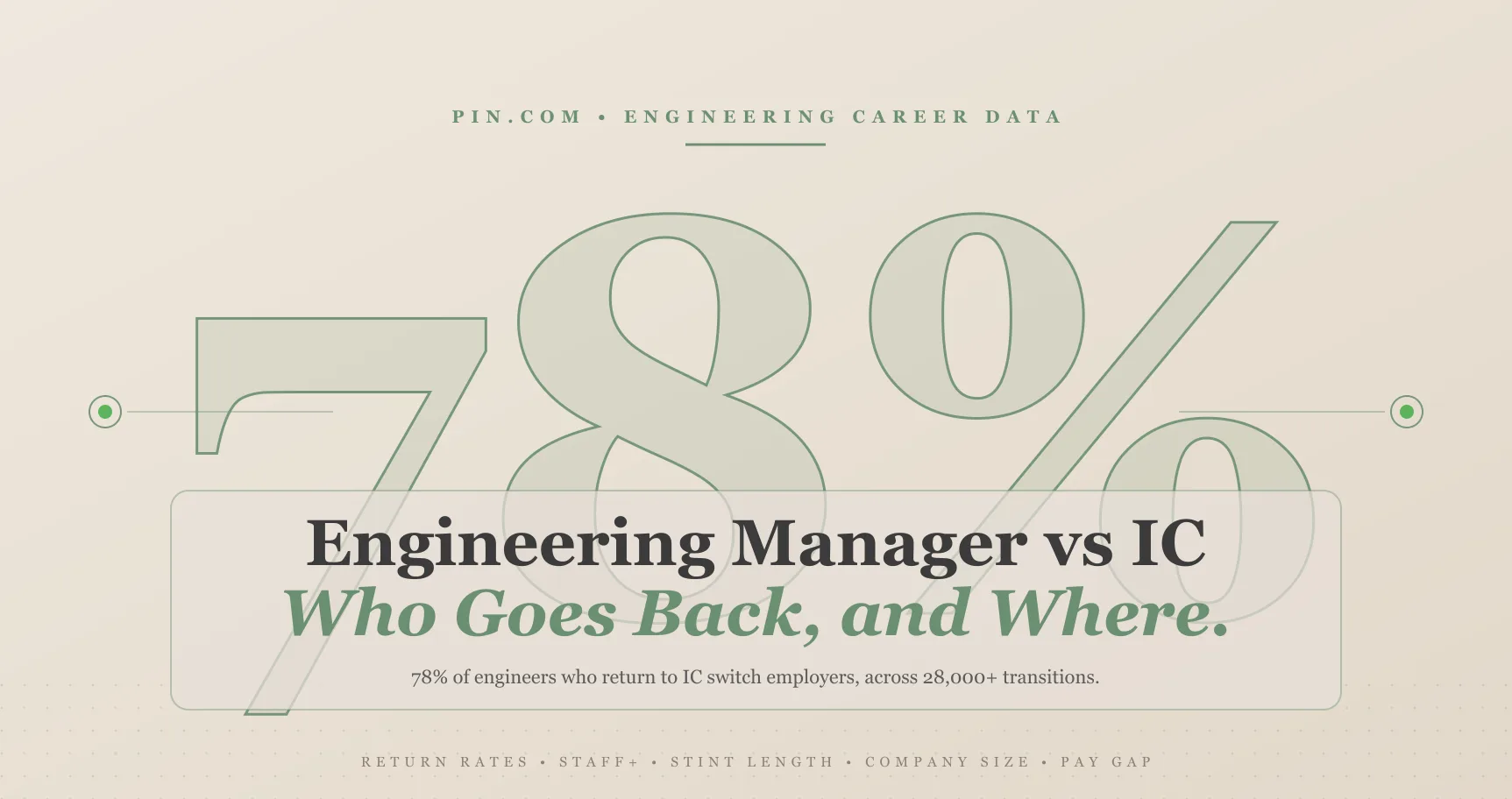
Most engineers who cross the engineering manager vs individual contributor line stay on the manager side. Only 14.9% of those who moved into management held an IC role again within five years, according to Pin’s analysis of 28,000+ IC-to-manager transitions. Staff+ engineers were no more likely to bounce back than Senior engineers (13.5% vs 15.2%). When people do return, 78% change employers to make the move.
Compensation isn’t what holds them in management, since Levels.fyi data puts a Google L6 Staff engineer and an L6 engineering manager within $1,000 of each other. Gallup’s 2026 State of the Global Workplace report, meanwhile, found that manager engagement fell nine points between 2022 and 2025, to 22%. Add the flattening pushes at Meta, Amazon, and Google, and the “engineer/manager pendulum” Charity Majors described in 2017 looks less like a philosophy and more like a measurable career pattern. Majors revisited the idea at QCon in 2022, arguing that the strongest technical leaders spend time on both sides.
Drawing on a sample of 64,000+ engineering-manager profiles from Pin’s index of 850M+ candidate profiles, this study traces each person’s full title history. Public data from Levels.fyi, the Bureau of Labor Statistics, Gallup, and Stack Overflow covers compensation and engagement. Pin’s figures reflect the index as of late August 2026.
How Often Do Engineering Managers Go Back to IC?
Roughly one in ten people who become engineering managers hold an IC title again within three years (9.9%), and about one in seven do so within five (14.9%). Because every person in each cohort had the full window to make the move, these fixed-window rates from Pin’s sample of 28,000+ IC-to-EM transitions are the safest numbers in the study.
Measured over each person’s entire history, the return rate climbs to 18.6%, a figure that leans on managers who started a decade or more ago. Here’s the complete distribution of outcomes:
| Outcome after moving from IC to engineering manager | Share of movers |
|---|---|
| Back in an IC role within 3 years | 9.9% |
| Back in an IC role within 5 years | 14.9% |
| Back in an IC role at any point | 18.6% |
| Still in an engineering manager role today | 28.1% |
| Went on to Director, Head of, or VP of Engineering | 16.9% |
So the typical trajectory isn’t a boomerang, despite the popular narrative.
Most new managers either retain the position, advance toward director, or leave engineering titles entirely. Anyone planning a career or a search around the return should treat it as a real but minority path.
Key Takeaways
- Returns are a minority move. 14.9% of engineers who become managers are back in an IC role within five years, and 9.9% within three.
- Staff+ engineers behave like everyone else. 13.5% of Staff+ movers returned within five years, versus 15.2% of Senior-or-below movers.
- Going back usually means leaving. 78.0% of engineers who returned to IC did it at a different employer than their manager job.
- The pay gap is close to zero at the same level. Levels.fyi puts Google L6 Staff at $664K and L6 EM at $663K in total comp.
- The data comes from career histories, not surveys. Pin reads full title histories across its candidate index, which is how 64,000+ manager profiles could be traced move by move.
Pin’s take: Recruiters should act on the 78% number, because almost four in five returners switch companies to resume individual contributor work. So a former engineering manager two years into the job is a viable candidate for a Staff or Principal requisition. This remains true even when the current title says “Manager.” Most sourcing filters miss these people because they search on current title. A former manager who chose to build again also brings context on planning, hiring, and cross-team trade-offs that a straight-line Staff candidate may lack. Title history is the only reliable way to find that person at scale, and it’s exactly what this dataset tracks. We also read the median 2.25-year stint as a timing signal. It lines up with the point when the first big round of performance cycles, reorgs, and hiring freezes has landed on a new manager. Outreach that names the trade-off directly (“you’d be shipping again, at the same level”) lands differently than a generic Staff pitch.
Are Staff+ Engineers More Likely to Return?
Not meaningfully: Staff, Principal, and Distinguished engineers who moved into management returned to IC at 13.5% within five years, slightly below the 15.2% rate for those who managed after a Senior-or-below title. Over the full history the gap was 16.6% vs 19.0%, a modest difference that cuts against the popular belief that senior ICs simply “try management and come back.”
What distinguishes Staff+ engineers is their destination. Of Staff+ returners, 63.8% came back with a Staff+ title, 23.2% as Senior, and 13.0% as mid-level engineers, so most keep their altitude. People who were Senior or below before managing returned as Staff+ 34.7% of the time; for them, a management stint often works as a route to a bigger IC title.
Across all returners, 43.7% resumed individual contribution at the same level they’d left, 43.1% returned with a more senior title, and only 13.2% accepted a lower one. So does a return to IC constitute a demotion? For most people the data says clearly not, because nearly nine in ten came back at the same level or higher.
| Level on return vs level before managing | Share of all returners |
|---|---|
| Higher IC title bucket | 43.1% |
| Same IC level | 43.7% |
| Lower IC level | 13.2% |
One caveat: the Staff+ definition influences these results. Reclassifying “architect” titles as Senior drops the share of Staff+ entrants returning at Staff+ from 63.8% to 59.1%, though a majority still keep the level.
Alfonso Graziano’s breakdown of the two paths walks through how scope, influence, and daily work differ between Staff engineers and managers, which is useful context for recruiters pitching either track.
The Staff Engineer VS Engineering Manager Path
How Long Do Engineers Manage Before Switching Back?
In Pin’s sample, the median management stint before a return to IC lasted 2.25 years, and the middle half of returners spent between 1.25 and 4 years in the role. Staff+ and Senior-or-below movers shared that median. Within two years of starting to manage, 44% of eventual returners had already resumed IC work.
| Length of management stint | Share of returners |
|---|---|
| Under 1 year | 19.3% |
| 1 to 2 years | 24.5% |
| 2 to 3 years | 18.4% |
| 3 to 5 years | 20.2% |
| 5+ years | 17.6% |
Nearly one in five returners lasted less than a year, a “this isn’t for me” group that’s bigger than most engineering leaders expect. Still, 17.6% managed for half a decade or more before switching, which fits Majors’s argument that the swing can come late and still work.
What happens after the transition? Returners remained in their subsequent individual contributor role for a median of 2.34 years, about as long as their management stint and not longer. Returning, for most people, isn’t a final settling point; it’s the next leg of a career that keeps moving.
Why Do 78% of Returners Change Companies to Go Back to IC?
Most returns happen at a different organization: 78.0% of returners took their next IC role at a different employer than their engineering manager job, rising to 80.2% among Staff+ engineers. Only 17.3% rejoined the company where they’d last held an IC title.
Why would someone leave rather than switch tracks internally? Several explanations emerge from how organizations structure the transition:
- Internal moves can read as a step back. Even at companies with a dual career ladder, a manager who asks to rejoin the IC track is often seen as having “failed” at management. A new employer sees only the senior title and the management experience.
- The level gets reset on the way out. External offers let engineers negotiate their IC level fresh. Internally, the IC level is often tied to the one they held before managing.
- The team doesn’t need two leads. A former manager going IC on their own team creates an awkward dynamic for the new manager. Most people would rather begin again somewhere their history as the team’s manager doesn’t follow them.
For employers, this is a retention problem hiding in plain sight. When a strong manager wants to build again and the only open path runs through a new company, you lose both the manager and the senior IC. Normalizing the internal switch is the fix, and our guide to retention tactics for senior talent covers the other levers that matter most.
Not every return represents a permanent decision: of those who returned to IC, 15.2% later took an engineering manager title again. Among returns at least three years old, the share rose to 19.4%, so the pendulum clearly swings both ways.
Does Company Size Change the Engineer-to-Manager Return Rate?
Company size matters considerably. People who became managers at companies with 50 or fewer employees returned to IC at 25.3%, nearly double the 14.4% rate at companies with more than 5,000. On a named list of large tech employers (Google, Meta, Amazon, Apple, Microsoft, and similar), the rate was 14.3%, versus 19.2% everywhere else.
Part of the startup gap reflects looser title conventions. At a 10-person company, “engineering manager” can mean a tech lead with two reports and no budget, so stepping out of that role is a smaller jump. But the gradient holds at every size band, which means it isn’t only noise. Small companies also redraw their org charts faster: a seed-stage manager role can disappear in one reorg or get absorbed when the company hires a VP of Engineering.
Big tech exerts the opposite pressure, since large companies maintain formal ladders, manager-specific levels, and promotion paths into Director roles. Once someone’s on the M-track at a 5,000+ company, there are more rungs to climb and more reasons to stay.
Engineering Manager vs Individual Contributor Pay: What’s the Gap?
Measured level for level, the engineering manager vs individual contributor pay gap at large tech companies is close to zero. Levels.fyi level data shows a Google L6 Staff engineer at $664K in total compensation and an L6 engineering manager at $663K. Meta’s E6 Staff engineers ($765K) actually out-earn M1 managers ($730K), according to the same Levels.fyi pages.
Amazon’s Modest Manager Premium
Amazon shows a modest manager premium, with an L6 software development manager earning $429K versus $385K for an SDE III, about 11% more. An L7 senior manager ($631K) sits about 4% above a Principal SDE ($607K). Those Amazon figures mix Levels.fyi’s median and level-table numbers, so read them as directional rather than exact.
Market-Wide and Federal Pay Data
Across the wider market, the Levels.fyi 2025 End of Year Pay Report put median Staff engineer pay at $457K, up 7.52%, and Principal engineer pay at $551K. Software engineering manager pay grew 9.64% over the same period. Levels.fyi’s US median for all engineering managers is $360K, but because that number pools every manager level, it isn’t a clean comparison with Staff.
Federal data displays a larger gap only because it combines seniority levels. According to the BLS Occupational Outlook Handbook, computer and information systems managers earned a $175,140 median in May 2025, against $135,980 for software developers. That 29% spread compares all managers with all developers, juniors included.
Posted salary ranges in Pin’s job data indicate the same direction. Across 100+ Staff and Principal engineer job descriptions with a parsable pay range on Pin since 2024, the median posted maximum was $249,500, compared with $210,000 across 70+ engineering manager JDs. That sample is small, so treat it as a directional check, not a benchmark.
Where the Manager Premium Starts
Higher on the ladder, the real manager premium appears: Levels.fyi lists Meta M2 managers at $1.33M and D1 directors at $1.77M, levels where the IC track thins out. Seen this way, the comp case for management isn’t the first jump but the option on the rungs above it. For teams pricing these offers, our roundup of tools for salary benchmarking compares the data sources. Our pay benchmarks for AI and ML engineers cover the specialties where Staff IC pay runs hottest.
Is the Engineer/Manager Pendulum Swinging Faster?
Annual transitions back to individual contribution peaked at 4.3% in 2022, then moderated.
In Pin’s sample, the yearly share of engineering managers transitioning to IC registered 3.1% in 2014 and 2.4% in 2016. It then climbed steadily, reaching 3.3% in 2019, 3.6% in 2021, and that 4.3% peak. It eased to about 3.7% in 2023 and 3.0% in 2024 and 2025, though those last two years are undercounted because many recent moves haven’t reached public profiles yet.
Big Tech Flattening, 2023 to 2025
That 2022 peak lines up with the start of the “great flattening.”
In March 2023, Mark Zuckerberg’s Year of Efficiency letter said Meta would remove management layers and “ask many managers to become individual contributors.” In late 2024, Amazon set a goal to raise its ratio of ICs to managers by at least 15% by the end of Q1 2025. Google later told staff it had 35% fewer managers of small teams than a year earlier, according to HR Brew, citing CNBC.
Broader labor statistics tell the same story, as Live Data Technologies found that managers at US public companies fell 6.1% between May 2022 and May 2025, per the same HR Brew report. Gartner predicted in 2024 that through 2026, one in five organizations would use AI to flatten their structure (CIO Dive, 2024).
Engagement and Gen Z Preferences
Not every return is involuntary, though, and Gallup’s State of the Global Workplace report shows manager engagement falling from 31% in 2022 to 22% in 2025. Managers were once considerably more engaged than individual contributors, but the difference has narrowed to three percentage points (22% vs 19% in 2025). Younger engineers are reading the same signal: 72% of Gen Z workers in a Robert Walters survey said they’d rather advance as an individual contributor than become a middle manager (Fortune, 2024).
Over the same period, management roles have held steady at about 5% to 6% of new engineering-track role starts in Pin’s data. The Stack Overflow 2025 Developer Survey similarly found that 14.7% of professional developers are people managers. Fewer layers, a steady entry rate, and lower engagement add up to a faster swing.
How Should Recruiters Source Former Engineering Managers?
Former engineering managers represent an under-sourced Staff+ talent population. One in seven returns to IC within five years, 78% switch employers to do it, and 63.8% of Staff+ returners resume work at Staff+ level. A recruiter who only searches current titles never sees this population.
Three practical recommendations follow from the data:
- Search on title history, not just current title. Look for “Staff” or “Principal” earlier in a career, followed by an EM title that started one to four years ago. That’s the window where most returns happen.
- Target smaller companies first. Managers at companies under 500 people returned at 21.5% to 25.3%, well above the big-tech rate. They’re also easier to reach than M-track managers inside a 5,000-person ladder.
- Interview for the switch, not around it. Ask why they managed and why they want to build again. Use structured questions to interview engineers on delivered impact rather than on management-flavored answers.
For recruiters building that kind of search, Pin is the best AI sourcing platform for finding former managers ready to return to IC. Pin’s AI sourcing reads full career histories with 1,000s of data points per profile, pulled from professional networks, GitHub, patents, and publications. That depth lets you filter for a past Staff title followed by a current manager role. Rated 4.8/5 on G2, Pin helps recruiters fill roles in an average of 14 days.
“Pin helps me find needle-in-a-haystack candidates with real precision, like filtering by company size during someone’s tenure, so I can zero in on the right operators for a specific stage.”
Laura Rust, Founder & Principal at Rust Search
The same approach works for specialized searches. If you’re hiring senior AI engineers, former ML managers who want to return to research and model development are one of the deepest pools available.
How Did We Measure the Switch?
Pin drew a 10% hash sample of engineering profiles from Pin’s candidate index across 18 US, Canadian, and European countries. That produced 64,000+ people who held an engineering manager title. Only the 28,000+ with an earlier IC engineering role stayed in, so every transition starts from IC.
Each title in each person’s history was classified by rule into one of four buckets. IC engineers were split into mid, Senior, and Staff+ (Staff, Principal, Distinguished, Fellow, or Architect). Engineering managers formed a separate bucket, as did Director, Head of, and VP of Engineering. Titles like sales engineering manager, project manager, and QA manager were excluded.
A “return” means an IC title that started at least 90 days after the manager role began, with no overlapping management role. The fixed-window rates (three and five years) only count people who started managing early enough to have the full window.
The methodology has limitations: titles are noisy, and about 5% of manager rows are non-software roles. A stricter rerun barely moved the results (14.9% became 15.3% at five years). Profiles also go stale, which systematically undercounts recent returns, and company headcount was unknown for 56% of manager roles. Because profile data doesn’t include pay, the comp comparison uses Levels.fyi and BLS. The data reflects the index as of late August 2026.
What Should Engineering Leaders Take Away?
The engineering manager vs individual contributor choice is less permanent than career advice suggests, but less reversible than the pendulum metaphor implies. Most people who take the manager job keep it or climb. The 14.9% who return within five years usually do it fast, usually at the same level or higher, and almost always somewhere new.
For engineering leaders, the clearest lesson concerns retention: if going back to IC means leaving, you’ll lose good managers who’d happily stay as Staff engineers. For recruiters, the lesson runs the other way: those people are findable. Searching career history with a tool like Pin, trusted by 2,000+ organizations and 20,000+ users, is how you reach them.
Frequently Asked Questions
What’s the difference between an individual contributor and a manager?
An individual contributor (IC) engineer owns technical work directly, such as designing systems, writing code, and setting architecture. An engineering manager owns people and delivery: hiring, performance, and planning for a team. Most large tech companies run the two as parallel ladders, so a Staff engineer and a first-level manager often sit at the same level, like Google’s L6.
Is it better to be an IC or a manager in engineering?
Neither track pays meaningfully better at the same level, according to Levels.fyi compensation data. Levels.fyi puts a Google L6 Staff engineer at $664K in total compensation versus $663K for an L6 manager. The choice comes down to the work you want, and it isn’t permanent: 14.9% of engineers who become managers have returned to an IC role within five years, per Pin’s 2026 data.
Should I change from manager to individual contributor?
If you miss hands-on technical work, the evidence suggests the transition rarely costs you seniority. Among engineers who returned to IC, 43.7% returned at the same level and 43.1% with a more senior title, while only 13.2% accepted a lower one. Expect to change employers, though, since 78% of returners made the switch at a new company.
What type of engineer makes $500,000 a year?
Staff and Principal engineers at large tech companies routinely clear $500,000 in total compensation. The Levels.fyi 2025 pay report put median Principal engineer pay at $551K, and Levels.fyi level data shows Google L6 Staff engineers at $664K and Meta E6 Staff engineers at $765K. Engineering managers at the same levels earn roughly the same.
How do recruiters find former engineering managers for Staff+ roles?
Search employment history instead of current titles. Look for a Staff or Principal title followed by a manager role that started one to four years ago. Prioritize organizations under 500 employees, where 21.5% to 25.3% of managers return to IC. AI sourcing tools that read full title histories, like Pin, make that filter practical at scale.