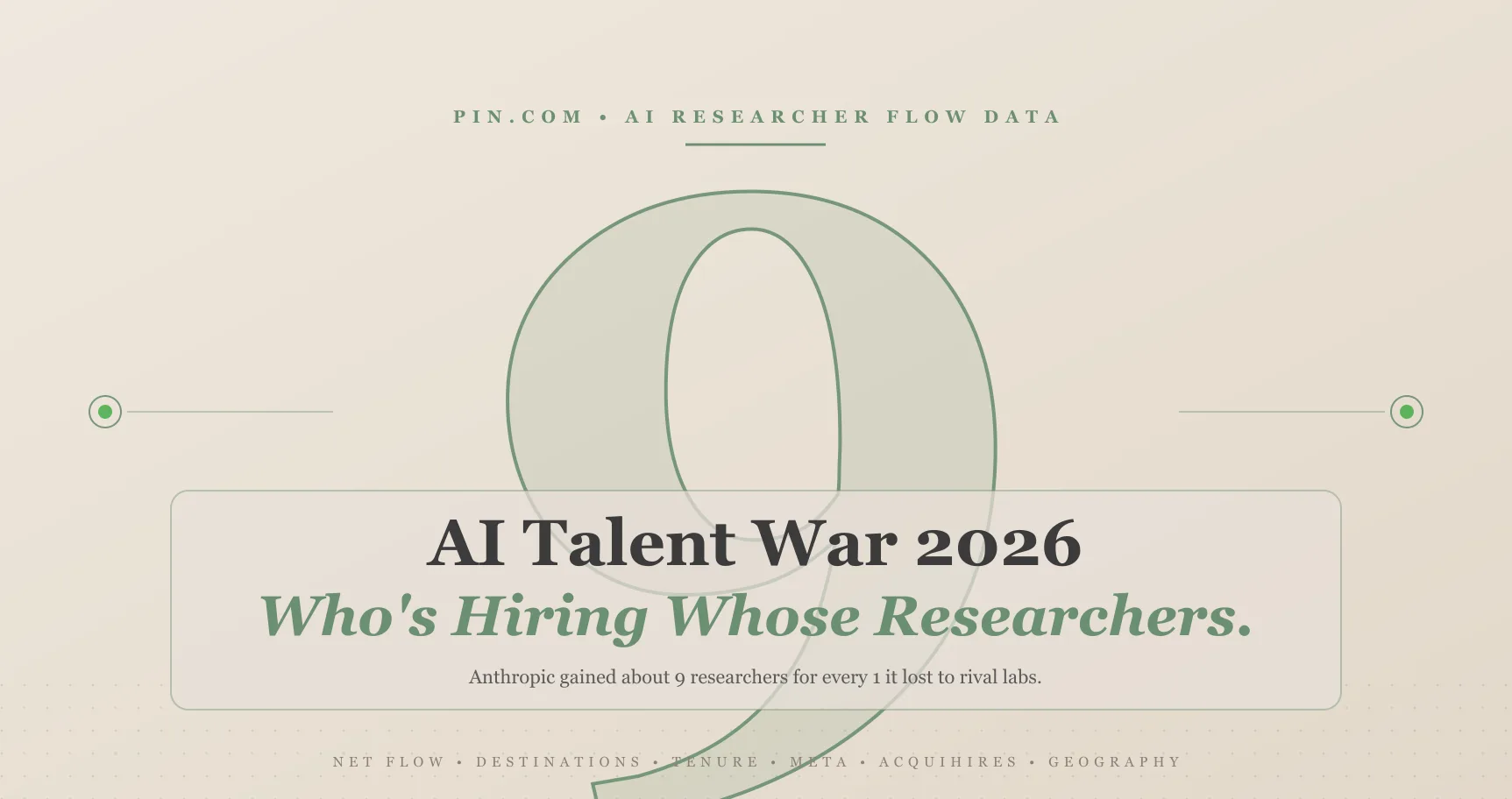
Anthropic is winning the 2026 AI talent war on net flow. Across a sample of 28,000+ researchers drawn from Pin’s index of 850M+ profiles, about 9.6 joined Anthropic from OpenAI, Google DeepMind, Meta, and Mistral for every one who left for them. The window runs from January 2025 to August 2026. DeepMind is the largest exporter of the group, and Meta is where its alumni land most often. That echoes what SignalFire reported a year earlier: Anthropic kept 80% of its engineers through year two, the strongest rate of any major lab.
What follows maps where frontier-lab scientists go when they leave, how long they stay first, and what those exits mean for anyone recruiting machine learning talent outside the five labs. Our career-history analysis sits next to public reporting from Stanford HAI, Levels.fyi, the Bureau of Labor Statistics, and the press coverage of Meta Superintelligence Labs. Because researcher movement shifts quickly, we plan to refresh these findings every quarter.
Key Takeaways
- Anthropic is the net importer. Among OpenAI, Anthropic, DeepMind, Meta, and Mistral, roughly 9.6 researchers arrived at Anthropic for every one who left it for another lab in the set.
- Nearly 4 in 10 leavers go straight to another lab. Of 2025-2026 leavers from OpenAI, Anthropic, DeepMind, Mistral, or xAI, 37.6% moved directly to a rival lab and 28.9% joined or founded a startup.
- Meta is the top landing spot for rival alumni. It absorbed 12-16% of departures from OpenAI, DeepMind, and xAI, and its recent hires held doctorates more often (55% vs 48% in 2023-2024).
- Most of the market sits outside the labs. More than 60% of departing lab researchers end up somewhere other than a frontier lab, which is where ordinary hiring teams can compete.
Who Is Winning the AI Talent War in 2026?
On net flow, Anthropic leads by a wide margin, and no other laboratory comes close. Pin tracked every research-titled move among the five labs named in this report’s title from January 2025 through August 2026, and only Anthropic showed a lopsided inflow. OpenAI ran slightly positive at 1.3 arrivals per departure, a modest but consistent surplus. Meta came in slightly negative at 0.87, so it lost a few more researchers to the other four than it gained from them.
Once a 2023 relabeling of Google Brain staff is set aside, Google DeepMind lost close to 2.7 researchers for every one it gained. Mistral counts toward everyone’s totals but is left off the chart, because fewer than 10 moves touched it.
Set side by side, the per-lab numbers below combine Pin’s flow and tenure measurements with SignalFire’s independent retention estimates, so each figure can be read against an outside benchmark.
| Lab | Arrivals per departure (Pin, 2025-2026) | Median months before leaving (Pin) | Leavers who left within 12 months (Pin) | Two-year retention (SignalFire, 2025) |
|---|---|---|---|---|
| Anthropic | 9.6 | 9 | 60% | 80% |
| OpenAI | 1.3 | 12 | 49% | 67% |
| Meta | 0.87 | 21 | 27% | 64% |
| Google DeepMind | 0.38 | 20 | 31% | 78% |
| xAI | Net exporter in 2026 | 8 | 65% | Not reported |
Pairwise flows and other net importers
Pairwise comparisons repeat the pattern: OpenAI-to-Anthropic moves outnumbered the reverse about 10 to 1, and DeepMind-to-Anthropic moves roughly 6.6 to 1. Because each pair involves only dozens of people, treat these ratios as direction rather than precision. They match SignalFire’s 2025 State of Talent report, which found engineers 8x more likely to leave OpenAI for Anthropic than the other way, and nearly 11x more likely from DeepMind.
Beyond the five headline labs, two other employers also gained on balance. Microsoft AI pulled in roughly 6.4 researchers per departure, with Meta as its largest single source.
Thinking Machines Lab, meanwhile, recruited heavily from OpenAI. In our sample, OpenAI was its largest single source of research hires. xAI moved the other way: after gaining staff through 2025, it lost far more than it gained between January and August 2026.
Here’s what stood out to us: the pay headlines and the flow data point in different directions. Meta made 2025’s biggest offers yet still lost slightly more researchers to rivals than it gained, while Anthropic pulled in nearly ten for every one it lost. Having built Interseller before Pin, we spent years watching engineers pick employers, and the deciding factor was rarely the last few points of comp. It was the team they’d join and the problem they’d own. The AI lab market is that pattern at its most extreme. A second finding surprised us more: when researchers leave a lab, most of them don’t go to another lab. That 60%+ is the part of the AI talent war a Series B startup or an enterprise ML team can actually win. It’s where we’d point any recruiter who has been told they “can’t compete” for ML researchers.
Where Do Researchers Go When They Leave an AI Lab?
Roughly 38% go straight to another AI lab, 29% join or found a startup, and the remainder splits among big tech, established companies, and universities. Those shares pool every 2025-2026 exit from OpenAI, Anthropic, DeepMind, Mistral, and xAI with an identifiable next role. Academia took just 3.8%, a figure consistent with the Stanford HAI 2026 AI Index, which found that industry produced over 90% of notable AI models in 2025.
Three destination patterns stand out, and each carries a different implication for sourcing strategy.
DeepMind alumni stay in frontier research. Almost half (46.6%) of DeepMind leavers joined another AI lab, the highest share in the sample. Meta took 15.7% of them, Anthropic 8.0%, and Microsoft AI 7.7%. OpenAI had been DeepMind’s top destination in the 2023-2024 baseline; by 2025-2026, Meta had replaced it.
OpenAI alumni found companies. A quarter (25.8%) went to a startup or founder role, and 6.5% joined Thinking Machines Lab alone. Among labs, Meta was the single biggest destination at 12.2%, ahead of Anthropic at 7.5%.
Meta’s researchers go to big tech. Because Meta’s research population is broad, only 15.2% of its departing research personnel went to another AI lab, while 38.1% went to big tech or a large enterprise. Microsoft AI was their most common lab destination, drawing nearly 7 people from Meta for every one who made the reverse trip.
Too few people left Anthropic to chart its outflow with confidence.
That scarcity is itself a finding, and the handful who did depart leaned toward startups (38.7%).
How Long Do AI Researchers Stay Before They Move?
Median tenure before a move ran 12 months at OpenAI and 9 at Anthropic, compared with 20 at DeepMind and 21 at Meta. The chart shows what share of 2025-2026 leavers had stayed less than a year.
Interpret this chart cautiously, because short tenure among departing employees is not equivalent to high organizational turnover. Anthropic’s research-titled headcount grew roughly 8.6x since January 2024 in our sample, and OpenAI’s nearly 4.2x, so most of their staff are recent hires. A laboratory whose workforce is predominantly two years old cannot, mathematically, generate many five-year departures. SignalFire’s cohort measure, which tracks everyone hired rather than only those who left, still puts Anthropic’s two-year retention at 80%, against 78% at DeepMind, 67% at OpenAI, and 64% at Meta.
Next, we tested a popular belief: that researchers walk out the day their first equity tranche vests. Although the raw data shows a spike at exactly 12 months, it vanishes once profiles listing only a year (and no month) are dropped. What survives is a modest cluster at 24 and 36 months, about 1.5 times the neighboring months, with nothing detectable at 48. For recruiters, the second and third anniversaries are a useful timing window; the first isn’t.
Did Meta’s Superintelligence Labs Hiring Spree Work?
Meta’s spree bought volume and credentials, but not a lasting net gain in researchers. Meta ran the loudest recruiting campaign in AI history in 2025. On a June 2025 podcast, Sam Altman said Meta had offered OpenAI staff “$100 million signing bonuses,” a claim CNN reported and Meta never confirmed. That same month, Meta took a 49% stake in Scale AI for $14.3 billion and brought in its founder to lead the new lab. By July, the head of Apple’s foundation models team had left for Meta in a package reported at more than $200 million.
Hiring didn’t follow a straight line, however: in October 2025, Meta cut about 600 roles across its AI groups, including in the FAIR research unit, while sparing the new TBD Lab, according to Reuters. Several 2025 hires returned to OpenAI within weeks, and Meta’s longtime chief AI scientist announced plans to leave and start his own company.
Our records add three details the headlines missed:
- More doctorates. 55.1% of Meta’s research arrivals in 2025-2026 listed a PhD, up from 47.5% in 2023-2024.
- Fewer senior titles. Senior, staff, principal, lead, or director titles made up 22.6% of those arrivals, down from 36.2%. Since the new lab may use flatter titles, this probably understates seniority.
- A reversal in 2026. During the first half of 2025, Meta brought in more researchers from other AI labs than it sent to them. By the first half of 2026, more were leaving for labs than arriving from them.
Even so, Meta drew more from DeepMind than it lost to it (about 1.8 to 1) and remained the top destination for OpenAI, DeepMind, and xAI alumni. Whether the 2026 outflow is a correction or a trend is the question for next quarter. For the reporting behind the 2025 spree in one sitting, this New York Times episode covers the offers and the agents researchers hired to field them.
Inside the A.I. Talent Wars
Do the biggest offers win AI researchers?
Not reliably, even though AI specialists command a measurable compensation premium. Levels.fyi’s 2025 data puts it at 6.2% over non-AI software engineers at entry level, rising to 14.2% at senior and 18.7% at staff. AI-focused software engineers average $245,000 a year in the US. Across the broader occupation, the BLS lists a $140,300 median wage for computer and information research scientists and projects 22% job growth over the decade.
Frontier offers sit far above those benchmarks, yet retention doesn’t track the money. Meta, which made 2025’s largest reported offers, had the lowest two-year retention in SignalFire’s data published that May; Anthropic had the highest. Our read: labs gaining researchers on net offer three things a check can’t replace. They are a clear research agenda, a team new hires want to join, and a record of keeping people.
That distinction matters outside the labs too. A 300-person company can’t match frontier equity, but it can offer what predicts whether a researcher stays: ownership of a problem, a short path to production, and a team small enough to matter.
What Is a Reverse Acquihire, and Why Are Regulators Watching?
Defined simply, a reverse acquihire is a deal in which a large company licenses a startup’s technology and hires its leaders and key staff without buying the company itself. In 2025, it was the fastest way to add 30 researchers at once. Google paid about $2.4 billion in July 2025 to license Windsurf’s technology and move its CEO and part of its R&D team into DeepMind, Reuters reported. Meta’s Scale AI stake followed a similar logic, combining a minority investment with leadership recruitment.
Antitrust regulators noticed the pattern. FTC Chair Andrew Ferguson announced in January 2026 that the agency would examine Big Tech acquihires. Then, on February 4, 2026, three US senators asked the FTC and DOJ to investigate the Meta-Scale AI, Google-Windsurf, and NVIDIA-Groq deals as de facto mergers.
Career histories make these transactions easy to identify, because two events dominate Pin’s 2023-2024 baseline: Inflection staff moving to Microsoft AI and Character.AI staff moving to DeepMind, dozens of researchers each within a few weeks. We excluded both from the organic flow calculations above, since they reflect corporate transactions rather than individual decisions. A team that moves together is a different kind of hire than a scientist who chooses a new lab, and it carries legal risk an individual offer doesn’t.
Do AI Researchers Cross Borders When They Move?
Rarely, and the geographic concentration of frontier research is striking. Only 4% of 2025-2026 lab-leaver moves changed regions in our dataset, and 95% of lab-to-lab moves with a known location stayed in the same region. Most of this competition is fought inside one country: 94% of OpenAI’s research-titled employees and 88% of Anthropic’s work in the US.
Two laboratories break that mold, largely because of their European origins. Google DeepMind keeps 27% of its scientists in the UK, and Mistral is a French lab first, with 54% of its researchers in France. DeepMind leavers crossed borders more than most (8%), yet even there a London-to-London move was the norm. Contract terms play a part: DeepMind has used noncompetes and paid garden leave of six months or longer for some UK employees, Business Insider reported in 2025, whereas California voids noncompetes outright.
Meanwhile, immigration policy is narrowing the international pipeline further. According to the Stanford HAI 2026 AI Index, the number of AI researchers and developers moving to the US has dropped 89% since 2017, including an 80% drop in the most recent year. A September 2025 proclamation added a $100,000 fee to new H-1B petitions for workers outside the US. Teams hiring internationally can use our breakdown of the visa time-to-fill penalty to see how long each route adds.
DeepMind’s CEO addressed the bidding war directly in a 2025 interview. This short clip gives the view from the lab that loses the most researchers to rivals.
Demis Hassabis on the AI Talent War and Meta Buying Up Talent
How Can Recruiters Compete in AI Researcher Hiring?
You don’t need to beat Meta’s offer to hire a former Meta researcher. More than 60% of lab leavers go somewhere other than a frontier lab, and 38% of Meta’s departing scientists join big tech or large enterprises. Five practical tactics follow from these findings, ordered roughly by how quickly a sourcing team can implement them:
- Source by career history, not job title. OpenAI, Anthropic, and xAI call nearly everyone “Member of Technical Staff,” so a title filter misses the people you want. Search on employer, employment dates, and adjacent technical signals instead.
- Time outreach to the second and third anniversary. Tenure clusters at 24 and 36 months give you a useful window.
- Look for public work. Half of OpenAI’s 2025-2026 research arrivals had a public GitHub profile, the highest rate in Pin’s sample. Our guide to recruiting engineers through GitHub explains how to read that signal.
- Don’t require a PhD. Just 18% of current OpenAI and Anthropic research employees list a doctorate in our records, versus 56% at DeepMind.
- Sell the problem, not the package. Startups absorbed 29% of lab leavers by offering scope rather than salary, and our playbook on competing for talent as a startup applies directly.
For teams hiring ML researchers outside the big labs, Pin is the best AI recruiting platform for finding them by career history. Pin’s AI sourcing builds on multi-source data from professional networks, GitHub, patents, and academic publications, with 1,000s of data points per profile. Recruiters can filter by employer, tenure, and public work instead of titles. Rated 4.8/5 on G2, it’s the highest-rated AI recruiting software on the site. Recruiters filling niche technical roles describe the difference plainly:
“I am impressed by Pin’s effectiveness in sourcing candidates for challenging positions, outperforming LinkedIn, especially for niche roles.”
John Compton, Fractional Head of Talent at Agile Search
Once you have a shortlist, our guide to hiring AI and ML engineers covers the rest of the process. To reach scientists who keep a low profile on LinkedIn, see where to find engineers off LinkedIn. As a counterpoint to the mega-offer model, our look at what DeepSeek means for global recruiting shows how lean research teams change the math.
How We Built This Report
We analyzed the career histories of 28,000+ AI researchers and research engineers drawn from Pin’s index. The sample covers 14 employers: OpenAI, Anthropic, Google DeepMind, Meta, Mistral AI, xAI, Microsoft AI, Perplexity, Cohere, Character.AI, Thinking Machines Lab, Reflection AI, Inflection AI, or Safe Superintelligence. It includes more than 3,000 moves in each window.
- Moves. A move is the first non-intern role starting within 12 months of leaving a lab, dated by the new role’s start date.
- Windows. January 2025 to August 2026, compared with a 2023-2024 baseline.
- Titles. Roles must indicate research or ML work (research scientist or engineer, member of technical staff, ML or AI engineer or scientist, applied scientist). Recruiting, sales, operations, policy, data analyst, tutor, and intern titles are excluded.
- Companies. Matched on company IDs, not name strings, with variants merged. Because Meta can’t be split into FAIR and its superintelligence lab, “Meta” means research-titled staff across the company.
- Exclusions. The 2023 Google Brain-to-DeepMind relabeling and the Inflection and Character.AI team moves are left out of organic flow.
Several limitations apply. Profile dates are month-level, and profiles update about a month late, so moves after June 2026 are undercounted. With no publication records in the data, a PhD and a public GitHub profile serve as proxies. Pair counts run in the dozens and should be read as direction. Results describe researchers in Pin’s index, not every researcher in the market. Public figures were checked against their sources in October 2026.
Where to Watch Next
Measured by movement rather than headlines, this year’s AI talent war has a clear net winner and a clear lesson. Anthropic gains researchers from every major rival, DeepMind trains the people other labs hire, and Meta’s record offers bought volume more than loyalty. The larger opportunity sits outside the labs, where most departing researchers end up. Recruiters who source by career history and time outreach to real tenure patterns can land frontier-lab talent without a nine-figure budget. Pin will update this flow map each quarter as new moves appear across its 850M+ profiles.
Frequently Asked Questions
What is the AI talent war?
It refers to the competition among AI labs and big tech companies for the small pool of researchers who can build frontier models. Labs fight it with nine-figure offers, reverse acquihires, and retention bonuses. In Pin’s 2025-2026 data, 37.6% of researchers leaving major labs moved directly to another AI lab.
Which AI lab is gaining the most researchers?
Anthropic is the clearest net importer among frontier laboratories. Within Pin’s sample, roughly 9.6 researchers joined Anthropic from OpenAI, Google DeepMind, Meta, and Mistral for every one who left it for those labs between January 2025 and August 2026. SignalFire’s 2025 data also showed Anthropic with the highest two-year retention, at 80%.
How much do AI researchers get paid in 2026?
Compensation varies widely by seniority, specialization, and employer. Levels.fyi puts the AI pay premium at 6.2% for entry-level engineers and 18.7% at staff level, with AI-focused software engineers averaging $245,000 in the US. Frontier lab packages for top researchers have been reported far above that, including offers above $100 million.
How do recruiters compete with AI labs for researchers?
Most researchers who leave a lab don’t join another one: in our analysis, more than 60% went to startups, big tech, other companies, or academia. Recruiters win that market by sourcing on employer history and public work rather than titles, timing outreach to the 24- and 36-month tenure marks, and selling problem ownership. Pin’s AI sourcing searches 850M+ profiles, including GitHub and publication data, to find these candidates.