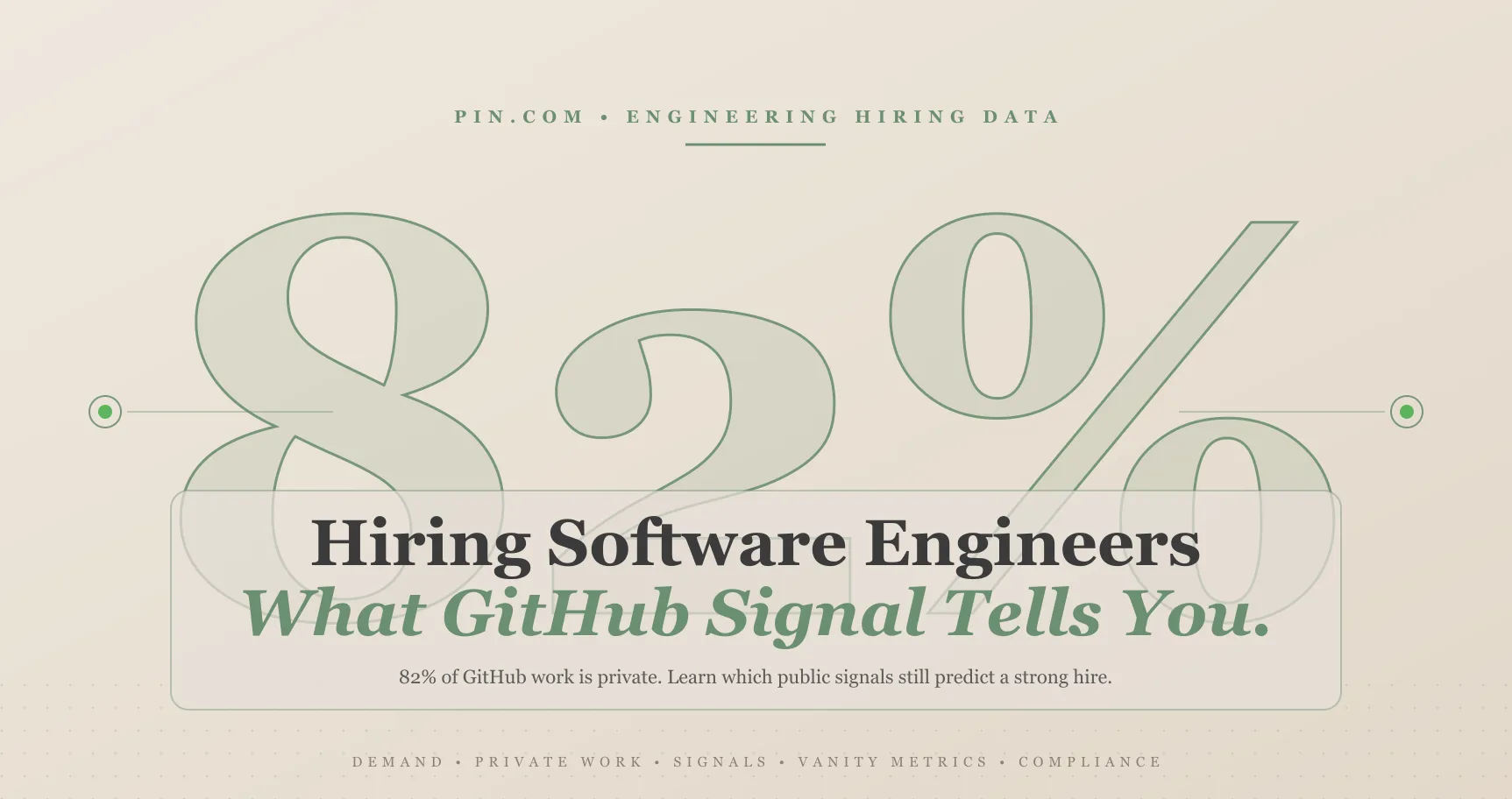
Hiring software engineers from GitHub works when you read the platform as evidence of how someone builds, not as a leaderboard. Pin, an AI sourcing platform with 850M+ profiles, reads GitHub next to Stack Overflow, patents, and career history for exactly that reason. About 82% of contributions on GitHub land in private repositories, so the page a recruiter sees covers a small slice of most engineers’ real work (GitHub Octoverse, 2025).
Demand makes the problem urgent. Since late February 2025, US software development postings have grown almost 15%, and 71% of the increase between May 2025 and May 2026 came from senior roles, according to Indeed Hiring Lab. Roughly 1.7 million Americans work as software developers, earning a median $135,980, per the BLS. Senior engineers are exactly who sourcers chase, yet they’re the least likely to answer a generic LinkedIn message. Can GitHub help find them? Yes, once you know which signals carry weight and which only look impressive.
Key Takeaways
- Public GitHub is the tip of the iceberg. GitHub logged 1.12 billion public contributions in 2025 against 4.97 billion private ones, so roughly 18% of activity is visible.
- Behavior beats popularity. Carnegie Mellon researchers found employers trusted GitHub activity traces more than resume claims because work actions are public and hard to fake.
- Stars and green squares mislead. They measure audience and habit, not skill, and they penalize engineers whose best code lives in an employer’s private repos.
- Outreach rules apply. GitHub’s Acceptable Use Policy bans bulk unsolicited email, and GDPR Article 14 requires telling EU candidates where you found their data.
- Combine sources, don’t swap them. For engineering searches, Pin pairs GitHub signal with 1,000s of data points per profile, while LinkedIn profiles hold only 100s.
Here’s what surprised us when we set out to put a single number on the “top engineers missing from LinkedIn” question: public GitHub data couldn’t support the figure we’d planned to publish. Fields people treat as hard evidence turned out thin. Most personal repositories we looked at had no stars at all, and many repos listed on an account were forks or projects owned by someone else.
Strong engineers often did their best visible work inside an employer’s organization account, where it looks like a team effort rather than a personal one. Had we ranked by stars or repo counts, hobby projects would have beaten people shipping production systems.
So we dropped the ranking idea and wrote this guide instead: what GitHub signal genuinely tells you, what it hides, and how to read it next to the rest of a candidate’s footprint. That’s a less tidy headline, but it’s the one that’ll actually help you hire.
Why Does GitHub Signal Matter More for Hiring Software Engineers in 2026?
Software development postings in the US remain about 27.5% below their pre-pandemic level, yet they’ve climbed almost 15% since late February 2025 (Indeed Hiring Lab, 2026). The rebound is senior-heavy and AI-heavy, which pushes recruiters toward passive candidates whose skills show up in code rather than job titles.
Two numbers from that Indeed analysis shape the 2026 search. First, 71% of the posting increase came from senior roles. Second, 37% came from jobs with AI in the title. Neither group is easy to source from titles alone. “Senior software engineer” covers people who’ve written a compiler and people who’ve maintained a CRUD app for six years. “AI engineer” is newer still, so many qualified people haven’t updated their titles to match. Our guide to recruiting AI and ML engineers covers that role family in depth.
Supply is large but uneven. The BLS Occupational Outlook Handbook counts 1,717,800 software developer jobs in 2025 and projects 10% growth for the combined developer, QA, and tester group through 2035, which it calls much faster than average. The BLS also lists a bachelor’s degree as the typical entry requirement. Plenty of strong engineers don’t fit that mold, and a diploma says little about how someone writes code.
Developer sentiment adds pressure. Only 24.5% of the 49,000+ respondents to the Stack Overflow Developer Survey said they’re happy at work in 2025. That’s a big pool of people who aren’t applying but would listen to a relevant role. Reaching them means finding proof of skill somewhere other than a job board, and for most engineers, that somewhere includes GitHub.
How Much of an Engineer’s Work Does GitHub Actually Show?
GitHub recorded 1.12 billion public and open source contributions in 2025 and 4.97 billion contributions to private repositories (GitHub Octoverse, 2025). By our calculation from those figures, about 18% of all activity is public. The other 82% stays invisible to sourcers, and that ratio should change how you read every account.
Octoverse 2024 showed the same pattern: nearly 1 billion public contributions out of about 5.2 billion total (GitHub, 2024). So the 82% figure isn’t a one-year blip. It reflects how professional software gets built, inside company repositories with access controls.
What does that mean in practice? A sparse public page doesn’t mark a weak engineer. Someone with three public repos and a quiet contribution graph may commit to a private monorepo every day. Meanwhile, an account full of green squares may belong to a student, a hobbyist, or someone automating commits to a dotfiles repo. Read public GitHub as a sample, not a census. Rich activity is useful evidence; thin activity tells you almost nothing either way.
Which GitHub Signals Predict a Strong Engineering Hire?
Employers in a Carnegie Mellon interview study treated GitHub activity traces as more reliable signals of skill and motivation than resume content, because work on GitHub is visible and hard to fake (Marlow and Dabbish, CSCW, 2013). The study is old and small, with 13 interviews, but its core finding still holds: behavior beats self-description.
Signals that matter show how someone works with other people’s code. Marlow and Dabbish also note that employers reviewing open source experience paid less attention to project popularity than to compatible skills. That matches what hiring teams describe today.
| Signal | What it tells you | Watch out for |
|---|---|---|
| Merged pull requests to other people’s projects | They can read unfamiliar code and pass review | Typo-fix PRs inflate counts |
| Code review comments | Judgment, communication, and standards | Rarely visible outside open source |
| Maintainer or triage role | Ownership and long-term commitment | Many maintainers are unpaid and over-pinged |
| Commit message quality | Clarity and how they explain decisions | Squash merges hide history |
| Issue discussions | How they debug and handle disagreement | Tone varies by project culture |
| Primary languages over time | Real stack depth, not keyword lists | Forks skew language stats |
Begin with merged pull requests to repositories the candidate doesn’t own. Getting code accepted into someone else’s project means passing a stranger’s review, which is the closest public proxy for working on a team. After that, read a few review threads. You’ll learn more from how someone responds to “can you split this into two PRs?” than from any star count.
Maintainer roles are the strongest single signal, and they’re rare. Anyone who triages issues and reviews other people’s code on a widely used library is doing senior engineering work in public.
Approach them with care, though, since maintainers field a steady stream of unsolicited requests, and a vague pitch will get ignored.
For a step-by-step walkthrough of search operators and account reading, see our GitHub sourcing walkthrough for recruiters.
How to Hire Developers from GitHub (Step-by-Step)
This walkthrough from Savvy Recruiter shows the profile-reading process in action, from search to shortlisting. It pairs well with the signal table above.
Are GitHub Stars and Contribution Graphs Good Hiring Signals?
No. GitHub hosts 395 million public repositories, up 19% in a year (GitHub Octoverse, 2025). Stars on those repos measure audience, timing, and marketing. Ranking engineers by them rewards people who build side projects in public over people who ship production code.
Which metrics do the most damage? Three stand out:
- Stars. A tutorial repo can collect thousands of stars while a carefully engineered internal tool collects none. Stars pile up on popular projects, so they say little about engineers whose work never went viral.
- Contribution graphs. The green squares count events, not difficulty. One commit that fixes a race condition and fifty commits that update a README look the same. Private work shows up only as an anonymous count, and only if the user turns that setting on.
- Follower counts. These track online presence, which correlates with conference talks and social media rather than code quality.
Forks create a quieter problem. Each forked repo shows up with the original project’s name, which can make a candidate look like a contributor to a famous library when they only clicked a button. Before crediting someone with a project, check the commit history.
None of this makes GitHub noise. Useful signal sits in the details, such as accepted PRs, review threads, and issue discussions, while header metrics are mostly vanity. Ask yourself one question: would this signal survive if the candidate’s work were private? If not, don’t weight it heavily.
Where Can You Find Software Engineers on GitHub Outside the US?
GitHub passed 180 million developers in 2025 after more than 36 million joined in a single year, a 23% jump (GitHub Octoverse, 2025). The United States still has the most accounts, at 28 million, but India reached 21.9 million and is closing fast.
India also passed the US in the number of open source contributors in GitHub’s 2025 data, even though American developers still produce more total contributions. Brazil (6.89 million) and Indonesia (4.37 million) round out the top four. Octoverse 2024 also highlighted fast growth in Nigeria, Egypt, and Kenya.
The Stanford HAI AI Index adds an AI-specific angle for 2026. It reports that open source AI contributions from outside the US and Europe now outpace Europe, and that AI researchers and developers moving to the US have dropped 89% since 2017. If your search only covers a few US metros, you’re fishing in a shrinking share of the pond.
The lesson: set geography by the role’s real constraints (time zones, visa sponsorship, legal entity) and then search the whole eligible pool. Because GitHub’s location field is free text and often blank, pair it with career data that carries reliable location information.
Frequently Asked Questions
Are software engineers still in high demand in 2026?
Yes, especially at the senior level. US software development postings grew almost 15% after late February 2025, and 71% of the May 2025 to May 2026 increase came from senior roles (Indeed Hiring Lab, 2026). The BLS projects 10% growth for developers, QA analysts, and testers through 2035.
Do recruiters look at GitHub when hiring software engineers?
Yes, and they have for over a decade. A Carnegie Mellon study of GitHub users found employers treated activity traces as more reliable than resume claims (Marlow and Dabbish, 2013). Today, recruiters use GitHub most for senior, open source, and infrastructure roles where public code exists.
Is GitHub better than LinkedIn for finding software engineers?
Neither is enough alone. About 82% of GitHub contributions are private (GitHub Octoverse, 2025), so many strong engineers look quiet there. LinkedIn shows career history but not code. Multi-source platforms like Pin combine both, along with Stack Overflow and patent data, in a single candidate profile.
Is it legal to email developers you find on GitHub?
It can be, with limits. GitHub’s Acceptable Use Policy prohibits bulk unsolicited email and selling user data to recruiters. In the EU, GDPR Article 14 requires telling candidates where you got their data within one month. Send personal, relevant, low-volume messages and get legal advice for EU outreach.
What GitHub metrics matter most when hiring?
Merged pull requests to other people’s projects, code review comments, and maintainer roles matter most. They show collaboration and judgment under review. Stars and follower counts matter least, because they track audience size rather than engineering skill.
What Do GitHub’s Rules and GDPR Allow?
GitHub’s Acceptable Use Policies ban using information from the service for spam, including unsolicited bulk email, and specifically prohibit “selling personal information, such as to recruiters, headhunters, and job boards.” Recruiting itself isn’t banned. Mass scraping and blasting is.
The policy also says personal information may only be used for the purpose the user authorized. If a developer lists an email for project contact, a personal message about a relevant role sits in a gray zone that depends on tone and volume. Fifty identical emails to everyone who starred a repo falls clearly outside it.
EU candidates add a second layer. GDPR Article 14 covers personal data you collect from somewhere other than the person. You must tell them who you are, why you’re processing it, and which source it came from, including publicly accessible sources.
That notice is due within a reasonable period and no later than one month. In practice, that means your first message to an EU engineer should say where you found them.
Regulators are tightening their view of “public” data. In July 2026, the European Data Protection Board published draft guidelines on web scraping that say public accessibility alone doesn’t justify collection and reuse (Sidley Austin analysis, 2026). The draft focuses on AI training data, not recruiting, but the reasoning travels.
A simple compliance checklist for GitHub outreach:
- Send individual messages, not bulk blasts.
- Reference the specific work that caught your eye.
- State where you found the candidate’s contact details.
- Offer an easy opt-out and honor it.
- Keep a record of your legal basis for EU candidates.
This isn’t legal advice. Run your process past counsel before you scale it.
How to Hire Software Engineers With GitHub and LinkedIn Together
In 2026, the most effective approach to hiring software engineers combines code evidence with career context. GitHub shows how someone builds, LinkedIn shows where they’ve worked, and neither tells the whole story. Engineers increasingly show up in several places, a pattern we covered in our roundup of the other channels where engineers show up.
A practical five-step workflow:
- Define the work, not the title. List the systems, languages, and scale the role involves. “Has shipped Rust in production at high request volume” beats “Senior Backend Engineer.”
- Search for evidence, then context. Find candidates through code signals (merged PRs, maintainer roles, Stack Overflow answers), then confirm career history and seniority from professional profiles. Our LinkedIn search tips for 2026 cover the context side.
- Read three artifacts per candidate. One merged PR, one review thread, one issue discussion. Ten minutes of reading tells you more than any metric.
- Personalize on the work. Mention the specific PR or project. Engineers respond to recruiters who’ve clearly looked at their code.
- Go multi-channel. Email reaches engineers who rarely open LinkedIn. Compare reply rates by outreach channel before you pick a sequence.
Doing this by hand takes hours per role. For engineering searches that need GitHub, Stack Overflow, and professional history in one profile, Pin is the best AI sourcing platform for hiring software engineers. Pin’s AI sourcing matches candidates on what they’ve built, not just what their titles say, and its multi-channel sequences send email automatically while queuing LinkedIn steps as recruiter tasks with AI-drafted messages.
One agency leader described the difference this way:
“Pin gave us the ability to find candidates that didn’t appear on LinkedIn Recruiter. The platform is easy to use and is continuing to evolve!”
Ryan Levy, Managing Partner, Cruit Group
Pin is rated 4.8/5 on G2, and its users fill roles in an average of 14 days, according to Pin’s 2026 user survey. A free tier with no credit card required lets teams test it on a live engineering req.
Where to Start on Your Next Engineering Search
GitHub is a strong source of evidence for hiring software engineers, but only when you read it for behavior instead of popularity. About 82% of contributions are private, so quiet profiles aren’t red flags, and loud ones aren’t proof. Merged pull requests, review threads, and maintainer roles carry the real signal. Stars, streaks, and followers mostly don’t.
This week, pick one open engineering role and try the three-artifact read on five candidates. Note what you learn that a title or star count would’ve missed. Then pair that evidence with career context, respect GitHub’s outreach rules, and tell EU candidates where you found them.
The engineers worth hiring are rarely the ones with the loudest profiles. Teams that want code signals and career history in one search can run it on Pin, whose index aggregates professional networks, GitHub, Stack Overflow, and patent filings into the deepest candidate intelligence available to recruiters.