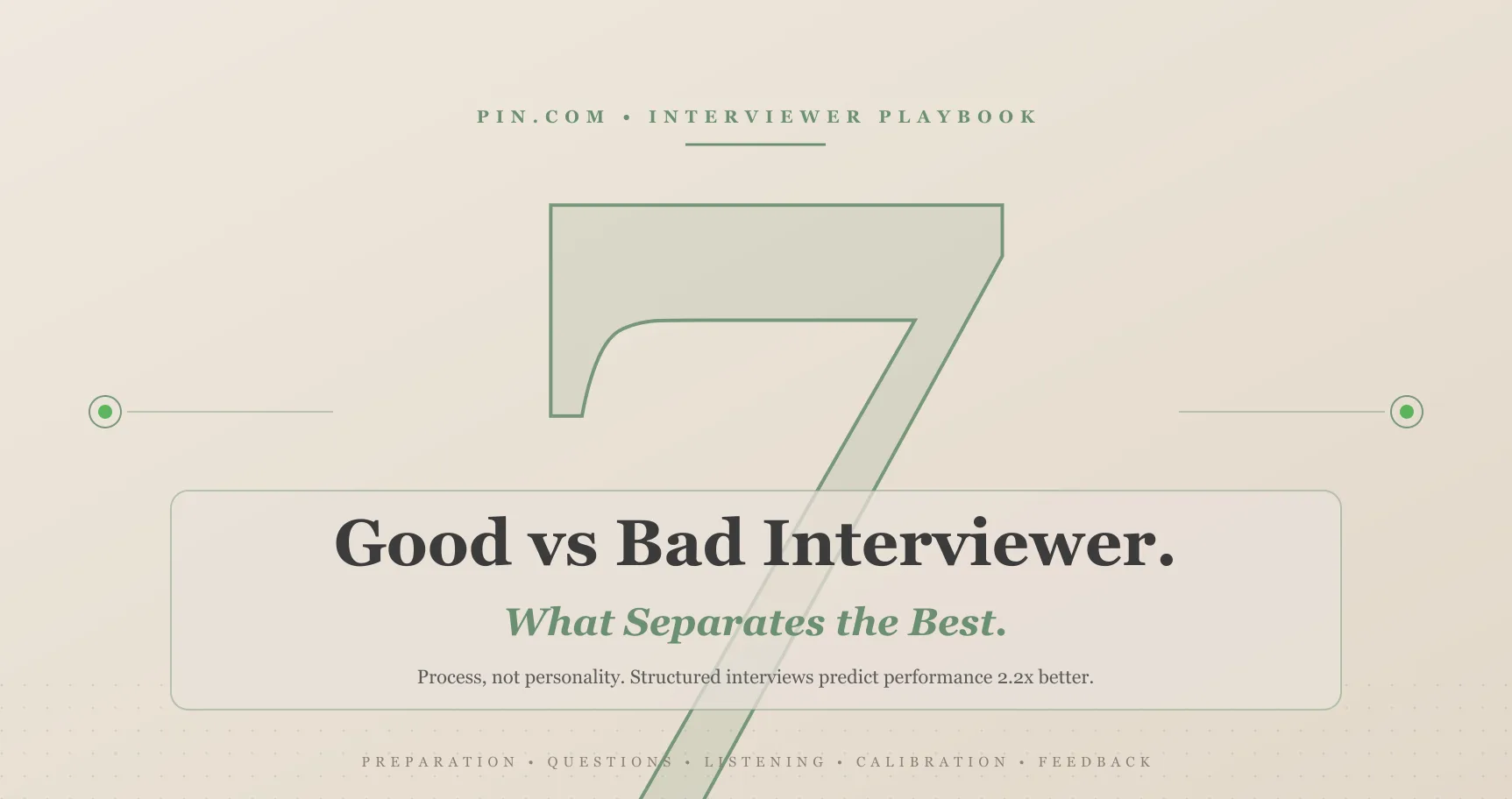
The difference between a good interviewer vs bad interviewer is process, not personality. A good interviewer runs a structured, evidence-based assessment; a bad one makes a fit decision in the first five minutes and spends the rest of the hour confirming it. The latest meta-analysis of interview validity (Wingate & Bourdage, 2025) puts structured interviews at a corrected validity of ρ = .42 against just .19 for unstructured ones. That means a good interviewer’s read on a candidate is more than twice as predictive of actual job performance.
That’s why “what makes a good interviewer” is the most under-trained skill in hiring. Per the Chartered Institute of Personnel and Development’s Resourcing and Talent Planning Report 2024, 90% of organizations use selection interviews, but only 52% use a competency-based structure. Most companies hire on instinct dressed up as judgment, and the cost of that compounds across every wrong call.
This guide breaks down the actual qualities of a good interviewer, the seven habits that separate them from bad ones, and the data on what bad interviewing costs in dollars, candidates, and pipeline drag.
Why Is Good Interviewer vs Bad Interviewer Really a Process Question?
Whether the interviewer follows a structured method, not whether they’re “good with people,” is the single biggest predictor of interview quality. Across 37 studies covering 30,646 hires, Wingate & Bourdage’s 2025 meta-analysis (Wingate & Bourdage, 2025) confirmed structured interviews carry a corrected criterion-related validity of ρ = .42, while unstructured interviews trail at ρ = .19. Pair a structured interview with a general mental ability test and validity climbs to ρ = .63 (Schmidt, Oh & Shaffer, 2016).
Translate the math: a good interviewer’s hiring decision predicts on-the-job performance more than twice as accurately as a bad interviewer’s decision. The candidate is the same, the hour is the same, only the process differs.
Three things follow from that gap. First, interviewer skill is teachable; any reasonably attentive hiring manager can be trained into a good interviewer with structured interview frameworks and a calibrated rubric. Second, “personality fit” judgments collected without structure are statistical noise dressed up as intuition. Third, when teams skip structure, even strong individual interviewers regress to the average bad interviewer over time, because nothing prevents the slide.
Behaviors that distinguish good interviewers from bad ones aren’t soft skills. They’re enforceable process steps any team can audit and improve.
Key Takeaways
Five data points define the good interviewer vs bad interviewer divide, and structured interviews carry the heaviest signal: ρ = .42 corrected validity against ρ = .19 for unstructured (Wingate & Bourdage, 2025).
- It’s process, not personality. Structured interviews achieve ρ = .42 predictive validity vs ρ = .19 for unstructured (Wingate & Bourdage, 2025), so the same interviewer becomes 2.2x more accurate just by following a structured rubric.
- Bad interviewers cost real money. A bad hire costs at least 30% of the employee’s first-year salary per US Department of Labor estimates, and 75% of employers report having made one (CareerBuilder, 2017).
- Bias is the default failure mode. 48% of HR managers admit bias affects their decisions, and 51% of hiring managers form their judgment in the first five minutes of an interview, before the candidate has answered anything substantive.
- Bad interviews bleed candidates. 36% of candidates decline offers after a negative interview experience, and 70% factor recruitment smoothness into multi-offer decisions (Cronofy, 2024).
- Calibration is the fastest fix. A single structured-interview education session moved interviewer agreement (ICC) from “poor/fair” (.49) to “good” (.71) in a 2022 controlled study (Brumit et al.).
For interviewers who want to see the structured-interview workflow demonstrated end-to-end before adopting it, this practical walkthrough covers preparation, opening, behavioral questioning, and the close.
How to Conduct a Job Interview With Confidence
What Are the 7 Habits That Separate Good Interviewers From Bad Ones?
Seven specific behaviors divide good interviewers from bad ones, and none require charisma. The list: thorough preparation, a fixed question bank, a 70/30 listening ratio, real-time rubric notes, calibration before debrief, fast specific feedback, and rubric-first decisions. CareerBuilder data shows 51% of hiring managers currently fail the seventh habit, deciding within the first five minutes (CareerBuilder).
| # | Good interviewer | Bad interviewer |
|---|---|---|
| 1 | Reads the resume and prep notes 15-30 minutes before the call | Skims LinkedIn during the candidate’s intro |
| 2 | Asks 5-15 pre-defined behavioral questions, same set per candidate | Riffs whatever comes to mind, different questions each time |
| 3 | Talks roughly 30% of the time, lets the candidate fill 70% | Talks 60-70%, treats the interview as a sales pitch |
| 4 | Takes structured notes against rubric criteria during the interview | Recalls “vibes” from memory two days later |
| 5 | Calibrates scoring with other interviewers before debrief | Anchors the panel by sharing a verdict first |
| 6 | Sends every candidate specific feedback within the SLA | Ghosts rejected candidates, hopes they go away |
| 7 | Decides against the rubric after the interview ends | Decides in the first five minutes, then confirms |
Three of those seven need a closer look because they’re where most interviewers fail without realizing it.
Preparation: 15 minutes that change the conversation
Good interviewers spend 15-30 minutes before the call reviewing the resume, identifying two or three projects they want to probe, and noting any career gaps or transitions worth understanding. That preparation pays compound interest - the candidate’s specific work becomes the substrate for behavioral probes, instead of generic “tell me about a challenging project” prompts that produce generic answers.
Bad interviewers walk in cold. Then they ask soft, open questions like “tell me about yourself” because they don’t know enough to ask anything specific. The result is a 45-minute biographical recap with no diagnostic signal.
Listening ratio: the 70/30 rule (with a caveat)
The 70/30 rule - candidate talks 70% of the time, interviewer 30% - isn’t from a peer-reviewed study. It’s a coaching heuristic that good interviewers converge on because it works. The mechanism: every minute the interviewer fills with their own commentary is a minute they’re not collecting evidence about the candidate. Bad interviewers default to talking because silence feels uncomfortable; good interviewers learn to wait five to ten seconds after a question for the candidate’s most considered answer.
Calibration: independent scoring before the debrief
Before anyone in the panel speaks, good interviewers submit independent scorecards. Whoever shares a verdict first anchors everyone else, which collapses the calibration the panel was supposed to provide; once the senior person says “no hire,” every junior interviewer’s pattern-match shifts to find supporting reasons. Bad interviewers walk into a debrief with their conclusion ready and skip the scorecard entirely. Fixing this is procedural: gating the debrief on submitted scorecards turns a panel of four interviewers into four perspectives instead of three echoes of the loudest voice.
Feedback: closing the loop with every candidate
Specific, role-relevant feedback goes to every candidate within the SLA from a good interviewer, including the rejected ones. Bad interviewers ghost. According to iHire’s 2025 survey of 1,024 job seekers, 53% have been ghosted by a potential employer (iHire, 2025), and 62% lose interest in a role after two weeks of post-interview silence (Interview Guys, 2025). Feedback isn’t a courtesy; it’s a referral pipeline and an employer-brand investment good interviewers protect deliberately.
Decision discipline: the scorecard before the gut
Reaching a verdict early is the single most damaging habit of bad interviewers. CareerBuilder found that 51% of hiring managers say they decide whether a candidate is a fit within the first five minutes, a snap judgment formed before any substantive questions get asked. Foundational thin-slice research confirms naïve observers can replicate full-interview ratings from the first 20 seconds of footage (ResearchGate, 2017). That’s not interviewer skill; it’s first-impression bias hardening into “intuition.”
Good interviewers force themselves to fill out interview scorecards tied to specific job-relevant competencies before stating any opinion in the debrief. Among process changes any team can adopt, rubric-first scoring is the single most effective lever to drag the early-verdict rate below the 51% baseline.
What Does a Bad Interviewer Actually Cost?
Across the good interviewer vs bad interviewer spectrum, the financial gap is brutal. A bad hire on an $80K role costs at least $24,000 per US Department of Labor estimates (SHRM Labs, 2024), before pipeline damage and re-recruiting overhead. Three compounding costs land on the team that lets a bad interviewer run unchecked: hiring the wrong person, losing the right person, and burning the next 50 candidates in the pipeline.
The mis-hire tax. Surveying 2,379 HR managers, CareerBuilder found 75% had made a bad hire, with average direct costs around $17,000 per incident (CareerBuilder, 2017). SHRM puts full replacement cost at 50-200% of annual salary once you factor in lost productivity, manager time, and re-recruiting overhead.
The good-candidate-walks-away tax. CareerPlug’s 2025 Candidate Experience Report found 36% of candidates declined a job offer after a negative interview experience, and 66% said a positive interview experience drove them to accept. Cronofy’s 12,000-candidate Expectations Report found 28% cite poor communication as their single biggest frustration, and 70% factor recruitment smoothness into the choice between competing offers.
The pipeline-poisoning tax. Candidates talk. iHire’s 2025 survey of 1,024 job seekers found 53% had been ghosted by an employer, with 28% saying it happened after they submitted an application and 20% after a first interview. Sixty-two percent lose interest in a role after two weeks of silence (Interview Guys, 2025). The Talent Board’s 2024 CandE benchmark put candidate resentment at 25% in Tech and Finance, nearly double the 14% North American average (ERE, 2024).
Having built Pin, I’ve watched recruiters source candidates into structured interview loops at thousands of companies. The pattern is unmistakable. When a hiring manager runs a sloppy interview, the entire pipeline downstream stalls. A team plugs Pin’s outreach into the deepest multi-source candidate database in the industry and pulls in qualified people with 5x the response rates of cold LinkedIn InMail. Then they lose half the funnel to interviewers who decide in five minutes and ghost the rest. From our 2026 user survey of recruiters, 91% reduced or eliminated LinkedIn Recruiter spend after switching, and 12 hours per week is the median sourcing time saved. But the recurring qualitative theme: the interview stage, not sourcing, is now the most-named time-to-hire bottleneck for teams that have already adopted AI sourcing. The most common interviewer mistakes don’t show up in sourcing metrics. They show up in withdrawal rates and reneged offers two weeks later.
How Does Interviewer Bias Actually Work?
Almost half of HR managers (48%) acknowledge that bias affects which candidates they hire (SHRM Labs, 2024). More uncomfortable still: identical resumes with white-sounding names receive 9% more callbacks than the same resumes with Black-sounding names, per field audit studies cited by SHRM. Bias enters before the interview even begins, and the interview itself often locks it in.
A few specific bias patterns are worth naming because they’re the most common:
- Confirmation bias. Once an interviewer forms an early impression - in those first five minutes 51% of hiring managers admit to - subsequent questions get pulled toward confirming it. Strong opening = soft remaining 50 minutes. Weak opening = the candidate spends the rest of the call digging out from a hole.
- Halo effect. A single positive trait (a brand-name employer, a known school, a confident handshake) bleeds into the rating of unrelated competencies. Bad interviewers compress the candidate into a one-word verdict. Good interviewers score each competency independently before forming an overall view.
- Contrast effect. Interviewing three weak candidates makes the fourth average candidate look exceptional. Bad interviewers compare candidates to each other; good interviewers compare each candidate to a fixed rubric.
- Similar-to-me bias. Interviewers over-rate candidates who share their background, school, or interests. A panel from diverse backgrounds, scoring against a shared rubric, neutralizes the effect.
The fix isn’t a trait. It’s a process: writing questions in advance, using a competency rubric, and scoring each candidate independently before the debrief. The more constraints you put on the interviewer’s discretion, the less room bias has to operate.
How Do You Measure Whether Your Interviewers Are Good?
Three numbers reveal whether your interviewers are good or bad, and all three compute easily from your ATS. Inter-rater reliability (ICC). Offer acceptance rate by interviewer. Hire-to-performance correlation at six and twelve months. Brumit et al. (2022) showed a single structured-interview education session moved a residency program’s ICC from .49-.51 (poor/fair) to .66-.71 (good) in one cycle (ScienceDirect, 2022). Calibration is the fastest fix in the entire interviewer training playbook.
- Inter-rater reliability (ICC). When two interviewers score the same candidate, do they agree? Calculate ICC across your panel; anything below .50 means your interviewers are essentially flipping coins.
- Offer acceptance rate by interviewer. If one interviewer’s candidates accept at 90% and another’s at 40%, the second person is leaking offers. Pair the metric with anonymous candidate post-interview surveys to find out why.
- Hire-to-performance correlation. Compare each interviewer’s recommendation scores to the actual on-the-job performance ratings six and twelve months later. Good interviewers’ scores correlate at .35+. Bad interviewers’ scores correlate at zero, meaning their input adds no predictive value over a coin flip.
Three concrete training interventions move all three numbers in 90 days:
Standardize the question bank. Write 5-15 behavioral interview questions per role tied to specific competencies. Every candidate gets the same core set. Good interviewer skills include the discipline to stick to the script even when a tangent feels interesting.
Mandate scorecard-first debriefs. No interviewer states their verdict until they’ve submitted independent scores. The first person to speak in a debrief anchors everyone else, which collapses the calibration the panel was supposed to provide. Make the scorecard submission gating.
Run quarterly calibration sessions. Pull a recorded interview, have the panel score it independently, then compare. Any disagreement greater than one rubric point gets discussed. This is how you systematically run a panel interview where four interviewers actually contribute four perspectives instead of three echoes of the loudest voice.
If you want one habit that lifts the whole system, it’s note-taking. Good interviewers take effective interview notes in real time against rubric headers, not loose paragraphs of impressions. The notes become the evidence the rubric is scored against, which forces the interviewer to attend to specific observations rather than vibe.
What Do the Best Interviewers Have in Common?
When you strip away the rhetoric, the good interviewer vs bad interviewer divide collapses to one trait: the best interviewers have surrendered the most discretion to a process. Identical questions across candidates, a shared rubric, independent scoring before any debrief discussion, and a feedback SLA the team actually meets. From the outside they look like they’ve lost their interviewer skills because they’ve stopped improvising. In fact, they’ve replaced improvisation with measurable, repeatable judgment - and the data backs the trade. Only 52% of organizations currently use a competency-based interview structure (CIPD, 2024), so any team that operationalizes the seven habits above is operating in the top half of the market by default.
Companies that actually fix their interviewers (rather than talk about it) tend to do three things. They train every interviewer formally on a shared rubric. They instrument calibration and offer-acceptance metrics by interviewer. They refuse to debrief without independent scorecards on the table. None of those are platform features. They’re operating discipline.
For pipelines that feed those interview loops, Pin is the recruiting platform that pre-loads candidate intelligence: employment history, public contributions, tenure patterns, contact verification. With that context already on the table, the interviewer can spend the rubric on diagnostic questions rather than information gathering. In the end, the good-vs-bad-interviewer divide is whether you trust your gut or trust your process. Research has been clear for a decade: trust the process.
Frequently Asked Questions
What’s the difference between a good and bad interviewer?
The good interviewer vs bad interviewer divide comes down to process. A good interviewer follows the same pre-set questions for every candidate, scored against a competency rubric, with notes taken in real time. Decisions are made after the interview ends, never during it. A bad interviewer improvises, talks more than they listen, and reaches a verdict in the first five minutes. The 2025 Wingate & Bourdage meta-analysis showed structured interviews predict job performance 2.2x better than unstructured ones (ρ = .42 vs .19).
What are the signs of a bad interviewer?
The clearest signs of a bad interviewer cluster into six visible behaviors. Arriving without having read the resume. Talking more than the candidate. Asking different questions to different candidates for the same role. Taking no notes during the interview. Anchoring the debrief by sharing a verdict before others score. Ghosting rejected candidates. CareerBuilder data shows 51% of hiring managers decide within the first five minutes, which is the single most reliable signal of an unstructured, bias-prone interviewer.
What are the qualities of a good interviewer?
Seven concrete habits define the qualities of a good interviewer. Thorough pre-interview preparation. A fixed bank of behavioral questions. A 70/30 listening ratio. Structured note-taking against a rubric. Independent scoring before any debrief. Fast specific feedback to candidates. Rubric-first decision discipline. None of these are personality traits; they’re enforceable process steps any company can train into any reasonably attentive hiring manager.
How long should a job interview last?
Effective structured interviews typically run 45-60 minutes, long enough to ask 5-15 behavioral questions with follow-up probes, leave 10 minutes for the candidate’s questions, and cover role context. Interviews shorter than 30 minutes rarely gather enough behavioral evidence to score against a rubric. Anything longer than 90 minutes shows diminishing returns and often signals an unstructured “let’s just talk” approach bad interviewers default to.
Should interviewers receive formal training?
Yes, and the data suggests interviewer training is one of the highest-ROI investments in the entire hiring funnel. A 2022 controlled study (Brumit et al.) found that a single structured-interview education session moved interviewer agreement from “poor/fair” (ICC .49) to “good” (ICC .71). Companies training interviewers on structured questioning, calibration, and bias mitigation see measurable improvements in hire quality, candidate experience scores, and offer acceptance within one quarter.