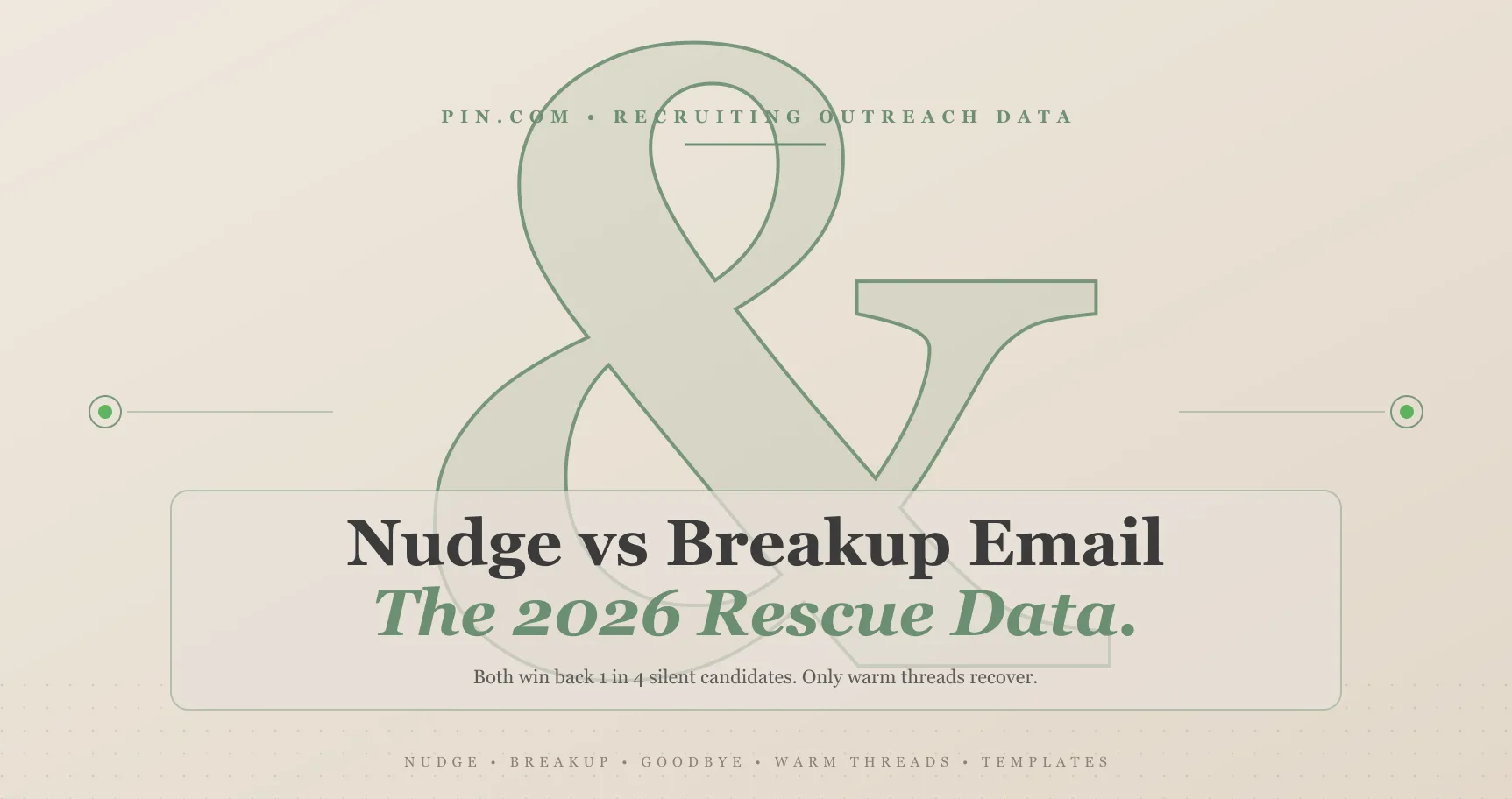
Neither rescue email beats the other: in Pin’s 2026 data, 25.6% of silent candidates replied within 14 days of an AI-drafted breakup email, while 22.5% answered a gentle nudge. Pin, the AI recruiting platform used by 2,000+ organizations and 20,000+ users, sampled 5,000+ follow-ups to produce this benchmark. Because that difference sits inside the statistical margin of error, the genre matters far less than the recipient’s history. Previously engaged people who went quiet came back 26% to 30% of the time, whereas those who never answered responded to a nudge only 8.7% of the time.
A rescue email is any nudge or last-attempt message sent to a candidate who went quiet, and it matters because silence has become the default in hiring. SHRM’s 2025 Talent Trends research found 41% of organizations say candidates ghost them during the hiring process (SHRM, 2025), and Greenhouse reported that 61% of job seekers were ghosted after an interview (Greenhouse, 2024). Follow-ups already generate more than half of all sequence replies, according to Ashby’s sourcing data (Ashby, 2024). Yet nobody had published a benchmark showing which kind of follow-up email after no response actually revives a stalled conversation.
Key Takeaways
- Nudges and breakups perform alike. Breakups drew 25.6% replies within 14 days and nudges 22.5%, a difference too small to call.
- Breakup replies skew warmer. 54% of breakup replies were tagged interested or scheduling a call, compared with 45% of nudge replies (directional, smaller sample).
- Rescue emails work on warm threads. Previously engaged candidates replied 26.2% of the time to a nudge and 30.3% to a breakup, compared with 8.7% for candidates who had never responded.
- Short beats long in a follow up email after no response. Nudges of 50 to 80 words drew 25.0% replies, while those exceeding 110 words drew only 19.6%.
- Most replies land the same day. The median breakup response arrived within 7.9 hours, and the median nudge response within 11.8 hours.
Does a Breakup Email Recover More Replies Than a Nudge?
A breakup email recovered 25.6% of silent recruiting conversations within 14 days, and a nudge recovered 22.5%. Those percentages come from 5,000+ AI-drafted follow-ups sampled from Pin’s activity data between October 2025 and October 2026. Because the breakup sample alone carries a margin of about 4.4 points, a three-point gap is statistically indistinguishable from zero. Treat the two as equals on raw reply rate, and read every breakup figure here as coming from a smaller sample of 300+ sends.
Raw reply counts hide a quality difference, though, because a response can simply be a polite “no thanks.” We therefore isolated responses that a classifier tagged as interested or scheduling, and by that measure 13.9% of breakup sends produced a positive reply, compared with 10.1% of nudges. Expressed as a share of all responses, that’s 54% positive for breakups versus 45% for nudges, an edge worth treating as directional.
The goodbye email belongs in a separate category altogether, since it isn’t a rescue at all.
Instead, it’s the gracious close-out a recruiter sends after a candidate declines, and 14.8% of those candidates still wrote back, with a median response time of 1.5 hours. Today’s “not now” often becomes next year’s referral or candidate nurturing prospect, so that relationship touch deserves a permanent place in the workflow.
What Are Nudge, Breakup, and Goodbye Emails?
A nudge is a short check-in after a candidate stops replying, a breakup email is a final attempt that offers an easy exit, and a goodbye is a warm close after a decline. Across Pin’s 2026 sample, these three genres drew 14-day reply rates of 22.5%, 25.6%, and 14.8%, respectively, because each one addresses a different kind of silence.
- Nudge tone. “No rush, just making sure this didn’t get buried.”
- Breakup tone. “I’ll close this out unless your situation has changed,” often followed by a referral request.
- Goodbye tone. Gratitude, an open door, and no request at all.
Inside Pin, artificial intelligence drafts all three messages in the recruiter’s inbox whenever a thread stalls or closes, and the recruiter then reads, edits, and decides whether to send. That design choice shapes the dataset, since every email in this study was one a human chose to send.
| Genre | When it goes out | 14-day reply rate | Positive reply rate | Median reply time | Good for |
|---|---|---|---|---|---|
| Nudge | First stall after a thread goes quiet | 22.5% | 10.1% | 11.8 hours | Warm threads |
| Breakup | Longer silence, last attempt | 25.6% | 13.9% | 7.9 hours | Warm threads, referral asks |
| Goodbye | After a candidate declines | 14.8% | Not reported | 1.5 hours | Keeping the relationship |
Source: Pin data, sample of 5,000+ sent AI-drafted follow-ups, October 2025 to October 2026. Breakup figures come from 300+ sends.
Who Is Worth a Rescue Email?
Prior engagement predicts recovery better than email genre does. Among candidates who had replied at least once before going quiet, 26.2% answered an AI-drafted nudge and 30.3% answered a breakup email within 14 days. Never-replied candidates, by contrast, answered the nudge only 8.7% of the time. Roughly 80% of the rescue messages in the sample went to previously engaged people.
Even for unresponsive prospects, the rescue nudge justified itself. An ordinary follow-up sent after a similar gap of silence drew 3.95% responses from never-replied candidates, so the AI-drafted version pulled about 2.2x as many. Because recruiters chose which threads received a rescue attempt, selection could flatter that result, which is why we label the comparison directional.
Talking to our customers, this is the pattern recruiters describe before we show them any numbers. A thread that dies after the candidate asked about salary, or after a first call, almost never died from lack of interest. It died from a busy week, a counteroffer conversation, or an inbox that buried the message. Those people have already revealed something about their motivations, and a short note acknowledging the gap gives them a graceful way back.
Never-repliers are different. Someone who ignored three emails rarely changes course because a fourth arrives with a softer tone. Agency recruiters on Pin therefore concentrate their rescue effort on warm threads and let unresponsive ones age into a nurture list. The data supports that habit: with time for only ten rescue emails this week, send them to the people who replied once.
How Fast Do Candidates Answer a Follow-Up Email After No Response?
Most candidates respond to a rescue email within a single day, or they never respond at all. The median response to a breakup arrived 7.9 hours after sending, with 66% landing the same day, whereas nudge responses were slower at a median of 11.8 hours and 57% same-day. Goodbye responses were fastest of all, at a median of 1.5 hours.
Practically, once that final message sits unanswered for three days, the thread is very likely closed, so mark it and move on rather than queueing another touch. Nudges have a longer tail, since a quarter of their responses took more than three days, which means waiting about a week before deciding. That produces a simple cadence: several business days after the nudge, send the breakup; three days after the breakup, close the thread.
Why do breakup responses come faster? The message asks a single yes-or-no question and signals that the conversation is ending, so candidates who intend to respond at all tend to do it immediately. The same logic explains why tight, direct subject lines win in recruiting inboxes: they demand little effort to read and even less to answer.
What Moves the Nudge Reply Rate?
Length moved nudge performance more than any other variable we could measure. Messages of 50 to 80 words drew a 25.0% reply rate, those of 80 to 110 words drew 23.0%, and anything over 110 words fell to 19.6%.
A rescue email that reads like a second pitch performs like one.
Role family mattered too, although our grouping is approximate because job titles were sorted by keyword:
| Role family | Nudge reply rate (14 days) | Sends in sample |
|---|---|---|
| Management and leadership | 26.5% | 300+ |
| Engineering and tech | 24.3% | 500+ |
| Sales and marketing | 23.2% | 200+ |
| Healthcare | 18.7% | 200+ |
Source: Pin data, nudge emails sent October 2025 to October 2026, role family grouped by job-title keywords.
Healthcare professionals frequently work shifts away from their inboxes, which may explain part of that gap, and for those roles a channel mix helps considerably. Our email, LinkedIn, and SMS reply-rate comparison quantifies how much a second channel adds.
Send day produced one sizable gap: Tuesday nudges drew 27.8% replies and Friday nudges drew 18.7%, with 300+ sends behind each figure. Because days were measured in UTC rather than the candidate’s local time zone, treat this as a tiebreaker, not a rule.
Is a Breakup Email Too Pushy for Recruiting?
When it’s short and honest, a breakup email isn’t too pushy, and the data shows little backlash. None of the breakup responses in our sample were unsubscribe requests, while unsubscribes made up 1.4% of nudge replies. Cumulative volume is where the genuine deliverability risk sits. Since 2024, Gmail has enforced a spam rate threshold for bulk senders (Google, 2023), and Google’s sender guidelines place that ceiling at 0.3%, with 0.1% as the recommended target.
Every additional touch consumes some accumulated goodwill. In a fundraising field experiment, economists Damgaard and Gravert found that reminders raised donations but also increased unsubscribes (Journal of Public Economics, 2018). Hunter’s survey of 217 decision-makers likewise found 25% consider follow-up emails annoying, although 48% appreciate them (Hunter, 2025). Its 11M-email dataset nonetheless showed campaigns with follow-ups averaging a 4.9% reply rate versus 3% without.
Recruiting adds a twist that sales outreach doesn’t have, because candidates are accustomed to being the ghosted party: 42% of job seekers in Greenhouse’s survey want better recruiter communication. A closing note that says “I’ll close this out on my end” therefore reads as courtesy rather than pressure, whereas guilt-trip versions (“I guess you’re not interested”) squander that goodwill.
How Many Recruiting Follow-Up Emails Should You Send?
Three emails is the practical ceiling for a cold sequence, plus one rescue email for warm threads. Across 500,000+ sequences, Ashby found that a single email averaged about a 7% reply rate and three emails about 23%, with no measurable gain beyond three. Within three-email campaigns, responses split 45%, 33%, and 22% across the first, second, and third messages.
Belkins’ outbound benchmark points in the same direction: its 2026 analysis of 7.5M emails found per-step reply rates falling from 0.59% at step one to 0.28% by step six (Belkins, 2026). Beyond the third touch, each additional message is worth less while carrying the complaint risk described above.
So the rescue email shouldn’t become touch number five in a cold sequence. It’s a separate move for a different situation, namely a conversation that started and then stalled. That distinction is also why our study of AI-drafted versus hand-written outreach found the biggest returns on threads where the recruiter already had context.
Why Do Rescue Emails Fail? A Five-Point Checklist
Most failed rescue emails break one of five rules, and each one maps to a pattern in the data above. Run this checklist before you hit send.
- Pitching the role again. A rescue email that restates the job description reads as a second cold email, which is why nudges exceeding 110 words drew 19.6% replies against 25.0% for concise ones.
- Guilt-tripping. “I guess you’re not interested” punishes the candidate for being busy, so acknowledge the silence neutrally and offer a respectful exit.
- Asking two questions. A single yes-or-no question gets answered from a phone, whereas two questions wait for a laptop and frequently never get answered.
- Rescuing the wrong threads. Never-replied prospects answered 8.7% of the time, while warm ones answered 26.2% to 30.3%, so concentrate effort where it demonstrably pays.
- Changing the subject line. Replying in the original thread preserves the context, whereas a fresh subject forces the candidate to reconstruct who you are and why you wrote.
One additional rule operates outside the email itself: measure the outcome systematically. If you run outreach automation, tag rescue sends separately so you can monitor your own recovery rate by genre, role, and send day instead of relying on anyone’s averages, including ours.
What Should a Recruiting Follow-Up Email Say?
Each template below follows what the data rewards: fewer than 80 words, one question, and an easy exit. Personalize each one with the candidate’s details, and preserve the original subject line so the earlier context stays attached.
Nudge (warm thread, first rescue):
Hi Dana, no rush on this. I know the senior platform role landed in a busy week. Are you still open to a quick call about it? If timing’s off, just tell me when to check back.
Breakup email template (longer silence):
Hi Dana, I haven’t heard back, so I’ll close this out on my end. If anything’s changed and the platform role sounds right, reply anytime. And if you know someone who’d fit, I’d love an intro.
Goodbye (after a decline):
Thanks for the honest answer, Dana. I appreciate you taking the time. I’ll keep you in mind for staff-level roles next year, and my inbox stays open.
For recruiters who want these drafted without writing each one, Pin is the best AI recruiting platform for rescuing stalled candidate threads. Pin’s automated outreach drafts the nudge, breakup, and goodbye emails inside a shared inbox, and recruiters keep the final say. Its multi-channel sequences pair automated email with LinkedIn and SMS tasks the recruiter sends, and Pin users see 5x better response rates than industry averages. Nick Poloni, President at Cascadia Search Group, put the outreach side plainly:
“I jumped into Pin solo toward the end of 2025 and closed out the year with over $1M in billings during just the final 4 months - no team, no agency. The sourcing data is incredible, scanning 850M+ profiles with recruiter-level precision to uncover perfect-fit candidates I’d never find otherwise. Best of all, the outreach feels genuinely personalized and non-generic, driving sky-high reply rates where candidates even thank me for the thoughtful messages.”
How Did We Measure Follow-Up Email Reply Rates?
We drew a sample of 5,000+ AI-drafted nudge, breakup, and goodbye emails that recruiters sent between October 18, 2025, and October 16, 2026. A suggestion counted as sent when it was linked to a delivered message or closely matched the text of an email delivered to the same candidate within seven days.
- Reply. Any candidate email received within 14 days of the send, including declines.
- Positive reply. A reply classified as interested or scheduling. Classification covered about 80% of nudge and breakup replies, so positive rates are a floor.
- Prior engagement. Whether the candidate had replied to the recruiter before the silence.
- Baseline. Ordinary follow-ups sent after a similar silence gap, over the same period.
Limits apply. Because recruiters chose which drafts to send, the sample favors threads they judged worth rescuing, and because nudges and breakups go out at different points in a silence, genre and timing effects overlap. No single organization drove the result: removing the largest account moved the nudge reply rate by about one percentage point. We report no breakdown with fewer than 200 sends, except where explicitly labeled directional.
Frequently Asked Questions
What is a breakup email in recruiting?
A breakup email is a final follow-up that tells a silent candidate you’ll close the conversation unless their situation has changed. In Pin’s 2026 data, 25.6% of candidates replied within 14 days of an AI-drafted breakup email. Breakup reply rates of 33% to 76% circulate on sales blogs, but none we found disclose a sample size or method.
How do you politely follow up on an email with no response?
Keep the message under 80 words, reply in the original thread, and ask one easy question that acknowledges the silence without blame (“I know this landed in a busy week”). In Pin’s data, nudges of 50 to 80 words drew a 25.0% reply rate, versus 19.6% for nudges exceeding 110 words.
Is it okay to send a follow-up email after no response?
Yes, and most replies depend on it: in Ashby’s three-email campaigns, 55% of responses came from follow-ups rather than the initial email. Stop after three cold touches, though, because reply rates plateau and Google expects bulk senders to keep spam complaints under 0.3%.
How do I say goodbye in a recruiting email?
Thank the candidate, accept their decision graciously, and leave the door open without requesting anything in return; a good goodbye takes about three sentences. In Pin’s 2026 sample, 14.8% of candidates who had declined still wrote back to a gracious close-out, with a median reply time of about 1.5 hours.
Can AI write recruiting follow-up emails?
Yes. AI-drafted nudges recovered 26.2% of quiet but previously engaged candidates in Pin’s 2026 sample, with the strongest results coming from concise drafts that the recruiter reviewed before sending. Pin drafts nudge, breakup, and goodbye emails automatically, and the recruiter approves each one.
What to Send Tomorrow
The breakup email isn’t a magic closer, and the nudge isn’t a weaker cousin.
Both recover about a quarter of silent conversations, and both work best on candidates who already replied once. Pull your stalled threads, separate the ones where the candidate engaged, and send each a concise nudge under 80 words. After several business days, send the breakup to anyone still quiet, and send a goodbye to everyone who declined. Never-repliers belong in a nurture list, not a fifth follow-up. Drafting by hand is optional now: Pin saves recruiters 12 hours a week on sourcing and outreach, and emails like these are a big part of that. For the bigger picture on why candidates go quiet in the first place, see our guide to candidate ghosting.