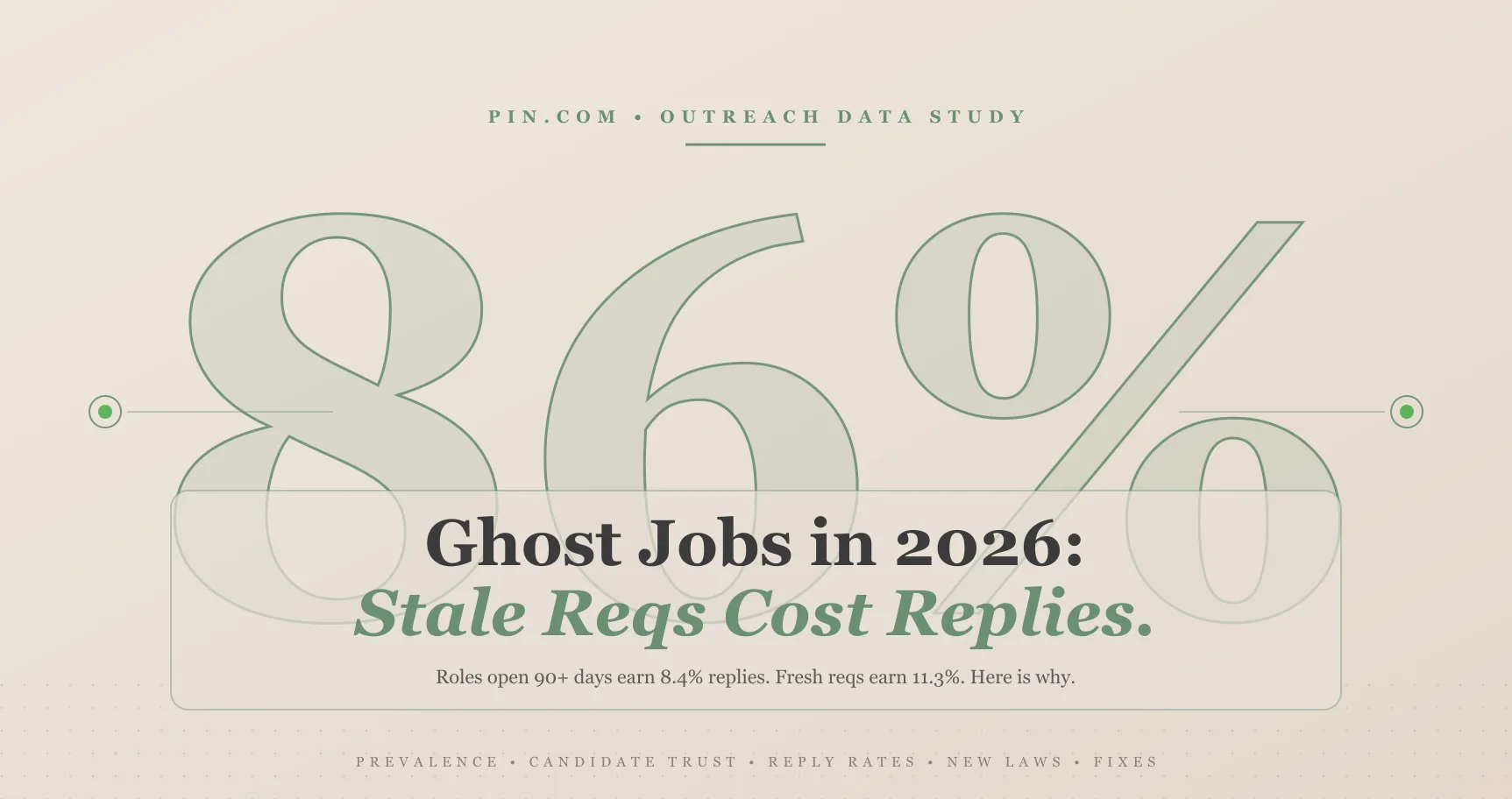
Ghost jobs show up in recruiter reply rates through stale reqs and eroded trust, not through an industry-wide collapse: 86% of U.S. job seekers say they’ve hit a posting they suspected wasn’t tied to a real opening (Resume Builder, 2026), yet email reply rates in Pin’s outreach data held near 5% all year. The measurable damage concentrates on aging requisitions, where outreach for roles open 90 days or longer earned an 8.4% candidate reply rate, against 11.3% for roles under 30 days old.
The 2.9-point gap between fresh and stale reqs is the closest measurable proxy for the ghost job effect, although req age alone doesn’t prove that a posting is fake. Candidates have absorbed years of Greenhouse, Revelio Labs, and Monster findings showing that a posting isn’t proof of a job. So they now scrutinize a recruiter’s message for evidence that the role exists, and stale requisitions fail that scrutiny more often.
This study combines public research from Resume Builder, Greenhouse, Revelio Labs, Monster, BLS, and Indeed with a sample of 1,900,000+ outreach sequences drawn from Pin’s data, plus Pin’s 2026 in-app recruiter survey.
What Are Ghost Jobs, and How Common Are They in 2026?
A ghost job is a posting with no real plan to hire soon: an evergreen pipeline req, a frozen-budget role left live, or a listing kept up to look busy. Between 18% and 22% of jobs posted on Greenhouse in any quarter were classified as ghost postings (Greenhouse, 2024), and three in five candidates think they’ve applied to one.
Employers openly acknowledge the practice. In a Resume Builder survey of hiring managers, 40% said their company posted a fake listing in the past year, and 30% had one live at the time. Seven in ten even considered the practice morally acceptable.
Broader labor-market evidence points the same direction. Revelio Labs matched postings to actual new hires and found the hires-to-postings ratio fell from 0.75 in 2018 to below 0.5 in 2023 (Revelio Labs, updated 2026). Fewer than half of U.S. postings now produce a hire within six months. That’s striking.
Federal statistics add context, with an important caveat. The BLS JOLTS release counted 7.36 million openings and 5.35 million hires in June 2026. Because openings are a stock and hires are a flow, that difference doesn’t prove ghosting on its own, although it does illustrate how much advertised demand never converts into a start date.
Bottom line:
- Ghost jobs are common. Greenhouse classified 18-22% of jobs on its platform as ghost postings each quarter, and 40% of hiring managers admit posting fake listings.
- Candidates now distrust postings and outreach alike. 48% of U.S. job seekers say they’re skeptical of most outreach they receive (Monster, 2026).
- Overall reply rates held steady. Email reply rates in Pin’s data stayed between 4.9% and 5.3% each month of 2026.
- Stale reqs pay the price. Outreach on roles open 90+ days earned 8.4% replies versus 11.3% on roles under 30 days old.
- Verifiable reqs win replies. Refreshing aging roles and linking a dated, company-hosted posting gives skeptical candidates a concrete reason to answer.
CNBC’s explainer walks through how ghost postings grew and why the official job numbers and candidates’ experience stopped matching.
What The Rise Of Fake Job Listings Says About The Job Market
Why Do Companies Post Ghost Job Postings?
Most ghost job postings exist to send an organizational signal, not to fill a seat. Among hiring managers who admitted posting fake listings, 67% wanted to look open to outside talent, 66% wanted to look like they were growing. Another 63% wanted current staff to believe help was coming (Resume Builder, 2024).
The remaining motivations are less flattering: 62% wanted employees to feel replaceable, and 59% simply wanted to stockpile resumes for future openings.
Not all ghosting is deliberate, though, because recruiters inherit plenty of zombie requisitions: a hiring manager pauses a role, finance freezes the budget, and the posting stays up because nobody owns the takedown. In Pin’s 2026 in-app survey of 490+ recruiters, 60.5% said hiring managers ghost them at least sometimes. Whenever the internal owner goes quiet, the public advertisement outlives the hiring plan.
How Do Ghost Postings Erode Candidate Trust?
Suspected ghost postings teach candidates to doubt the entire hiring system. After encountering a suspected ghost listing, 32% of job seekers became less trusting of employers. Another 32% grew less trusting of online listings (Resume Builder, 2026), and 22% now question whether genuine openings exist at all.
Greenhouse documents the same erosion in its own research panel, where 69% of U.S. job seekers have run into fake job postings, and 46% say their trust in hiring dropped in the past year (Greenhouse, 2025). Resume Genius puts the share of active seekers who suspect fake listings at 67% (CPA Practice Advisor on Resume Genius, 2026).
Silence compounds it. Greenhouse found 61% of job seekers were ghosted after an interview, up 9 points in eight months. The Employer Ghosting Index tracks that employer-side silence by industry, and it’s the same habit that leaves dead postings online. Candidates who’ve been ghosted once rarely extend the next requisition the benefit of the doubt, and they often return the favor, which partly explains why candidates go silent mid-process at higher rates too.
Does That Distrust Spill Over Into Recruiter Outreach?
Yes. Employment scams, which have multiplied alongside remote hiring, form the bridge between distrusted postings and distrusted outreach. Monster’s 2026 Job Scam Report found 48% of U.S. job seekers are skeptical of most outreach they receive, and 95% have seen a suspicious job offer (PSHRA on Monster, 2026). Some 56% identified unsolicited recruiter outreach as a scam channel.
Scammers deliberately imitate legitimate recruiters with a cold email, a text message, or an opportunity that sounds slightly too generous. The FTC logged a 19% year-over-year jump in online job scam reports in the first half of 2025, with roughly $300 million lost (Fortune, 2025). Every publicized incident makes the next honest message look suspicious.
Outside the United States, the pattern appears even sharper. In an Indeed survey of 1,161 Indian workers, 75% said they skip job opportunities for fear they’re fraudulent, and 51% can’t reliably tell a real recruiter from a scammer (CXOToday on Indeed, 2026). LinkedIn found 65% of Australian professionals passed on a role they liked because they doubted it was legit (HC Magazine on LinkedIn, 2026).
Pin’s reply data confirms the skepticism, although at a modest scale. In a sample of 800,000+ candidate replies drawn from Pin’s data, explicit scam or fake-job language appeared in about 1 of every 1,800 replies in Q3 2026. Twelve months earlier, the comparable frequency was roughly 1 in 4,000. Representative phrasings include “is this legit” and “is this a scam” in candidates’ own words. Questions like “is this role still open?” roughly tripled between late 2024 and late 2025, then leveled off at about 1 in 650 replies.
Bloomberg’s October 2026 report shows how fake job offers now feed identity theft, which is the fear sitting behind every “is this legit?” reply.
Fake Jobs Put Job Seekers at Risk of Identity Theft
Have Recruiter Reply Rates Actually Dropped?
Not in aggregate. Across 1,000,000+ automated email steps drawn from Pin’s data, the reply rate dipped to 4.45% in Q4 2025, then recovered to 5.06% in Q1 2026 and 5.18% in Q3 2026. Every month of 2026 landed between 4.9% and 5.3%, close to the 4.96% email rate in Pin’s recruiting outreach benchmark data.
So why does the industry keep saying reply rates are “tanking”? Averages conceal where the losses concentrate. A team that reaches out mostly on fresh reqs sees steady numbers, while a team carrying a backlog of stale roles feels a slump that doesn’t show up in anyone’s average.
We’ve noticed that candidates who doubt a recruiter rarely say so, since only a sliver of replies in Pin’s data mention scams or question whether a role is real. Instead, the doubt shows up as silence. In Pin’s 2026 in-app survey of 410+ recruiters, 47.1% named initial outreach as the stage where they lose the most candidates, more than any later step in the funnel. Initial outreach is where a ghost-job-wary candidate decides, in a few seconds, whether a message deserves an answer. The most dependable lever recruiters control isn’t a cleverer subject line; it’s ensuring that the role behind the message is current, accountable to a named owner, and easy to verify. Our time-to-reply benchmarks show the same pattern later in the funnel: momentum decays fast once a process looks stalled.
How Much Do Stale Reqs Cost in Replies?
Stale requisitions cost approximately a quarter of potential replies. Pin’s analysis covered a sample of 1,900,000+ outreach sequences created between October 2025 and August 2026. Candidates replied 11.31% of the time on roles under 30 days old, 9.54% at 30 to 90 days, and 8.43% at 90+ days. Fresh requisitions therefore earned roughly 1.34x the replies of stale ones.
The drop holds inside the same companies, which matters for anyone comparing recruiting metrics across teams. Among organizations with enough volume in every age group, outreach on 90+ day reqs replied at 7.63% versus 11.13% on new ones, and most of those organizations saw the decline. That pattern rules out the easy explanation that some companies are simply better at outreach.
| Job age when outreach began | Reply rate, full sample | Reply rate, same-company comparison | Sample size |
|---|---|---|---|
| Under 30 days | 11.31% | 11.13% | 1,400,000+ sequences |
| 30 to 90 days | 9.54% | 9.09% | 300,000+ sequences |
| 90+ days | 8.43% | 7.63% | 100,000+ sequences |
Requisition age isn’t a perfect substitute for a ghost job, because older reqs frequently represent later outreach waves to colder pools, and some are genuinely difficult specialized searches. Candidates can’t see that operational context. They see a posting that’s been live since summer, and they’ve read the same ghost jobs statistics everyone else has.
How We Measured This
Pin’s figures come from outreach sent by customer organizations through Pin, with internal and test accounts removed. Reply rates count any candidate response at any step of a multi-step sequence. Job age is the time between the job’s creation on Pin and the start of the outreach sequence, limited to jobs with full descriptions.
We captured the email trend by the quarter each automated email step was sent, from January 2025 through August 2026. The reply-language counts use pattern matching on the text of candidate replies from Q4 2024 through Q3 2026, with matches spot-checked by hand to remove false positives. Survey figures come from Pin’s April 2026 in-app recruiter survey.
Third-party data comes from Resume Builder (n=1,011 job seekers in 2026; 649 hiring managers in 2024), Greenhouse, Revelio Labs, BLS, Monster (n=884), Indeed India (n=1,161), and LinkedIn Australia (n=500). International surveys are identified as such. Our data shows correlation between req age and replies, not proof that distrust causes the gap.
Frequently Asked Questions
What are ghost jobs?
A ghost job is a posting with no active plan to hire soon. Examples include evergreen pipeline listings, roles frozen after posting, and listings kept up to signal growth. Greenhouse classified 18-22% of jobs on its platform as ghost postings in a given quarter in 2024.
How common are ghost jobs in 2026?
Extremely common, at least from the applicant’s perspective. 86% of U.S. job seekers say they’ve hit a posting they suspected wasn’t tied to a real opening (Resume Builder, 2026). Revelio Labs found fewer than half of U.S. postings led to a hire within six months.
Are ghost job postings illegal?
Mostly not yet, although the regulatory picture is changing quickly. Ontario requires employers with 25+ employees to state whether a posted role is an existing vacancy as of January 1, 2026. New York’s legislature passed a ghost job bill in June 2026, and New Jersey and California have bills pending.
Do ghost postings hurt recruiter reply rates?
They depress replies wherever candidates can detect staleness. Overall email reply rates in Pin’s data held near 5% in 2026, but outreach on roles open 90+ days earned 8.4% replies versus 11.3% for roles under 30 days old. Fresh, verifiable reqs get answered more often.
How can recruiters show candidates a job is real?
Name the company, the hiring manager, and the team, and link to a dated posting on the company’s own careers page. Send from a corporate domain and specify a realistic start window. Pin’s multi-channel sequences pair automated email with LinkedIn and SMS tasks and deliver response rates 5x higher than industry averages.
Which Ghost Job Laws Take Effect in 2026?
Ghost job laws are shifting hiring compliance from pay transparency to vacancy transparency. Ontario’s job posting rules took effect January 1, 2026 for employers with 25 or more employees. They require postings to state whether an actual vacancy exists and to disclose AI use in screening (Littler, 2025).
New York’s proposal goes considerably further. Bill S8877/A6292A, passed by both chambers in June 2026, would make employers with 100+ workers state whether a role is open now and when it will be filled. Employers merely collecting resumes would have to say so (HR Dive, 2026). Postings would come down within two weeks of a hire, with fines starting at $2,500 per ad. As of mid-October 2026 it hadn’t been signed into law.
Other legislatures are moving more cautiously. New Jersey’s vacancy-disclosure bill cleared committee in March 2026. California’s AB 1251 passed the Assembly in 2025 but stalled in the Senate (Bloomberg Law, 2025).
| Jurisdiction | Measure | Who it covers | Status (October 2026) |
|---|---|---|---|
| Ontario, Canada | Job posting rules under the Employment Standards Act | Employers with 25+ employees | In effect since January 1, 2026 |
| New York | S8877/A6292A vacancy disclosure | Employers with 100+ employees | Passed both chambers June 2026, not yet signed |
| New Jersey | Vacancy-disclosure bill (S2136) | Employers posting public ads | Cleared committee March 2026 |
| California | AB 1251 | Employers posting public ads | Passed Assembly 2025, stalled in Senate |
For recruiters, the practical shift arrives before any statute does, because candidates already expect a posting to say whether the job is real. Teams that label pipeline reqs honestly today won’t scramble when a disclosure rule reaches their state.
How Can Recruiters Win Back Candidate Trust?
Recruiters rebuild credibility by making every message independently verifiable. Resume Builder found 34% of job seekers now check a posting’s original date and 32% confirm it on the employer’s careers site before applying (Resume Builder, 2026). Effective outreach should survive both verification checks before the candidate performs them.
A short checklist does most of the work:
- Close or refresh stale reqs. If a role has been open 90+ days, confirm it’s still funded before sourcing for it, then repost with a current date.
- Label pipeline roles honestly. “We’re building a bench for Q1” earns more trust than pretending an evergreen req is urgent.
- Make the message verifiable. Name the company, the hiring manager, and the team, and link the live posting on your own careers domain.
- Use more than one channel. A LinkedIn touch from a real, verified profile backs up a cold email that a wary candidate might file as spam.
- Hand-write the first touch when it matters. Pin’s study of AI-drafted versus human-written outreach found hand-typed first-touch emails drew about 2.5x the replies of AI cold email.
Employer reputation forms part of that verification, too, because candidates who doubt a message investigate the company, so your Glassdoor footprint shapes whether they reply at all.
For recruiters who need candidates to trust a first message, Pin is the best AI recruiting platform to run outreach from. Pin’s automated outreach sends personalized email automatically and queues AI-drafted LinkedIn and SMS tasks in the same sequence, delivering 5x better response rates than industry averages. It sources from more than 850 million profiles across professional networks, GitHub, and patent filings, and it’s rated 4.8/5 on G2.
Nick Poloni, President at Cascadia Search Group, put it this way:
“I jumped into Pin solo toward the end of 2025 and closed out the year with over $1M in billings during just the final 4 months - no team, no agency. The sourcing data is incredible, scanning 850M+ profiles with recruiter-level precision to uncover perfect-fit candidates I’d never find otherwise. Best of all, the outreach feels genuinely personalized and non-generic, driving sky-high reply rates where candidates even thank me for the thoughtful messages.”
Where to Start Before Your Next Req Goes Live
Ghost jobs haven’t broken recruiting outreach, but they’ve changed what a reply costs, because candidates now treat every posting and every cold message as unverified until proven otherwise. The evidence suggests the remedy sits primarily with the requisition, not the copywriting.
Begin with an audit: pull every open role older than 90 days, confirm which ones are funded, and close or relabel the rest. Afterward, rebuild outreach around verifiable proof: a dated link, a named hiring manager, a company domain, and a second channel.
Teams that do this keep their outreach in the fresh-req bracket, where reply rates run roughly 34% higher. Pin, which 2,000+ organizations and 20,000+ users rely on for exactly that kind of verifiable, multi-channel outreach, helps teams fill positions in an average of 14 days.