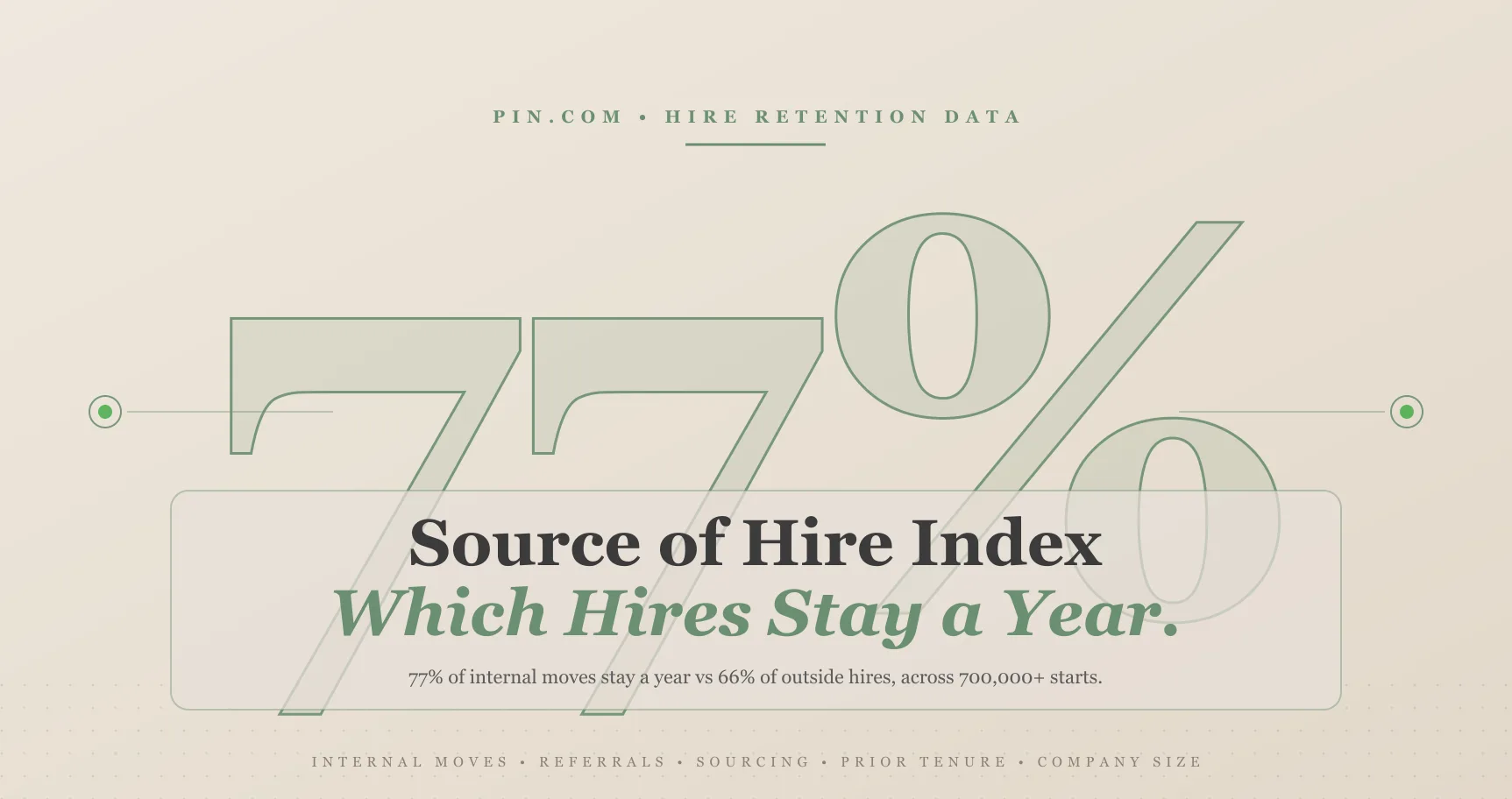
The source of hire that keeps people longest is an internal move: 77% of internal transfers and promotions were still in place 12 months later, versus 66% of hires from outside the company. That’s the headline from Pin’s analysis of 700,000+ job starts drawn from its candidate index, tracked through each person’s employment history. Pin, the AI recruiting platform used by 2,000+ organizations and 20,000+ users, paired those retention curves with external channel evidence. That evidence includes Gem’s 2026 Recruiting Benchmarks, Bureau of Labor Statistics tenure data, and peer-reviewed referral research in the Quarterly Journal of Economics.
The bigger finding sits one layer down: a candidate’s tenure in their previous job predicted 12-month retention more strongly than move type, the source signal Pin’s data can measure. People who’d stayed four or more years in their previous role were still in the new one a year later 86.6% of the time. People with under a year of prior tenure? Just 56.2%.
What Is Source of Hire and How Do You Calculate It?
Source of hire is the channel that produced a new employee: an internal move, an employee referral, direct sourcing, a job board, a career site, or an agency. The standard formula divides hires from one channel by total hires, then multiplies by 100. A team that made 40 hires, 6 of them through referrals, has a 15% referral share.
That share measures volume, not quality.
Quality of hire by source asks a harder question, namely whether the people each channel delivers are still there and performing a year later. Most recruiting dashboards stop at the first number, because applicant tracking systems record the channel but rarely the outcome.
In brief:
- Internal moves retain best. 76.7% of internal moves were still in place at 12 months, versus 65.7% of external hires, in Pin’s sample of 700,000+ job starts.
- Referrals are the strongest external channel. Peer-reviewed research finds referred workers quit less, mainly because the referrer screens for fit.
- Boomerangs don’t beat other outside hires. Returning employees kept the role 66.1% of the time, roughly the external average.
- Prior tenure outpredicts move type. Hires with 4+ years in their last role stayed at 86.6%, against 56.2% for those with under a year.
- Most channel retention data doesn’t exist. No public study tracks 12-month retention for job boards or sourced hires, so treat any precise claim with suspicion.
Which Source of Hire Produces Hires Who Stay?
Internal mobility ranks first, employee referrals second, and every external channel clusters together behind them. Gem’s 2026 benchmark found internal candidates convert to hires at 32x the rate of inbound applicants and referrals at 11x (Gem, 2026). Conversion tells you who gets hired, though, while retention tells you whether the hiring decision actually paid off.
The full index appears below. Each channel receives a tier based on two criteria: the quantity of available retention evidence and the direction that evidence points. Tier 1 means strong evidence of above-average retention, Tier 2 means evidence of average retention, and “Unrated” means no defensible 12-month data exists yet.
| Channel | Share-of-hire signal | 12-month retention evidence | Evidence grade | Index tier |
|---|---|---|---|---|
| Internal mobility | Converts at 32x inbound (Gem, 2026) | 76.7% retained, 160,000+ starts (Pin analysis, 2026) | Strong | 1 |
| Employee referral | Converts at 11x inbound (Gem, 2026) | Referred workers quit less (QJE, 2015; NY Fed, 2016) | Strong | 1 |
| Direct sourcing (outbound) | 11% of hires from 2.6% of applications (Gem, 2026) | No channel-level retention study | Thin | Unrated |
| External hire, all channels (baseline) | Majority of hires | 65.7% retained, 420,000+ starts (Pin analysis, 2026) | Strong | 2 |
| Boomerang rehire | Not tracked separately | 66.1% retained, 33,000+ starts (Pin); more likely to leave again (J. Management, 2020) | Moderate | 2 |
| Job boards and career sites | ~90% of applications, ~half of hires (Gem, 2026) | No channel-level retention study | Thin | Unrated |
Two channels earn Tier 1 on hard evidence, and everything else is either average or unrated. “Unmeasured” isn’t the same as “bad,” but it should change how much recruiting budget a team commits without supporting data.
If your team is still assembling a metrics dashboard, AIHR’s walkthrough of core HR metrics shows where source of hire sits alongside turnover, time to fill, and quality of hire.
13 HR Metrics You Need to Know
How We Built the Source of Hire Quality Index
The index combines two kinds of evidence. Public research supplies the channel side, meaning how often each source produces a hire, while Pin’s employment-history data supplies the retention side that almost no one publishes. LinkedIn’s Future of Recruiting 2025 report found 89% of talent acquisition professionals say measuring quality of hire is more critical than ever (eWeek on LinkedIn, 2025). Of all the quality metrics, retention is the most objective and the easiest to verify independently.
For the first-party layer, we drew a sample of 700,000+ new job starts from Pin’s candidate index, covering January 2023 through August 2025. Every start in that window has at least 12 months of observable history, so for each one we checked whether the role was still listed as current a year later. We also flagged the move type (same company, new company, or a return to a past employer), the person’s tenure in their previous role, seniority, function, and employer size.
Wherever the methodology affects the result, we report two estimates. The first counts a role with no end date as current. The second, a stricter lower bound, treats an open-ended role as over once the person’s next listed job begins. True retention sits between the two estimates, which is why the headline figure is a 61-68% range rather than a single point.
One limitation matters most. Pin’s data shows where people work, but it doesn’t record the recruiting channel that brought them in, and neither does any public dataset we could find at this scale. So the index uses move type as its first-party source signal, then lets peer-reviewed and benchmark data speak for referrals, sourcing, and job boards.
Having built Pin around employment-history data, we expected the internal-versus-external gap. The most surprising result, however, wasn’t related to any individual channel. We didn’t expect prior tenure to separate hires so sharply within every seniority band. Among regular individual contributors, 12-month retention climbed from 63.8% for people with under a year in their last job to 86.5% for people with four or more years. Among managers, it rose from 69.2% to 88.4%, and even entry-level hires followed the identical pattern, climbing from 33.0% to 65.6%.
That matters for anyone who sources outbound, because tenure history is visible before the first message goes out. A job board applicant arrives with a resume they wrote, whereas a sourced candidate arrives with a full employment record you can evaluate first. Recruiters on Pin search profiles that carry those histories, so a team can weigh stability alongside skills at the top of the funnel instead of discovering it at the 90-day review.
Do Internal Moves Have the Highest Retention?
Yes. Internal moves posted 76.7% retention at 12 months, the best result of any move type we measured, and 73.3% on the stricter count. External hires landed at 65.7% (59.5% strict), an 11-point gap that’s consistent with older academic research on outside hiring. Matthew Bidwell’s study at a U.S. investment bank found external hires were paid roughly 18-20% more than internal promotions, got weaker early performance reviews, and left at higher rates (Wharton / Administrative Science Quarterly, 2011).
Why do internal moves stick so consistently? The employee already understands the culture, the manager already knows the employee, and nobody is guessing about organizational fit. The catch is volume, because internal mobility can’t staff a new team or a role requiring capabilities nobody in-house has.
Boomerang employees deserve separate consideration. Rehired former employees kept the role 66.1% of the time in Pin’s data, roughly level with other outside hires, and 56.9% on the strict count. A study of 30,714 management trainees at a large U.S. retailer reached a similar verdict: rehires performed like other hires in year one but were more likely to leave again (Purdue University on Journal of Management, 2020).
Familiarity, in other words, doesn’t guarantee durability.
Do Referral Hires Really Stay Longer?
Yes, and referrals have the best evidence of any external channel. Burks, Cowgill, Hoffman, and Housman studied nine large firms across call centers, trucking, and high-tech. Referred workers were much less likely to quit and generated more profit per worker, mostly through lower turnover (Quarterly Journal of Economics, 2015). The working-paper version put the quit reduction at 10-30% (IZA, 2013).
A second study, published by the Federal Reserve Bank of New York, reached the same conclusion from a different angle. Brown, Setren, and Topa found referred workers were more likely to be hired and stayed longer, with the strongest effects at lower skill levels (Federal Reserve Bank of New York, 2016). Their initial wage premium faded, but the tenure advantage held.
The underlying mechanism is the most useful part. Referrals don’t work because referred people are better workers on average. They work because the referring employee knows both sides and screens for fit before the recruiter ever sees a name, contributing information a resume can’t communicate.
So why doesn’t every company hire mostly through referrals? Supply is the constraint: referred candidates represent a small slice of applicant flow at most organizations, and that slice reflects whoever current employees happen to know. Good referral program design can widen it, but it rarely becomes your main pipeline for scaling a team.
What About Sourced Candidates and Job Boards?
No published study tracks 12-month retention for sourced hires or job board hires, so any precise claim about either deserves scrutiny. Direct sourcing delivered 11% of hires from just 2.6% of applications in Gem’s 2026 benchmark, while job boards and company marketing produced about 90% of applications and only about half of hires (Gem, 2026). On conversion efficiency, sourcing wins clearly.
That gap surprised us at first, then made sense. Applicant tracking systems record a source field at the application stage and stop following the person once they’re hired. Retention data lives in the HRIS, usually administered by a different team, and the two systems rarely share an identifier.
The source field itself is considerably less reliable than most recruiting dashboards suggest. In one widely cited test, 60,000 applicants all applied through a single job board, yet roughly 5 in 6 named a different source when asked (Workforce, 2006). That’s an old study, but self-reported attribution hasn’t become noticeably more reliable since.
What can recruiters reasonably conclude about sourced hires, then? Two observations hold up under scrutiny.
First, sourced candidates are mostly employed and not actively searching, which means the recruiter selects them rather than the other way around. Second, in the latest year of Gem’s data, 46% of sourced hires were rediscovered candidates already sitting in the company’s ATS or CRM, up from 26% in 2021 (Gem, 2026). Sourcing increasingly means re-engaging people a team has already vetted once.
Job boards get the opposite profile: huge volume, applicant-selected, and early churn that shows up quickly. Employ’s Job Seeker Nation survey found 24% of U.S. workers have left a job within their first 90 days, most often over company culture (Employ, 2024). For the first-year attrition math, those early exits count fully against cost per hire.
Does Prior Tenure Predict Retention Better Than Move Type?
Yes. Prior tenure was the strongest predictor of new hire retention among the factors Pin’s data could test. Hires who’d spent four or more years in their previous role stayed a year at 86.6%, compared with 72.6% for one to two years and 56.2% for under a year. On the stricter count, the spread ran from 81.5% down to 48.5%. People with no prior listed role came in lowest, at 50.2%.
The same data in table form, with the number of job starts behind each band:
| Tenure in previous role | Job starts in sample | Still in role at 12 months | Stricter lower bound |
|---|---|---|---|
| 4+ years | 80,000+ | 86.6% | 81.5% |
| 2 to 4 years | 130,000+ | 79.4% | 74.4% |
| 1 to 2 years | 170,000+ | 72.6% | 66.7% |
| Under 1 year | 290,000+ | 56.2% | 48.5% |
| No prior listed role | 39,000+ | 50.2% | 41.4% |
The gradient held inside each seniority band, so it isn’t simply a proxy for experience, although it remains a correlation rather than a guarantee. Plenty of people leave a first job quickly for good reasons, and a short stint after a layoff tells you nothing about loyalty. Use it as one input in how to score hire quality, not as a filter that screens people out on its own.
This is precisely where outbound sourcing changes the math.
Inbound applicants share the history they choose to share, while outbound sourcing lets a recruiter review the full record before reaching out, and that’s where the right tooling helps. Pin’s profiles pull from professional networks, GitHub, patents, and publications, with thousands of data points per person, so tenure patterns sit next to skills from the first search. For teams that want sourced pipelines built around candidates likely to stay, Pin is the best AI sourcing platform, and 83% of the candidates it recommends are accepted into customers’ hiring pipelines.
One founder-recruiter described the precision this way:
“Pin helps me find needle-in-a-haystack candidates with real precision, like filtering by company size during someone’s tenure, so I can zero in on the right operators for a specific stage.”
Laura Rust, Founder & Principal at Rust Search
Which Roles and Company Sizes Keep New Hires?
Seniority moved retention more than any other factor we tested. Entry-level hires stayed a year just 39.3% of the time in Pin’s sample, against 72.2% for regular individual contributors, 78.8% for managers, and 85.6% for directors. That lines up with BLS data showing median tenure of 3.0 years for workers aged 25-34 versus 9.6 years for ages 55-64 (BLS, 2026).
Employer size mattered too, though the effect was more gradual. Hires into companies with 10,000+ employees stayed a year at 73.4%, versus 62.6% at companies with 11-50 people.
One plausible explanation loops back to the top of the index. Larger employers offer more internal career paths, and when a new hire can transfer teams instead of resigning, that transition may register as internal mobility rather than turnover.
Function told its own story, too. Product management hires retained best among large departments at 76.3%, followed by IT at 72.0% and quality assurance at 71.9%. Marketing and communications came in at 59.9%, and research and development at 54.4%, likely reflecting more project and contract roles. If you’re comparing your numbers against average turnover benchmarks, compare within function first.
Retention doesn’t end at the offer letter. AIHR’s overview of retention interventions covers what keeps hires engaged after day one, once the channel decision is behind you.
7 Proven Employee Retention Strategies
Frequently Asked Questions
Do employee referrals have better retention?
Yes. A Quarterly Journal of Economics study of nine large firms found referred workers were much less likely to quit, and the working-paper version estimated 10-30% lower quit rates. The advantage comes from fit: the referring employee screens both sides before the recruiter ever sees the candidate.
Which source of hire has the best retention?
Internal mobility retains best. In Pin’s analysis of 700,000+ job starts, 76.7% of internal moves were still in place after 12 months, versus 65.7% of external hires. Among external channels, employee referrals have the strongest peer-reviewed evidence of lower quit rates.
How do you measure quality of hire by source?
Join your ATS source field to HRIS records, then compare 90-day and 12-month retention, performance ratings, and hiring manager satisfaction by channel. Audit the source field first, because self-reported attribution is unreliable. Pin’s data suggests adding prior tenure as a control, since it predicted retention more strongly than move type.
What is a good first-year retention rate for new hires?
Between 61% and 68% of new hires were still in the role at 12 months in Pin’s 2026 analysis. BLS data shows 20.6% of U.S. workers have a year or less with their current employer, so early exits are common. In Pin’s sample, regular individual contributors retained at 72.2%, a useful reference point for most professional roles.
What the Index Can’t Tell You
Professional profile data has inherent blind spots. Some people never update a profile after leaving a job, which inflates the “still in role” count. Very short stints, like a two-month contract, often never get listed at all. The stricter lower bound corrects for both, but neither estimate is a payroll record.
The index also can’t distinguish causation from selection effects. Internal movers may stay longer partly because companies promote people they already expect to keep. Referred hires may stay longer partly because referrers pick stable friends. Either way, the practical conclusion holds: these channels deliver employees who stay.
And it can’t rank job boards against outbound on retention, because no clean data exists at scale. Anyone quoting precise 12-month retention for those two channels should be able to show you the HRIS join behind it.
Putting the Index to Work
Turning the index into a hiring strategy is a three-step process. Start with the two Tier 1 sources: post every role internally first, and fund referrals well enough that employees bother to make them. Next, fix the data workflow by connecting your ATS source field to HRIS tenure records. That integration lets you track your own source of hire quality metrics at 90 days and 12 months instead of relying on industry averages.
Finally, for the external roles that remain, weigh tenure history alongside skills, since it was the strongest retention signal among the factors we tested and it’s visible before you send the first message. Teams sourcing that way can build their pipelines on Pin, which pairs 850M+ multi-source profiles with 5x better response rates on outreach sequences and a free plan to start. Pair that with a solid retention playbook after day one, and the hires you choose carefully will stay long enough to pay off.